
Recent from talks
Cytoplasm
Knowledge base stats:
Talk channels stats:
Members stats:
Cytoplasm
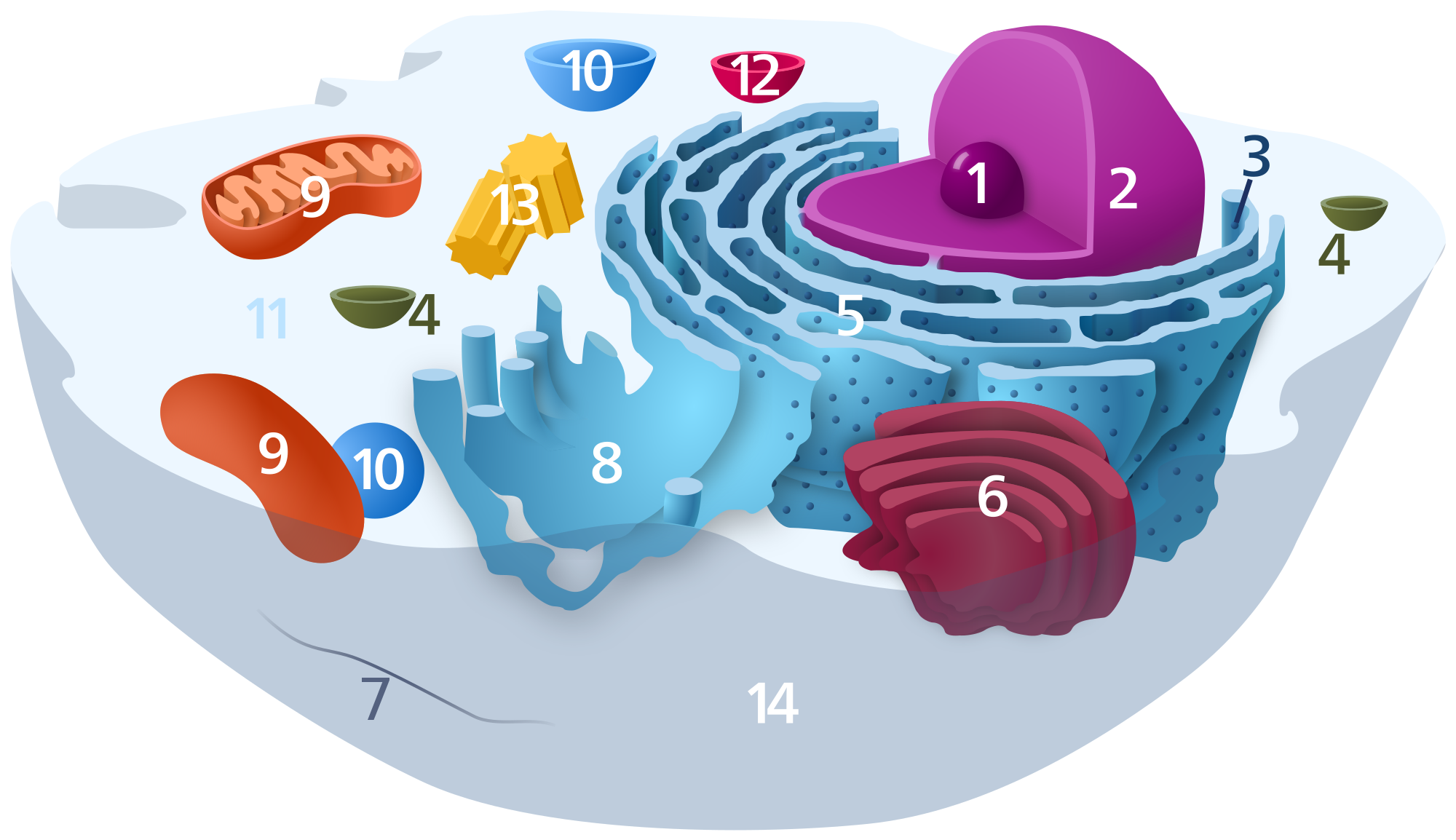
The cytoplasm is all the material within a eukaryotic or prokaryotic cell, enclosed by the cell membrane, including the organelles and excluding the nucleus in eukaryotic cells. The material inside the nucleus of a eukaryotic cell and contained within the nuclear membrane is termed the nucleoplasm. The main components of the cytoplasm are the cytosol (a gel-like substance), the cell's internal sub-structures, and various cytoplasmic inclusions. The cytoplasm is about 80% water and is usually colorless.
The cytosol or cytoplasmic matrix or groundplasm, remains after the exclusion of the cell organelles and cytoplasmic inclusions. Microscopically it is a highly complex, polyphasic system in which all resolvable cytoplasmic elements are suspended, including the larger organelles such as the ribosomes, mitochondria, plant plastids, lipid droplets, and vacuoles.
Many cellular activities take place within the cytoplasm, such as many metabolic pathways, including glycolysis, photosynthesis, and processes such as cell division. The concentrated inner area is called the endoplasm and the outer layer is called the cell cortex, or ectoplasm.
Movement of calcium ions in and out of the cytoplasm is a signaling activity for metabolic processes.
In large animal and plant cells, amoebae and slime molds, movement of the cytoplasm around organelles and vacuoles is known as cytoplasmic streaming.
The term was introduced by Rudolf von Kölliker in 1863, originally as a synonym for protoplasm, but later it has come to mean the cell substance and organelles outside the nucleus.
There has been certain disagreement on the definition of cytoplasm, as some authors prefer to exclude from it some organelles, especially the vacuoles and sometimes the plastids.
It remains uncertain how the various components of the cytoplasm interact to allow movement of organelles while maintaining the cell's structure. The flow of cytoplasmic components plays an important role in many cellular functions which are dependent on the permeability of the cytoplasm. An example of such function is cell signalling, a process which is dependent on the manner in which signaling molecules are allowed to diffuse across the cell. While small signaling molecules like calcium ions are able to diffuse with ease, larger molecules and subcellular structures often require aid in moving through the cytoplasm. The irregular dynamics of such particles have given rise to various theories on the nature of the cytoplasm.
Hub AI
Cytoplasm AI simulator
(@Cytoplasm_simulator)
Cytoplasm
The cytoplasm is all the material within a eukaryotic or prokaryotic cell, enclosed by the cell membrane, including the organelles and excluding the nucleus in eukaryotic cells. The material inside the nucleus of a eukaryotic cell and contained within the nuclear membrane is termed the nucleoplasm. The main components of the cytoplasm are the cytosol (a gel-like substance), the cell's internal sub-structures, and various cytoplasmic inclusions. The cytoplasm is about 80% water and is usually colorless.
The cytosol or cytoplasmic matrix or groundplasm, remains after the exclusion of the cell organelles and cytoplasmic inclusions. Microscopically it is a highly complex, polyphasic system in which all resolvable cytoplasmic elements are suspended, including the larger organelles such as the ribosomes, mitochondria, plant plastids, lipid droplets, and vacuoles.
Many cellular activities take place within the cytoplasm, such as many metabolic pathways, including glycolysis, photosynthesis, and processes such as cell division. The concentrated inner area is called the endoplasm and the outer layer is called the cell cortex, or ectoplasm.
Movement of calcium ions in and out of the cytoplasm is a signaling activity for metabolic processes.
In large animal and plant cells, amoebae and slime molds, movement of the cytoplasm around organelles and vacuoles is known as cytoplasmic streaming.
The term was introduced by Rudolf von Kölliker in 1863, originally as a synonym for protoplasm, but later it has come to mean the cell substance and organelles outside the nucleus.
There has been certain disagreement on the definition of cytoplasm, as some authors prefer to exclude from it some organelles, especially the vacuoles and sometimes the plastids.
It remains uncertain how the various components of the cytoplasm interact to allow movement of organelles while maintaining the cell's structure. The flow of cytoplasmic components plays an important role in many cellular functions which are dependent on the permeability of the cytoplasm. An example of such function is cell signalling, a process which is dependent on the manner in which signaling molecules are allowed to diffuse across the cell. While small signaling molecules like calcium ions are able to diffuse with ease, larger molecules and subcellular structures often require aid in moving through the cytoplasm. The irregular dynamics of such particles have given rise to various theories on the nature of the cytoplasm.
Recent media