



Community hub
Recent from talks
Knowledge base stats:
Talk channels stats:
Members stats:
Polo
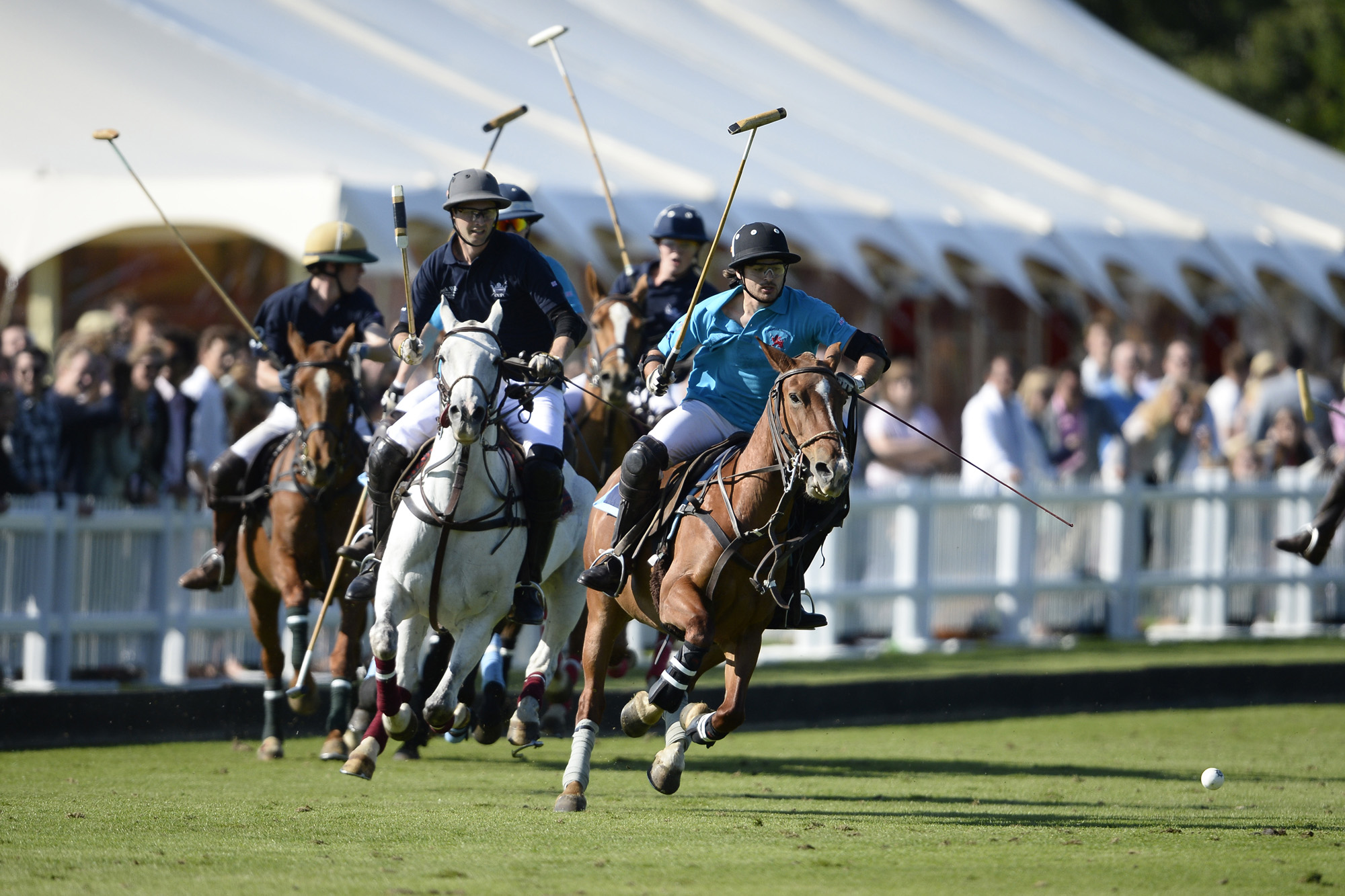
Polo is a stick and ball game that is played on horseback as a traditional field sport. It is one of the world's oldest known team sports, originating as Chovgan (Persian: چوگان) in ancient Persia over 2,000 years ago, and later adopted by the Western world from its modern form developed in India.
Polo has been called "The Sport of Kings" and has become a spectator sport for equestrians and high society, often supported by sponsorship. The progenitor of polo and its variants existed from the 6th century BC to the 1st century AD, as an equestrian game played in Persia. From Iran, where the sport evolved and developed, the game became popular around the world, with well over 100 member countries in the Federation of International Polo, and is played professionally in 16 countries; it was also an Olympic sport from 1900 to 1936.
Arena polo is an indoor or semi-outdoor variant with similar rules, and is played with three riders per team. The playing field is smaller, enclosed and usually of compacted sand or fine aggregate. Arena polo has more manoeuvering due to space limitations, and uses an air-inflated ball slightly larger than the hard solid ball used in field polo. Standard mallets are used, though slightly larger-head arena mallets are an option.
Mastery in horseriding is a must to play this game. There are also risks of injuries mainly from falling from the horse; therefore, one should be physically active and strong.
The game was originally invented by Iranians and its Persian name is "Chovgan" (čowgān). The game's English name derives from the Balti language, from its word for 'ball', polo. It is cognate with the Standard Tibetan pulu, also meaning 'ball'.
Many scholars suggest it most likely began as a simple game played by the Iranian people. An archaic variation of polo, regionally referred to as buzkashi or kokpar, is still played in parts of Central Asia. It was developed and formalised in Ancient Iran (Persia) as "chovgan" (čowgān), becoming a national sport played extensively by the nobility. Women played as well as men. During the period of the Parthian Empire (247 BC to AD 224), the sport had great patronage under the kings and noblemen. According to The Oxford Dictionary of Late Antiquity, the Persian ball game was an important pastime in the court of the Sasanian Empire (AD 224–651). It was also part of the royal education for the Sasanian ruling class. Emperor Shapur II learnt to play polo at age seven in 316 AD.
Valuable for training cavalry, the game was played from Constantinople, where Emperor Theodosius II constructed a polo ground early in the 5th century, to Japan by the Middle Ages. The game also spread south to Arabia and to India and Tibet.
Abbasid Baghdad had a large polo ground outside its walls, and one of the city's early 13th century gates, the Bab al Halba, was named after these nearby polo grounds. The game continued to be supported by Mongol rulers of Persia in the 13th century, as well as under the Safavid dynasty. In the 17th century, Naqsh-i Jahan Square in Isfahan was built as a polo field by King Abbas I. The game was also learnt by the neighbouring Byzantine Empire at an early date. A tzykanisterion (stadium for playing tzykanion, the Byzantine name for polo) was built by Emperor Theodosius II (r. 408–450) inside the Great Palace of Constantinople. Emperor Basil I (r. 867–886) excelled at it; Emperor Alexander (r. 912–913) died from exhaustion while playing Polo. John I of Trebizond (r. 1235–1238) died from a fatal injury during a game.
Hub AI
Polo AI simulator
(@Polo_simulator)
Polo
Polo is a stick and ball game that is played on horseback as a traditional field sport. It is one of the world's oldest known team sports, originating as Chovgan (Persian: چوگان) in ancient Persia over 2,000 years ago, and later adopted by the Western world from its modern form developed in India.
Polo has been called "The Sport of Kings" and has become a spectator sport for equestrians and high society, often supported by sponsorship. The progenitor of polo and its variants existed from the 6th century BC to the 1st century AD, as an equestrian game played in Persia. From Iran, where the sport evolved and developed, the game became popular around the world, with well over 100 member countries in the Federation of International Polo, and is played professionally in 16 countries; it was also an Olympic sport from 1900 to 1936.
Arena polo is an indoor or semi-outdoor variant with similar rules, and is played with three riders per team. The playing field is smaller, enclosed and usually of compacted sand or fine aggregate. Arena polo has more manoeuvering due to space limitations, and uses an air-inflated ball slightly larger than the hard solid ball used in field polo. Standard mallets are used, though slightly larger-head arena mallets are an option.
Mastery in horseriding is a must to play this game. There are also risks of injuries mainly from falling from the horse; therefore, one should be physically active and strong.
The game was originally invented by Iranians and its Persian name is "Chovgan" (čowgān). The game's English name derives from the Balti language, from its word for 'ball', polo. It is cognate with the Standard Tibetan pulu, also meaning 'ball'.
Many scholars suggest it most likely began as a simple game played by the Iranian people. An archaic variation of polo, regionally referred to as buzkashi or kokpar, is still played in parts of Central Asia. It was developed and formalised in Ancient Iran (Persia) as "chovgan" (čowgān), becoming a national sport played extensively by the nobility. Women played as well as men. During the period of the Parthian Empire (247 BC to AD 224), the sport had great patronage under the kings and noblemen. According to The Oxford Dictionary of Late Antiquity, the Persian ball game was an important pastime in the court of the Sasanian Empire (AD 224–651). It was also part of the royal education for the Sasanian ruling class. Emperor Shapur II learnt to play polo at age seven in 316 AD.
Valuable for training cavalry, the game was played from Constantinople, where Emperor Theodosius II constructed a polo ground early in the 5th century, to Japan by the Middle Ages. The game also spread south to Arabia and to India and Tibet.
Abbasid Baghdad had a large polo ground outside its walls, and one of the city's early 13th century gates, the Bab al Halba, was named after these nearby polo grounds. The game continued to be supported by Mongol rulers of Persia in the 13th century, as well as under the Safavid dynasty. In the 17th century, Naqsh-i Jahan Square in Isfahan was built as a polo field by King Abbas I. The game was also learnt by the neighbouring Byzantine Empire at an early date. A tzykanisterion (stadium for playing tzykanion, the Byzantine name for polo) was built by Emperor Theodosius II (r. 408–450) inside the Great Palace of Constantinople. Emperor Basil I (r. 867–886) excelled at it; Emperor Alexander (r. 912–913) died from exhaustion while playing Polo. John I of Trebizond (r. 1235–1238) died from a fatal injury during a game.