
 | This article needs additional citations for verification. (July 2022) |
Polo is a stick and ball game that is played on horseback as a traditional field sport. It is one of the world's oldest known team sports,[7] originating as Chovgan (Persian: چوگان) in ancient Persia over 2,000 years ago, and later adopted by the Western world from its modern form developed in India.[8][9][10][11]
Key Information


Polo has been called "The Sport of Kings"[12] and has become a spectator sport for equestrians and high society, often supported by sponsorship. The progenitor of polo and its variants existed from the 6th century BC to the 1st century AD, as an equestrian game played in Persia.[13][14][4] From Iran,[15][16] where the sport evolved and developed, the game became popular around the world,[5] with well over 100 member countries in the Federation of International Polo, and is played professionally in 16 countries; it was also an Olympic sport from 1900 to 1936.
Arena polo is an indoor or semi-outdoor variant with similar rules, and is played with three riders per team. The playing field is smaller, enclosed and usually of compacted sand or fine aggregate. Arena polo has more manoeuvering due to space limitations, and uses an air-inflated ball slightly larger than the hard solid ball used in field polo. Standard mallets are used, though slightly larger-head arena mallets are an option.
Mastery in horseriding is a must to play this game. There are also risks of injuries mainly from falling from the horse; therefore, one should be physically active and strong.
History
[edit]Origins and etymology
[edit]
The game was originally invented by Iranians[17][18][19][20][21] and its Persian name is "Chovgan" (čowgān).[22][23][24][25] The game's English name derives from the Balti language,[a] from its word for 'ball', polo.[26] It is cognate with the Standard Tibetan pulu, also meaning 'ball'.[26][27]: 25
Many scholars[28] suggest it most likely began as a simple game played by the Iranian people.[29][3][4] An archaic variation of polo, regionally referred to as buzkashi or kokpar, is still played in parts of Central Asia.[4] It was developed and formalised in Ancient Iran (Persia) as "chovgan" (čowgān), becoming a national sport played extensively by the nobility. Women played as well as men.[5] During the period of the Parthian Empire (247 BC to AD 224), the sport had great patronage under the kings and noblemen. According to The Oxford Dictionary of Late Antiquity, the Persian ball game was an important pastime in the court of the Sasanian Empire (AD 224–651).[6] It was also part of the royal education for the Sasanian ruling class.[6] Emperor Shapur II learnt to play polo at age seven in 316 AD.

Middle Ages and Early Modern era
[edit]
Valuable for training cavalry, the game was played from Constantinople, where Emperor Theodosius II constructed a polo ground early in the 5th century,[31] to Japan by the Middle Ages. The game also spread south to Arabia and to India and Tibet.
Abbasid Baghdad had a large polo ground outside its walls, and one of the city's early 13th century gates, the Bab al Halba, was named after these nearby polo grounds. The game continued to be supported by Mongol rulers of Persia in the 13th century, as well as under the Safavid dynasty. In the 17th century, Naqsh-i Jahan Square in Isfahan was built as a polo field by King Abbas I. The game was also learnt by the neighbouring Byzantine Empire at an early date. A tzykanisterion (stadium for playing tzykanion, the Byzantine name for polo) was built by Emperor Theodosius II (r. 408–450) inside the Great Palace of Constantinople.[32] Emperor Basil I (r. 867–886) excelled at it; Emperor Alexander (r. 912–913) died from exhaustion while playing Polo. John I of Trebizond (r. 1235–1238) died from a fatal injury during a game.[33]
After the Muslim conquests to the Ayyubid and Mameluke dynasties of Egypt and the Levant, their elites favoured it above all other sports. Notable sultans such as Saladin and Baybars were known to play it and encourage it in their courts.[34] Saladin was known for being a skilled polo player, which contributed to his cavalry training.[35][36] Polo sticks were featured as one of the suits on the Mamluk precursor to modern-day playing cards. Europeans transformed the polo stick suit into the "clubs" of the "Latin" decks, as polo was little known to them at that time.[37]

The game spread to South Asia where it has had a strong presence in the northwestern areas of present-day Pakistan (including Gilgit, Chitral, Hunza, and Baltistan) since at least the 15th to the 16th centuries.[38] Qutubuddin Aibak (r. 1206–1210), originally a Turkic slave who later founded the Mamluk dynasty (1206–1290) Delhi Sultanate, was accidentally killed during a game of polo when his horse fell and he was impaled on the pommel of his saddle.
Polo likely travelled via the Silk Road to China where it was popular in the Tang dynasty capital of Chang'an, where it was played by women, who had to wear a male dress to do so; many Tang dynasty tomb figures of female players survive.[39] According to The Oxford Dictionary of Late Antiquity, the popularity of polo in Tang China was "bolstered, no doubt, by the presence of the Sasanian court in exile".[6] A "polo-obsessed" noblewoman was buried with her donkeys on 6 October 878 in Xi’an, China.[40]
Modern game
[edit]India and Britain
[edit]In use in Manipur were the game's Tibetic names, polo or pulu, referring to the wooden ball, and it was these terms, anglicised, which were adopted for the sport's name in its slow spread to the west. A European polo club was established in the town of Silchar in Assam, India, in 1859, the English tea planters having learnt it from Manipuri incomers.[41][42]

Sagol kangjei was one of three forms of hockey in Manipur, the other ones being field hockey (called khong kangjei) and wrestling-hockey (called mukna kangjei).[43] Local rituals such as those connected to the Ibudhou Marjing, the winged-pony god of polo and the creation-ritual episodes of the Lai Haraoba festival enacting the life of his son, Khoriphaba, the polo-playing god of sports. These may indicate an origin earlier than the historical records of Manipur. Later, according to Cheitharol Kumbaba, a royal chronicle of King Kangba, who ruled Manipur much earlier than Nongda Lairen Pakhangba (33 CE) introduced sagol kangjei ('kangjei on horseback'). Further regular playing of this game commenced in 1605, during the reign of King Khagemba under newly framed rules of the game.

In Manipur, polo is traditionally played with seven players to a side. The players are mounted on the indigenous Manipuri Pony, which stands less than 13 hands (52 inches, 132 cm). There are no goal posts, and a player scores simply by hitting the ball out of either end of the field. Players strike the ball with the long side of the mallet head, not the end.[44] Players are not permitted to carry the ball, although blocking the ball with any part of the body except the open hand is permitted.[45] The sticks are made of cane, and the balls are made from the roots of bamboo. Players protected their legs by attaching leather shields to their saddles and girths.[27]: 26

In Manipur, the game was played even by commoners who owned a pony.[27]: 25 The kings of Manipur had a royal polo ground within the ramparts of their Kangla Fort. Here they played on the manung kangjei bung (lit. 'inner polo ground'). Public games were held, as they still are today, at the mapan kangjei bung (lit. 'outer polo ground'), a polo ground just outside the Kangla. Weekly games called hapta kangjei (lit. 'weekly polo') were also played in a polo ground outside the current palace.
The oldest polo ground in the world is the Imphal Polo Ground in Manipur. The history of this polo ground is contained in the royal chronicle Cheitharol Kumbaba starting from 33 CE. Lieutenant (later Major General) Joseph Ford Sherer, the father of modern polo, visited the state and played on this polo ground in the 1850s. Lord Curzon, the Viceroy of India visited the state in 1901 and measured the polo ground as "225 yards long and 110 yards wide" (206 m × 101 m).[46]
The Cachar Club, established in 1859,[5][47] is located on Club Road in the heart of Silchar city in Assam. In 1862, the oldest polo club still in existence, Calcutta Polo Club, was established by two British soldiers, Sherer and Captain Robert Stewart.[48] Later they spread the game to their peers in England. Polo was first played in England by the 10th Hussars in 1869.[49] The British are credited with spreading polo worldwide in the late 19th century and the early 20th century at the height of its empire. Military officers imported the game to Britain in the 1860s. The establishment of polo clubs throughout England and western Europe followed after the formal codification of rules.[27]: 26 The 10th Hussars at Aldershot, Hants, introduced polo to England in 1834. The game's governing body in the United Kingdom is the Hurlingham Polo Association, which drew up the first set of formal British rules in 1874, many of which are still in existence.
This version of polo played in the 19th century was different from the faster form that was played in Manipur. The game was slow and methodical, with little passing between players and few set plays that required specific movements by participants without the ball. Neither players nor horses were trained to play a fast, non-stop game. This form of polo lacked the aggressive methods and required fewer equestrian skills. From the 1800s to the 1910s, a host of teams representing Indian principalities dominated the international polo scene.[27]: 26 The game had reached Samoa by the 1890's.[50]
The World Champions Polo League was launched in Jaipur in 2016. It is a new version of polo, similar to the Twenty20 format of cricket. The pitch was made smaller and accommodated a large audience. The first event of the World Champions Polo League took place in Bhavnagar, Gujarat, with six teams and room for 10,000 spectators. The rules were changed[51] and the duration of matches made shorter.[52]
Argentina
[edit]
Polo was brought to many parts of the Americas, but found its greatest popularity in Argentina. Irish, Scottish, Welsh, and English immigrants in the Argentine pampas started practising polo during their free time, and eventually some of them began to put together games. Among them, David Shennan is credited with having organised the first formal polo game of the country in 1875, at Estancia El Negrete, located in Buenos Aires Province.
The sport spread quickly among the skillful gauchos, and several clubs opened in the following years in the towns of Venado Tuerto, Cañada de Gómez, Quilmes, Flores and later (1888) Hurlingham. In 1892 The River Plate Polo Association was founded and constituted the basis for the current Asociación Argentina de Polo. In the Olympic Games held in Paris in 1924 a team composed of Juan Miles, Enrique Padilla, Juan Nelson, Arturo Kenny, G. Brooke Naylor and A. Peña achieved the first gold medal in the nation's Olympic history. The title was defended at the 1936 Berlin Games with players Manuel Andrada, Andrés Gazzotti, Roberto Cavanagh, Luis Duggan, Juan Nelson, Diego Cavanagh, and Enrique Alberdi.
The game spread across the country, and Argentina is often credited as the capital of polo;[53] Argentina is also noted for having the largest contingent of 10 handicap players out of any other country.[54]
Five teams were able to gather four 10 handicap players each, to make 40 handicap teams: Coronel Suárez, 1975, 1977–1979 (Alberto Heguy, Juan Carlos Harriott Jr., Alfredo Harriot and Horacio Heguy); La Espadaña, 1989–1990 (Carlos Gracida, Gonzalo Pieres, Alfonso Pieres y Ernesto Trotz Jr.); Indios Chapaleufú, 1992–1993 (Bautista Heguy, Gonzalo Heguy, Horacio Heguy Jr. and Marcos Heguy); La Dolfina, 2009–2010 (Adolfo Cambiaso Jr., Lucas Monteverde, Mariano Aguerre y Bartolomé Castagnola); Ellerstina, 2009 (Facundo Pieres, Gonzalo Pieres Jr., Pablo Mac Donough and Juan Martín Nero).
The three major polo tournaments in Argentina, known as "Triple Corona" ("Triple Crown"), are Hurlingham Polo Open, Tortugas Polo Open and Palermo Polo Open. Polo season usually lasts from October to December.[55]

High season vs. Low season
Argentina Polo School in Mar del Plata[56] reflects the rhythms of the region’s climate and tourism. The high season typically aligns with the Argentine summer, from November to March, when the weather is warm and ideal for outdoor events. During this time, polo tournaments and social gatherings attract players and enthusiasts, creating a vibrant atmosphere. Conversely, the low season falls in the winter months, from May to September, when activities slow down, allowing fields and players a period of rest and maintenance. This seasonal flow highlights Mar del Plata’s dual role as a sports hub and a seaside retreat.
Polo has found popularity throughout the rest of the Americas, including Brazil, Chile, Mexico, and the United States of America.[27]: 26–27 [57] Even with the global spread of the sport Argentina has remained the largest producer of the highest quality horses and players. The country's fertile farmland around Buenos Aires and its long standing tradition of polo has made Argentina the center of the polo world. Every major polo tournament in the world is filled with players and horses hailing from Argentina.
United States
[edit].jpg)
James Gordon Bennett Jr. on 16 May 1876 organised what was billed as the first polo match in the United States at Dickel's Riding Academy at 39th Street and Fifth Avenue in New York City.[58] The historical record states that James Gordon Bennett established the Westchester Polo Club on 6 May 1876, and on 13 May 1876, the Jerome Park Racetrack in Westchester County (now Bronx County) was the site of the "first" American outdoor polo match.
H. L. Herbert, James Gordon Bennett and August Belmont Jr. financed the original New York Polo Grounds. Herbert stated in a 1913 article[59] that they formed the Westchester Club after the "first" outdoor game was played on 13 May 1876. This contradicts the historical record of the club being established before the Jerome Park game.
There is ample evidence that the first to play polo in America were actually the English Texans. The Galveston News reported on 2 May 1876 that Denison, Texas had a polo club which was before James Gordon Bennett established his Westchester Club or attempted to play the "first" game.[60] The Denison team sent a letter to James Gordon Bennett challenging him to a match. The challenge was published 2 June 1876, in The Galveston Daily News. By the time the article came out on 2 June, the Denison Club had already received a letter from Bennett indicating the challenge was offered before the "first" games in New York.[61]
There is an urban legend that the first game of polo in America was played in Boerne, Texas, at retired British officer Captain Glynn Turquand's famous Balcones Ranch.[62] The Boerne, Texas, legend also has plenty of evidence pointing to the fact that polo was played in Boerne before James Gordon Bennett Jr. ever picked up a polo mallet.[63]
During the early part of the 20th century, under the leadership of Harry Payne Whitney, polo changed to become a high-speed sport in the United States, differing from the game in England, where it involved short passes to move the ball towards the opposition's goal. Whitney and his teammates used the fast break, sending long passes downfield to riders who had broken away from the pack at a full gallop. In 1909 a United States team defeated an English team with ease.[49]
In the late 1950s, champion polo player and Director of the Long Island Polo Association, Walter Scanlon, introduced the "short form", or "European" style, four period match, to the game of polo.[64]

The rules of polo are written to include the safety of both players and horses. Games are monitored by umpires. A whistle is blown when an infraction occurs, and penalties are awarded. Strategic plays in polo are based on the "line of the ball", an imaginary line that extends through the ball in the line of travel. This line traces the ball's path and extends past the ball along that trajectory. The line of the ball defines rules for players to approach the ball safely. The "line of the ball" changes each time the ball changes direction. The player who hits the ball generally has the right of way, and other players cannot cross the line of the ball in front of that player. As players approach the ball, they ride on either side of the line of the ball giving each access to the ball. A player can cross the line of the ball when it does not create a dangerous situation. Most infractions and penalties are related to players improperly crossing the line of the ball or the right of way. When a player has the line of the ball on their right, they have the right of way. A "ride-off" is when a player moves another player off the line of the ball by making shoulder-to-shoulder contact with the other players' horses.
The defending player has a variety of opportunities for their team to gain possession of the ball. They can push the opponent off the line or steal the ball from the opponent. Another common defensive play is called "hooking." While a player is taking a swing at the ball, their opponent can block the swing by using their mallet to hook the mallet of the player swinging at the ball. A player may hook only if they are on the side where the swing is being made or directly behind an opponent. A player may not purposely touch another player, another player's tack, or a pony with their mallet. Unsafe hooking is a foul that will result in a penalty shot being awarded. For example, it is a foul for a player to reach over an opponent's mount in an attempt to hook.
The other basic defensive play is called the bump or ride-off. It's similar to a body check in ice hockey. In a ride-off, a player rides their pony alongside an opponent's mount to move an opponent away from the ball or to take them out of a play. It must be executed properly so that it does not endanger the horses or the players. The angle of contact must be safe and can not knock the horses off balance, or harm the horses in any way. Two players following the line of the ball and riding one another off have the right of way over a single man coming from any direction.
Like in hockey, ice hockey, or basketball, fouls are potentially dangerous plays that infringe on the rules of the game. To the novice spectator, fouls may be difficult to discern. There are degrees of dangerous and unfair play and penalty shots are awarded depending based on the severity of the foul and where the foul was committed on the polo field. White lines on the polo field indicate where the mid-field, sixty, forty, and thirty yard penalties are taken.
The official set of rules and rules interpretations are reviewed and published annually by each country's polo association. Most of the smaller associations follow the rules of the Hurlingham Polo Association, the national governing body of the sport of polo in the United Kingdom, and the United States Polo Association.[65]
Outdoor polo
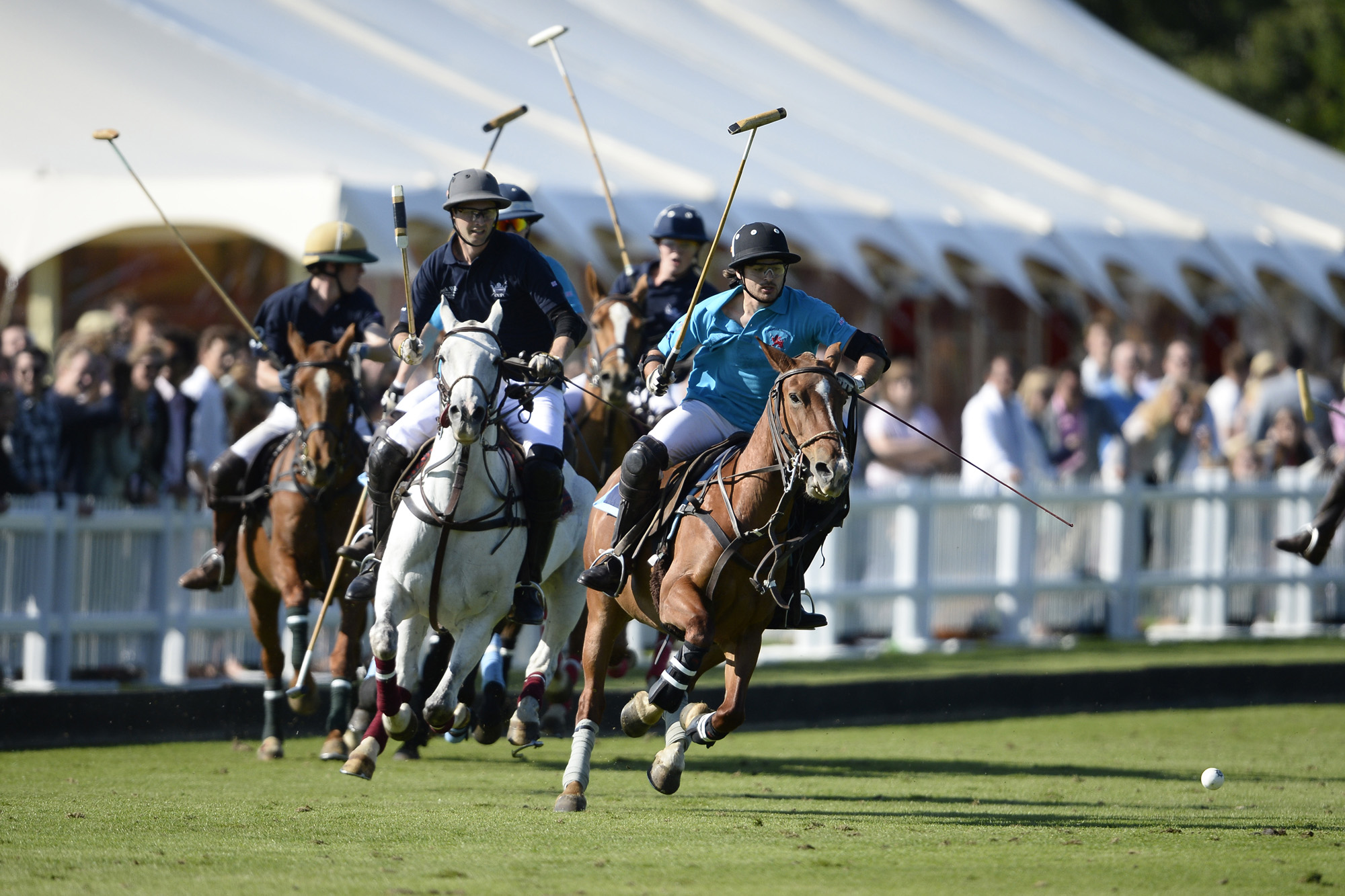
[edit]Outdoor or field polo lasts about one and a half to two hours and consists of four to eight seven-minute chukkas, between or during which players change mounts. At the end of each seven-minute chukka, play continues for an additional 30 seconds or until a stoppage in play, whichever comes first. There is a four-minute interval between chukkas and a ten-minute halftime. Play is continuous and is only stopped for rule infractions (fouls), broken tack (equipment) or injury to horse or player. The object is to score goals by hitting the ball between the goal posts, no matter how high in the air. If the ball goes wide of the goal, the defending team is allowed a free "knock-in" from the place where the ball crossed the goal line, thus getting ball back into play.[66]
Indoor or arena polo
[edit]Arena polo has rules similar to the field version, and is less strenuous for the player. It is played in a 300 by 150 feet (91 by 46 m) enclosed arena, much like those used for other equestrian sports; the minimum size is 150 by 75 feet (46 by 23 m). There are many arena clubs in the United States, and most major polo clubs, including the Santa Barbara Polo and Racquet Club, have active arena programmes. The major differences between the outdoor and indoor games are: speed (outdoor being faster), physicality/roughness (indoor/arena is more physical), ball size (indoor is larger), goal size (because the arena is smaller the goal is smaller), and some penalties. In the United States and Canada, collegiate polo is arena polo;[67][68] in the United Kingdom, collegiate polo is both.[69]
Some of the most important arena polo tournaments held are:
- The U.S. Arena Polo Championship, a 12-18 goal tournament, is one of the highest levels of fast version of polo competition currently played in the United States. Its history dates back to 1926, where the first tournament was held and won by the Yale University team of Reddington Barret, Winston Guest and William Mui.
- The Arena Polo Grand Prix held in Argentina, promoted by La Carona Polo Club along with the Argentine Polo Association, was organized for the first time in June 2019, and was the start for the Arena Polo in Argentina.
- The Arena Polo European Championship. The first tournament of this championship was held in 2015. Alongside the Equestrian Federation of Azerbaijan Republic (ARAF) the tournament was organized by the team of World Polo

Rules
[edit]All tournaments and levels of play and players are organized within and between polo clubs, including membership, rules, safety, fields and arenas.
The rules of polo are written to include the safety of both players and horses. Games are monitored by umpires. A whistle is blown when an infraction occurs, and penalties are awarded.[70] Strategic plays in polo are based on the "line of the ball", an imaginary line that extends through the ball in the line of travel.[70] This line traces the ball's path and extends past the ball along that trajectory. The line of the ball defines rules for players to approach the ball safely. The "line of the ball" changes each time the ball changes direction.[71] The player who hits the ball generally has the right of way, and other players cannot cross the line of the ball in front of that player.[70] As players approach the ball, they ride on either side of the line of the ball giving each access to the ball. A player can cross the line of the ball when it does not create a dangerous situation. Most infractions and penalties are related to players improperly crossing the line of the ball or the right of way. When a player has the line of the ball on their right, or "off-side," they have the right of way.[71] A "ride-off" is when a player moves another player off the line of the ball by making shoulder-to-shoulder contact with the other players' horses.[72] This is called "bumping".[73] In order for a player to bump another played without committing an "uneven ride-off" foul, the two horses must be shoulder-to-shoulder and moving at the same speed.[74]
Polo ponies
[edit]
The mounts used are called 'polo ponies', although the term pony is purely traditional and the mount is actually a full-sized horse. They range from 14.2 to 16 hands (58 to 64 inches, 147 to 163 cm) high at the withers, and weigh 900 to 1,100 pounds (410 to 500 kg). The polo pony is selected carefully for quick bursts of speed, stamina, agility and manoeuvrability. Temperament is critical; the horse must remain responsive under pressure and not become excited or difficult to control. Many are Thoroughbreds or Thoroughbred crosses. They are trained to be handled with one hand on the reins, and to respond to the rider's leg and weight cues for moving forward, turning and stopping. A well trained horse will carry its rider smoothly and swiftly to the ball and can account for 60 to 75 percent of the player's skill and net worth to their team.[75]
Polo pony training generally begins at age 3 and lasts from about 6 months to 2 years. Most horses reach full physical maturity at about age 5, and ponies are at their peak of athleticism and training at around age 6 or 7. However, without any accidents, polo ponies may have the ability to play until they are 18 to 20 years of age.[76]
Each player must have more than one horse, to allow for tired mounts to be replaced by fresh ones between or even during chukkas. A player's "string" of polo ponies may number two or three in Low Goal matches (with ponies being rested for at least a chukka before reuse), four or more for Medium Goal matches (at least one per chukka), and even more for the highest levels of competition.[citation needed]
Players
[edit]
Grass polo is played by two teams of four mounted players, while arena polo is played with three players a side.[77] Teams can be all-male, all-female, or mixed. Each player on the team has a specific number and has a specific role on the team.[78]
Polo must be played right-handed to prevent head-on collisions.[79]
Equipment
[edit]The rules for equipment vary in details between the hosting authorities, but are always for the safety of the players and mounts.
Mandatory equipment includes a protective helmet with chinstrap worn at all times by all players and mounted grooms. They have a rigid exterior and interior protective padding and must be to a locally accepted safety standard, PAS015 (UK), NOCSAE (US). A face guard is commonly integral with the helmet.
Polo boots and knee guards are mandatory in the UK during official play, and boots are recommended for all play everywhere. The UK also recommends goggles, elbow pads and gum shields. A shirt or jersey is required that distinguishes the player's team, and is not black and white stripes like an umpire shirt.
White polo pants or trousers are worn during official play. Polo gloves are commonly worn to protect from working the reins and mallet.
Not permitted is any equipment that may harm horses, such as certain spurs or whips.[80][81]
-
 Polo helmet with face guard
 -
 Polo knee pads, mandatory equipment


Ball
[edit]The modern outdoor polo ball is made of a high-impact plastic. Historically they have been made of bamboo, leather covered cork, hard rubber, and for many years willow root. Originally the British used a white painted leather covered cricket ball.[82]
The regulation outdoor polo ball is 3 inches (7.6 cm) to 3+1⁄2 inches (8.9 cm) in diameter and weighs 3+1⁄2 ounces (99 g) to 4+1⁄2 ounces (130 g).[83]
Plastic balls were introduced in the 1970s. They are less prone to breakage and much cheaper.[84]
The indoor and arena polo ball is leather-covered and inflated, and is about 4+1⁄2 inches (11 cm) in diameter.[citation needed]
It must be not less than 12.5 inches (32 cm) or more than 15 inches (38 cm) in circumference. The weight must be not less than 170 grams (6.0 oz) or more than 182 grams (6.4 oz). In a bounce test from 9 feet (2.7 m) on concrete at 70 °F (21 °C), the rebound should be a minimum of 54 inches (140 cm) and a maximum of 64 inches (160 cm) at the inflation rate specified by the manufacturer. This provides for a hard and lively ball.[citation needed]
Mallet
[edit]
The polo mallet consists of a cane shaft with a rubber-wrapped grip, a webbed thong, called a sling, for wrapping around the thumb, and a wooden cigar-shaped head. The shaft is made of manau-cane (not bamboo, which is hollow) although a small number of mallets today are made from composite materials. Composite materials are usually not preferred by top players because the shaft of composite mallets cannot absorb vibrations as well as traditional cane mallets. The mallet head is generally made from a hardwood called tipa, approximately 91⁄4" inches long. The mallet head weighs from 160 g (5.6 oz) to 240 g (8.5 oz), depending on player preference and the type of wood used, and the shaft can vary in weight and flexibility depending on the player's preference. The weight of the mallet head is of important consideration for the more seasoned players. Female players often use lighter mallets than male players. For some polo players, the length of the mallet depends on the size of the horse: the taller the horse, the longer the mallet. However, some players prefer to use a single length of mallet regardless of the height of the horse. Either way, playing horses of differing heights requires some adjustment by the rider. Variable lengths of the mallet typically range from 127 cm (50 in) to 134 cm (53 in). The term mallet is used exclusively in US English; British English prefers the term polo stick. The ball is struck with the broad sides of the mallet head rather than its round and flat tips.
Saddle
[edit]
Polo saddles are English-style, close contact, similar to jumping saddles; although most polo saddles lack a flap under the billets. Some players will not use a saddle blanket. The saddle has a flat seat and no knee support; the rider adopting a forward-leaning seat and closed knees dissimilar to a classical dressage seat. A breastplate is added, usually attached to the front billet. A standing martingale must be used: so, a breastplate is a necessity for safety. The tie-down is usually supported by a neck strap. Many saddles also have an overgirth. The stirrup irons are heavier than most, and the stirrup leathers are wider and thicker, for added safety when the player stands in the stirrups. The legs of the pony are wrapped with polo wraps from below the knee to the fetlock to minimize pain. Jumping (open front) or gallop boots are sometimes used along with the polo wraps for added protection. Often, these wraps match the team colours. The pony's mane is most often roached (hogged), and its tail is docked or braided so that it will not snag the rider's mallet.
Polo is ridden with double reins for greater accuracy of signals. The bit is frequently a gag bit or Pelham bit. In both cases, the gag or shank rein will be the bottom rein in the rider's hands, while the snaffle rein will be the top rein. If a gag bit is used, there will be a drop noseband in addition to the cavesson, supporting the tie-down. One of the rein sets may alternately be draw reins.
The field
[edit].svg)
The playing field is 300 by 160 yards (274 by 146 m), the area of approximately six soccer fields or nine American football fields 10 acres (4.0 hectares),[85] while arena polo is 315 by 151 feet (96 by 46 m).[86] This is the largest playing field of any modern sport. The playing field is carefully maintained with closely mowed turf providing a safe, fast playing surface. Goals are posts which are set eight yards apart, centred at each end of the field. The surface of a polo field requires careful and constant grounds maintenance to keep the surface in good playing condition. During half-time of a match, spectators are invited to go onto the field to participate in a polo tradition called "divot stomping", which was developed not only to help replace the mounds of earth (divots) that are torn up by the horses' hooves, but also to afford spectators the opportunity to walk about and socialise.
Contemporary sport
[edit]Polo is played professionally in many countries, notably Argentina, Australia, Brazil, Canada, Chile, Dominican Republic, France, Germany, Iran, India, New Zealand, Mexico, Pakistan, Jamaica, Spain, South Africa, Switzerland, the United Kingdom, and the United States, and is now an active sport in 77 countries.[87] Although its tenure as an Olympic sport was limited to 1900–1939, in 1998 the International Olympic Committee recognised it as a sport with a bona fide international governing body, the Federation of International Polo. The World Polo Championship is held every three years by the Federation.
Polo is unique among team sports in that amateur players, often the team patrons, routinely hire and play alongside the sport's top professionals.
East and Southeast Asia
[edit]
Polo has been played in Malaysia and Singapore, both of which are former British colonies, since being introduced to Malaya during the late 19th century. Royal Johor Polo Club was formed in 1884 and Singapore Polo Club was formed in 1886. The oldest polo club in the modern country of Malaysia is Selangor Polo Club, founded in 1902.[88] It was largely played by royalty and the political and business elite.[89]
Polo was played at the 2007 Southeast Asian Games, 2017 Southeast Asian Games and 2019 Southeast Asian Games. Nations that competed in the tournament were Indonesia, Singapore, Malaysia, Thailand, and Philippines (2007), Brunei, Malaysia, Singapore, and Thailand (2017) and Indonesia, Brunei, Philippines, and Malaysia (2019). The 2007 tournament's gold medal was won by the Malaysian team, followed by Singapore with silver and Thailand with bronze while the 2017 tournament's gold medal was won by Malaysia, followed by Thailand with silver and Brunei with bronze. The 2019 tournament's gold medal was won by Malaysia, followed by the Philippines with silver, and Brunei receiving bronze.[90] The recent resurgence in south-east Asia has resulted in its popularity in cities such as Pattaya, Kuala Lumpur and Jakarta. In Pattaya alone, there are three active polo clubs: Polo Escape, Siam Polo Park, and the Thai Polo and Equestrian Club. Indonesia has a polo club (Nusantara Polo Club). More recently, Janek Gazecki and Australian professional Jack "Ruki" Baillieu have organised polo matches in parks "around metropolitan Australia, backed by wealthy sponsors."[91]
A Chinese Equestrian Association has been formed with two new clubs in China itself: the Beijing Sunny Time Polo Club, founded by Xia Yang in 2004[92] and the Nine Dragons Hill Polo Club in Shanghai, founded in 2005.[93]
West Asia
[edit]Polo is not widely spread in West Asia, but still counts five active clubs in Iran, four active polo clubs in the UAE, one club in Bahrain[94] and The Royal Jordanian Polo Club in Amman, Jordan.[95]
Polo in Iran is governed by the Polo Federation of Iran. There are five polo clubs in Iran: Ghasr-e Firoozeh, Nowroozabad, Army Ground Forces, Kanoon-e Chogan and Nesf-e Jahan. Iran possesses some of the best grass polo fields in the region. The country currently has over 100 registered players of which approximately 15% are women. Historically, Kurdish and Persian Arabian horses were the most widely used for polo. This was probably also the case in ancient times. Today Thoroughbreds are being increasingly used alongside the Kurdish and Persian Arabian horses. Some players have also been experimenting with Anglo-Arabians. Iranians still refer to the game of polo by its original Persian name of "Chogan", which means mallet. Iranians still maintain some of the ancient rituals of the game in official polo matches.[citation needed]
India
[edit]The world's oldest polo club is the Calcutta Polo Club in Kolkata, founded in the 19th century. It hosts the Ezra Cup, the oldest polo tournament.
The governing body of polo in India is the Indian Polo Association.
Ireland
[edit]Polo first began its Irish history in 1870 with the first official game played on Gormanstown Strand, Co. Meath. Three years later the All Ireland Polo Club was founded by Mr. Horace Rochford in the Phoenix Park.[96] Since then the sport has continued to grow with a further seven clubs opening around the country. The sport has also been made more accessible to these clubs by the creation of more affordable training programmes, such as the beginner to pro programme at Polo Wicklow.[97]
Pakistan
[edit]
The annual Shandur Polo Festival at Shandur Top in Chitral District is an international event attended by enthusiasts from all over the world.[98] The Shandur polo ground at Shandur Pass is the world's highest, at approximately 3,734 metres (12,251 ft).[99] The governing body of polo in Pakistan is the Pakistan Polo Association. There are more than twenty-one polo clubs in Pakistan[100] and over forty polo championships held all over the country every year.[101] Pakistan has qualified for the preliminary rounds of the World Polo Championship three times. Pakistan's Hissam Ali Haider is the highest capped played in the Asian circuit. He has played for Cartier in the St. Moritz Snow Polo World Cup and the Commonwealth team in the Royal Salute Coronation Cup, both of which were won by his team.[102]
United Kingdom
[edit]The governing body in the United Kingdom is the Hurlingham Polo Association, dating from 1875, which amalgamated with the County Polo Association in 1949.[103] The UK Armed Forces Polo Association oversees the sport in the three armed services.
United States
[edit]The United States Polo Association (USPA) is the governing body for polo in the U.S. The U.S. is the only country that has separate women's polo, run by the United States Women's Polo Federation.
Variants and related sports
[edit]
These variants are considered sports separate from standard polo because of the differences in the composition of teams, equipment, rules, game facilities, and so on.
Variant forms of arena polo include beach polo, played in many countries between teams of three riders on a sand surface,[105] and cowboy polo, played almost exclusively in the western United States by teams of five riders on a dirt surface.

Another modern variant is snow polo, which is played on compacted snow on flat ground or a frozen lake. The format of snow polo varies depending on the space available. Each team generally consists of three players and a bright coloured light plastic ball is preferred.[106] Snow polo is not the same sport as ice polo, which was popular in the US in the late 1890s. That sport resembled ice hockey and bandy but died out entirely in favour of the Canadian ice hockey rules.
Water polo shares a name with polo, but more closely resembles handball. Sagol kāngjei is arguably a version of polo as well, though it can also be seen as the precursor of modern outdoor polo.
Variants that are related but clearly diverge from the polo format include:
- Cowboy polo uses rules similar to regular polo, but riders compete with western saddles, usually in a smaller arena, using an inflatable rubber medicine ball.
- Horseball is a game played on horseback where a ball is handled and points are scored by shooting it through a high net. The sport is a combination of polo, rugby, and basketball.
- Pato was played in Argentina for centuries, but is very different from modern polo. No mallets are used, and it is not played on grass.
- Polocrosse is a combination of polo and lacrosse and is also played on horseback. It was developed in Australia in the late 1930s.
Played on vehicles or other animals
[edit]Polo is not played exclusively on horseback. Such polo variants are mostly played for recreational or tourism purposes.
Non-equine variations include:
On other animals
[edit]- Camel polo is played in Mongolia[107]
- Elephant polo is played in South Asia.
- Yak polo is played in Mongolia and western China.
On vehicles
[edit]- Auto polo was a motorsport invented in the United States in the early 1900s. Its rules and equipment were similar to polo but automobiles were used instead of horses.[108]
- Canoe polo is played around the world in kayaks and governed by the International Canoe Federation.
- Cycle polo is a similar game played on bicycles instead of horses. A variant of cycle polo is also played on penny-farthings.[109]
- Golfcart polo
- Motoball (motorcycle polo) was invented in the United States.
- Segway polo originated in the United States.
- Roda Polo is played on electric unicycles[110]
A lighthearted variant, hobby horse polo (German: Steckenpferdpolo), was devised in 1998 in south western Germany. The Erster Kurfürstlich-Kurpfälzisch Polo-Club in Mannheim was founded in 2002 to organise matches and promote the game. Since then, the variant has gained further interest in other German cities.[111][112] It is played on hobby horses, the toy, instead of polo ponies. While following standard polo rules in part, it has some more unusual rules: Goals, for example, are the height and width of bar stools; and any departure from accepted gameplay standards will attract "penalty sherries" to be consumed by the offending player.[113]
Popular culture
[edit]The sport inspired Jilly Cooper's 1991 bonkbuster novel Polo.[114]
See also
[edit]Notes
[edit]- ^ Balti is a Tibetic language spoken by the Balti people in Pakistani-administered Gilgit-Baltistan and in Indian-administered Ladakh
References
[edit]- ^ "Preview: The Sport of Kings", CBS News Archived 10 April 2012 at the Wayback Machine, 5 April 2012
- ^ "Polo: the sport of kings that anyone can play" Archived 18 August 2018 at the Wayback Machine, The Telegraph, 29 April 2010
- ^ a b c Laffaye, Horace A. (19 January 2010). The Evolution of Polo. McFarland. pp. 5–6.
It can be safely assumed that polo began as a simple folk game played by the nomadic tribes in central Asia (before turks) . Westward and eastward expansion followed, to Byzantium and China, most likely along the trail of the Silk Road.
- ^ a b c d Hong, Fan; Mangan, J. A (18 November 2005). Evolution of Sport in Asian Society: Past and Present. Routledge. pp. 309–311. ISBN 978-1-135-76043-4.
In all probability polo developed from rough equestrian games played by the mounted nomadic peoples of Central Asia, both Iranian and Turkic.
- ^ a b c d Richard C. Latham (20 July 1998). "Sport: Polo". Encyclopædia Britannica. Archived from the original on 27 November 2020. Retrieved 23 August 2022.
- ^ a b c d Canepa, Matthew (2018). "polo". In Nicholson, Oliver (ed.). The Oxford Dictionary of Late Antiquity. Oxford: Oxford University Press. ISBN 978-0-19-866277-8.
- ^ "THE HISTORY OF POLO". argentinapolo.com. Archived from the original on 18 December 2019. Retrieved 9 August 2018.
- ^ “History of Polo,” *Polo Museum* (Museum of Polo and Hall of Fame), accessed 8 October 2025, https://www.polomuseum.org/sport-polo/history-polo.
- ^ Mohta, Nikita (19 July 2024). "Polo: The elite sport that India gave to its imperial rulers". The Indian Express. Retrieved 8 October 2025.
- ^ Mangan, J. A. (2006). "Sport, Cultural Imperialism and Colonial Response in the British Empire". The International Journal of the History of Sport. 23 (2). Routledge. Retrieved 8 October 2025.
- ^ Laffaye, Horace A. (2009). The Evolution of Polo. Jefferson, North Carolina: McFarland & Company. ISBN 978-0786438143.
- ^ Heitner, Darren. "The Economics of Polo, The Sport of Kings". Forbes. Archived from the original on 9 August 2018. Retrieved 9 August 2018.
- ^ Massé, H. (24 April 2012). "Čawgān". In Bearman, P.; Bianquis, Th.; Bosworth, C.E.; van Donzel, E.; Heinrichs, W.P. (eds.). Encyclopaedia of Islam, Second Edition. Vol. 2. Brill Online.
The game originated in Persia, and was generally played on horseback (...)
- ^ "The origins and history of Polo". Historic UK. Retrieved 4 October 2020.
It is since these origins in Persia that the game has often been associated with the rich and noble of society; the game was played by Kings, Princes and Queens in Persia.
- ^ Chovgan added as Iran’s intangible cultural heritage to UNESCO lists چوگان به عنوان میراث فرهنگی ناملموس ایران در فهرست یونسکو ثبت شد
- ^ Decision of the Intergovernmental Committee: 12.COM 11.B.14 تصمیم کمیته بین دولتی
- ^ چوگان به نام ايران ثبت جهاني شده است، نه آذربايجان Polo(Chogan) is registered worldwide in the name of Iran, not Azerbaijan
- ^ Polo World Record Document Unveiled سند ثبت جهانی چوگان رونمایی شد
- ^ Polo to become Iran’s UNESCO’s list of Intangible Cultural Heritage of Humanity: Official چوگان ایران در فهرست میراث فرهنگی ناملموس یونسکو قرار میگیرد
- ^ UNESCO lists polo as Iran’s intangible cultural heritage یونسکو چوگان را به عنوان میراث فرهنگی ناملموس ایران ثبت کرد
- ^ Iran Celebrates UNESCO’s Inscription of Polo as Iranian Heritage ایران ثبت چوگان در یونسکو به عنوان میراث ایرانی را جشن میگیرد
- ^ چوگان به نام ايران ثبت جهاني شده است، نه آذربايجان Polo(Chogan) is registered worldwide in the name of Iran, not Azerbaijan
- ^ Polo registered in Iran's name worldwide چوگان به نام ایران ثبت جهانی شد
- ^ Polo sport registered in the name of Iran on UNESCO World Heritage Listورزش چوگان به نام ایران در فهرست میراث یونسکو ثبت جهانی شد
- ^ Polo registration shows Iran's contribution to building global civilization چوگان نشانگر سهم ایران در ساخت تمدن جهانی است
- ^ a b "polo". Oxford English Dictionary (Online ed.). Oxford University Press. (Subscription or participating institution membership required.)
- ^ a b c d e f Robert Crego (2003). Sports and Games of the 18th and 19th Centuries. Greenwood Publishing Group. pp. 25–27. ISBN 978-0-313-31610-4.
- ^ Multiple references:
- "Polo: The Emperor of Games". Asian Games: The Art of Contest. The Asia Society. Archived from the original on 27 November 2022. Retrieved 27 November 2022.
- Perry, John R. (2001). "Introduction". Asian Folklore Studies. 60 (2): 191–202. doi:10.2307/1179053. ISSN 0385-2342. JSTOR 1179053. Archived from the original on 27 November 2022. Retrieved 27 November 2022.
- Willekes, Carolyn (2017). "A Tale of Two Games: "Cirit, Buzkashi" and the Horsemen of the Asiatic Steppe". Nomadic Peoples. 21 (2): 286–301. doi:10.3197/np.2017.210206. ISSN 0822-7942. JSTOR 44652688. Archived from the original on 27 November 2022. Retrieved 27 November 2022.
- Milburn, Frank (1994). Polo, the emperor of games (1st ed.). New York: Knopf. ISBN 978-0394571614.
- ^ Mousavinia, Mehdi (26 June 2023). "The culture of polo players; Analyzing polo game among Iranian people". Iranian Studies. 14 (2): 117–138. doi:10.22059/jis.2023.355152.1187 (inactive 12 July 2025). ISSN 2252-0643.
A part of the identity and culture of the people of Iran has been preserved in the framework of native and local games. In Iran land, many local and diverse sports are performed in various ceremonies. Among these games that have gained a national aspect in Iranian culture is the game of polo, which has been passed down from one generation to the next and continues to exist.
{{cite journal}}: CS1 maint: DOI inactive as of July 2025 (link) - ^ "Playing Polo in Historic Naqsh-e Jahan Square?". Payvand.com. 29 October 2007. Archived from the original on 3 February 2020. Retrieved 25 January 2012.
- ^ Herrin, Judith (2007). Byzantium: The Surprising Life of a Medieval Empire. Penguin. pp. 50–51. ISBN 978-0713999976.
- ^ Kelly, Christopher (2013). Theodosius II: Rethinking the Roman Empire in Late Antiquity. Cambridge: Cambridge University Press. p. 4. ISBN 978-1107038585.
- ^ Kazhdan, Alexander Petrovich, ed. (1991). The Oxford Dictionary of Byzantium. New York City and Oxford, United Kingdom: Oxford University Press. ISBN 978-0-19-504652-6.
- ^ "Touregypt.net". Touregypt.net. Archived from the original on 22 September 2020. Retrieved 25 January 2012.
- ^ Cartwright, Mark (30 August 2018). "Saladin". World History Encyclopedia. Archived from the original on 30 April 2021. Retrieved 13 August 2020.
- ^ Azzam, Dr ‘Abd al-Raḥmān (2014). Saladin: The Triumph of the Sunni Revival. Islamic Texts Society. pp. 42, 50, 73. ISBN 978-1-903682-87-6.
- ^ Pollett, Andrea (2002). "Tûmân, or the 10,000 Cups of the Mamlûk Cards". The Playing-Card. 31 (1: July–August): 34–41.
- ^ Malcolm D. Whitman, Tennis: Origins and Mysteries, Published by Courier Dover Publications, 2004, ISBN 0-486-43357-9, p. 98.
- ^ Michaelson, Carol, Gilded Dragons, pp. 72–73, 1999, British Museum Press, ISBN 0714114898; Medley, Margaret, T'ang Pottery and Porcelain, pp. 49–50, 1981, Faber & Faber, ISBN 0571109578
- ^ Michael Price (16 March 2020). "'Polo-obsessed' Chinese noblewoman buried with her donkey steed". Science. sciencemag.org. doi:10.1126/science.abb7559. S2CID 216498085. Archived from the original on 25 July 2022. Retrieved 30 June 2022.
- ^ "The Mists of Time: Origins of Polo". Indianpolo.com. Archived from the original on 28 March 2009. Retrieved 28 September 2008.
- ^ Stephen, J. K. (25 March 2007). "Manipur Polo: History of Polo in Imphal". Indianpolo.com. Archived from the original on 11 February 2019. Retrieved 25 January 2012.
- ^ Singh, L.Joychandra (1991). "Origin of Polo game" (1st ed.). Enfield, Middlesex, UK: Guinness Publishing. ISBN 9780851123745. Archived from the original on 22 July 2023. Retrieved 22 July 2023.
- ^ J. del Carril editions:
- Carril, Justo del (March 2009). "Introduction". Essential Tips: Polo. p. 9. ISBN 978-987-02-7039-3. Archived from the original on 3 December 2022. Retrieved 3 December 2022 – via Issu.
- Carril, Justo del (1 November 2013). "Introduction: The equipment". Essentials Tips: Polo. Ayacucho, Buenos Aires, Argentina: Editorial Dunken. p. 13. ISBN 978-987-02-7039-3. Archived from the original on 15 July 2023. Retrieved 3 December 2022.
- ^ "Rule F12 International Rules for Polo" (PDF). Federation of International Polo. Archived from the original (PDF) on 18 August 2018. Retrieved 8 December 2018.
- ^ "History of polo". Royal Polo Club Rasnov. Archived from the original on 3 December 2017. Retrieved 2 December 2017.
- ^ "The Pony Returns - Indian Express". Archived from the original on 28 July 2020. Retrieved 6 January 2020.
- ^ "Polo Club". calcuttapolo.com. Archived from the original on 3 September 2020. Retrieved 2 December 2017.
- ^ a b Dale, Thomas Francis (1911). . In Chisholm, Hugh (ed.). Encyclopædia Britannica. Vol. 22 (11th ed.). Cambridge University Press. p. 11.
- ^ "Polo Tournament - The Final". Samoa Times and South Sea Advertiser. Apia, Samoa. 22 April 1893. p. 2 – via Newspapers.com.
- ^ Das, Deepika (19 December 2016). "Polo league to kick off in March". Deccan Chronicle. Archived from the original on 11 August 2022. Retrieved 11 August 2022.
- ^ Champions Polo League (17 December 2016). "India's First Official Polo League Announced in Jaipur" (Press release). PRNewswire. Archived from the original on 11 August 2022. Retrieved 11 August 2022.
- ^ "Polo in Argentina: Where Tradition Meets Excellence". Vakiano. 19 September 2023. Archived from the original on 30 September 2023. Retrieved 10 February 2024.
- ^ "Handicaps". POLO+10. Archived from the original on 10 June 2023. Retrieved 10 February 2024.
- ^ "Polo Basics: Quick facts about Polo". blog.palosantohotel.com. Archived from the original on 6 April 2016. Retrieved 28 July 2016.
- ^ "Argentina Polo School - Escuela de Polo". poloschoolargentina.com (in Spanish). Retrieved 6 December 2024.
- ^ "FIP World Cup VIII – 2007". Polobarn.com. Archived from the original on 25 January 2012. Retrieved 25 January 2012.
- ^ "Polo In The United States And The Ascension Of The Polo Giant: USPA". www.lapolo.in. Archived from the original on 17 May 2021. Retrieved 19 March 2021.
- ^ "Polo in America has Advanced: H.L. Herbert Tells of the Game from Its Start in This Country" (PDF). The New York Times. 19 May 1913. Archived from the original (PDF) on 26 March 2012. Retrieved 2 July 2011.
- ^ "State News: Grayson County" (PDF). The Galveston News. 2 May 1876. Archived from the original (PDF) on 26 March 2012. Retrieved 2 July 2011.
Mr Lane, living near Denison, has 25-acres of wheat headed up and nearly ripe ... Denison has a Polo Club; also counterfeit metal dimes, base ball players and lightning rod men ... This section was visited by the hardest storm of the season Thursday night.
- ^ "State News: Grayson County" (PDF). The Galveston News. 2 June 1876. Archived from the original (PDF) on 26 March 2012.
Grayson County:
"At Denison Monday evening while Messers Harold Gooch and Will Lowe were practicing at the game of polo, quite a serious accident happened to former. Mr. Gooch's saddle turned throwing him into the ground when his horse gave him a severe kick, cutting a gash about five inches long across his head over the right ear. Dr. Berry rendered the necessary medical attention, and Mr. Gooch is doing well.
"Will Lowe, Secretary of the Denison Polo Club, wrote James Gordon Bennett asking him if arrangements could be made for a match game between the Denison and New York Clubs. Mr. Lowe received a letter from Mr. Bennett Monday, in which he says he will lay the matter before the club at the next meeting. There is little doubt the New York club will invite our boys to play them. The Denison club will go into training at once, as they are confident the game will come off. - ^ "Gracy Travel – Balcones Ranch" (PDF). gracytravel.com. Archived from the original (PDF) on 26 March 2012. Retrieved 28 July 2016.
- ^ "The Texas Polo Club". Archived from the original on 26 March 2012.
- ^ Newspaper article from the 1950s – the actual article uploaded on Wiki commons
- ^ "USPA Rulebook" (PDF). uspolo.org. United States Polo Association. Archived from the original (PDF) on 9 November 2017. Retrieved 8 November 2017.
- ^ "RULES OF THE GAME – United States Polo Association". United States Polo Association. Archived from the original on 12 July 2017. Retrieved 8 November 2017.
- ^ "Intercollegiate (College) Polo". Archived from the original on 13 April 2009. Retrieved 3 September 2009.
- ^ "Arena Polo". Archived from the original on 29 September 2011. Retrieved 6 January 2010.
- ^ "Universities polo with SUPA". Schools & Universities Polo Association. Retrieved 27 March 2025.
- ^ a b c "Rules". United States Polo Association®. Retrieved 27 March 2025.
- ^ a b Cole, Nicola (8 February 2020). "Rules of Polo: The "Line of the Ball" & "Right of Way"". Riverlands Polo. Retrieved 27 March 2025.
- ^ Cole, Nicola (3 March 2020). "Safely Riding Off Your Opponent". Riverlands Polo. Retrieved 27 March 2025.
- ^ "About Polo: What to Know to Enjoy the Game". King Family Vineyards. Retrieved 27 March 2025.
- ^ "Uneven Ride Off". testing.polo-development.com. Retrieved 27 March 2025.
- ^ Henry, Miles (3 March 2021). "What Horses Are Used For Polo? 4 Popular Polo Pony Breeds". Horse Racing Sense. Archived from the original on 6 July 2022. Retrieved 11 August 2022.
- ^ "Polo - Team Sport, Mallet, Horsemanship | Britannica". www.britannica.com. 7 October 2024. Retrieved 11 November 2024.
- ^ dnlx (26 January 2023). "POLO 101". Global Polo. Retrieved 27 March 2025.
- ^ "Polo Players. Each team consists of four mounted players, which can be mixed teams of both men and women..." www.caminorealpolo.com. Archived from the original on 11 January 2024. Retrieved 11 January 2024.
- ^ "Left-handed Polo Players". ryanpemblepolo. Archived from the original on 29 January 2018. Retrieved 28 January 2018.
- ^ USPA Rules:
- "Sport of Polo: Rules of the Game". United States Polo Association. Archived from the original on 28 November 2022. Retrieved 3 December 2022.
- 2022 USPA Rulebook: Organizational documents, rules, tournament conditions and policies of the U.S. Polo Association, United States Polo Association, 2022, archived from the original on 3 December 2022, retrieved 3 December 2022 – via Issuu
- United States Polo Association Rule Book 2018 (PDF), United States Polo Association, September 2018, archived from the original (PDF) on 3 December 2022
- Rules and Rule Interpretations of the United States Polo Association (PDF). United States Polo Association. 2017. Archived from the original (PDF) on 9 November 2017. Retrieved 9 November 2017.
- ^ Hurlingham Polo Association rules:
- "Playing: Rules". Hurlingham Polo Association UK. Archived from the original on 12 June 2023. Retrieved 3 December 2022.
- HPA Rules & Regulations for Polo 2022 (PDF), Hurlingham Polo Association, archived from the original (PDF) on 3 December 2022
- Hurlingham Polo Association Rule Book 2018 (PDF), archived from the original (PDF) on 16 July 2018, retrieved 16 July 2018
- ^ Laffaye, Horace A. (2004). The polo encyclopedia. Jefferson, N.C.: McFarland. p. 28. ISBN 0-7864-1724-2.
- ^ Rules and Rule Interpretations of the United States Polo Association (PDF). United States Polo Association. 2017. p. 64. Archived from the original (PDF) on 9 November 2017. Retrieved 9 November 2017.
- ^ "Outdoor Polo Ball". World Polo News. 7 October 2015. Archived from the original on 9 November 2017. Retrieved 9 November 2017.
- ^ "Grass Polo - FIP | Federation of International Polo". fippolo.com. 27 November 2021. Retrieved 22 April 2025.
- ^ Radueg, David (January 2012). "Polo fields" (PDF). FieldScience. Retrieved 11 March 2025.
- ^ "Polo Today | Polo Museum". www.polomuseum.com. Archived from the original on 15 May 2021. Retrieved 15 May 2021.
- ^ "About the Club". Royal Selangor Polo Club. Archived from the original on 19 October 2018. Retrieved 30 March 2016.
- ^ "History of Polo in Malaysia". Royal Malaysian Polo Association. Archived from the original on 23 March 2016. Retrieved 30 March 2016.
- ^ "Men's water polo: Indonesians win SEA Games gold, break Singapore's 54-year reign". Today Online. Retrieved 29 July 2024.
- ^ David, Ceri (23 November 2008). "Going Polo". Sunday Herald Sun. pp. Sunday magazine supplement (pp. 20–21).
- ^ Eimer, David (25 October 2008). "The Daily Telegraph". UK. Archived from the original on 12 January 2022. Retrieved 25 January 2012.
- ^ "NDPpolo.com". Ndhpolo.com. Archived from the original on 5 December 2020. Retrieved 25 January 2012.
- ^ "The Country Club, Bahrain". countryclubbahrain.com. Archived from the original on 12 November 2020. Retrieved 28 July 2016.
- ^ "Polo & Riding – Life in Jordan | The Royal Jordanian Polo Club". Archived from the original on 4 November 2020. Retrieved 28 July 2016.
- ^ "All Ireland Polo Club news". Archived from the original on 7 July 2011. Retrieved 26 May 2011.
- ^ "Polo Wicklow – Index – Polo in Ireland – Polo Wicklow". polowicklow.com. Archived from the original on 30 June 2016. Retrieved 28 July 2016.
- ^ "Polo match draws all the performers". BBC News. 18 July 2007. Archived from the original on 17 June 2019. Retrieved 17 June 2019.
- ^ "Pakistan Tourism Department notice". tourism.gov.pk. Archived from the original on 31 December 2018. Retrieved 28 July 2016.
- ^ "Polo Clubs in Pakistan". Archived from the original on 14 September 2022. Retrieved 14 September 2022.
- ^ "Sports Calendar 2021-22 (POLO)". Archived from the original on 14 September 2022. Retrieved 14 September 2022.
- ^ "'The level of polo I have already played far exceeds any dreams I had when I started out' [Interview]". Click Polo. 27 February 2021. Archived from the original on 5 October 2022. Retrieved 14 September 2022.
- ^ "HPA History". Hurlingham Polo Association. Archived from the original on 8 March 2021. Retrieved 2 June 2020.
- ^ Maharaja Sawai Man Singh II Museum: Night Polo Ball Archived 28 October 2014 at the Wayback Machine
- ^ "The rules". Polo on the Beach, Watergate Bay. Watergate Bay Hotel Ltd. Archived from the original on 16 March 2016. Retrieved 15 March 2016.
- ^ "Aspen World Snow Polo Official Website". Worldsnowpolo.com. Archived from the original on 25 January 2012. Retrieved 25 January 2012.
- ^ McKechnie, Steve (19 March 2013). "Camel Polo in Mongolia". Newsport: Port Douglas News. Archived from the original on 27 November 2022. Retrieved 27 November 2022 – via Port Douglas News Archive. Newsport Archived 27 November 2022 at the Wayback Machine
- ^ Carlebach, Michael (2011). Bain's New York: The City in News Pictures 1900–1925. New York: Courier. p. 143. ISBN 9780486478586.
- ^ "Home". Penny Farthing Club. Archived from the original on 3 September 2022. Retrieved 3 September 2022.
- ^ Kassam, Amanda (17 January 2025). "Argentina embraces a new sport: e-wheel polo". The Guardian. Retrieved 2 September 2025.
- ^ "Steckenpferdpolo: Trendsportart in Düsseldorf im Rheinpark – Trendsportart Steckenpferdpolo: Ich glaub', mein Gaul holzt, Spiegel September 2014". Der Spiegel (in German). 27 September 2014. Archived from the original on 4 March 2016. Retrieved 28 July 2016.
- ^ "Was fehlt ...: ... lebende Poloponys". Die Tageszeitung: taz (in German). 28 September 2014. Archived from the original on 27 November 2022. Retrieved 27 November 2022.
- ^ "Spielfeld, Regeln und so – Polo ist unser Steckenpferd, Steckenpferdpolo unser Leben!". Kurfürstlich-Kurpfälzischer Polo-Club Mannheim (in German). Archived from the original on 27 November 2022. Retrieved 27 November 2022.
Fouls of any kind will be punished with a penalty sherry ... If you don't like to drink alcohol, you will face a delicious Brottrunk. ['Brottrunk für Antialkoholiker']
- ^ Wishart, Ruth (17 August 1991). "Soundbites, but no gap in the schedule". The Scotsman. p. 9.
Further reading
[edit]- Penina Meisels; Michael Cronan (1992). Polo. San Francisco: Collins. ISBN 0-00-637796-3.
- Santiago Novillo-Astrada; Raphael De Oliveira; Uwe Seebacher (2009). Simply Polo. Munich: BookRix. ASIN B00XKVIYOK.
