



Community hub
Recent from talks
Contribute something to knowledge base
Content stats: 0 posts, 0 articles, 1 media, 0 notes
Members stats: 0 subscribers, 0 contributors, 0 moderators, 0 supporters
Subscribers
Supporters
Contributors
Moderators
Hub AI
Port Angeles, Washington AI simulator
(@Port Angeles, Washington_simulator)
Hub AI
Port Angeles, Washington AI simulator
(@Port Angeles, Washington_simulator)
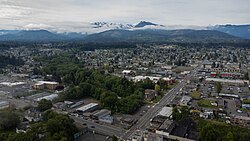
Port Angeles, Washington
Port Angeles (/ˈændʒələs/ AN-jəl-əs) is a city in and the county seat of Clallam County, Washington, United States. The population was 19,960 at the 2020 census, it is the most populous city in the county, as well as the most populous city on the Olympic Peninsula. The population was estimated at 20,112 in 2024.
The city's harbor was dubbed Puerto de Nuestra Señora de los Ángeles (Port of Our Lady of the Angels) by Spanish explorer Francisco de Eliza in 1791. By the mid-19th century, after settlement by English speakers from the United States, the name was shortened and partially anglicized to its current form, Port Angeles Harbor.
Port Angeles is home to Peninsula College. It is the birthplace of football hall of famer John Elway and residents include writers and other celebrities. The city is served by William R. Fairchild International Airport. Ferry service is provided across the Strait of Juan de Fuca to Victoria, British Columbia, Canada on the MV Coho.
This area was long occupied by succeeding cultures of indigenous peoples. In 1791, the harbor was entered by Spanish explorer Francisco de Eliza, who named it Puerto de Nuestra Señora de los Ángeles (Port of Our Lady of the Angels), claiming it for Spain. He was on an expedition from southern California. This name was shortened to the current one of Port Angeles.
It was not until the 19th century that European Americans began to settle here. A small whaling, fishing and shipping village developed, which traded with Victoria, British Columbia. In 1856–57, the first settlers arrived and were followed by the Cherbourg Land Company in 1859.
Soon afterwards the site caught the attention of Victor Smith. Smith, a protege of Salmon Chase, was Collector of Customs for the Puget Sound District. He quickly gained approval to relocate the U.S. Customs port of entry for Washington Territory from Port Townsend to Port Angeles. With Chase's support, he also succeeded in getting President Abraham Lincoln to designate 3,520 acres (1,424 ha) at Port Angeles as a federal reserve for lighthouse, military and naval purposes. The U.S. Army Corps of Engineers platted a federal town site on the reserve land, laying out the street plan which still exists today. The fact that Washington, D.C., was the only other city officially laid out by the federal government led the U.S. Board of Trade in 1890 to dub Port Angeles the "Second National City." Settlers soon followed slowly, but Smith's death in the sinking of the Brother Jonathan led to the loss of interest in the area. The Port of Entry was returned to Port Townsend and the area sank into obscurity until the 1880s.
In 1884, a hotel was built and the trading post was expanded into the area's first general store. A wharf was soon built upon the site where the current ferry pier stands. A village of 300 in 1886, Port Angeles' population grew to 3,000 by 1890. Hundreds of its new residents were part of the Puget Sound Cooperative Colony, which was established in 1887 and built several of the settlement's first permanent civic facilities, including a sawmill, church, office building, and opera house. The town was incorporated on June 11, 1890, and was named the county seat of Clallam County later that year. A depression a few years later was weathered and the town continued to grow into the new century. In 1914, large-scale logging began with construction of a large mill and a railway connecting the hinterlands to the mill. Other mills were soon built and the lumber and pulp mills supported the economy of the area until well into the century.[citation needed]
Tourism became increasingly important as the growing national affluence, and especially the 1961 opening of the Hood Canal Bridge that cut driving time from the populated central Puget Sound region, brought more visitors drawn by the mountains, rivers, and rainforest of Olympic National Park and by fishing and boating along the Strait of Juan de Fuca. The mills began to close in the 1970s and 1980s until only one pulp mill remained in operation; the Rayonier specialty pulp mill was shuttered in 1997.
Port Angeles, Washington
Port Angeles (/ˈændʒələs/ AN-jəl-əs) is a city in and the county seat of Clallam County, Washington, United States. The population was 19,960 at the 2020 census, it is the most populous city in the county, as well as the most populous city on the Olympic Peninsula. The population was estimated at 20,112 in 2024.
The city's harbor was dubbed Puerto de Nuestra Señora de los Ángeles (Port of Our Lady of the Angels) by Spanish explorer Francisco de Eliza in 1791. By the mid-19th century, after settlement by English speakers from the United States, the name was shortened and partially anglicized to its current form, Port Angeles Harbor.
Port Angeles is home to Peninsula College. It is the birthplace of football hall of famer John Elway and residents include writers and other celebrities. The city is served by William R. Fairchild International Airport. Ferry service is provided across the Strait of Juan de Fuca to Victoria, British Columbia, Canada on the MV Coho.
This area was long occupied by succeeding cultures of indigenous peoples. In 1791, the harbor was entered by Spanish explorer Francisco de Eliza, who named it Puerto de Nuestra Señora de los Ángeles (Port of Our Lady of the Angels), claiming it for Spain. He was on an expedition from southern California. This name was shortened to the current one of Port Angeles.
It was not until the 19th century that European Americans began to settle here. A small whaling, fishing and shipping village developed, which traded with Victoria, British Columbia. In 1856–57, the first settlers arrived and were followed by the Cherbourg Land Company in 1859.
Soon afterwards the site caught the attention of Victor Smith. Smith, a protege of Salmon Chase, was Collector of Customs for the Puget Sound District. He quickly gained approval to relocate the U.S. Customs port of entry for Washington Territory from Port Townsend to Port Angeles. With Chase's support, he also succeeded in getting President Abraham Lincoln to designate 3,520 acres (1,424 ha) at Port Angeles as a federal reserve for lighthouse, military and naval purposes. The U.S. Army Corps of Engineers platted a federal town site on the reserve land, laying out the street plan which still exists today. The fact that Washington, D.C., was the only other city officially laid out by the federal government led the U.S. Board of Trade in 1890 to dub Port Angeles the "Second National City." Settlers soon followed slowly, but Smith's death in the sinking of the Brother Jonathan led to the loss of interest in the area. The Port of Entry was returned to Port Townsend and the area sank into obscurity until the 1880s.
In 1884, a hotel was built and the trading post was expanded into the area's first general store. A wharf was soon built upon the site where the current ferry pier stands. A village of 300 in 1886, Port Angeles' population grew to 3,000 by 1890. Hundreds of its new residents were part of the Puget Sound Cooperative Colony, which was established in 1887 and built several of the settlement's first permanent civic facilities, including a sawmill, church, office building, and opera house. The town was incorporated on June 11, 1890, and was named the county seat of Clallam County later that year. A depression a few years later was weathered and the town continued to grow into the new century. In 1914, large-scale logging began with construction of a large mill and a railway connecting the hinterlands to the mill. Other mills were soon built and the lumber and pulp mills supported the economy of the area until well into the century.[citation needed]
Tourism became increasingly important as the growing national affluence, and especially the 1961 opening of the Hood Canal Bridge that cut driving time from the populated central Puget Sound region, brought more visitors drawn by the mountains, rivers, and rainforest of Olympic National Park and by fishing and boating along the Strait of Juan de Fuca. The mills began to close in the 1970s and 1980s until only one pulp mill remained in operation; the Rayonier specialty pulp mill was shuttered in 1997.
Recent media
Recent media