



Community hub
Recent from talks
Contribute something to knowledge base
Content stats: 0 posts, 0 articles, 1 media, 0 notes
Members stats: 0 subscribers, 0 contributors, 0 moderators, 0 supporters
Subscribers
Supporters
Contributors
Moderators
Hub AI
Portrait of a Musician AI simulator
(@Portrait of a Musician_simulator)
Hub AI
Portrait of a Musician AI simulator
(@Portrait of a Musician_simulator)
Portrait of a Musician
The Portrait of a Musician is an unfinished painting by the Italian Renaissance artist Leonardo da Vinci, dated to c. 1483–1487. Produced while Leonardo was in Milan, the work is painted in oils, and perhaps tempera, on a small panel of walnut wood. It is his only known male portrait painting, and the identity of its sitter has been closely debated among scholars.
Perhaps influenced by Antonello da Messina's introduction of the Early Netherlandish style of portrait painting to Italy, the work marks a dramatic shift from the profile portraiture that predominated in 15th-century Milan. It shares many similarities with other paintings Leonardo executed there, such as the Louvre Virgin of the Rocks and the Lady with an Ermine, but the Portrait of a Musician is his only panel painting remaining in the city, where it has been in the Pinacoteca Ambrosiana since at least 1672. One of Leonardo's best preserved paintings, there are no extant contemporary records of the commission. Based on stylistic resemblances to other works by Leonardo, virtually all current scholarship attributes at least the sitter's face to him. Uncertainty over the rest of the painting arises from the stiff and rigid qualities of the body, which are uncharacteristic of Leonardo's work. While this may be explained by the painting's unfinished state, some scholars believe that Leonardo was assisted by one of his students.
The portrait's intimacy indicates a private commission, or one by a personal friend. Until the 20th century it was thought to show Ludovico Sforza, a Duke of Milan and employer of Leonardo. During a 1904–1905 restoration, the removal of overpainting revealed a hand holding sheet music, indicating that the sitter was a musician. Many musicians active in 15th-century Milan have been proposed as the sitter; Franchinus Gaffurius was the most favored candidate throughout the 20th century, but in the 21st century scholarly opinion shifted towards Atalante Migliorotti. Other notable suggestions include Josquin des Prez and Gaspar van Weerbeke, but there is no historical evidence to substantiate any of these claims with certainty. The work has been criticized for its stoic and wooden qualities, but noted for its intensity and the high level of detail in the subject's face. Scholarly interpretations range from the painting depicting a musician mid-performance, to representing Leonardo's self-proclaimed ideology of the superiority of painting over other art forms, such as music.
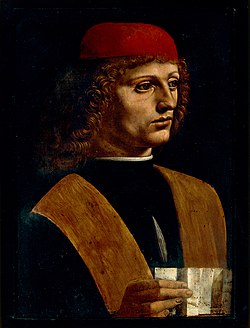
This painting was executed in oils and perhaps tempera on a small, 44.7 cm × 32 cm (17.6 in × 12.6 in) walnut wood panel. It depicts a young man in bust length and three-quarter view, whose right hand holds a folded piece of sheet music. The painting is largely unfinished save for the face and hair, but is in good condition overall, with only the bottom right corner suffering damage. The art historian Kenneth Clark noted that out of Leonardo's surviving works, the Musician is perhaps the best preserved, despite the fading of colors over time.
The bottom of the work may have been slightly trimmed. There is a small amount of retouching, especially towards the back of the head; the art historian Frank Zöllner has noted that this retouching introduced the somewhat unsuccessful shading of the neck and the left side of the lips. With its black background, the portrait is reminiscent of Leonardo's later portraits, the Lady with an Ermine and La Belle Ferronnière, but differs from them in that the sitter's body and head face the same direction. The biographer Walter Isaacson has noted that due to the work's unfinished state, the portrait's shadows are overtly harsh, and the portrait itself features fewer of the thin layers of oil paint typically found in Leonardo's paintings.
The sitter has curly shoulder-length hair, wears a red cap, and stares intently at something outside the viewer's field of vision. His stare is intensified by careful lighting that focuses attention on his face, especially on his large glassy eyes. He wears a tight white undershirt. The painting of his black doublet is unfinished and his brownish-orange stole is only underpainted. The colors are faded, probably due to minor repainting and poor conservation. Technical examination of the work has revealed that the doublet was probably originally dark red, and the stole bright yellow.
The mouth hints at a smile, or suggests that the man is about to sing or has just sung. A notable feature of his face is the effect on his eyes from the light outside the frame. The light dilates the pupils of both eyes, but the proper right far more than the left, something that is not possible. Some have argued that this is simply for dramatic effect, so that the viewer feels a sense of motion from the musician's left to right side of his face. The art historian Luke Syson has written that "the eyes are perhaps the most striking feature of the Musician, sight given primacy as the noblest sense and the most important tool of the painter".
The stiffly folded piece of paper, which is held in an odd and delicate manner, is a piece of sheet music with musical notes and letters written on it. Due to the poor condition of the lower part of the painting, the notes and letters are largely illegible. This has not stopped some scholars from hypothesizing what the letters say, often using their interpretations to support their theory of the musician's identity. The partially erased letters can be made out as "Cant" and "An" and are usually read as "Cantum Angelicum", Latin for 'angelic song', although the art historian Martin Kemp notes that it could be "Cantore Angelico", Italian for 'angelic singer'. The notes have offered little clarity into the painting, other than strongly suggesting that the subject is a musician. They are in mensural notation and therefore probably show polyphonic music. Leonardo's surviving drawings of rebuses with musical notation in the Print Room of Windsor Castle do not resemble the music in the painting. This suggests that this musical composition is not by Leonardo, which leaves the composer and the significance of the music unknown.
Portrait of a Musician
The Portrait of a Musician is an unfinished painting by the Italian Renaissance artist Leonardo da Vinci, dated to c. 1483–1487. Produced while Leonardo was in Milan, the work is painted in oils, and perhaps tempera, on a small panel of walnut wood. It is his only known male portrait painting, and the identity of its sitter has been closely debated among scholars.
Perhaps influenced by Antonello da Messina's introduction of the Early Netherlandish style of portrait painting to Italy, the work marks a dramatic shift from the profile portraiture that predominated in 15th-century Milan. It shares many similarities with other paintings Leonardo executed there, such as the Louvre Virgin of the Rocks and the Lady with an Ermine, but the Portrait of a Musician is his only panel painting remaining in the city, where it has been in the Pinacoteca Ambrosiana since at least 1672. One of Leonardo's best preserved paintings, there are no extant contemporary records of the commission. Based on stylistic resemblances to other works by Leonardo, virtually all current scholarship attributes at least the sitter's face to him. Uncertainty over the rest of the painting arises from the stiff and rigid qualities of the body, which are uncharacteristic of Leonardo's work. While this may be explained by the painting's unfinished state, some scholars believe that Leonardo was assisted by one of his students.
The portrait's intimacy indicates a private commission, or one by a personal friend. Until the 20th century it was thought to show Ludovico Sforza, a Duke of Milan and employer of Leonardo. During a 1904–1905 restoration, the removal of overpainting revealed a hand holding sheet music, indicating that the sitter was a musician. Many musicians active in 15th-century Milan have been proposed as the sitter; Franchinus Gaffurius was the most favored candidate throughout the 20th century, but in the 21st century scholarly opinion shifted towards Atalante Migliorotti. Other notable suggestions include Josquin des Prez and Gaspar van Weerbeke, but there is no historical evidence to substantiate any of these claims with certainty. The work has been criticized for its stoic and wooden qualities, but noted for its intensity and the high level of detail in the subject's face. Scholarly interpretations range from the painting depicting a musician mid-performance, to representing Leonardo's self-proclaimed ideology of the superiority of painting over other art forms, such as music.
This painting was executed in oils and perhaps tempera on a small, 44.7 cm × 32 cm (17.6 in × 12.6 in) walnut wood panel. It depicts a young man in bust length and three-quarter view, whose right hand holds a folded piece of sheet music. The painting is largely unfinished save for the face and hair, but is in good condition overall, with only the bottom right corner suffering damage. The art historian Kenneth Clark noted that out of Leonardo's surviving works, the Musician is perhaps the best preserved, despite the fading of colors over time.
The bottom of the work may have been slightly trimmed. There is a small amount of retouching, especially towards the back of the head; the art historian Frank Zöllner has noted that this retouching introduced the somewhat unsuccessful shading of the neck and the left side of the lips. With its black background, the portrait is reminiscent of Leonardo's later portraits, the Lady with an Ermine and La Belle Ferronnière, but differs from them in that the sitter's body and head face the same direction. The biographer Walter Isaacson has noted that due to the work's unfinished state, the portrait's shadows are overtly harsh, and the portrait itself features fewer of the thin layers of oil paint typically found in Leonardo's paintings.
The sitter has curly shoulder-length hair, wears a red cap, and stares intently at something outside the viewer's field of vision. His stare is intensified by careful lighting that focuses attention on his face, especially on his large glassy eyes. He wears a tight white undershirt. The painting of his black doublet is unfinished and his brownish-orange stole is only underpainted. The colors are faded, probably due to minor repainting and poor conservation. Technical examination of the work has revealed that the doublet was probably originally dark red, and the stole bright yellow.
The mouth hints at a smile, or suggests that the man is about to sing or has just sung. A notable feature of his face is the effect on his eyes from the light outside the frame. The light dilates the pupils of both eyes, but the proper right far more than the left, something that is not possible. Some have argued that this is simply for dramatic effect, so that the viewer feels a sense of motion from the musician's left to right side of his face. The art historian Luke Syson has written that "the eyes are perhaps the most striking feature of the Musician, sight given primacy as the noblest sense and the most important tool of the painter".
The stiffly folded piece of paper, which is held in an odd and delicate manner, is a piece of sheet music with musical notes and letters written on it. Due to the poor condition of the lower part of the painting, the notes and letters are largely illegible. This has not stopped some scholars from hypothesizing what the letters say, often using their interpretations to support their theory of the musician's identity. The partially erased letters can be made out as "Cant" and "An" and are usually read as "Cantum Angelicum", Latin for 'angelic song', although the art historian Martin Kemp notes that it could be "Cantore Angelico", Italian for 'angelic singer'. The notes have offered little clarity into the painting, other than strongly suggesting that the subject is a musician. They are in mensural notation and therefore probably show polyphonic music. Leonardo's surviving drawings of rebuses with musical notation in the Print Room of Windsor Castle do not resemble the music in the painting. This suggests that this musical composition is not by Leonardo, which leaves the composer and the significance of the music unknown.
Recent media
Recent media