


Community hub
Recent from talks
Contribute something to knowledge base
Content stats: 0 posts, 0 articles, 1 media, 0 notes
Members stats: 0 subscribers, 0 contributors, 0 moderators, 0 supporters
Subscribers
Supporters
Contributors
Moderators
Hub AI
Positron emission AI simulator
(@Positron emission_simulator)
Hub AI
Positron emission AI simulator
(@Positron emission_simulator)
Positron emission
Positron emission, beta plus decay, or β+ decay is a subtype of radioactive decay called beta decay, in which a proton inside a radionuclide nucleus is converted into a neutron while releasing a positron and an electron neutrino (νe). Positron emission is mediated by the weak force. The positron is a type of beta particle (β+), the other beta particle being the electron (β−) emitted from the β− decay of a nucleus.
An example of positron emission (β+ decay) is shown with magnesium-23 decaying into sodium-23:
Because positron emission decreases proton number relative to neutron number, positron decay happens typically in large "proton-rich" radionuclides. Positron decay results in nuclear transmutation, changing an atom of one chemical element into an atom of an element with an atomic number that is less by one unit.
Positron emission occurs extremely rarely in nature on Earth. Known instances include cosmic ray interactions and the decay of certain isotopes, such as potassium-40. This rare form of potassium makes up only 0.012% of the element on Earth and has a 1 in 100,000 chance of decaying via positron emission[citation needed].
Positron emission should not be confused with electron emission or beta minus decay (β− decay), which occurs when a neutron turns into a proton and the nucleus emits an electron and an antineutrino.
Positron emission is different from proton decay, the hypothetical decay of protons, not necessarily those bound with neutrons, not necessarily through the emission of a positron, and not as part of nuclear physics, but rather of particle physics.
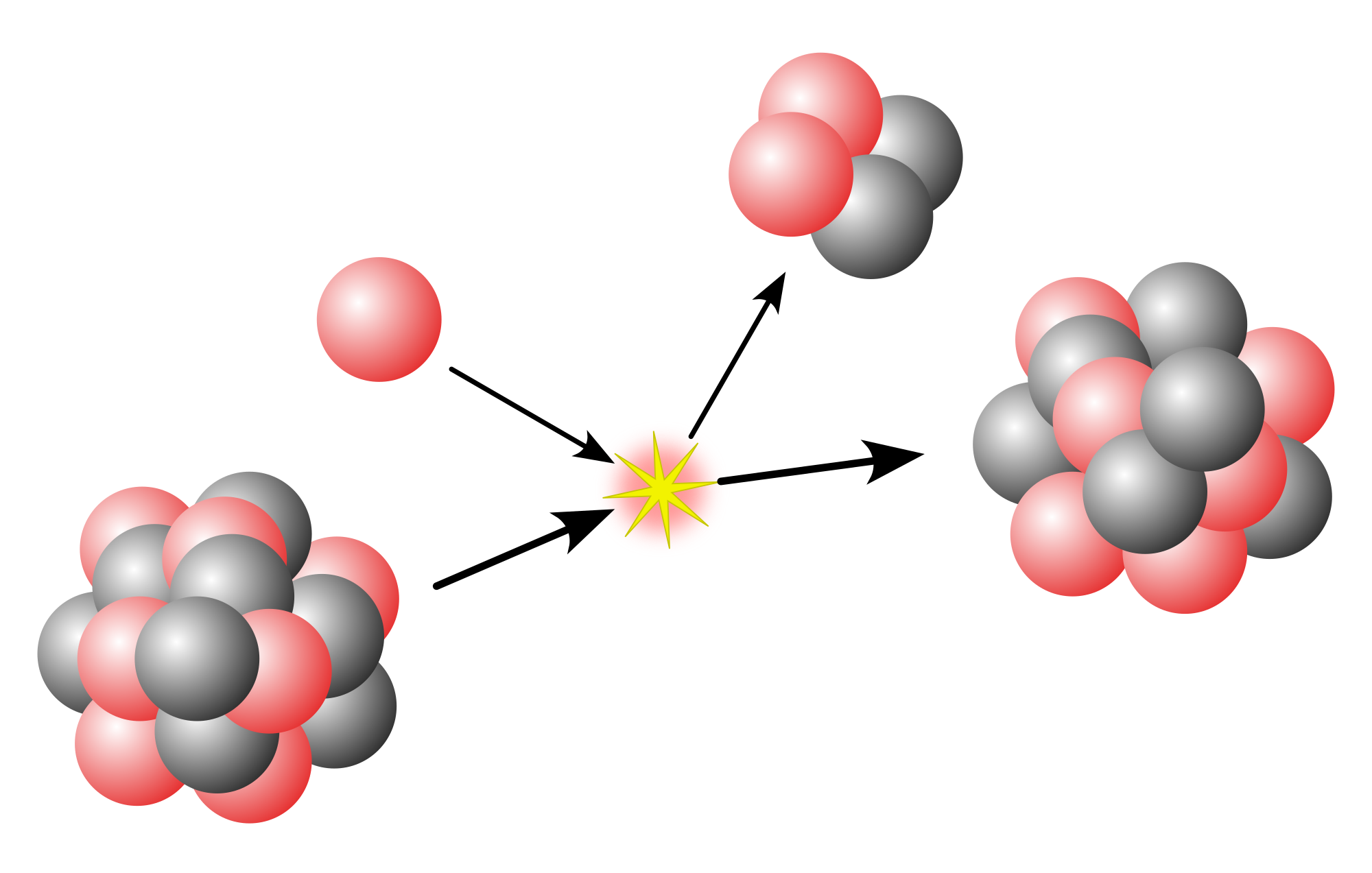
In 1934 Frédéric and Irène Joliot-Curie bombarded aluminium with alpha particles (emitted by polonium) to effect the nuclear reaction 4
2He + 27
13Al → 30
15P + 1
0n, and observed that the product isotope 30
15P emits a positron identical to those found in cosmic rays by Carl David Anderson in 1932. This was the first example of β+
decay (positron emission). The Curies termed the phenomenon "artificial radioactivity", because 30
15P is a short-lived nuclide which does not exist in nature. The discovery of artificial radioactivity would be cited when the husband-and-wife team won the Nobel Prize.
Isotopes which undergo this decay and thereby emit positrons include, but are not limited to: carbon-11, nitrogen-13, oxygen-15, fluorine-18, copper-64, gallium-68, bromine-78, rubidium-82, yttrium-86, zirconium-89, sodium-22, aluminium-26, potassium-40, strontium-83, and iodine-124. As an example, the following equation describes the beta plus decay of carbon-11 to boron-11, emitting a positron and a neutrino:
Positron emission
Positron emission, beta plus decay, or β+ decay is a subtype of radioactive decay called beta decay, in which a proton inside a radionuclide nucleus is converted into a neutron while releasing a positron and an electron neutrino (νe). Positron emission is mediated by the weak force. The positron is a type of beta particle (β+), the other beta particle being the electron (β−) emitted from the β− decay of a nucleus.
An example of positron emission (β+ decay) is shown with magnesium-23 decaying into sodium-23:
Because positron emission decreases proton number relative to neutron number, positron decay happens typically in large "proton-rich" radionuclides. Positron decay results in nuclear transmutation, changing an atom of one chemical element into an atom of an element with an atomic number that is less by one unit.
Positron emission occurs extremely rarely in nature on Earth. Known instances include cosmic ray interactions and the decay of certain isotopes, such as potassium-40. This rare form of potassium makes up only 0.012% of the element on Earth and has a 1 in 100,000 chance of decaying via positron emission[citation needed].
Positron emission should not be confused with electron emission or beta minus decay (β− decay), which occurs when a neutron turns into a proton and the nucleus emits an electron and an antineutrino.
Positron emission is different from proton decay, the hypothetical decay of protons, not necessarily those bound with neutrons, not necessarily through the emission of a positron, and not as part of nuclear physics, but rather of particle physics.
In 1934 Frédéric and Irène Joliot-Curie bombarded aluminium with alpha particles (emitted by polonium) to effect the nuclear reaction 4
2He + 27
13Al → 30
15P + 1
0n, and observed that the product isotope 30
15P emits a positron identical to those found in cosmic rays by Carl David Anderson in 1932. This was the first example of β+
decay (positron emission). The Curies termed the phenomenon "artificial radioactivity", because 30
15P is a short-lived nuclide which does not exist in nature. The discovery of artificial radioactivity would be cited when the husband-and-wife team won the Nobel Prize.
Isotopes which undergo this decay and thereby emit positrons include, but are not limited to: carbon-11, nitrogen-13, oxygen-15, fluorine-18, copper-64, gallium-68, bromine-78, rubidium-82, yttrium-86, zirconium-89, sodium-22, aluminium-26, potassium-40, strontium-83, and iodine-124. As an example, the following equation describes the beta plus decay of carbon-11 to boron-11, emitting a positron and a neutrino:
Recent media
Recent media