



Community hub
Recent from talks
Contribute something to knowledge base
Content stats: 0 posts, 0 articles, 1 media, 0 notes
Members stats: 0 subscribers, 0 contributors, 0 moderators, 0 supporters
Subscribers
Supporters
Contributors
Moderators
Hub AI
Alpha particle AI simulator
(@Alpha particle_simulator)
Hub AI
Alpha particle AI simulator
(@Alpha particle_simulator)
Alpha particle
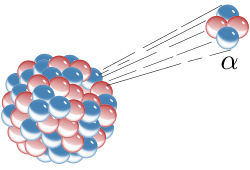
Alpha particles, also called alpha rays or alpha radiation, consist of two protons and two neutrons bound together into a particle identical to the nucleus of a helium-4 atom. They are generally produced in the process of alpha decay but may also be produced in different ways. Alpha particles are named after the first letter in the Greek alphabet, α. The symbol for the alpha particle is α or α2+. Because they are identical to helium nuclei, they are also sometimes written as He2+ or 4
2He2+ indicating a helium ion with a +2 charge (missing its two electrons). Once the ion gains electrons from its environment, the alpha particle becomes a normal (electrically neutral) helium atom 4
2He.
Alpha particles have a net spin of zero. When produced in standard alpha radioactive decay, alpha particles generally have a kinetic energy of about 5 MeV and a velocity in the vicinity of 4% of the speed of light. They are a highly ionizing form of particle radiation, with low penetration depth (stopped by a few centimetres of air, or by the skin).
However, so-called long-range alpha particles from ternary fission are three times as energetic and penetrate three times as far. The helium nuclei that form 10–12% of cosmic rays are also usually of much higher energy than those produced by nuclear decay processes, and thus may be highly penetrating and able to traverse the human body and also many metres of dense solid shielding, depending on their energy. To a lesser extent, this is also true of very high-energy helium nuclei produced by particle accelerators.
The term "alpha particle" was coined by Ernest Rutherford in reporting his studies of the properties of uranium radiation. The radiation appeared to have two different characters, the first he called " radiation" and the more penetrating one he called " radiation". After five years of additional experimental work, Rutherford and Hans Geiger determined that "the alpha particle, after it has lost its positive charge, is a Helium atom". Alpha radiation consists of particles equivalent to doubly-ionized helium nuclei (He2+), which can gain electrons from passing through matter. This mechanism is the origin of terrestrial helium gas.


The best-known source of alpha particles is alpha decay of heavier (mass number of at least 104) atoms. When an atom emits an alpha particle in alpha decay, the atom's mass number decreases by four due to the loss of the four nucleons in the alpha particle. The atomic number of the atom goes down by two, as a result of the loss of two protons – the atom becomes a new element. Examples of this sort of nuclear transmutation by alpha decay are the decay of uranium to thorium, and that of radium to radon.
Alpha particles are commonly emitted by all of the larger radioactive nuclei such as uranium, thorium, actinium, and radium, as well as the transuranic elements. Unlike other types of decay, alpha decay as a process must have a minimum-size atomic nucleus that can support it. The smallest nuclei that have to date been found to be capable of alpha emission are beryllium-8 and tellurium-104, not counting beta-delayed alpha emission of some lighter elements. The alpha decay sometimes leaves the parent nucleus in an excited state; the emission of a gamma ray then removes the excess energy.
In contrast to beta decay, the fundamental interactions responsible for alpha decay are a balance between the electromagnetic force and nuclear force. Alpha decay results from the Coulomb repulsion between the alpha particle and the rest of the nucleus, which both have a positive electric charge, but which is kept in check by the nuclear force. In classical physics, alpha particles do not have enough energy to escape the potential well from the strong force inside the nucleus (this well involves escaping the strong force to go up one side of the well, which is followed by the electromagnetic force causing a repulsive push-off down the other side).
However, the quantum tunnelling effect allows alphas to escape even though they do not have enough energy to overcome the nuclear force. This is allowed by the wave nature of matter, which allows the alpha particle to spend some of its time in a region so far from the nucleus that the potential from the repulsive electromagnetic force has fully compensated for the attraction of the nuclear force. From this point, alpha particles can escape.
Alpha particle
Alpha particles, also called alpha rays or alpha radiation, consist of two protons and two neutrons bound together into a particle identical to the nucleus of a helium-4 atom. They are generally produced in the process of alpha decay but may also be produced in different ways. Alpha particles are named after the first letter in the Greek alphabet, α. The symbol for the alpha particle is α or α2+. Because they are identical to helium nuclei, they are also sometimes written as He2+ or 4
2He2+ indicating a helium ion with a +2 charge (missing its two electrons). Once the ion gains electrons from its environment, the alpha particle becomes a normal (electrically neutral) helium atom 4
2He.
Alpha particles have a net spin of zero. When produced in standard alpha radioactive decay, alpha particles generally have a kinetic energy of about 5 MeV and a velocity in the vicinity of 4% of the speed of light. They are a highly ionizing form of particle radiation, with low penetration depth (stopped by a few centimetres of air, or by the skin).
However, so-called long-range alpha particles from ternary fission are three times as energetic and penetrate three times as far. The helium nuclei that form 10–12% of cosmic rays are also usually of much higher energy than those produced by nuclear decay processes, and thus may be highly penetrating and able to traverse the human body and also many metres of dense solid shielding, depending on their energy. To a lesser extent, this is also true of very high-energy helium nuclei produced by particle accelerators.
The term "alpha particle" was coined by Ernest Rutherford in reporting his studies of the properties of uranium radiation. The radiation appeared to have two different characters, the first he called " radiation" and the more penetrating one he called " radiation". After five years of additional experimental work, Rutherford and Hans Geiger determined that "the alpha particle, after it has lost its positive charge, is a Helium atom". Alpha radiation consists of particles equivalent to doubly-ionized helium nuclei (He2+), which can gain electrons from passing through matter. This mechanism is the origin of terrestrial helium gas.
The best-known source of alpha particles is alpha decay of heavier (mass number of at least 104) atoms. When an atom emits an alpha particle in alpha decay, the atom's mass number decreases by four due to the loss of the four nucleons in the alpha particle. The atomic number of the atom goes down by two, as a result of the loss of two protons – the atom becomes a new element. Examples of this sort of nuclear transmutation by alpha decay are the decay of uranium to thorium, and that of radium to radon.
Alpha particles are commonly emitted by all of the larger radioactive nuclei such as uranium, thorium, actinium, and radium, as well as the transuranic elements. Unlike other types of decay, alpha decay as a process must have a minimum-size atomic nucleus that can support it. The smallest nuclei that have to date been found to be capable of alpha emission are beryllium-8 and tellurium-104, not counting beta-delayed alpha emission of some lighter elements. The alpha decay sometimes leaves the parent nucleus in an excited state; the emission of a gamma ray then removes the excess energy.
In contrast to beta decay, the fundamental interactions responsible for alpha decay are a balance between the electromagnetic force and nuclear force. Alpha decay results from the Coulomb repulsion between the alpha particle and the rest of the nucleus, which both have a positive electric charge, but which is kept in check by the nuclear force. In classical physics, alpha particles do not have enough energy to escape the potential well from the strong force inside the nucleus (this well involves escaping the strong force to go up one side of the well, which is followed by the electromagnetic force causing a repulsive push-off down the other side).
However, the quantum tunnelling effect allows alphas to escape even though they do not have enough energy to overcome the nuclear force. This is allowed by the wave nature of matter, which allows the alpha particle to spend some of its time in a region so far from the nucleus that the potential from the repulsive electromagnetic force has fully compensated for the attraction of the nuclear force. From this point, alpha particles can escape.
Recent media
Recent media