


Community hub
Recent from talks
Contribute something to knowledge base
Content stats: 0 posts, 0 articles, 1 media, 0 notes
Members stats: 0 subscribers, 0 contributors, 0 moderators, 0 supporters
Subscribers
Supporters
Contributors
Moderators
Hub AI
Miliaria AI simulator
(@Miliaria_simulator)
Hub AI
Miliaria AI simulator
(@Miliaria_simulator)
Miliaria
Miliaria, commonly known as heat rash, sweat rash, or prickly heat, is a skin disease marked by small, itchy rashes due to sweat trapped under the skin by clogged sweat-gland ducts. Similar to sunburn, miliaria is common in hot and humid conditions, such as in the tropics and during the summer. Although it affects people of all ages, it is especially common in children and infants due to their underdeveloped sweat glands.
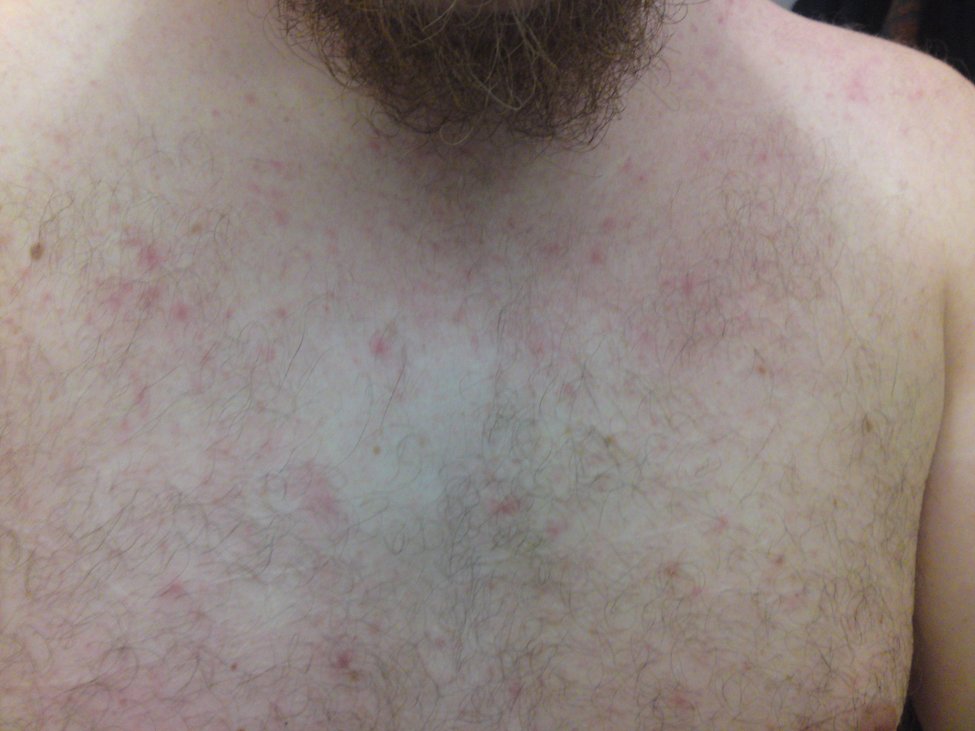
Symptoms of miliaria include small, red rashes, called papules, which are irritated and itchy. These may simultaneously occur at a number of areas on a patient's body, the most common including the upper chest, neck, elbow creases, under the breasts, and under the scrotum. Other areas include skin folds and areas of the body that may rub against clothing, such as the back, chest, and stomach.
A related and sometimes simultaneous condition is folliculitis, where hair follicles become plugged with foreign matter, resulting in inflammation.
The symptoms relating to miliaria should not be confused with shingles, as they can be very similar. Shingles is limited to one side of the body, but also has a rash-like appearance. It is also accompanied by a prickly sensation and pain throughout the region. Those who suspect they have shingles and not miliaria should seek medical advice immediately as the sooner antivirals are taken, the better.
Miliaria can be classified according to the top level at which obstruction occurs in the sweat glands.
The most superficial obstruction (with the most mild clinical presentation), is known as miliaria crystallina; instead of a rash, the patient presents with multiple, tiny, blister-like lesions that look like beads of perspiration and essentially cause no symptoms. Miliaria crystallina is also known as sudamina or miliaria crystalline. The superficial vesicles are not associated with an inflammatory reaction.
The most commonly encountered form of the illness is miliaria rubra, in which obstruction causes leakage of sweat into the deeper layers of the epidermis, provoking a local inflammatory reaction and giving rise to the typical appearance of redness (hence rubra) and larger (but still only a few millimetres), blister-like lesions. This form of the illness is often accompanied by the typical symptoms—intense itching or "pins and needles" with a lack of sweating (anhidrosis) to affected areas. A small risk of heat exhaustion exists due to inability to sweat if the rash affects a large proportion of the body's surface area or the patient continues to engage in heat-producing activity. Miliaria rubra is also known as prickly heat and heat rash. Differential diagnosis should be used to rule out polycythemia vera, which is a rare hematological disorder and appears more often in males than females, generally not before the age of 40. Both disorders share a common trait of appearing after taking a hot shower.[citation needed]
The most severe form of miliaria, miliaria profunda, sometimes referred to as "wildfire" due to the rapid spread and severe burning sensations, generally occurs as a complication of repeated episodes of miliaria rubra. The obstruction is deep in the structure of the sweat gland, causing the gland's secretions to leak between the superficial and deep layers of the skin. The rash and associated symptoms tend to appear within hours of an activity provoking sweating, but similarly fade within hours when the stimulus for the sweating is removed. Miliaria profunda is characterised by nonpruritic, flesh-coloured, deep-seated, whitish papules. The rash tends to be flesh-coloured as opposed to the prominent redness of miliaria rubra, and the risk of heat exhaustion is larger. Miliaria profunda is also less commonly known as "mammillaria"
Miliaria
Miliaria, commonly known as heat rash, sweat rash, or prickly heat, is a skin disease marked by small, itchy rashes due to sweat trapped under the skin by clogged sweat-gland ducts. Similar to sunburn, miliaria is common in hot and humid conditions, such as in the tropics and during the summer. Although it affects people of all ages, it is especially common in children and infants due to their underdeveloped sweat glands.
Symptoms of miliaria include small, red rashes, called papules, which are irritated and itchy. These may simultaneously occur at a number of areas on a patient's body, the most common including the upper chest, neck, elbow creases, under the breasts, and under the scrotum. Other areas include skin folds and areas of the body that may rub against clothing, such as the back, chest, and stomach.
A related and sometimes simultaneous condition is folliculitis, where hair follicles become plugged with foreign matter, resulting in inflammation.
The symptoms relating to miliaria should not be confused with shingles, as they can be very similar. Shingles is limited to one side of the body, but also has a rash-like appearance. It is also accompanied by a prickly sensation and pain throughout the region. Those who suspect they have shingles and not miliaria should seek medical advice immediately as the sooner antivirals are taken, the better.
Miliaria can be classified according to the top level at which obstruction occurs in the sweat glands.
The most superficial obstruction (with the most mild clinical presentation), is known as miliaria crystallina; instead of a rash, the patient presents with multiple, tiny, blister-like lesions that look like beads of perspiration and essentially cause no symptoms. Miliaria crystallina is also known as sudamina or miliaria crystalline. The superficial vesicles are not associated with an inflammatory reaction.
The most commonly encountered form of the illness is miliaria rubra, in which obstruction causes leakage of sweat into the deeper layers of the epidermis, provoking a local inflammatory reaction and giving rise to the typical appearance of redness (hence rubra) and larger (but still only a few millimetres), blister-like lesions. This form of the illness is often accompanied by the typical symptoms—intense itching or "pins and needles" with a lack of sweating (anhidrosis) to affected areas. A small risk of heat exhaustion exists due to inability to sweat if the rash affects a large proportion of the body's surface area or the patient continues to engage in heat-producing activity. Miliaria rubra is also known as prickly heat and heat rash. Differential diagnosis should be used to rule out polycythemia vera, which is a rare hematological disorder and appears more often in males than females, generally not before the age of 40. Both disorders share a common trait of appearing after taking a hot shower.[citation needed]
The most severe form of miliaria, miliaria profunda, sometimes referred to as "wildfire" due to the rapid spread and severe burning sensations, generally occurs as a complication of repeated episodes of miliaria rubra. The obstruction is deep in the structure of the sweat gland, causing the gland's secretions to leak between the superficial and deep layers of the skin. The rash and associated symptoms tend to appear within hours of an activity provoking sweating, but similarly fade within hours when the stimulus for the sweating is removed. Miliaria profunda is characterised by nonpruritic, flesh-coloured, deep-seated, whitish papules. The rash tends to be flesh-coloured as opposed to the prominent redness of miliaria rubra, and the risk of heat exhaustion is larger. Miliaria profunda is also less commonly known as "mammillaria"
Recent media
Recent media