
Recent from talks
Potassium acetate
Knowledge base stats:
Talk channels stats:
Members stats:
Potassium acetate
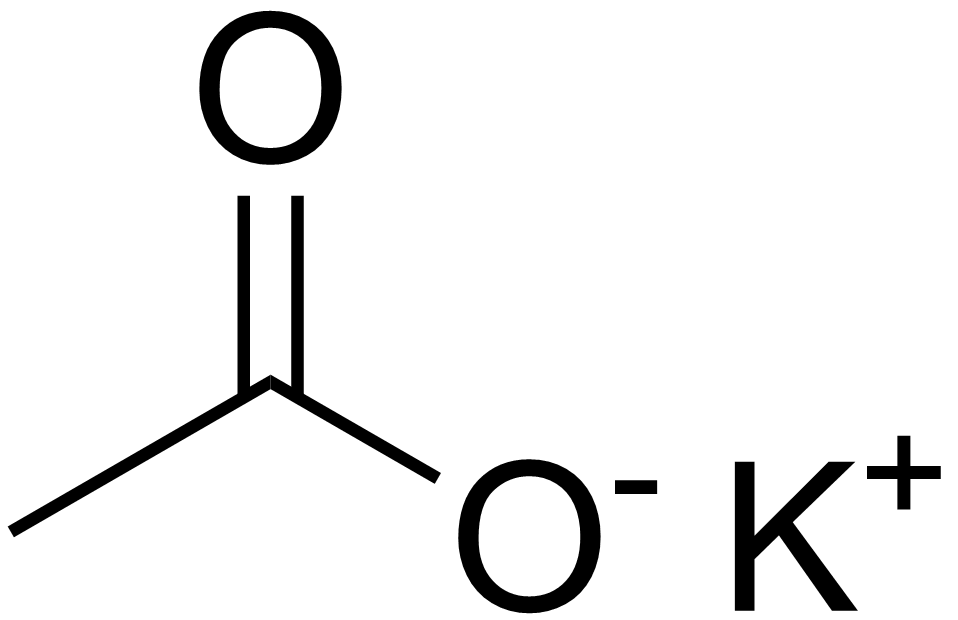
Potassium acetate (also called potassium ethanoate), (CH3COOK) is the potassium salt of acetic acid. It is a hygroscopic solid at room temperature.
It can be prepared by treating a potassium-containing base such as potassium hydroxide with acetic acid:
This sort of reaction is known as an acid-alkalai reaction.
At saturation, the sesquihydrate in water solution (2CH3COOK·3H2O) begins to form the semihydrate (2CH3COOK·H2O) at 41.3 °C (106.3 °F).
Potassium acetate (as a substitute for calcium chloride or magnesium chloride) can be used as a deicer to remove ice or prevent its formation. It offers the advantages over chlorides of being less aggressive on soils and much less corrosive: for this reason, it is one of the preferred substances for removal of ice from airplanes and airport runways.
Potassium acetate is the extinguishing agent used as a component in some Class K fire extinguishers because of its ability to cool and form a crust over burning oils.[citation needed]
Potassium acetate is used in processed foods as a preservative and acidity regulator. In the European Union, it is labeled by the E number E261; it is also approved for usage in the USA, Australia, and New Zealand.
In molecular biology, potassium acetate is used to precipitate Sodium dodecyl sulfate (SDS) and SDS-bound proteins to allow their removal from DNA.[citation needed]
Hub AI
Potassium acetate AI simulator
(@Potassium acetate_simulator)
Potassium acetate
Potassium acetate (also called potassium ethanoate), (CH3COOK) is the potassium salt of acetic acid. It is a hygroscopic solid at room temperature.
It can be prepared by treating a potassium-containing base such as potassium hydroxide with acetic acid:
This sort of reaction is known as an acid-alkalai reaction.
At saturation, the sesquihydrate in water solution (2CH3COOK·3H2O) begins to form the semihydrate (2CH3COOK·H2O) at 41.3 °C (106.3 °F).
Potassium acetate (as a substitute for calcium chloride or magnesium chloride) can be used as a deicer to remove ice or prevent its formation. It offers the advantages over chlorides of being less aggressive on soils and much less corrosive: for this reason, it is one of the preferred substances for removal of ice from airplanes and airport runways.
Potassium acetate is the extinguishing agent used as a component in some Class K fire extinguishers because of its ability to cool and form a crust over burning oils.[citation needed]
Potassium acetate is used in processed foods as a preservative and acidity regulator. In the European Union, it is labeled by the E number E261; it is also approved for usage in the USA, Australia, and New Zealand.
In molecular biology, potassium acetate is used to precipitate Sodium dodecyl sulfate (SDS) and SDS-bound proteins to allow their removal from DNA.[citation needed]
Recent media