
Recent from talks
Potassium sorbate
Knowledge base stats:
Talk channels stats:
Members stats:
Potassium sorbate
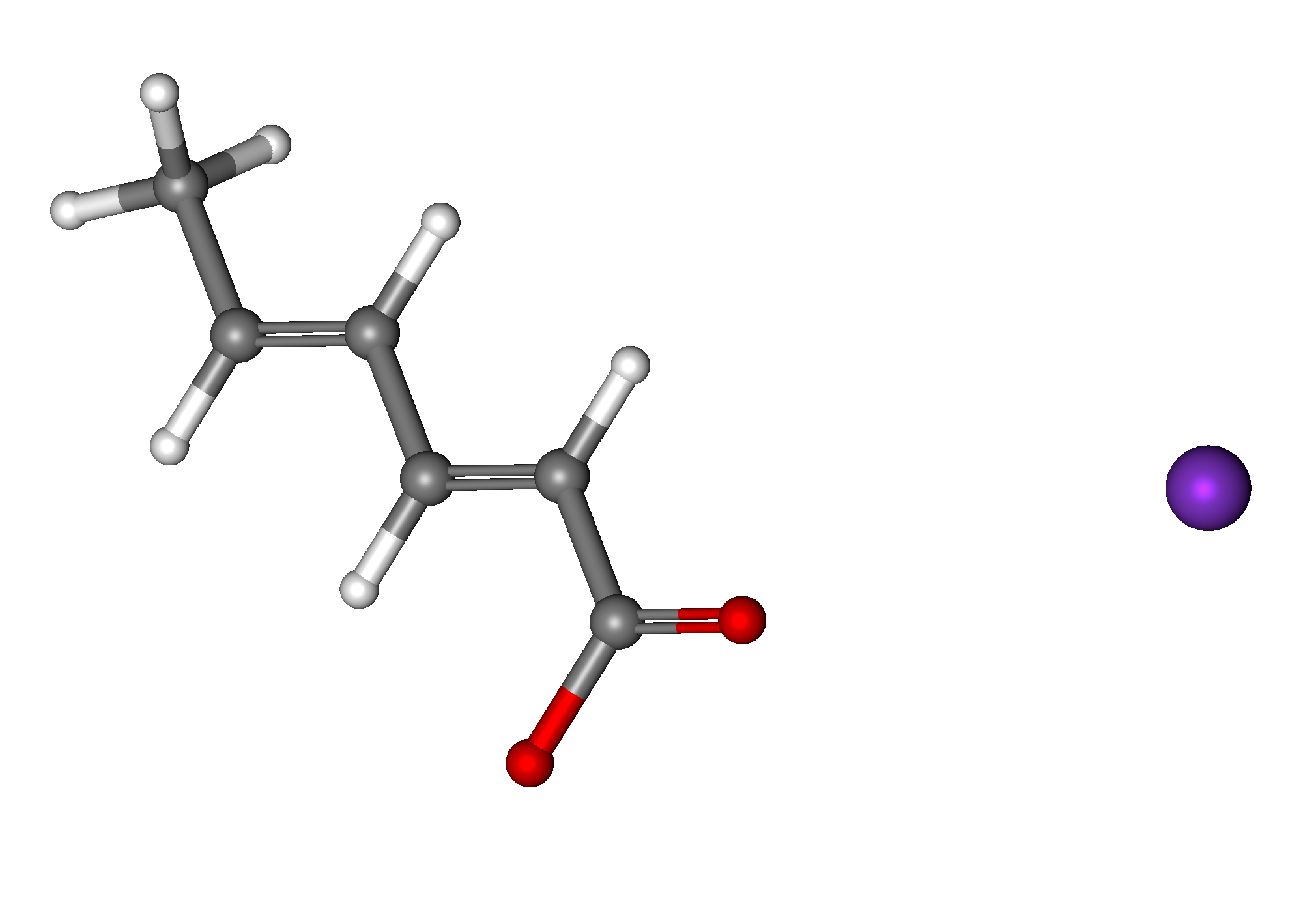
Potassium sorbate is the potassium salt of sorbic acid, structural formula CH3CH=CH−CH=CH−CO2K. It is a white salt that is very soluble in water (58.2% at 20 °C). It is primarily used as a food preservative (E number 202). Potassium sorbate is effective in a variety of applications including food, wine, and personal care products. While sorbic acid occurs naturally in rowan and hippophae berries, virtually all of the world's supply of sorbic acid, from which potassium sorbate is derived, is manufactured synthetically.
Potassium sorbate is produced industrially by neutralizing sorbic acid with potassium hydroxide. The precursor sorbic acid is produced in a two-step process via the condensation of crotonaldehyde and ketene.
Potassium sorbate is used to inhibit molds and yeasts in many foods, such as cheese, wine, yogurt, dried meats, apple cider, dried fruits, soft drinks and fruit drinks, and baked goods. It can also be found in the ingredients list of many dried fruit products. In addition, herbal dietary supplement products generally contain potassium sorbate, which acts to prevent mold and microbes and to increase shelf life. It is used in quantities at which no adverse health effects are known, over short periods of time. Labeling of this preservative on ingredient statements reads as "potassium sorbate" or "E202".
Also, it is used in many personal care products to inhibit the development of microorganisms to increase shelf stability. Some manufacturers use this preservative as a replacement for parabens.
Also known as "wine stabilizer", potassium sorbate produces sorbic acid when added to wine. It serves two purposes:
Some molds (notably some Trichoderma and Penicillium strains) and yeasts are able to detoxify sorbates by decarboxylation, producing piperylene (1,3-pentadiene). The pentadiene manifests as a typical odor of kerosene or petroleum.
In pure form, potassium sorbate is a skin, eye, and respiratory irritant. Concentrations up to 0.5% are not significant skin irritants.
As a food additive, potassium sorbate is used as a preservative in concentrations of 0.025%–0.1%, which in a 100 g serving yields an intake of 25–100 mg. In the United States, no more than 0.1% is allowed in fruit butters, jellies, preserves, and related products. Up to 0.4% has been studied in low-salt, naturally-fermented pickles, and when combined with calcium chloride, 0.2% made "good quality pickles." Potassium sorbate has about 74% of sorbic acid's anti-microbial activity. When calculated as sorbic acid, 0.3% is allowed in "cold pack cheese food." The upper pH limit for effectiveness is 6.5.
Hub AI
Potassium sorbate AI simulator
(@Potassium sorbate_simulator)
Potassium sorbate
Potassium sorbate is the potassium salt of sorbic acid, structural formula CH3CH=CH−CH=CH−CO2K. It is a white salt that is very soluble in water (58.2% at 20 °C). It is primarily used as a food preservative (E number 202). Potassium sorbate is effective in a variety of applications including food, wine, and personal care products. While sorbic acid occurs naturally in rowan and hippophae berries, virtually all of the world's supply of sorbic acid, from which potassium sorbate is derived, is manufactured synthetically.
Potassium sorbate is produced industrially by neutralizing sorbic acid with potassium hydroxide. The precursor sorbic acid is produced in a two-step process via the condensation of crotonaldehyde and ketene.
Potassium sorbate is used to inhibit molds and yeasts in many foods, such as cheese, wine, yogurt, dried meats, apple cider, dried fruits, soft drinks and fruit drinks, and baked goods. It can also be found in the ingredients list of many dried fruit products. In addition, herbal dietary supplement products generally contain potassium sorbate, which acts to prevent mold and microbes and to increase shelf life. It is used in quantities at which no adverse health effects are known, over short periods of time. Labeling of this preservative on ingredient statements reads as "potassium sorbate" or "E202".
Also, it is used in many personal care products to inhibit the development of microorganisms to increase shelf stability. Some manufacturers use this preservative as a replacement for parabens.
Also known as "wine stabilizer", potassium sorbate produces sorbic acid when added to wine. It serves two purposes:
Some molds (notably some Trichoderma and Penicillium strains) and yeasts are able to detoxify sorbates by decarboxylation, producing piperylene (1,3-pentadiene). The pentadiene manifests as a typical odor of kerosene or petroleum.
In pure form, potassium sorbate is a skin, eye, and respiratory irritant. Concentrations up to 0.5% are not significant skin irritants.
As a food additive, potassium sorbate is used as a preservative in concentrations of 0.025%–0.1%, which in a 100 g serving yields an intake of 25–100 mg. In the United States, no more than 0.1% is allowed in fruit butters, jellies, preserves, and related products. Up to 0.4% has been studied in low-salt, naturally-fermented pickles, and when combined with calcium chloride, 0.2% made "good quality pickles." Potassium sorbate has about 74% of sorbic acid's anti-microbial activity. When calculated as sorbic acid, 0.3% is allowed in "cold pack cheese food." The upper pH limit for effectiveness is 6.5.
Recent media