



Community hub
Recent from talks
Knowledge base stats:
Talk channels stats:
Members stats:
Potentially hazardous object
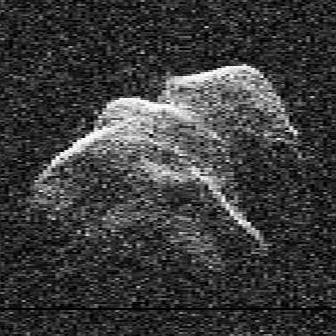
A potentially hazardous object (PHO) is a near-Earth object – either an asteroid or a comet – with an orbit that can make close approaches to the Earth and which is large enough to cause significant regional damage in the event of impact. They are conventionally defined as having a minimum orbit intersection distance with Earth of less than 0.05 astronomical units (19.5 lunar distances) and an absolute magnitude of 22 or brighter, the latter of which roughly corresponds to a size larger than 140 meters. More than 99% of the known potentially hazardous objects are no impact threat over the next 100 years. As of February 2025[update], just 21 of the known potentially hazardous objects listed on the Sentry Risk Table could not be excluded as potential threats over the next hundred years. Over hundreds if not thousands of years though, the orbits of some "potentially hazardous" asteroids can evolve to live up to their namesake.
Most of these objects are potentially hazardous asteroids (PHAs), and a few are comets. As of November 2022[update] there are 2,304 known PHAs (about 8% of the total near-Earth population), of which 153 are estimated to be larger than one kilometer in diameter (see list of largest PHAs below). Most of the discovered PHAs are Apollo asteroids (1,965) and fewer belong to the group of Aten asteroids (185).
A potentially hazardous object can be known not to be a threat to Earth for the next 100 years or more, if its orbit is reasonably well determined. Potentially hazardous asteroids with some threat of impacting Earth in the next 100 years are listed on the Sentry Risk Table. As of September 2022[update], only 17 potentially hazardous asteroids are listed on the Sentry Risk Table. Most potentially hazardous asteroids are ruled out as hazardous to at least several hundreds of years when their competing best orbit models are sufficiently constrained, but recent discoveries whose orbital constraints are little-known have divergent or incomplete mechanical models until observation yields further data. After several astronomical surveys, the number of known PHAs has increased tenfold since the end of the 1990s (see bar charts below). The Minor Planet Center's website List of the Potentially Hazardous Asteroids also publishes detailed information for these objects.
In May 2021, NASA astronomers reported that 5 to 10 years of preparation may be needed to avoid a potential impactor, as most recently based on a simulated exercise conducted by the 2021 Planetary Defense Conference.
An object is considered a PHO if its minimum orbit intersection distance (MOID) with respect to Earth is less than 0.05 AU (7,500,000 km; 4,600,000 mi) – approximately 19.5 lunar distances – and its absolute magnitude is brighter than 22, approximately corresponding to a diameter above 140 meters (460 ft). This is big enough to cause regional devastation to human settlements unprecedented in human history in the case of a land impact, or a major tsunami in the case of an ocean impact. Such impact events occur on average around once per 10,000 years. NEOWISE data estimates that there are 4,700 ± 1,500 potentially hazardous asteroids with a diameter greater than 100 meters.
The two main scales used to categorize the impact hazards of asteroids are the Palermo scale and the Torino scale.
A potentially hazardous comet (PHC) is a short-period comet which currently has an Earth-MOID less than 0.05 AU. Known PHCs include: 109P/Swift-Tuttle, 55P/Tempel–Tuttle, 15P/Finlay, 289P/Blanpain, 255P/Levy, 206P/Barnard–Boattini, 21P/Giacobini–Zinner, and 73P/Schwassmann–Wachmann. Halley's Comet fit the criteria before AD 837, when it passed the earth at a distance of 0.033 AU. It now has an MOID of 0.075 AU.
In 2012 NASA estimated 20 to 30 percent of these objects have been found. During an asteroid's close approaches to another planet it will be subject to gravitational perturbation, modifying its orbit, and potentially changing a previously non-threatening asteroid into a PHA or vice versa. This is a reflection of the dynamic character of the Solar System.
Hub AI
Potentially hazardous object AI simulator
(@Potentially hazardous object_simulator)
Potentially hazardous object
A potentially hazardous object (PHO) is a near-Earth object – either an asteroid or a comet – with an orbit that can make close approaches to the Earth and which is large enough to cause significant regional damage in the event of impact. They are conventionally defined as having a minimum orbit intersection distance with Earth of less than 0.05 astronomical units (19.5 lunar distances) and an absolute magnitude of 22 or brighter, the latter of which roughly corresponds to a size larger than 140 meters. More than 99% of the known potentially hazardous objects are no impact threat over the next 100 years. As of February 2025[update], just 21 of the known potentially hazardous objects listed on the Sentry Risk Table could not be excluded as potential threats over the next hundred years. Over hundreds if not thousands of years though, the orbits of some "potentially hazardous" asteroids can evolve to live up to their namesake.
Most of these objects are potentially hazardous asteroids (PHAs), and a few are comets. As of November 2022[update] there are 2,304 known PHAs (about 8% of the total near-Earth population), of which 153 are estimated to be larger than one kilometer in diameter (see list of largest PHAs below). Most of the discovered PHAs are Apollo asteroids (1,965) and fewer belong to the group of Aten asteroids (185).
A potentially hazardous object can be known not to be a threat to Earth for the next 100 years or more, if its orbit is reasonably well determined. Potentially hazardous asteroids with some threat of impacting Earth in the next 100 years are listed on the Sentry Risk Table. As of September 2022[update], only 17 potentially hazardous asteroids are listed on the Sentry Risk Table. Most potentially hazardous asteroids are ruled out as hazardous to at least several hundreds of years when their competing best orbit models are sufficiently constrained, but recent discoveries whose orbital constraints are little-known have divergent or incomplete mechanical models until observation yields further data. After several astronomical surveys, the number of known PHAs has increased tenfold since the end of the 1990s (see bar charts below). The Minor Planet Center's website List of the Potentially Hazardous Asteroids also publishes detailed information for these objects.
In May 2021, NASA astronomers reported that 5 to 10 years of preparation may be needed to avoid a potential impactor, as most recently based on a simulated exercise conducted by the 2021 Planetary Defense Conference.
An object is considered a PHO if its minimum orbit intersection distance (MOID) with respect to Earth is less than 0.05 AU (7,500,000 km; 4,600,000 mi) – approximately 19.5 lunar distances – and its absolute magnitude is brighter than 22, approximately corresponding to a diameter above 140 meters (460 ft). This is big enough to cause regional devastation to human settlements unprecedented in human history in the case of a land impact, or a major tsunami in the case of an ocean impact. Such impact events occur on average around once per 10,000 years. NEOWISE data estimates that there are 4,700 ± 1,500 potentially hazardous asteroids with a diameter greater than 100 meters.
The two main scales used to categorize the impact hazards of asteroids are the Palermo scale and the Torino scale.
A potentially hazardous comet (PHC) is a short-period comet which currently has an Earth-MOID less than 0.05 AU. Known PHCs include: 109P/Swift-Tuttle, 55P/Tempel–Tuttle, 15P/Finlay, 289P/Blanpain, 255P/Levy, 206P/Barnard–Boattini, 21P/Giacobini–Zinner, and 73P/Schwassmann–Wachmann. Halley's Comet fit the criteria before AD 837, when it passed the earth at a distance of 0.033 AU. It now has an MOID of 0.075 AU.
In 2012 NASA estimated 20 to 30 percent of these objects have been found. During an asteroid's close approaches to another planet it will be subject to gravitational perturbation, modifying its orbit, and potentially changing a previously non-threatening asteroid into a PHA or vice versa. This is a reflection of the dynamic character of the Solar System.