
Recent from talks
Halley's Comet
Knowledge base stats:
Talk channels stats:
Members stats:
Halley's Comet
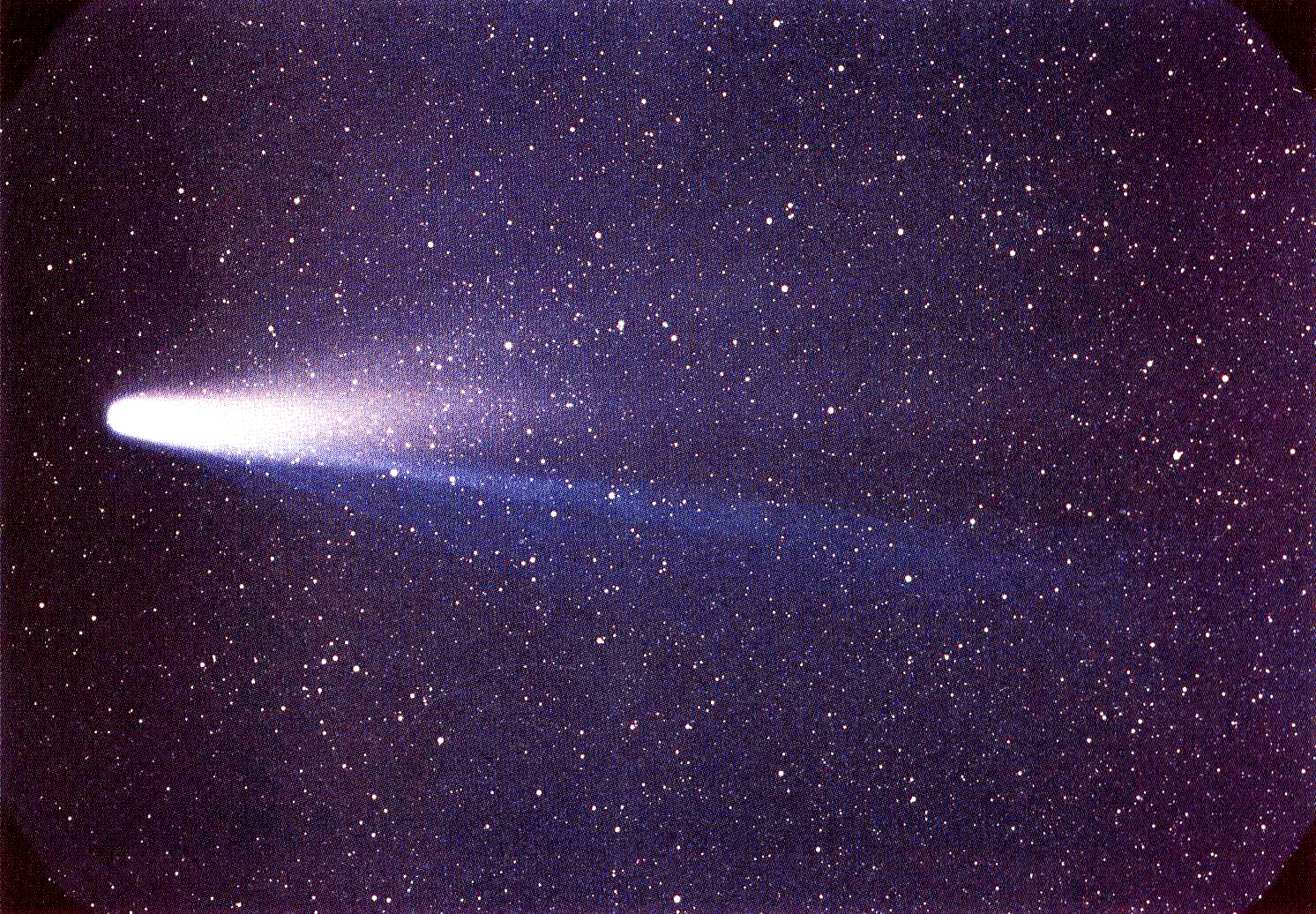
Halley's Comet is the only known short-period comet that is consistently visible to the naked eye from Earth, appearing every 72–80 years, though with the majority of recorded apparitions (25 of 30) occurring after 75–77 years. It last appeared in the inner parts of the Solar System in 1986 and will next appear in mid-2061. Officially designated 1P/Halley, it is also commonly called Comet Halley, or sometimes simply Halley.
Halley's periodic returns to the inner Solar System have been observed and recorded by astronomers around the world since at least 240 BC, but it was not until 1705 that the English astronomer Edmond Halley understood that these appearances were re-appearances of the same comet. As a result of this discovery, the comet is named after Halley.
In March 1986, during its latest visit to the inner Solar System, Halley's Comet became the first comet to be observed in detail by a spacecraft, ESA's Giotto mission, providing the first observational data on the structure of a comet nucleus and the mechanism of coma and tail formation. These observations supported several longstanding hypotheses about comet construction, particularly Fred Whipple's "dirty snowball" model, which correctly predicted that Halley would be composed of a mixture of volatile ices—such as water, carbon dioxide, ammonia—and dust. The missions also provided data that substantially reformed and reconfigured these ideas; for instance, it is now understood that the surface of Halley is largely composed of dusty, non-volatile materials, and that only a small portion of it is icy. It was also visited by the two spacecrafts of the Vega program, Vega 1 & 2, on March 6 and March 9, respectively. They went as close as 8,890 km (5,520 mi), and 8,030 km (4,990 mi), providing data on Halley's dimensions, shape, temperature, and surface properties.
Comet Halley is usually pronounced /ˈhæli/, rhyming with valley, or sometimes /ˈheɪli/, rhyming with daily. As to the surname Halley, Colin Ronan, one of Edmond Halley's biographers, preferred /ˈhɔːli/, rhyming with crawly. Spellings of Halley's name during his lifetime included Hailey, Haley, Hayley, Halley, Haly, Hawley, and Hawly, so its contemporary pronunciation is uncertain, but the version rhyming with valley seems to be preferred by modern bearers of the surname.
Halley was the first comet to be recognised as periodic. Until the Renaissance, the philosophical consensus on the nature of comets, promoted by Aristotle, was that they were disturbances in Earth's atmosphere. This idea was disproven in 1577 by Tycho Brahe, who used parallax measurements to show that comets must lie beyond the Moon. Many were still unconvinced that comets orbited the Sun, and assumed instead that they must follow straight paths through the Solar System. In 1687, Sir Isaac Newton published his Philosophiæ Naturalis Principia Mathematica, in which he outlined his laws of gravity and motion. His work on comets was decidedly incomplete. Although he had suspected that two comets that had appeared in succession in 1680 and 1681 were the same comet before and after passing behind the Sun (he was later found to be correct; see Newton's Comet), he was initially unable to completely reconcile comets into his model.
Ultimately, it was Newton's friend, editor and publisher, Edmond Halley, who, in his 1705 Synopsis of the Astronomy of Comets, used Newton's new laws to calculate the gravitational effects of Jupiter and Saturn on cometary orbits. Having compiled a list of 24 comet observations, he calculated that the orbital elements of a second comet that had appeared in 1682 were nearly the same as those of two comets that had appeared in 1531 (observed by Petrus Apianus) and 1607 (observed by Johannes Kepler). Halley thus concluded that all three comets were the same object returning about every 76 years, a period that has since been found to vary between 72 and 80 years. After a rough estimate of the perturbations the comet would sustain from the gravitational attraction of the planets, he predicted its return for 1758. He personally observed the comet around perihelion in September 1682, but died in 1742 before he could observe its predicted return.
Halley's prediction of the comet's return proved to be correct, although it was not seen until 25 December 1758, by Johann Georg Palitzsch, a German farmer and amateur astronomer. Other observers from throughout Europe and its colonies sent confirmations to Paris after the comet brightened early the following year. In the Americas, John Winthrop lectured at Harvard University to explain the implications of the comet's reappearance for Newtonian mechanics and natural theology.
Another independent recognition that the comet had returned was made by the Jamaican astronomer Francis Williams, but his observations did not reach Europe. A unique portrait commissioned by Williams demonstrates the impact of the comet's return on period astronomers. Williams' hand rests on page 521 of the third edition of Newton's Principia with procedures to predict comet sightings. The white smudge in the sky is probably a depiction of Halley's comet relative to the constellations in March 1759, and the chord hanging above the book likely represents the comet's orbit. In 2024, using X-ray imaging, the painting was shown to depict the field of stars in which the comet would have been visible in 1759. Williams likely commissioned the portrait to commemorate his observations.
Hub AI
Halley's Comet AI simulator
(@Halley's Comet_simulator)
Halley's Comet
Halley's Comet is the only known short-period comet that is consistently visible to the naked eye from Earth, appearing every 72–80 years, though with the majority of recorded apparitions (25 of 30) occurring after 75–77 years. It last appeared in the inner parts of the Solar System in 1986 and will next appear in mid-2061. Officially designated 1P/Halley, it is also commonly called Comet Halley, or sometimes simply Halley.
Halley's periodic returns to the inner Solar System have been observed and recorded by astronomers around the world since at least 240 BC, but it was not until 1705 that the English astronomer Edmond Halley understood that these appearances were re-appearances of the same comet. As a result of this discovery, the comet is named after Halley.
In March 1986, during its latest visit to the inner Solar System, Halley's Comet became the first comet to be observed in detail by a spacecraft, ESA's Giotto mission, providing the first observational data on the structure of a comet nucleus and the mechanism of coma and tail formation. These observations supported several longstanding hypotheses about comet construction, particularly Fred Whipple's "dirty snowball" model, which correctly predicted that Halley would be composed of a mixture of volatile ices—such as water, carbon dioxide, ammonia—and dust. The missions also provided data that substantially reformed and reconfigured these ideas; for instance, it is now understood that the surface of Halley is largely composed of dusty, non-volatile materials, and that only a small portion of it is icy. It was also visited by the two spacecrafts of the Vega program, Vega 1 & 2, on March 6 and March 9, respectively. They went as close as 8,890 km (5,520 mi), and 8,030 km (4,990 mi), providing data on Halley's dimensions, shape, temperature, and surface properties.
Comet Halley is usually pronounced /ˈhæli/, rhyming with valley, or sometimes /ˈheɪli/, rhyming with daily. As to the surname Halley, Colin Ronan, one of Edmond Halley's biographers, preferred /ˈhɔːli/, rhyming with crawly. Spellings of Halley's name during his lifetime included Hailey, Haley, Hayley, Halley, Haly, Hawley, and Hawly, so its contemporary pronunciation is uncertain, but the version rhyming with valley seems to be preferred by modern bearers of the surname.
Halley was the first comet to be recognised as periodic. Until the Renaissance, the philosophical consensus on the nature of comets, promoted by Aristotle, was that they were disturbances in Earth's atmosphere. This idea was disproven in 1577 by Tycho Brahe, who used parallax measurements to show that comets must lie beyond the Moon. Many were still unconvinced that comets orbited the Sun, and assumed instead that they must follow straight paths through the Solar System. In 1687, Sir Isaac Newton published his Philosophiæ Naturalis Principia Mathematica, in which he outlined his laws of gravity and motion. His work on comets was decidedly incomplete. Although he had suspected that two comets that had appeared in succession in 1680 and 1681 were the same comet before and after passing behind the Sun (he was later found to be correct; see Newton's Comet), he was initially unable to completely reconcile comets into his model.
Ultimately, it was Newton's friend, editor and publisher, Edmond Halley, who, in his 1705 Synopsis of the Astronomy of Comets, used Newton's new laws to calculate the gravitational effects of Jupiter and Saturn on cometary orbits. Having compiled a list of 24 comet observations, he calculated that the orbital elements of a second comet that had appeared in 1682 were nearly the same as those of two comets that had appeared in 1531 (observed by Petrus Apianus) and 1607 (observed by Johannes Kepler). Halley thus concluded that all three comets were the same object returning about every 76 years, a period that has since been found to vary between 72 and 80 years. After a rough estimate of the perturbations the comet would sustain from the gravitational attraction of the planets, he predicted its return for 1758. He personally observed the comet around perihelion in September 1682, but died in 1742 before he could observe its predicted return.
Halley's prediction of the comet's return proved to be correct, although it was not seen until 25 December 1758, by Johann Georg Palitzsch, a German farmer and amateur astronomer. Other observers from throughout Europe and its colonies sent confirmations to Paris after the comet brightened early the following year. In the Americas, John Winthrop lectured at Harvard University to explain the implications of the comet's reappearance for Newtonian mechanics and natural theology.
Another independent recognition that the comet had returned was made by the Jamaican astronomer Francis Williams, but his observations did not reach Europe. A unique portrait commissioned by Williams demonstrates the impact of the comet's return on period astronomers. Williams' hand rests on page 521 of the third edition of Newton's Principia with procedures to predict comet sightings. The white smudge in the sky is probably a depiction of Halley's comet relative to the constellations in March 1759, and the chord hanging above the book likely represents the comet's orbit. In 2024, using X-ray imaging, the painting was shown to depict the field of stars in which the comet would have been visible in 1759. Williams likely commissioned the portrait to commemorate his observations.
Recent media