
Recent from talks
Power module
Knowledge base stats:
Talk channels stats:
Members stats:
Power module
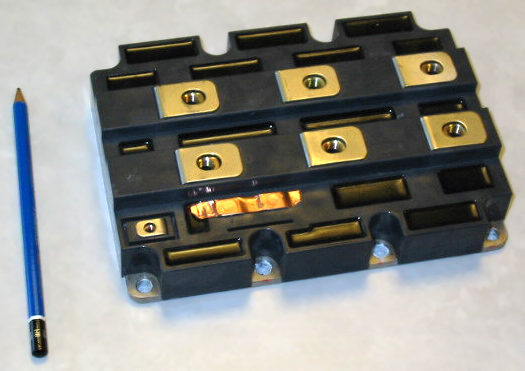
A power module or power electronic module provides the physical containment for several power components, usually power semiconductor devices. These power semiconductors (so-called dies) are typically soldered or sintered on a power electronic substrate that carries the power semiconductors, provides electrical and thermal contact and electrical insulation where needed. Compared to discrete power semiconductors in plastic housings as TO-247 or TO-220, power packages provide a higher power density and are in many cases more reliable.
Power modules trace their roots to the mid-20th century, when power switching was handled by discrete bipolar junction transistors (BJTs) and, later, a Darlington pair mounted in screw-terminal packages. These early assemblies offered high current gain but suffered from bulky form factors, limited thermal performance, and complex wiring.
In 1974, Semikron introduced the SemiPack 1, the first commercially available “potential-free” hybrid power module. It was available in a variety of connection layouts using both diodes and thyristors. “Potential-free” meant that the module’s metal baseplate is electrically isolated from its semiconductor circuitry, allowing direct mounting to a heatsink without additional insulation.
During the 1980s, module packaging evolved with the adoption of direct-bonded copper (DBC) substrates and insulated metal substrates (IMS), boosting thermal cycling resilience. Additionally, as the technology advanced over time, the gate‐drive requirements grew more sophisticated.
The early 1990s saw the commercial rise of IGBT (Insulated Gate Bipolar Transistor) modules. By combining MOSFET‐like gate control with BJT current capacity, IGBTs rapidly displaced Darlington‐based designs in 600–1,200 V classes. Half-bridge modules, complete with built-in antiparallel freewheeling diodes (FWD), became ubiquitous in power modules.
Through the 2000s, power modules integrated on‐board temperature sensors - both substrate-mounted NTC thermistors as well as on-chip temperature sense diodes, gate‐driver ICs, and fault‐protection circuits, giving birth to the first “smart” power modules. Substrate materials and molding compounds continued to improve, extending lifetimes under harsh power cycling.
More recently, wide-bandgap devices, such as SiC MOSFETs, have entered power‐module form factors, offering higher switching frequencies, lower losses, and smaller footprints. Hybrid modules pairing SiC Schottky barrier diodes with silicon IGBTs, and full SiC modules, demonstrate the continual drive to push performance while leveraging existing package platforms.
Besides modules that contain a single power electronic switch (as MOSFET, IGBT, BJT, Thyristor, GTO or JFET) or diode, classical power modules contain multiple semiconductor dies that are connected to form an electrical circuit of a certain structure, called topology. Modules also contain other components such as ceramic capacitors to minimize switching voltage overshoots and NTC thermistors to monitor the module's substrate temperature. Examples of broadly available topologies implemented in modules are:
Hub AI
Power module AI simulator
(@Power module_simulator)
Power module
A power module or power electronic module provides the physical containment for several power components, usually power semiconductor devices. These power semiconductors (so-called dies) are typically soldered or sintered on a power electronic substrate that carries the power semiconductors, provides electrical and thermal contact and electrical insulation where needed. Compared to discrete power semiconductors in plastic housings as TO-247 or TO-220, power packages provide a higher power density and are in many cases more reliable.
Power modules trace their roots to the mid-20th century, when power switching was handled by discrete bipolar junction transistors (BJTs) and, later, a Darlington pair mounted in screw-terminal packages. These early assemblies offered high current gain but suffered from bulky form factors, limited thermal performance, and complex wiring.
In 1974, Semikron introduced the SemiPack 1, the first commercially available “potential-free” hybrid power module. It was available in a variety of connection layouts using both diodes and thyristors. “Potential-free” meant that the module’s metal baseplate is electrically isolated from its semiconductor circuitry, allowing direct mounting to a heatsink without additional insulation.
During the 1980s, module packaging evolved with the adoption of direct-bonded copper (DBC) substrates and insulated metal substrates (IMS), boosting thermal cycling resilience. Additionally, as the technology advanced over time, the gate‐drive requirements grew more sophisticated.
The early 1990s saw the commercial rise of IGBT (Insulated Gate Bipolar Transistor) modules. By combining MOSFET‐like gate control with BJT current capacity, IGBTs rapidly displaced Darlington‐based designs in 600–1,200 V classes. Half-bridge modules, complete with built-in antiparallel freewheeling diodes (FWD), became ubiquitous in power modules.
Through the 2000s, power modules integrated on‐board temperature sensors - both substrate-mounted NTC thermistors as well as on-chip temperature sense diodes, gate‐driver ICs, and fault‐protection circuits, giving birth to the first “smart” power modules. Substrate materials and molding compounds continued to improve, extending lifetimes under harsh power cycling.
More recently, wide-bandgap devices, such as SiC MOSFETs, have entered power‐module form factors, offering higher switching frequencies, lower losses, and smaller footprints. Hybrid modules pairing SiC Schottky barrier diodes with silicon IGBTs, and full SiC modules, demonstrate the continual drive to push performance while leveraging existing package platforms.
Besides modules that contain a single power electronic switch (as MOSFET, IGBT, BJT, Thyristor, GTO or JFET) or diode, classical power modules contain multiple semiconductor dies that are connected to form an electrical circuit of a certain structure, called topology. Modules also contain other components such as ceramic capacitors to minimize switching voltage overshoots and NTC thermistors to monitor the module's substrate temperature. Examples of broadly available topologies implemented in modules are:
Recent media