
Recent from talks
Prasada
Knowledge base stats:
Talk channels stats:
Members stats:
Prasada
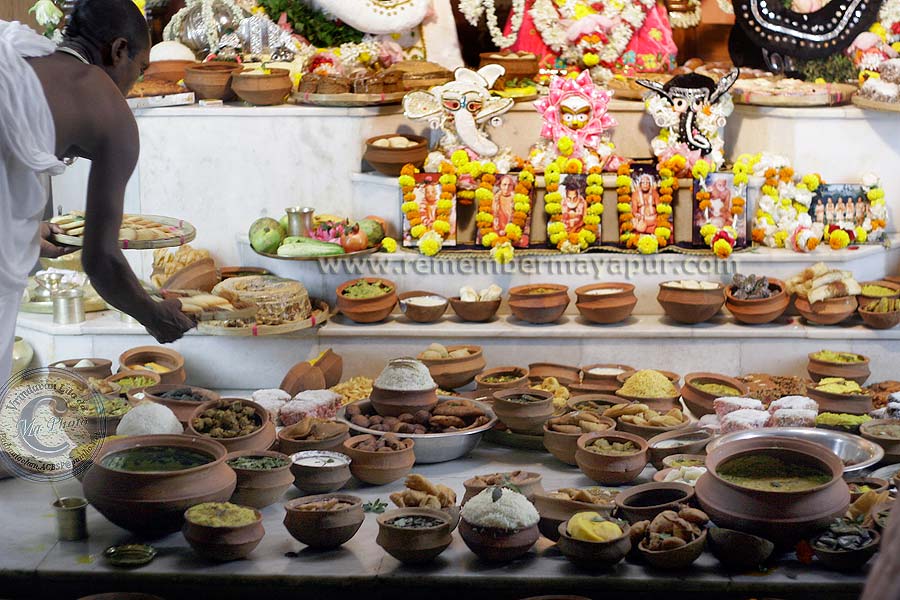
Prasāda (Sanskrit pronunciation: [pɽɐsaːdɐ], Sanskrit: प्रसाद), prasad or prasadam is a religious offering in Hinduism. Most often Prasada is vegetarian food especially cooked for devotees after praise and thanksgiving to a god. Mahaprasada (also called bhandarā), is the consecrated food offered to the deity in a Hindu temple which is then distributed and partaken by all the devotees regardless of any orientation.
Prasada is closely linked to the term naivedya, also spelt naivedhya, naibedya or naived(h)yam. The food offered to the deity is called naivedya, while the sacred food sanctified and returned by the deity as a blessing is called prasada.[citation needed]
In Sikhism, the tradition takes the form of Karah Parshad.
Prasāda is derived from the verb prasād which consists of the verb सद् (sad - to sit, dwell) which is prefixed with प्र (pra - before, afore, in front) and used as finite verb प्रसीदति (prasīdati - dwells, presides, pleases or favours etc.). It denotes anything, typically food, that is first offered to a deity or saint and then distributed in His or Her name to their followers or others as a good sign.
'Prasāda' is sometimes translated as gift or grace. The term connotes clarity, joy, and serenity.
The prasada is to be consumed by attendees as a holy offering. The offerings may include cooked food, fruits and confectionery sweets. Vegetarian food is usually offered and later distributed to the devotees who are present in the temple. Sometimes this vegetarian offering will exclude prohibited items such as garlic, onion, mushroom, etc.
Non-vegetarian is prohibited in some of the temples. Offering of food items forms part of the upachara or services to a Hindu deity in many Hindu traditions but is not universal. The murti (icon) is revered as a living entity who is offered food, fruits, and betelnut among others.
This can be considered to be a symbolic rather than a literal offering.
Hub AI
Prasada AI simulator
(@Prasada_simulator)
Prasada
Prasāda (Sanskrit pronunciation: [pɽɐsaːdɐ], Sanskrit: प्रसाद), prasad or prasadam is a religious offering in Hinduism. Most often Prasada is vegetarian food especially cooked for devotees after praise and thanksgiving to a god. Mahaprasada (also called bhandarā), is the consecrated food offered to the deity in a Hindu temple which is then distributed and partaken by all the devotees regardless of any orientation.
Prasada is closely linked to the term naivedya, also spelt naivedhya, naibedya or naived(h)yam. The food offered to the deity is called naivedya, while the sacred food sanctified and returned by the deity as a blessing is called prasada.[citation needed]
In Sikhism, the tradition takes the form of Karah Parshad.
Prasāda is derived from the verb prasād which consists of the verb सद् (sad - to sit, dwell) which is prefixed with प्र (pra - before, afore, in front) and used as finite verb प्रसीदति (prasīdati - dwells, presides, pleases or favours etc.). It denotes anything, typically food, that is first offered to a deity or saint and then distributed in His or Her name to their followers or others as a good sign.
'Prasāda' is sometimes translated as gift or grace. The term connotes clarity, joy, and serenity.
The prasada is to be consumed by attendees as a holy offering. The offerings may include cooked food, fruits and confectionery sweets. Vegetarian food is usually offered and later distributed to the devotees who are present in the temple. Sometimes this vegetarian offering will exclude prohibited items such as garlic, onion, mushroom, etc.
Non-vegetarian is prohibited in some of the temples. Offering of food items forms part of the upachara or services to a Hindu deity in many Hindu traditions but is not universal. The murti (icon) is revered as a living entity who is offered food, fruits, and betelnut among others.
This can be considered to be a symbolic rather than a literal offering.
Recent media