
Recent from talks
Praseodymium
Knowledge base stats:
Talk channels stats:
Members stats:
Praseodymium
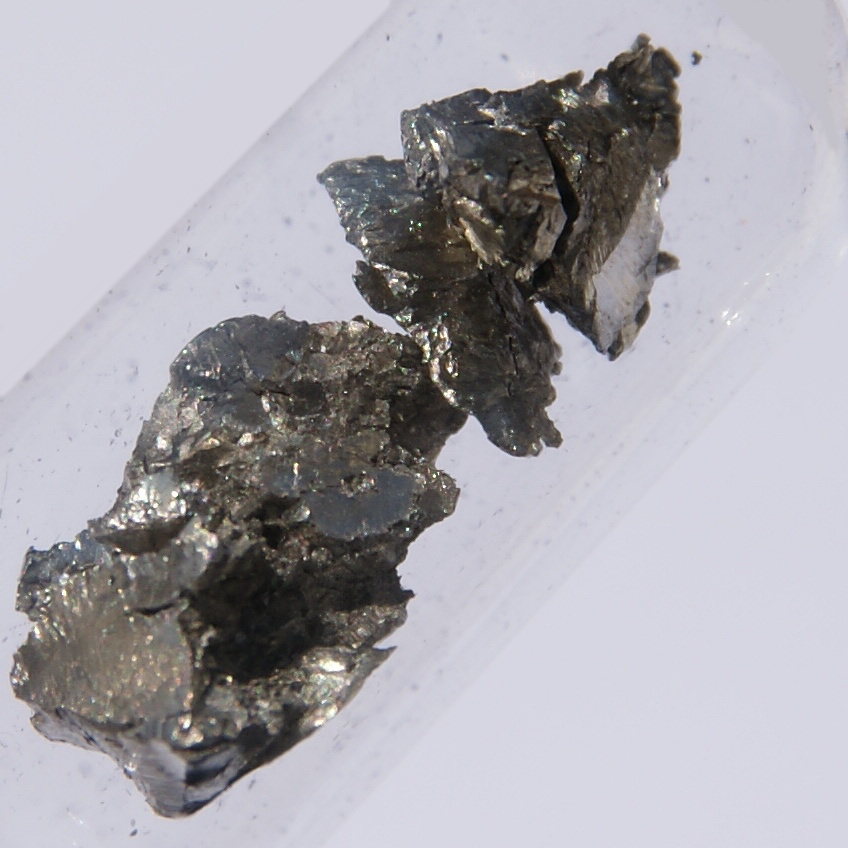
Praseodymium is a chemical element; it has symbol Pr and atomic number 59. It is the third member of the lanthanide series and is considered one of the rare-earth metals. It is a soft, silvery, malleable and ductile metal, valued for its magnetic, electrical, chemical, and optical properties. It is too reactive to be found in native form, and pure praseodymium metal slowly develops a green oxide coating when exposed to air.
Praseodymium always occurs naturally together with the other rare-earth metals. It is the sixth-most abundant rare-earth element and fourth-most abundant lanthanide, making up 9.1 parts per million of the Earth's crust, an abundance similar to that of boron. In 1841, Swedish chemist Carl Gustav Mosander extracted a rare-earth oxide residue he called didymium from a residue he called "lanthana", in turn separated from cerium salts. In 1885, the Austrian chemist Carl Auer von Welsbach separated didymium into two elements that gave salts of different colours, which he named praseodymium and neodymium. The name praseodymium comes from the Ancient Greek πράσινος (prasinos), meaning 'leek-green', and δίδυμος (didymos) 'twin'.
Like most rare-earth elements, praseodymium most readily forms the +3 oxidation state, which is the only stable state in aqueous solution, although the +4 oxidation state is known in some solid compounds and, uniquely among the lanthanides, the +5 oxidation state is attainable at low temperatures. The 0, +1, and +2 oxidation states are rarely found. Aqueous praseodymium ions are yellowish-green, and similarly, praseodymium results in various shades of yellow-green when incorporated into glasses. Many of praseodymium's industrial uses involve its ability to filter yellow light from light sources.
Praseodymium is the third member of the lanthanide series, and a member of the rare-earth metals. In the periodic table, it appears between the lanthanides cerium to its left and neodymium to its right, and above the actinide protactinium. It is a ductile metal with a hardness comparable to that of silver. Praseodymium is calculated to have a very large atomic radius; with a radius of 247 pm, barium, rubidium and caesium are larger. However, observationally, it is usually 185 pm.
Neutral praseodymium's 59 electrons are arranged in the configuration [Xe]4f36s2. Like most other lanthanides, praseodymium usually uses only three electrons as valence electrons, as the remaining 4f electrons are too strongly bound to engage in bonding: this is because the 4f orbitals penetrate the most through the inert xenon core of electrons to the nucleus, followed by 5d and 6s, and this penetration increases with higher ionic charge. Even so, praseodymium can in some compounds lose a fourth valence electron because it is early in the lanthanide series, where the nuclear charge is still low enough and the 4f subshell energy high enough to allow the removal of further valence electrons.
Similarly to the other early lanthanides, praseodymium has a double hexagonal close-packed crystal structure at room temperature, called the alpha phase (α-Pr). At 795 °C (1,068 K) it transforms to a different allotrope that has a body-centered cubic structure (β-Pr), and it melts at 931 °C (1,204 K).
Praseodymium, like all of the lanthanides, is paramagnetic at room temperature. Unlike some other rare-earth metals, which show antiferromagnetic or ferromagnetic ordering at low temperatures, praseodymium is paramagnetic at all temperatures above 1 K.[dead link]
Praseodymium metal tarnishes slowly in air, forming a spalling green oxide layer like iron rust; a centimetre-sized sample of praseodymium metal corrodes completely in about a year. It burns readily at 150 °C to form praseodymium(III,IV) oxide, a nonstoichiometric compound approximating to Pr6O11:
Hub AI
Praseodymium AI simulator
(@Praseodymium_simulator)
Praseodymium
Praseodymium is a chemical element; it has symbol Pr and atomic number 59. It is the third member of the lanthanide series and is considered one of the rare-earth metals. It is a soft, silvery, malleable and ductile metal, valued for its magnetic, electrical, chemical, and optical properties. It is too reactive to be found in native form, and pure praseodymium metal slowly develops a green oxide coating when exposed to air.
Praseodymium always occurs naturally together with the other rare-earth metals. It is the sixth-most abundant rare-earth element and fourth-most abundant lanthanide, making up 9.1 parts per million of the Earth's crust, an abundance similar to that of boron. In 1841, Swedish chemist Carl Gustav Mosander extracted a rare-earth oxide residue he called didymium from a residue he called "lanthana", in turn separated from cerium salts. In 1885, the Austrian chemist Carl Auer von Welsbach separated didymium into two elements that gave salts of different colours, which he named praseodymium and neodymium. The name praseodymium comes from the Ancient Greek πράσινος (prasinos), meaning 'leek-green', and δίδυμος (didymos) 'twin'.
Like most rare-earth elements, praseodymium most readily forms the +3 oxidation state, which is the only stable state in aqueous solution, although the +4 oxidation state is known in some solid compounds and, uniquely among the lanthanides, the +5 oxidation state is attainable at low temperatures. The 0, +1, and +2 oxidation states are rarely found. Aqueous praseodymium ions are yellowish-green, and similarly, praseodymium results in various shades of yellow-green when incorporated into glasses. Many of praseodymium's industrial uses involve its ability to filter yellow light from light sources.
Praseodymium is the third member of the lanthanide series, and a member of the rare-earth metals. In the periodic table, it appears between the lanthanides cerium to its left and neodymium to its right, and above the actinide protactinium. It is a ductile metal with a hardness comparable to that of silver. Praseodymium is calculated to have a very large atomic radius; with a radius of 247 pm, barium, rubidium and caesium are larger. However, observationally, it is usually 185 pm.
Neutral praseodymium's 59 electrons are arranged in the configuration [Xe]4f36s2. Like most other lanthanides, praseodymium usually uses only three electrons as valence electrons, as the remaining 4f electrons are too strongly bound to engage in bonding: this is because the 4f orbitals penetrate the most through the inert xenon core of electrons to the nucleus, followed by 5d and 6s, and this penetration increases with higher ionic charge. Even so, praseodymium can in some compounds lose a fourth valence electron because it is early in the lanthanide series, where the nuclear charge is still low enough and the 4f subshell energy high enough to allow the removal of further valence electrons.
Similarly to the other early lanthanides, praseodymium has a double hexagonal close-packed crystal structure at room temperature, called the alpha phase (α-Pr). At 795 °C (1,068 K) it transforms to a different allotrope that has a body-centered cubic structure (β-Pr), and it melts at 931 °C (1,204 K).
Praseodymium, like all of the lanthanides, is paramagnetic at room temperature. Unlike some other rare-earth metals, which show antiferromagnetic or ferromagnetic ordering at low temperatures, praseodymium is paramagnetic at all temperatures above 1 K.[dead link]
Praseodymium metal tarnishes slowly in air, forming a spalling green oxide layer like iron rust; a centimetre-sized sample of praseodymium metal corrodes completely in about a year. It burns readily at 150 °C to form praseodymium(III,IV) oxide, a nonstoichiometric compound approximating to Pr6O11:
Recent media