



Community hub
Recent from talks
Contribute something
Nothing was collected or created yet.
Pre-exponential factor
View on Wikipedia | This article needs additional citations for verification. (June 2018) |
In chemical kinetics, the pre-exponential factor or A factor is the pre-exponential constant in the Arrhenius equation (equation shown below), an empirical relationship between temperature and rate coefficient. It is usually designated by A when determined from experiment, while Z is usually left for collision frequency. The pre-exponential factor can be thought of as a measure of the frequency of properly oriented collisions. It is typically determined experimentally by measuring the rate constant at a particular temperature and fitting the data to the Arrhenius equation. The pre-exponential factor is generally not exactly constant, but rather depends on the specific reaction being studied and the temperature at which the reaction is occurring.[1]

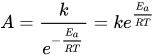
The units of the pre-exponential factor A are identical to those of the rate constant and will vary depending on the order of the reaction. For a first-order reaction, it has units of s−1. For that reason, it is often called frequency factor.
According to collision theory, the frequency factor, A, depends on how often molecules collide when all concentrations are 1 mol/L and on whether the molecules are properly oriented when they collide. Values of A for some reactions can be found at Collision theory.
According to transition state theory, A can be expressed in terms of the entropy of activation of the reaction.
References
[edit]- ^ "How do you calculate the pre-exponential factor from the Arrhenius equation?". Retrieved December 8, 2022.
 | This chemical reaction article is a stub. You can help Wikipedia by expanding it. |