
Recent from talks
Prefabricated building
Knowledge base stats:
Talk channels stats:
Members stats:
Prefabricated building
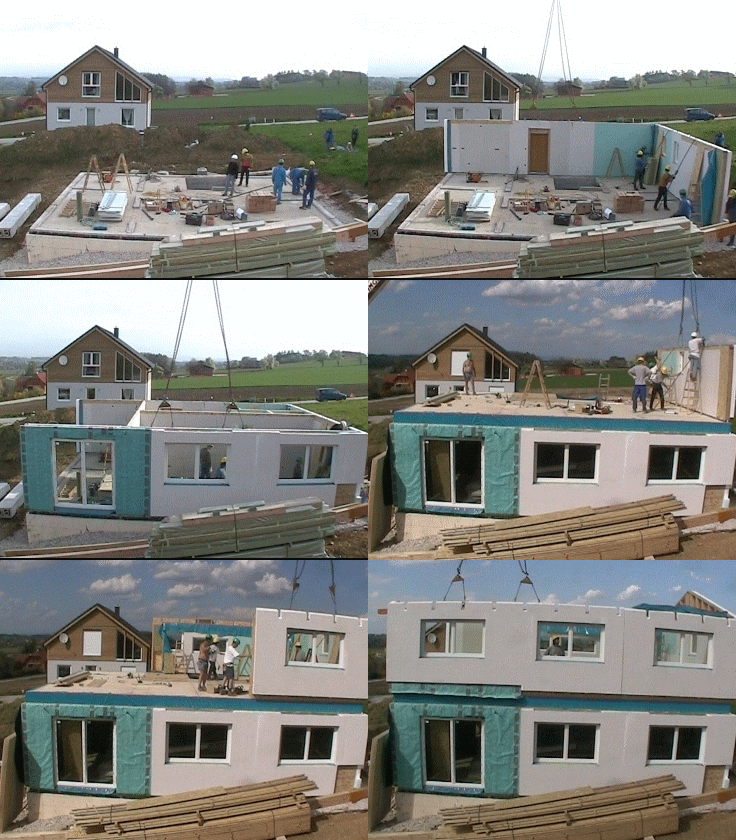
A prefabricated building, informally a prefab, is a building that is manufactured and constructed using prefabrication. It consists of factory-made components or units that are transported and assembled on-site to form the complete building. Various materials were combined to create a part of the installation process.
Buildings have been built in one place and reassembled in another throughout history. This was especially true for mobile activities, or for new settlements. Elmina Castle, the first slave fort in West Africa, was also the first European prefabricated building in Sub-saharan Africa. In North America, in 1624 one of the first buildings at Cape Ann was probably partially prefabricated, and was rapidly disassembled and moved at least once. John Rollo described in 1801 earlier use of portable hospital buildings in the West Indies. Possibly the first advertised prefab house was the "Manning cottage". A London carpenter, Henry Manning, constructed a house that was built in components, then shipped and assembled by British emigrants. This was published at the time (advertisement, South Australian Record, 1837) and a few still stand in Australia. One such is the Friends Meeting House, Adelaide. The peak year for the importation of portable buildings to Australia was 1853, when several hundred arrived. These have been identified as coming from Liverpool, Boston and Singapore (with Chinese instructions for re-assembly). In Barbados the Chattel house was a form of prefabricated building which was developed by emancipated slaves who had limited rights to build upon land they did not own. As the buildings were moveable they were legally regarded as chattels.
In 1855 during the Crimean War, after Florence Nightingale wrote a letter to The Times, Isambard Kingdom Brunel was commissioned to design a prefabricated modular hospital. In five months he designed the Renkioi Hospital: a 1,000 patient hospital, with innovations in sanitation, ventilation and a flushing toilet. Fabricator William Eassie constructed the required 16 units in Gloucester Docks, shipped directly to the Dardanelles. Only used from March 1856 to September 1857, it reduced the death rate from 42% to 3.5%.
The world's first prefabricated, pre-cast panelled apartment blocks were pioneered in Liverpool. A process that was invented by city engineer John Alexander Brodie. The tram stables at Walton in Liverpool followed in 1906. The idea was not extensively adopted in Britain, however was widely adopted elsewhere, particularly in Eastern Europe.
Prefabricated homes were produced during the Gold Rush in the United States, when kits were produced to enable Californian prospectors to quickly construct accommodation. Homes were available in kit form by mail order in the United States in 1908.
Prefabricated housing was popular during the Second World War due to the need for mass accommodation for military personnel. The United States used Quonset huts as military buildings, and in the United Kingdom prefabricated buildings used included Nissen huts and Bellman Hangars. 'Prefabs' were built after the war as a means of quickly and cheaply providing quality housing as a replacement for the housing destroyed during the Blitz. The proliferation of prefabricated housing across the country was a result of the Burt Committee and the Housing (Temporary Accommodation) Act 1944. Under the Ministry of Works Emergency Factory Made housing programme, a specification was drawn up and bid on by various private construction and manufacturing companies. After approval by the MoW, companies could bid on Council led development schemes, resulting in whole estates of prefabs constructed to provide accommodation for those made homeless by the War and ongoing slum clearance. Almost 160,000 had been built in the UK by 1948 at a cost of close to £216 million. The largest single prefab estate in Britain was at Belle Vale (South Liverpool), where more than 1,100 were built after World War 2. The estate was demolished in the 1960s amid much controversy as the prefabs were very popular with residents at the time.
Prefabs were aimed at families, and typically had an entrance hall, two bedrooms (parents and children), a bathroom (a room with a bath) — which was a novel innovation for many Britons at that time, a separate toilet, a living room and an equipped (not fitted in the modern sense) kitchen. Construction materials included steel, aluminium, timber or asbestos cement, depending on the type of dwelling. The aluminium Type B2 prefab was produced as four pre-assembled sections which could be transported by lorry anywhere in the country.
The Universal House (pictured left & lounge diner right) was given to the Chiltern Open Air Museum after 40 years temporary use. The Mark 3 was manufactured by the Universal Housing Company Ltd, Rickmansworth.
Hub AI
Prefabricated building AI simulator
(@Prefabricated building_simulator)
Prefabricated building
A prefabricated building, informally a prefab, is a building that is manufactured and constructed using prefabrication. It consists of factory-made components or units that are transported and assembled on-site to form the complete building. Various materials were combined to create a part of the installation process.
Buildings have been built in one place and reassembled in another throughout history. This was especially true for mobile activities, or for new settlements. Elmina Castle, the first slave fort in West Africa, was also the first European prefabricated building in Sub-saharan Africa. In North America, in 1624 one of the first buildings at Cape Ann was probably partially prefabricated, and was rapidly disassembled and moved at least once. John Rollo described in 1801 earlier use of portable hospital buildings in the West Indies. Possibly the first advertised prefab house was the "Manning cottage". A London carpenter, Henry Manning, constructed a house that was built in components, then shipped and assembled by British emigrants. This was published at the time (advertisement, South Australian Record, 1837) and a few still stand in Australia. One such is the Friends Meeting House, Adelaide. The peak year for the importation of portable buildings to Australia was 1853, when several hundred arrived. These have been identified as coming from Liverpool, Boston and Singapore (with Chinese instructions for re-assembly). In Barbados the Chattel house was a form of prefabricated building which was developed by emancipated slaves who had limited rights to build upon land they did not own. As the buildings were moveable they were legally regarded as chattels.
In 1855 during the Crimean War, after Florence Nightingale wrote a letter to The Times, Isambard Kingdom Brunel was commissioned to design a prefabricated modular hospital. In five months he designed the Renkioi Hospital: a 1,000 patient hospital, with innovations in sanitation, ventilation and a flushing toilet. Fabricator William Eassie constructed the required 16 units in Gloucester Docks, shipped directly to the Dardanelles. Only used from March 1856 to September 1857, it reduced the death rate from 42% to 3.5%.
The world's first prefabricated, pre-cast panelled apartment blocks were pioneered in Liverpool. A process that was invented by city engineer John Alexander Brodie. The tram stables at Walton in Liverpool followed in 1906. The idea was not extensively adopted in Britain, however was widely adopted elsewhere, particularly in Eastern Europe.
Prefabricated homes were produced during the Gold Rush in the United States, when kits were produced to enable Californian prospectors to quickly construct accommodation. Homes were available in kit form by mail order in the United States in 1908.
Prefabricated housing was popular during the Second World War due to the need for mass accommodation for military personnel. The United States used Quonset huts as military buildings, and in the United Kingdom prefabricated buildings used included Nissen huts and Bellman Hangars. 'Prefabs' were built after the war as a means of quickly and cheaply providing quality housing as a replacement for the housing destroyed during the Blitz. The proliferation of prefabricated housing across the country was a result of the Burt Committee and the Housing (Temporary Accommodation) Act 1944. Under the Ministry of Works Emergency Factory Made housing programme, a specification was drawn up and bid on by various private construction and manufacturing companies. After approval by the MoW, companies could bid on Council led development schemes, resulting in whole estates of prefabs constructed to provide accommodation for those made homeless by the War and ongoing slum clearance. Almost 160,000 had been built in the UK by 1948 at a cost of close to £216 million. The largest single prefab estate in Britain was at Belle Vale (South Liverpool), where more than 1,100 were built after World War 2. The estate was demolished in the 1960s amid much controversy as the prefabs were very popular with residents at the time.
Prefabs were aimed at families, and typically had an entrance hall, two bedrooms (parents and children), a bathroom (a room with a bath) — which was a novel innovation for many Britons at that time, a separate toilet, a living room and an equipped (not fitted in the modern sense) kitchen. Construction materials included steel, aluminium, timber or asbestos cement, depending on the type of dwelling. The aluminium Type B2 prefab was produced as four pre-assembled sections which could be transported by lorry anywhere in the country.
The Universal House (pictured left & lounge diner right) was given to the Chiltern Open Air Museum after 40 years temporary use. The Mark 3 was manufactured by the Universal Housing Company Ltd, Rickmansworth.
Recent media