
Recent from talks
Prefabricated home
Knowledge base stats:
Talk channels stats:
Members stats:
Prefabricated home
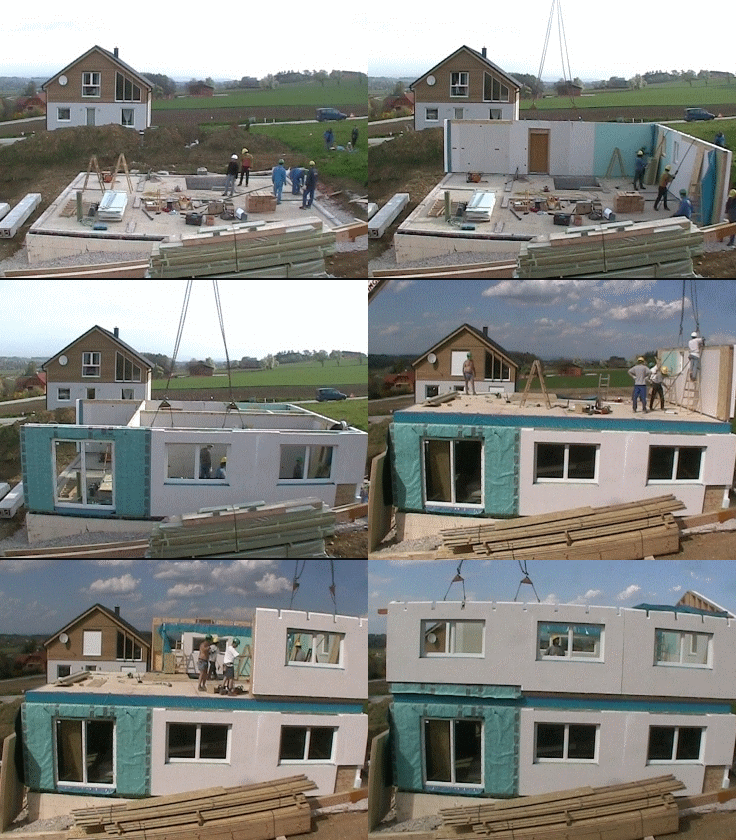
Prefabricated homes, often referred to as prefab homes or simply prefabs, are specialist dwelling types of prefabricated building, which are manufactured off-site in advance, usually in standard sections that can be easily shipped and assembled. Some current prefab home designs include architectural details inspired by postmodernism or futurist architecture.
"Prefabricated" may refer to buildings built in components (e.g. panels), modules (modular homes) or transportable sections (manufactured homes), and may also be used to refer to mobile homes, i.e., houses on wheels. Although similar, the methods and design of the three vary widely. There are two-level home plans, as well as custom home plans. There are considerable differences in the construction types. In the U.S., mobile and manufactured houses are constructed in accordance with HUD building codes, while modular houses are constructed in accordance with the IRC (International Residential Code).
The first mention of a prefabricated building was in 1160 to 1170 by Wace as confirmed by Pierre Bouet. In the special May/June 2015 edition of the French magazine Historia, he spoke of a castle transported by Normans in 'kit' form.[citation needed] According to Bouet, Wace's epic poem Roman de Rou, verses 6,516–6,526, states: "They took out of the ship beams of wood and dragged them to the ground. Then the Count (Earl) who brought them, (the beams) already pierced and planed, carved and trimmed, the pegs (raw-plugs/dowels) already trimmed and transported in barrels, erected a castle, had a moat dug around it and thus had constructed a big fortress during the night."
Movable structures were used in 16th century in India by Emperor Akbar The Great. These structures were reported by Arif Qandahari in 1579.
In the United States, several companies, including Sears Catalog Homes, began offering mail-order kit homes between 1902 and 1910. The Forest Products Laboratory, a division of the U.S. Forest Service, put extensive research into prefabricated homes in the 1930s, including building one for the 1935 Madison Home Show. This research continued into the 1960s.
Lustron houses were mass-produced, prefabricated, enameled steel, houses developed in the post-World War II era United States. Lustron Corporation manufactured homes that were clad in coated steel panels Over 2,000 homes were constructed during Lustron's brief production period, and they proved to be extremely durable with many still in use seventy years later (2020). Lustron production ceased in 1950 due to the company's inability to pay back the startup loans it had received from the Reconstruction Finance Corporation.
In the early to mid-1960s, a line of inexpensive Leisurama prefabricated houses designed by Andrew Geller, were made available for purchase from a display on the ninth floor of Macy's in New York City and shown at the 1964 New York World's Fair. The precursor to the final design had been shown in Moscow in 1959 provoking the noted Kitchen Debate between Vice President Richard Nixon and Soviet Premier Nikita Khrushchev. Over 200 Leisurama houses were built at the Culloden Point development in Montauk, New York between 1963 and 1965.
By 1958, roughly 10 percent of new houses in the United States were prefabricated.
Hub AI
Prefabricated home AI simulator
(@Prefabricated home_simulator)
Prefabricated home
Prefabricated homes, often referred to as prefab homes or simply prefabs, are specialist dwelling types of prefabricated building, which are manufactured off-site in advance, usually in standard sections that can be easily shipped and assembled. Some current prefab home designs include architectural details inspired by postmodernism or futurist architecture.
"Prefabricated" may refer to buildings built in components (e.g. panels), modules (modular homes) or transportable sections (manufactured homes), and may also be used to refer to mobile homes, i.e., houses on wheels. Although similar, the methods and design of the three vary widely. There are two-level home plans, as well as custom home plans. There are considerable differences in the construction types. In the U.S., mobile and manufactured houses are constructed in accordance with HUD building codes, while modular houses are constructed in accordance with the IRC (International Residential Code).
The first mention of a prefabricated building was in 1160 to 1170 by Wace as confirmed by Pierre Bouet. In the special May/June 2015 edition of the French magazine Historia, he spoke of a castle transported by Normans in 'kit' form.[citation needed] According to Bouet, Wace's epic poem Roman de Rou, verses 6,516–6,526, states: "They took out of the ship beams of wood and dragged them to the ground. Then the Count (Earl) who brought them, (the beams) already pierced and planed, carved and trimmed, the pegs (raw-plugs/dowels) already trimmed and transported in barrels, erected a castle, had a moat dug around it and thus had constructed a big fortress during the night."
Movable structures were used in 16th century in India by Emperor Akbar The Great. These structures were reported by Arif Qandahari in 1579.
In the United States, several companies, including Sears Catalog Homes, began offering mail-order kit homes between 1902 and 1910. The Forest Products Laboratory, a division of the U.S. Forest Service, put extensive research into prefabricated homes in the 1930s, including building one for the 1935 Madison Home Show. This research continued into the 1960s.
Lustron houses were mass-produced, prefabricated, enameled steel, houses developed in the post-World War II era United States. Lustron Corporation manufactured homes that were clad in coated steel panels Over 2,000 homes were constructed during Lustron's brief production period, and they proved to be extremely durable with many still in use seventy years later (2020). Lustron production ceased in 1950 due to the company's inability to pay back the startup loans it had received from the Reconstruction Finance Corporation.
In the early to mid-1960s, a line of inexpensive Leisurama prefabricated houses designed by Andrew Geller, were made available for purchase from a display on the ninth floor of Macy's in New York City and shown at the 1964 New York World's Fair. The precursor to the final design had been shown in Moscow in 1959 provoking the noted Kitchen Debate between Vice President Richard Nixon and Soviet Premier Nikita Khrushchev. Over 200 Leisurama houses were built at the Culloden Point development in Montauk, New York between 1963 and 1965.
By 1958, roughly 10 percent of new houses in the United States were prefabricated.
Recent media