


Community hub
Recent from talks
Contribute something
Nothing was collected or created yet.
Modular building
View on Wikipedia | This article needs additional citations for verification. (January 2024) |

A modular building is a prefabricated building that consists of repeated sections called modules.[1] Modularity involves constructing sections away from the building site, then delivering them to the intended site. Installation of the prefabricated sections is completed on site. Prefabricated sections are sometimes placed using a crane. The modules can be placed side-by-side, end-to-end, or stacked, allowing for a variety of configurations and styles. After placement, the modules are joined together using inter-module connections, also known as inter-connections. The inter-connections tie the individual modules together to form the overall building structure.[2]
Uses
[edit]
Modular buildings may be used for long-term, temporary or permanent facilities, such as construction camps, schools and classrooms, civilian and military housing, and industrial facilities. Modular buildings are used in remote and rural areas where conventional construction may not be reasonable or possible, for example, the Halley VI accommodation pods used for a BAS Antarctic expedition.[3] Other uses have included churches, health care facilities, sales and retail offices, fast food restaurants and cruise ship construction. They can also be used in areas that have weather concerns, such as hurricanes. Modular buildings are often used to provide temporary facilities, including toilets and ablutions at events. The portability of the buildings makes them popular with hire companies and clients alike. The use of modular buildings enables events to be held at locations where existing facilities are unavailable, or unable to support the number of event attendees.
Construction process
[edit]Construction is offsite, using lean manufacturing techniques to prefabricate single or multi-story buildings in deliverable module sections. Often, modules are based around standard 20 foot containers, using the same dimensions, structures, building and stacking/placing techniques, but with smooth (instead of corrugated) walls, glossy white paint, and provisions for windows, power, potable water, sewage lines, telecommunications and air conditioning. Permanent Modular Construction (PMC) buildings are manufactured in a controlled setting and can be constructed of wood, steel, or concrete. Modular components are typically constructed indoors on assembly lines. Modules' construction may take as little as ten days but more often one to three months. PMC modules can be integrated into site built projects or stand alone and can be delivered with MEP, fixtures and interior finishes.
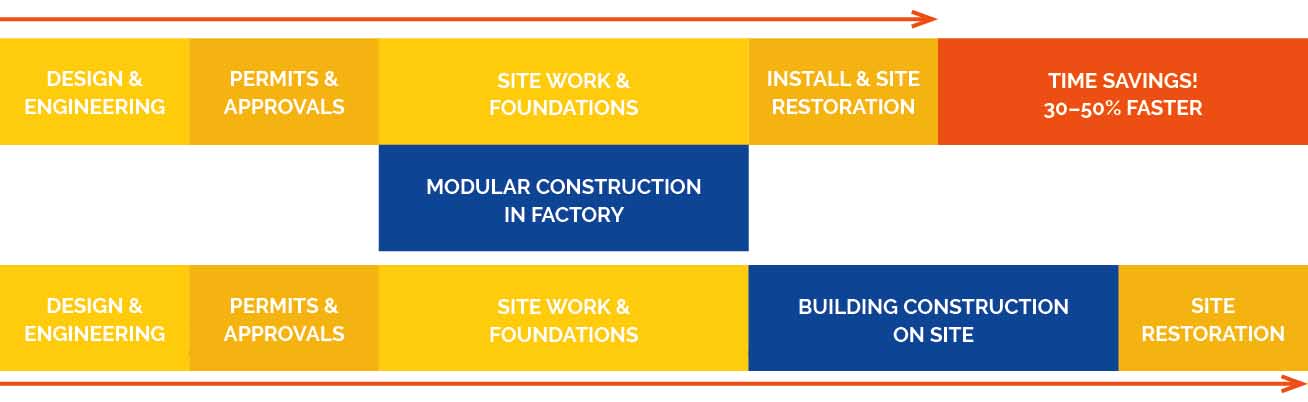
The buildings are 60% to 90% completed offsite in a factory-controlled environment, and transported and assembled at the final building site. This can comprise the entire building or be components or subassemblies of larger structures. In many cases, modular contractors work with traditional general contractors to exploit the resources and advantages of each type of construction. Completed modules are transported to the building site and assembled by a crane.[4] Placement of the modules may take from several hours to several days. Off-site construction running in parallel to site preparation providing a shorter time to project completion is one of the common selling points of modular construction. Modular construction timeline
Permanent modular buildings are built to meet or exceed the same building codes and standards as site-built structures and the same architect-specified materials used in conventionally constructed buildings are used in modular construction projects. PMC can have as many stories as building codes allow. Unlike relocatable buildings, PMC structures are intended to remain in one location for the duration of their useful life.
Manufacturing considerations
[edit]The entire process of modular construction places significance on the design stage. This is where practices such as Design for Manufacture and Assembly (DfMA) are used to ensure that assembly tolerances are controlled throughout manufacture and assembly on site. It is vital that there is enough allowance in the design to allow the assembly to take up any "slack" or misalignment of components. The use of advanced CAD systems, 3D printing and manufacturing control systems are important for modular construction to be successful. This is quite unlike on-site construction where the tradesman can often make the part to suit any particular installation.
-
 Bulk materials
 -
 Walls attached to floor
 -
 Ceiling drywalled in spray booth
 -
 Roof set in place
 -
 Roof shingled and siding installed
 -
 Ready for delivery to site
 -
 Two-story modular dwelling
 -
 Pratt Modular Home in Tyler Texas
 -
 Pratt Modular Home kitchen
 -
 Pratt Modular Home in Tyler Texas


Upfront production investment
[edit]The development of factory facilities for modular homes requires significant upfront investment. To help address housing shortages in the 2010s, the United Kingdom Government (via Homes England) invested in modular housing initiatives. Several UK companies (for example, Ilke Homes, L&G Modular Homes, House by Urban Splash, Modulous, TopHat and Lighthouse) were established to develop modular homes as an alternative to traditionally-built residences, but failed as they could not book revenues quickly enough to cover the costs of establishing manufacturing facilities.
IIke Homes opened a factory in Knaresborough, Yorkshire in 2018, and Homes England invested £30m in November 2019,[5] and a further £30m in September 2021.[6] Despite a further fund-raising round, raising £100m in December 2022,[7][8] Ilke Homes went into administration on 30 June 2023,[9][10] with most of the company's 1,150 staff made redundant,[11] and debts of £320m,[12] including £68m owed to Homes England.[13]
In 2015 Legal & General launched a modular homes operation, L&G Modular Homes, opening a 550,000 sq ft factory in Sherburn-in-Elmet, near Selby in Yorkshire.[14] The company incurred large losses as it invested in its factory before earning any revenues; by 2019, it had lost over £100m.[15] Sales revenues from a Selby project, plus schemes in Kent and West Sussex, started to flow in 2022, by which time the business's total losses had grown to £174m.[16] Production was halted in May 2023, with L&G blaming local planning delays and the COVID-19 pandemic for its failure to grow its sales pipeline.[17][18] The enterprise incurred total losses over seven years of £295m.[19]
Market acceptance
[edit]
Some home buyers and some lending institutions resist consideration of modular homes as equivalent in value to site-built homes.[citation needed] While the homes themselves may be of equivalent quality, entrenched zoning regulations and psychological marketplace factors may create hurdles for buyers or builders of modular homes and should be considered as part of the decision-making process when exploring this type of home as a living and/or investment option. In the UK and Australia, modular homes have become accepted in some regional areas; however, they are not commonly built in major cities. Modular homes are becoming increasingly common in Japanese urban areas, due to improvements in design and quality, speed and compactness of onsite assembly, as well as due to lowering costs and ease of repair after earthquakes. Recent innovations allow modular buildings to be indistinguishable from site-built structures.[20] Surveys have shown that individuals can rarely tell the difference between a modular home and a site-built home.[21]
Modular homes vs. mobile homes
[edit]Differences include the building codes that govern the construction, types of material used and how they are appraised by banks for lending purposes. Modular homes are built to either local or state building codes as opposed to manufactured homes, which are also built in a factory but are governed by a federal building code.[22] The codes that govern the construction of modular homes are exactly the same codes that govern the construction of site-constructed homes.[citation needed] In the United States, all modular homes are constructed according to the International Building Code (IBC), IRC, BOCA or the code that has been adopted by the local jurisdiction.[citation needed] In some states, such as California, mobile homes must still be registered yearly, like vehicles or standard trailers, with the Department of Motor Vehicles or other state agency. This is true even if the owners remove the axles and place it on a permanent foundation.[23]
Recognizing a mobile or manufactured home
[edit]A mobile home should have a small metal tag on the outside of each section. If a tag cannot be located, details about the home can be found in the electrical panel box. This tag should also reveal a manufacturing date.[citation needed] Modular homes do not have metal tags on the outside but will have a dataplate installed inside the home, usually under the kitchen sink or in a closet. The dataplate will provide information such as the manufacturer, third party inspection agency, appliance information, and manufacture date.
Materials
[edit]The materials used in modular buildings are of the same quality and durability as those used in traditional construction, preserving characteristics such as acoustic insulation and energy efficiency, as well as allowing for attractive and innovative designs thanks to their versatility.[24] Most commonly used are steel, wood and concrete.[25]
- Steel: Because it is easily moldable, it allows for innovation in design and aesthetics.
- Wood: Wood is an essential part of most modular buildings. Thanks to its lightness, it facilitates the work of assembling and moving the prefabricated modules.
- Concrete: Concrete offers a solid structure that is ideal for the structural reinforcement of permanent modular buildings. It is increasingly being used as a base material in this type of building, thanks to its various characteristics such as fire resistance, energy savings, greater acoustic insulation, and durability.[26]
Wood-frame floors, walls and roof are often utilized. Some modular homes include brick or stone exteriors, granite counters and steeply pitched roofs. Modulars can be designed to sit on a perimeter foundation or basement. In contrast, mobile homes are constructed with a steel chassis that is integral to the integrity of the floor system. Modular buildings can be custom built to a client's specifications. Current designs include multi-story units, multi-family units and entire apartment complexes. The negative stereotype commonly associated with mobile homes has prompted some manufacturers to start using the term "off-site construction."
New modular offerings include other construction methods such as cross-laminated timber frames.[27]
Financing
[edit]Mobile homes often require special lenders.[28]
Modular homes on the other hand are financed as site built homes with a construction loan
Standards and zoning considerations
[edit]Typically, modular dwellings are built to local, state or council code, resulting in dwellings from a given manufacturing facility having differing construction standards depending on the final destination of the modules.[29] The most important zones that manufacturers have to take into consideration are local wind, heat, and snow load zones.[citation needed] For example, homes built for final assembly in a hurricane-prone, earthquake or flooding area may include additional bracing to meet local building codes. Steel and/or wood framing are common options for building a modular home.
Some US courts have ruled that zoning restrictions applicable to mobile homes do not apply to modular homes since modular homes are designed to have a permanent foundation.[citation needed] Additionally, in the US, valuation differences between modular homes and site-built homes are often negligible in real estate appraisal practice; modular homes can, in some market areas, (depending on local appraisal practices per Uniform Standards of Professional Appraisal Practice) be evaluated the same way as site-built dwellings of similar quality. In Australia, manufactured home parks are governed by additional legislation that does not apply to permanent modular homes. Possible developments in equivalence between modular and site-built housing types for the purposes of real estate appraisals, financing and zoning may increase the sales of modular homes over time.[30]
CLASP (Consortium of Local Authorities Special Programme)
[edit]The Consortium of Local Authorities Special Programme (abbreviated and more commonly referred to as CLASP) was formed in England in 1957 to combine the resources of local authorities with the purpose of developing a prefabricated school building programme. Initially developed by Charles Herbert Aslin, the county architect for Hertfordshire, the system was used as a model for several other counties, most notably Nottinghamshire and Derbyshire. CLASP's popularity in these coal mining areas was in part because the system permitted fairly straightforward replacement of subsidence-damaged sections of building.
Building strength
[edit]
Modular homes are designed to be stronger than traditional homes by, for example, replacing nails with screws, adding glue to joints, and using 8–10% more lumber than conventional housing.[31] This is to help the modules maintain their structural integrity as they are transported on trucks to the construction site. However, there are few studies on the response of modular buildings to transport and handling stresses. It is therefore presently difficult to predict transport induced damage.[1]
When FEMA studied the destruction wrought by Hurricane Andrew in Dade County Florida, they concluded that modular and masonry homes fared best compared to other construction.[32]
CE marking
[edit]The CE mark is a construction norm that guarantees the user of mechanical resistance and strength of the structure. It is a label given by European community empowered authorities for end-to-end process mastering and traceability.[citation needed]
All manufacturing operations are being monitored and recorded:
- Suppliers have to be known and certified,
- Raw materials and goods being sourced are to be recorded by batch used,
- Elementary products are recorded and their quality is monitored,
- Assembly quality is managed and assessed on a step by step basis,
- When a modular unit is finished, a whole set of tests are performed and if quality standards are met, a unique number and EC stamp is attached to and on the unit.
This ID and all the details are recorded in a database, At any time, the producer has to be able to answer and provide all the information from each step of the production of a single unit, The EC certification guaranties standards in terms of durability, resistance against wind and earthquakes.[citation needed]
Open modular building
[edit]The term Modularity can be perceived in different ways. It can even be extended to building P2P (peer-to-peer) applications; where a tailored use of the P2P technology is with the aid of a modular paradigm. Here, well-understood components with clean interfaces can be combined to implement arbitrarily complex functions in the hopes of further proliferating self-organising P2P technology. Open modular buildings are an excellent example of this. Modular building can also be open source and green. Bauwens, Kostakis and Pazaitis[33] elaborate on this kind of modularity. They link modularity to the construction of houses.
This commons-based activity is geared towards modularity. The construction of modular buildings enables a community to share designs and tools related to all the different parts of house construction. A socially-oriented endeavour that deals with the external architecture of buildings and the internal dynamics of open source commons. People are thus provided with the tools to reconfigure the public sphere in the area where they live, especially in urban environments. There is a robust socializing element that is reminiscent of pre-industrial vernacular architecture and community-based building.[34]
Some organisations already provide modular housing. Such organisations are relevant as they allow for the online sharing of construction plans and tools. These plans can be then assembled, through either digital fabrication like 3D printing or even sourcing low-cost materials from local communities. It has been noticed that given how easy it is to use these low-cost materials are (for example: plywood), it can help increase the permeation of these open buildings to areas or communities that lack the know-how or abilities of conventional architectural or construction firms. Ergo, it allows for a fundamentally more standardised way of constructing houses and buildings. The overarching idea behind it remains key - to allow for easy access to user-friendly layouts which anyone can use to build in a more sustainable and affordable way.
Modularity in this sense is building a house from different standardised parts, like solving a jigsaw puzzle.
3D printing can be used to build the house.
The main standard is OpenStructures and its derivative Autarkytecture.[35]
Research and development
[edit]Modular construction is the subject of continued research and development worldwide as the technology is applied to taller and taller buildings. Research and development is carried out by modular building companies and also research institutes such as the Modular Building Institute[36] and the Steel Construction Institute.[37]
See also
[edit]
- Affordable housing
- Alternative housing
- Commercial modular construction
- Construction 3D printing
- Container home
- Kit house
- List of BIM software
- MAN steel house
- Manufactured housing
- Modern methods of construction
- Modular design
- Portable building
- Prefabrication
- Open-source architecture
- Open source hardware
- OpenStructures
- Prefabricated home
- Relocatable buildings
- Recreational vehicles
- Shipping container architecture
- Stick-built home
- Tiny house movement
- Toter
References
[edit]- ^ a b Lacey, Andrew William; Chen, Wensu; Hao, Hong; Bi, Kaiming (2018). "Structural Response of Modular Buildings – An Overview". Journal of Building Engineering. 16: 45–56. doi:10.1016/j.jobe.2017.12.008. hdl:20.500.11937/60087.
- ^ Lacey, Andrew William; Chen, Wensu; Hao, Hong; Bi, Kaiming (2019). "Review of bolted inter-module connections in modular steel buildings". Journal of Building Engineering. 23: 207–219. doi:10.1016/j.jobe.2019.01.035. S2CID 86540434.
- ^ "Halley VI Research Station – British Antarctic Survey". Bas.ac.uk. Retrieved 2016-05-03.
- ^ "Why Build Modular?". Modular.org. Retrieved 2016-05-03.
- ^ Morby, Aaron (4 November 2019). "Government pumps £30m into modular house builder". Construction Enquirer. Retrieved 14 March 2024.
- ^ Morby, Aaron (27 September 2021). "Ilke Homes raises £60m for top 10 house builder plan". Construction Enquirer. Retrieved 14 March 2024.
- ^ Morby, Aaron (6 December 2022). "Ilke Homes pulls off £100m record-breaking fund raise". Construction Enquirer. Retrieved 14 March 2024.
- ^ O'Connor, Rob (6 December 2022). "ilke Homes announces new £100m investment". Infrastructure Intelligence. Retrieved 14 March 2024.
- ^ Gardiner, Joey (30 June 2023). "Ilke Homes sinks into administration with most of firm's 1,100 staff set to lose their jobs". Building. Retrieved 14 March 2024.
- ^ Riding, James (30 June 2023). "Modular house builder Ilke Homes enters administration with majority of staff to be made redundant". Inside Housing. Retrieved 14 March 2024.
- ^ Morby, Aaron (30 June 2023). "Ilke Homes falls into administration". Construction Enquirer. Retrieved 14 March 2024.
- ^ Prior, Grant (25 August 2023). "Ilke Homes went under owing £320m". Construction Enquirer. Retrieved 14 March 2024.
- ^ Willmore, James (14 February 2024). "Homes England to lose most of £68.8m it is owed from Ilke Homes following collapse". Inside Housing. Retrieved 14 March 2024.
- ^ Dale, Sharon (11 May 2020). "Head of Legal & General modular homes factory reveals plans for its future". Yorkshire Post. Retrieved 20 March 2024.
- ^ Morby, Aaron (30 November 2020). "L&G modular homes losses exceed £100m". Construction Enquirer. Retrieved 20 March 2024.
- ^ Morby, Aaron (3 October 2022). "L&G modular homes amassed loss deepens to £174m". Construction Enquirer. Retrieved 20 March 2024.
- ^ Prior, Grant (4 May 2023). "L&G halts production at modular homes factory". Construction Enquirer. Retrieved 20 March 2024.
- ^ Kollewe, Julia (4 May 2023). "Legal & General halts new production at modular homes factory near Leeds". The Guardian.
- ^ Morby, Aaron (6 November 2023). "L&G modular homes foray amassed £295m of losses". Construction Enquirer. Retrieved 20 March 2024.
- ^ fab, ukporta (19 August 2020). "prefabricated structures". ukportaprefab. Retrieved 4 September 2020.
- ^ "Factory-Built Construction and the American Homebuyer: Perceptions and Opportunities" (PDF). Huduser.gov. p. 9. Retrieved 2017-09-10.
- ^ Solutions, Dryside Property – Jennifer Mitchell and Magic Web. "Mobile homes vs Manufactured homes vs Modular homes". Drysideproperty.com. Retrieved 2018-03-09.
- ^ "HCD Manufactured and Mobile Homes". Hcd.ca.gov.
- ^ Métodos modernos de construcción (MMC): Fabricación modular. Upv.es. 2020-10-02 Retrieved 2022-09-08
- ^ A guide to the latest modular building construction materials. Hydrodiseno.com. 2021-12-14 Retrieved 2022-09-05
- ^ Construcción modular en hormigón: una tendencia al alza (PDF). Andece.org. p. 53. Retrieved 2022-07-06
- ^ "Prefabricated Housing Module Advances Wood Research at the University of British Columbia | 2017-05-15T00:00:00 | Perkins + Will News". Archived from the original on 2019-03-31. Retrieved 2019-03-31.
- ^ "HUD Financing Manufactured (Mobile) Homes". Portal.hud.gov. Archived from the original on 2016-05-03. Retrieved 2016-05-03.
- ^ "Australian Government modular home regulations". Austlii.edu.au. Retrieved 2007-10-21.
- ^ "Building Codes for Modular Homes". Modularhomesnetwork.com. Retrieved 2010-08-06.
- ^ "Disruptive Development: Modular Manufacturing In Multifamily Housing" (PDF). p. 35. Retrieved 10 September 2017.
- ^ "FIA 22, Mitigation Assessment Team Report: Hurricane Andrew in Florida (1993)". Fema.gov. Archived from the original on August 27, 2007.
- ^ Bouwens, M., Kostakis, V., & Pazaitis, A. 2019. The Commons Manifesto. University of Westminster Press, London, pg. 24
- ^ Bouwens, M., Kostakis, V., & Pazaitis, A. 2019. The Commons Manifesto. University of Westminster Press, London, pg. 25
- ^ "Thomas Lommée & Christiane Hoegner - Autarkytecture | z33". Archived from the original on 2014-12-31. Retrieved 2015-01-01.
- ^ "Modular Building Institute". Modular.org.
- ^ "The Steel Construction Institute (SCI) UK Global Steel Expertise". Steel-sci.com.
34 - "Volumetric modular construction trend gaining groun d". https://www.aa.com.tr/en/corporate-news/volumetric-modular-construction-trend-gaining-ground/2357158 06.09.2021
Modular building
View on GrokipediaHistory
Origins and Early Prefabrication
Prefabrication in construction, the precursor to modern modular building, emerged as a practical response to the logistical challenges of remote or rapid deployment needs, with the earliest documented examples appearing in the 17th century. In 1624, English settlers transported a panelized wooden house—consisting of prefabricated panels assembled on-site—from England to Cape Ann, Massachusetts, to support a fishing outpost; the structure was later disassembled and relocated multiple times, demonstrating early modularity in response to transient colonial demands.[11][12] Similarly, in 1609, framed wooden houses were shipped from London to the reconstructed settlement of Londonderry (Derry) in Ireland, highlighting prefabrication's utility for rebuilding in unstable regions.[11] The 19th century marked the industrialization of prefabrication, driven by expanding empires, resource booms, and technological advances in materials like iron and standardized manufacturing. In 1837, London carpenter Henry Manning introduced the "Portable Cottage," a prefabricated bungalow designed for export to British colonies such as Australia, where on-site assembly addressed labor shortages and transportation constraints over vast distances.[11][12] During the 1848-1849 California Gold Rush, prefabricated frame houses were imported from Britain, Sweden, China, and U.S. East Coast factories, with over 500 preassembled units shipped from New York alone to house the influx of miners in makeshift boomtowns.[11][6] In the 1850s, Manchester-based E.T. Bellhouse produced prefabricated iron houses shipped to Melbourne, Australia, leveraging cast iron for durable, transportable components suited to colonial expansion.[11] A landmark in scale and engineering, the Crystal Palace of 1851 in London exemplified prefabrication's potential for large structures; designed by Joseph Paxton, it utilized thousands of standardized cast-iron columns, wrought-iron girders, and glass panels prefabricated off-site and assembled in just nine months for the Great Exhibition, later relocated to Sydenham.[13] This event underscored causal advantages of off-site fabrication—reduced on-site labor, faster erection, and economies from repetition—principles foundational to modular systems, though early efforts were predominantly panelized rather than fully volumetric modules. By the late 19th century, firms like E.F. Hodgson in the U.S. began catalog sales of modular homes in 1897, capitalizing on population growth and rail transport for nationwide distribution.[6] These developments laid empirical groundwork for prefabrication's efficiency in addressing housing shortages without relying on skilled on-site labor, a pattern evident from colonial outposts to industrial exhibitions.20th Century Expansion and Post-War Boom
The adoption of Henry Ford's assembly line production method in 1913 revolutionized manufacturing processes, enabling the scalable and cost-effective production of prefabricated and modular building components.[6] This innovation built on earlier catalog-based systems, with companies such as Sears, Roebuck and Montgomery Ward selling hundreds of thousands of prefabricated home kits to consumers across the United States from the early 1900s through the 1920s.[6] By the pre-Great Depression era, these efforts had resulted in an estimated 50,000 modular units sold in the U.S., reflecting growing demand for affordable, standardized housing amid urbanization and industrial growth.[14] World War II's aftermath intensified housing shortages worldwide, spurring a significant expansion in modular and prefabricated construction to meet rapid needs for returning veterans and displaced populations. In the United States, the return of approximately 7.6 million troops contributed to acute demand, with home ownership rates climbing from 43.6% in 1940 to 62% by 1960; the War Production Board's revocation of building restrictions on October 15, 1945, facilitated this surge, supported by Federal Housing Administration (FHA) and National Housing Agency (NHA) programs targeting annual production of 500,000 units.[15] Manufacturers like Lustron Corporation produced 2,498 enameled steel prefabricated homes between 1947 and 1950, while overall output of aluminum and steel prefabs from firms including Beech Aircraft, Alcoa, and others totaled fewer than 2,600 units between 1945 and 1955, leveraging wartime surplus materials for quick assembly.[15] In Europe, particularly the United Kingdom, wartime destruction of about 450,000 homes prompted the post-war prefabricated housing programme under the 1944 Housing Act, yielding over 156,000 temporary prefabricated homes built between 1945 and 1959 as a stopgap measure while the country recovered; these were only ever intended for short-term use, with many utilizing aluminum or steel systems from designs like AIROH and Arcon.[15] Unlike these temporary structures, modern modular construction in the UK produces permanent buildings with 60-year design lives, where quality rivals or exceeds traditional methods.[16] This effort contributed to the construction of 1.2 million total houses in the UK by 1951, emphasizing factory-based modularity for speed and economy amid material scarcities.[15] The era also extended modular applications beyond residential use, with mobile homes repurposed as classrooms, offices, and commercial structures like diners in the U.S., demonstrating versatility in addressing broader infrastructural demands.[6]Late 20th to Early 21st Century Evolution
In the 1980s, modular construction experienced refinement and expanded applications beyond residential uses, including hotels, apartment buildings, and large-scale industrial projects such as global oil and gas facilities.[17][18] Techniques improved to support multi-level structures, overcoming prior single-story limitations, while urban initiatives in places like New York City's Brooklyn and Bronx utilized modular units for low-income housing rehabilitation starting in 1985.[19] State officials inspecting factories in 1986 observed high-quality finishes that challenged associations with lower-end trailers.[19] The 1990s marked increased consumer and developer adoption driven by modular methods' efficiency, lower costs, and faster timelines compared to traditional site-building.[5] Customization advanced, enabling upscale designs like a 8,900-square-foot Georgian-style mansion completed in Greenwich, Connecticut, in 1999, demonstrating viability for high-end markets.[19] Expansion into commercial and institutional sectors followed, with more sophisticated modules incorporating better insulation, HVAC systems, and compliance with local codes.[20][21] Entering the early 2000s, modular construction comprised approximately 3% of U.S. single-family homes by 2006, offering 5-15% cost savings through off-site efficiencies.[19] The 2008 Museum of Modern Art exhibition "Home Delivery" showcased prefabricated innovations, elevating design perceptions and accelerating acceptance amid technological booms in CAD software and materials.[19][22] Sustainability features, such as reduced waste and energy-efficient assemblies, positioned modular as a premium option by the decade's end.[23][24]Definition and Core Principles
Fundamental Concepts and Modularity
Modular building encompasses a construction methodology wherein discrete, prefabricated components—termed modules—are fabricated within controlled factory settings and subsequently transported to the construction site for integration into the final structure.[25] This process leverages off-site manufacturing to parallelize activities such as component production with on-site groundwork, thereby minimizing weather dependencies and logistical disruptions inherent in conventional stick-built methods.[26] Modules typically adhere to the same building codes and material standards as traditional construction, but their factory-based assembly permits up to 90% completion prior to transport in volumetric formats.[25] Central to this approach is the concept of modularity, defined as the deliberate partitioning of a building system into interdependent yet separable subunits that maintain internal coherence while aligning via standardized interfaces for recombination.[27] Modularity as a property quantifies the configurability of these subunits, enabling a finite set of modules to generate diverse structural outcomes through combinatorial assembly, much like subsystems in engineered products.[28] This principle draws from systems theory, where interdependence is minimized at module boundaries to enhance interchangeability, fault isolation, and scalability—allowing, for instance, the replication of identical units for multi-unit developments or the substitution of upgraded modules in existing builds.[29] Key tenets include factory prefabrication, which enforces precise environmental controls to mitigate defects arising from on-site variables like humidity or labor inconsistencies, and transportability, necessitating robust module designs capable of enduring shipping loads without compromising structural integrity.[30] Flexibility inheres in the modular framework, as standardized connections permit post-occupancy modifications, such as expansions or reconfigurations, without necessitating wholesale reconstruction.[31] Empirical distinctions arise between volumetric modularity—yielding fully enclosed, box-like units finished internally before transport—and panelized variants, where flat components form modules on-site; the former prioritizes enclosure for quality assurance, while the latter suits applications demanding higher customization at assembly.[26] These elements collectively underscore modularity's causal role in streamlining complexity, as evidenced by reduced interface variability that curtails assembly errors compared to bespoke on-site integrations.[32]Types of Modular Systems
All modular systems benefit from factory-controlled environments, rendering weather delays irrelevant, dramatically improving quality control through consistent conditions, and significantly reducing waste compared to open-site construction.[25] Volumetric modular systems involve the prefabrication of complete three-dimensional units, such as individual rooms or building sections, in a controlled factory setting. These modules typically include structural framing, insulation, interior finishes, electrical, plumbing, and mechanical systems fully integrated before transportation to the site, where they are craned into position, stacked, and interconnected. This approach suits projects requiring rapid assembly, such as multi-story residential or hotel buildings, with modules often limited to standard transport dimensions of about 4 meters wide by 12 meters long to comply with road regulations.[33][34] Panelized modular systems, in contrast, consist of two-dimensional prefabricated components like flat wall panels, floor cassettes, or roof elements, which are manufactured off-site and assembled on location into a structural frame. These panels may include openings for windows and doors, along with pre-installed services, but require significant on-site labor for erection, sheathing, and finishing, offering greater design flexibility for irregular shapes or site-specific adaptations compared to volumetric methods. Panelized construction is commonly used in low- to mid-rise commercial structures or extensions, where transportation of larger modules would be impractical.[35][36] Hybrid modular systems integrate elements of volumetric and panelized approaches, often combining pre-assembled 3D modules for core areas like bathrooms or kitchens with 2D panels for open-plan spaces, facades, or structural cores built via traditional methods such as concrete or steel framing. This method balances the efficiency of factory-controlled volumetric units with the adaptability of panelized or site-built components, enabling customized designs while mitigating limitations like module transport constraints; for instance, hybrid techniques have been applied in high-rise projects exceeding 20 stories by using modular pods within a conventional skeleton. Empirical studies indicate hybrid systems can achieve 20-30% faster construction timelines than fully traditional methods by optimizing off-site fabrication for 60-80% of components.[37][38][39]Applications
Residential and Housing
Modular construction in residential applications involves fabricating home modules in controlled factory environments, which are then transported and assembled on-site to form single-family dwellings, multi-family apartments, townhouses, and accessory dwelling units (ADUs). This method adheres to local building codes, distinguishing it from manufactured housing built to federal HUD standards, and enables customization comparable to traditional site-built homes while leveraging factory precision for components like walls, floors, and roofs. In the United States, residential modular projects represented approximately 55.4% of the North American modular construction market share in 2024, driven by demand for affordable housing amid shortages.[40] The approach addresses housing affordability challenges by reducing construction timelines and material waste; empirical analyses indicate modular homes can be completed 40% faster than traditional methods, with potential cost savings of 10-25% due to economies of scale and minimized on-site labor exposure to weather delays. A 2023 Harvard Joint Center for Housing Studies report estimated modular construction costs at about 15% below site-built equivalents for the structural phase, though total costs including land and permitting vary by region. In practice, projects like multi-unit developments in urban areas, such as those in Minneapolis, Minnesota, have utilized modular techniques to deliver affordable rentals faster, with factory production enabling up to 50% reductions in site disruption compared to stick-built construction.[41][42][43] Adoption remains limited, comprising only about 5% of non-site-built housing starts in the U.S. in 2023, constrained by factors including lender hesitancy, zoning restrictions, and perceptions of lower resale value despite equivalent code compliance. Government initiatives, such as HUD's exploratory study on factory-built homes, highlight modular's role in expanding entry-level ownership, with average per-square-foot costs for modular units around $100-150 in 2023, versus $150-200 for site-built, though these figures exclude site-specific variables like foundation work. In Europe and North America, modular residential growth is projected at 6-8% annually through 2030, fueled by sustainability mandates, as factory settings allow for integrated energy-efficient features like insulated panels that achieve higher thermal performance than field-assembled equivalents.[44][45][46]| Aspect | Modular Residential | Traditional Site-Built |
|---|---|---|
| Build Time | 3-6 months total | 6-12 months |
| Cost Savings Potential | 10-25% | Baseline |
| Waste Reduction | Up to 90% less | Higher on-site waste |