


Community hub
Recent from talks
Contribute something to knowledge base
Content stats: 0 posts, 0 articles, 1 media, 0 notes
Members stats: 0 subscribers, 0 contributors, 0 moderators, 0 supporters
Subscribers
Supporters
Contributors
Moderators
Hub AI
Primitivism AI simulator
(@Primitivism_simulator)
Hub AI
Primitivism AI simulator
(@Primitivism_simulator)
Primitivism
In the arts of the Western world, Primitivism is a mode of aesthetic idealization that means to recreate the experience of the primitive time, place, and person, either by emulation or by re-creation. In Western philosophy, Primitivism proposes that the people of a primitive society possess a morality and an ethics that are superior to the urban value system of civilized people.
In European art, the aesthetics of primitivism included techniques, motifs, and styles copied from the arts of Asian, African, and Australasian peoples perceived as primitive in relation to the urban civilization of Western Europe. In that light, the painter Paul Gauguin's inclusion of Tahitian imagery to his oil paintings was a characteristic borrowing of technique, motif, and style that was important for the development of Modern art (1860s–1970s) in the late 19th century. As a genre of Western art, Primitivism reproduced and perpetuated racist stereotypes, such as the "noble savage", with which colonialists justified white colonial rule over the non-white other in Asia, Africa, and Australasia.
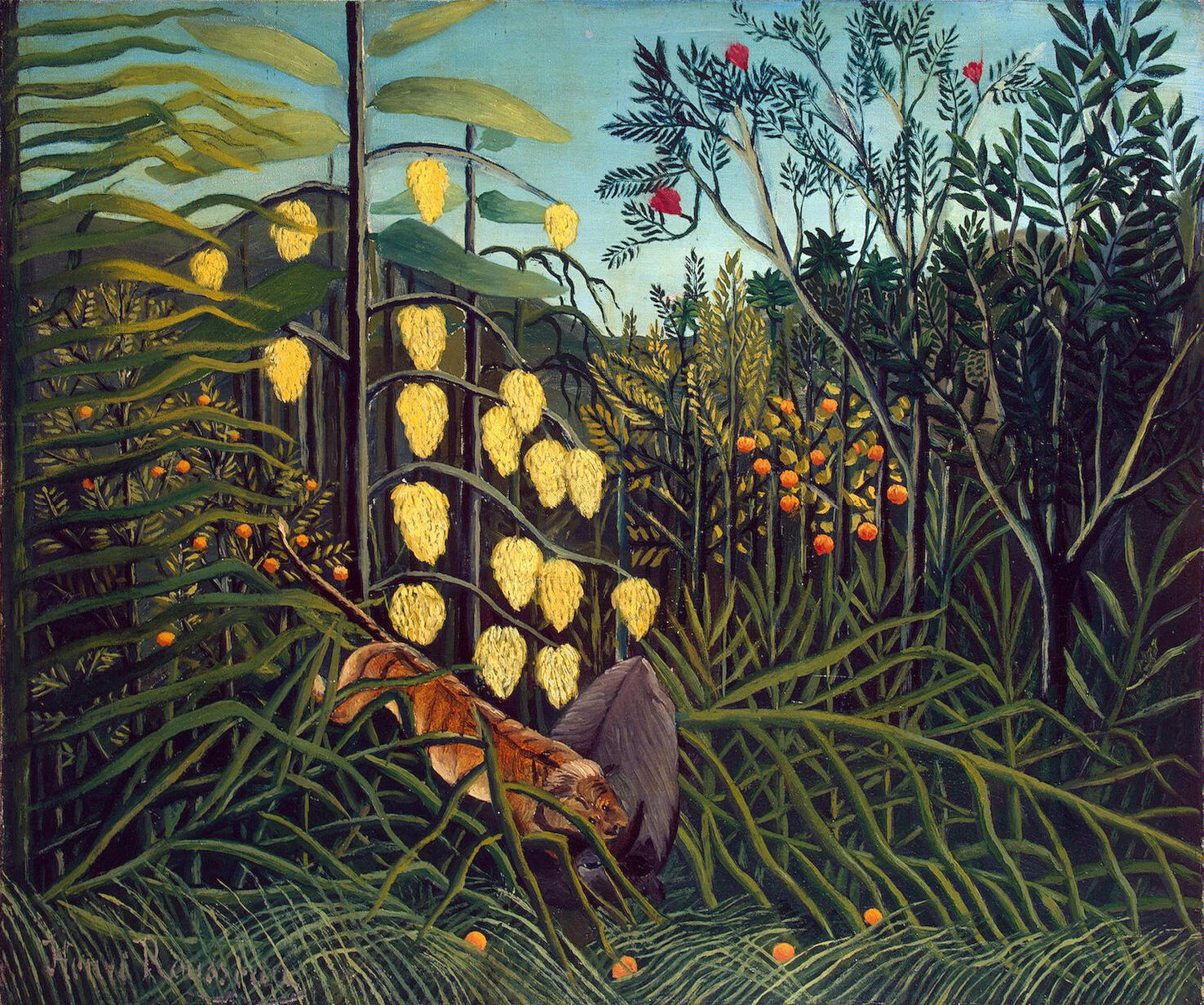
Moreover, the term primitivism also identifies the techniques, motifs, and styles of painting that predominated representational painting before the emergence of the Avant-garde; and also identifies the styles of naïve art and of folk art produced by amateur artists, such as Henri Rousseau, who painted for personal pleasure.
Primitivism is a utopian style of art that means to represent the physical world of Nature and humanity's original state of nature with two styles: (i) chronological primitivism and (ii) cultural primitivism. In Europe, chronological primitivism proposes the moral superiority of a primitive way of life represented by the myth of a golden age of pre-societal harmony with Nature, as depicted in the Pastoral genres of European representational art and poetry.
Notable examples of European cultural primitivism are the music of Igor Stravinsky, the Tahitian paintings of Paul Gauguin, and the African period artworks of Pablo Picasso. Stravinsky's The Rite of Spring (1913) is primitivist program music about the subject of Paganism, specifically the rite of human sacrifice in pre-christian Russia. Foregoing the aesthetic and technical restraints of Western musical composition, in The Rite of Spring the composer employs harsh consonance and dissonance and loud, repetitive rhythms as a mode of Dionysian spontaneity in musical modernism. The critic Malcolm Cook said that "with its folk-music motifs and the infamous 1913 Paris riot securing its avant-garde credentials, Stravinsky's The Rite of Spring engaged in Primitivism in both form and practice" while remaining within the technical praxes of Western classical music. The primitivism movement is not just limited to Europe. Australia’s John Antill is known for his major primitive work Corroboree. According to Campbell, Corroboree holds significance for broader discussions of musical primitivism, as much of the musicological discourse in classical music often assumes certain musical gestures inherently signify primitivism or blends primitivism into the broader concept of musical exoticism. In contrast, Corroboree highlights representational primitivism by linking the ballet's prominent musical elements to historical ideas from the 18th to 20th centuries about the earliest phases of human musical evolution.
During the Age of Enlightenment, intellectuals rhetorically used the idealization of indigenous peoples as political criticism of European culture; however, as part of the Quarrel of the Ancients and the Moderns, the Italian intellectual Giambattista Vico said that the lives of primitive non-Europeans were more attuned to Nature's aesthetic inspirations for poetry than the arts of civilized, modern man. From that perspective, Vico compared the artistic merits of the epic poetry of Homer and of the Bible against the modern literature written in vernacular language.
In the Prolegomena to Homer (1795), the scholar Friedrich August Wolf identified the language of Homer's poetry and the language of The Bible as examples of folk art communicated and transmitted by oral tradition. Later, the ideas of Vico and Wolf were developed at the beginning of the 19th century by Johann Gottfried Herder; nevertheless, although influential in literature, the ideas of Vico and Wolf slightly influenced the visual arts.
The emergence of historicism — judging and evaluating different eras according to their historical context and criteria — resulted in new schools of visual art dedicated to historical fidelity of setting and costume, such as the art of Neoclassicism and the Romantic art of the Nazarene movement in Germany who were inspired by the primitive school of Italian devotional paintings, i.e. before Raphael and the discovery of oil painting.
Primitivism
In the arts of the Western world, Primitivism is a mode of aesthetic idealization that means to recreate the experience of the primitive time, place, and person, either by emulation or by re-creation. In Western philosophy, Primitivism proposes that the people of a primitive society possess a morality and an ethics that are superior to the urban value system of civilized people.
In European art, the aesthetics of primitivism included techniques, motifs, and styles copied from the arts of Asian, African, and Australasian peoples perceived as primitive in relation to the urban civilization of Western Europe. In that light, the painter Paul Gauguin's inclusion of Tahitian imagery to his oil paintings was a characteristic borrowing of technique, motif, and style that was important for the development of Modern art (1860s–1970s) in the late 19th century. As a genre of Western art, Primitivism reproduced and perpetuated racist stereotypes, such as the "noble savage", with which colonialists justified white colonial rule over the non-white other in Asia, Africa, and Australasia.
Moreover, the term primitivism also identifies the techniques, motifs, and styles of painting that predominated representational painting before the emergence of the Avant-garde; and also identifies the styles of naïve art and of folk art produced by amateur artists, such as Henri Rousseau, who painted for personal pleasure.
Primitivism is a utopian style of art that means to represent the physical world of Nature and humanity's original state of nature with two styles: (i) chronological primitivism and (ii) cultural primitivism. In Europe, chronological primitivism proposes the moral superiority of a primitive way of life represented by the myth of a golden age of pre-societal harmony with Nature, as depicted in the Pastoral genres of European representational art and poetry.
Notable examples of European cultural primitivism are the music of Igor Stravinsky, the Tahitian paintings of Paul Gauguin, and the African period artworks of Pablo Picasso. Stravinsky's The Rite of Spring (1913) is primitivist program music about the subject of Paganism, specifically the rite of human sacrifice in pre-christian Russia. Foregoing the aesthetic and technical restraints of Western musical composition, in The Rite of Spring the composer employs harsh consonance and dissonance and loud, repetitive rhythms as a mode of Dionysian spontaneity in musical modernism. The critic Malcolm Cook said that "with its folk-music motifs and the infamous 1913 Paris riot securing its avant-garde credentials, Stravinsky's The Rite of Spring engaged in Primitivism in both form and practice" while remaining within the technical praxes of Western classical music. The primitivism movement is not just limited to Europe. Australia’s John Antill is known for his major primitive work Corroboree. According to Campbell, Corroboree holds significance for broader discussions of musical primitivism, as much of the musicological discourse in classical music often assumes certain musical gestures inherently signify primitivism or blends primitivism into the broader concept of musical exoticism. In contrast, Corroboree highlights representational primitivism by linking the ballet's prominent musical elements to historical ideas from the 18th to 20th centuries about the earliest phases of human musical evolution.
During the Age of Enlightenment, intellectuals rhetorically used the idealization of indigenous peoples as political criticism of European culture; however, as part of the Quarrel of the Ancients and the Moderns, the Italian intellectual Giambattista Vico said that the lives of primitive non-Europeans were more attuned to Nature's aesthetic inspirations for poetry than the arts of civilized, modern man. From that perspective, Vico compared the artistic merits of the epic poetry of Homer and of the Bible against the modern literature written in vernacular language.
In the Prolegomena to Homer (1795), the scholar Friedrich August Wolf identified the language of Homer's poetry and the language of The Bible as examples of folk art communicated and transmitted by oral tradition. Later, the ideas of Vico and Wolf were developed at the beginning of the 19th century by Johann Gottfried Herder; nevertheless, although influential in literature, the ideas of Vico and Wolf slightly influenced the visual arts.
The emergence of historicism — judging and evaluating different eras according to their historical context and criteria — resulted in new schools of visual art dedicated to historical fidelity of setting and costume, such as the art of Neoclassicism and the Romantic art of the Nazarene movement in Germany who were inspired by the primitive school of Italian devotional paintings, i.e. before Raphael and the discovery of oil painting.
Recent media
Recent media