



Community hub
Recent from talks
Knowledge base stats:
Talk channels stats:
Members stats:
Princeton University Chapel
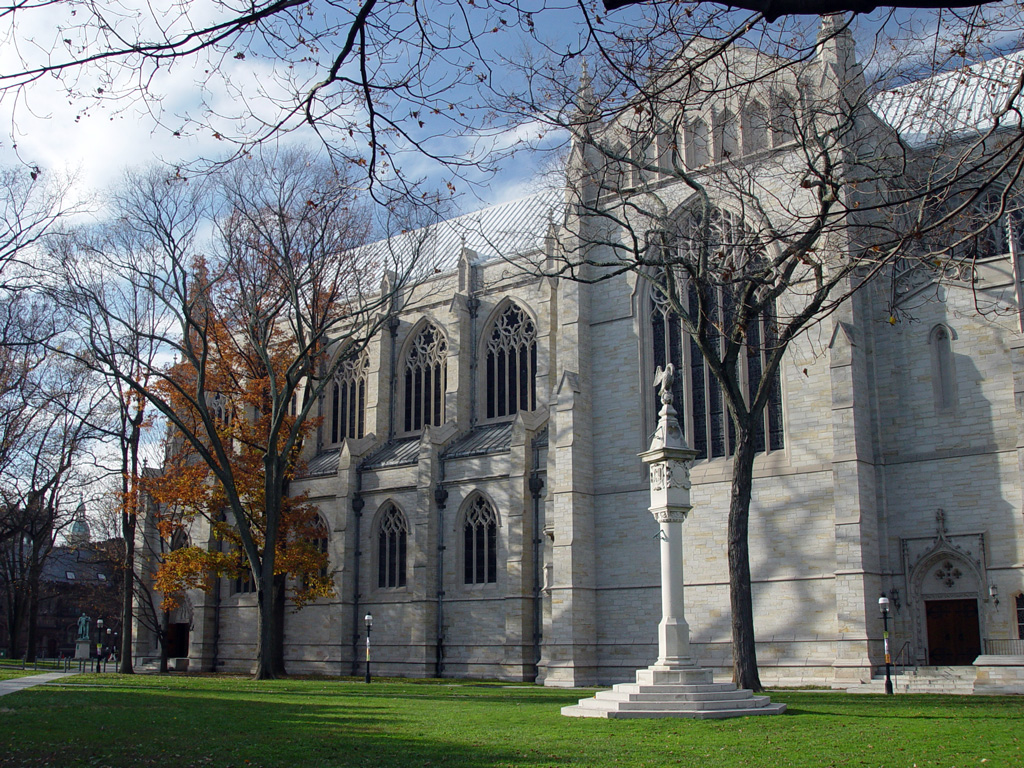
The Princeton University Chapel is a Collegiate Gothic chapel located on that university's main campus in Princeton, New Jersey, United States. It replaces an older chapel that burned down in 1920. Designed in 1921 by Ralph Adams Cram in his signature style, it was built by the university between 1924 and 1928 at a cost of $2.3 million. The chapel was rededicated in an interfaith ceremony in 2002 following a major two-year restoration.
Its size and design evoke a small cathedral of the English Middle Ages. The only university chapel of its size at the time it was built was King's College Chapel at the University of Cambridge. The foundation is poured concrete, and the superstructure is sandstone and limestone. The main sanctuary consists of a narthex, a gallery, a nave, two transepts joined by a crossing, and an elevated choir.
The chapel's extensive iconography consists of stained glass, stonemasonry, and wood carvings. Among the stained glass are four "great windows", one facing each cardinal direction, and four "Christian epic" windows in the walls of the choir. The iconography was planned by Albert M. Friend, a faculty member in Princeton's Department of Art and Archaeology, with the goal of portraying, in one scholar's words, a "synthesis between Christian faith and modern thought."
The chapel seats almost 2,000 people. A nondenominational chapel, it hosts weekly ecumenical Christian services and daily Catholic Masses. It also hosts several annual special events, such as baccalaureate services and commencements.
Princeton University built the chapel to replace the Marquand Chapel, which stood between where the present chapel and McCosh Hall stand until it burned to the ground in 1920. The location for the new chapel was chosen for two reasons: symbolically, the new chapel would rise from the ashes of the old one, and practically, it would locate the new chapel centrally as the campus expanded eastward.
Ralph Adams Cram, the university's supervising architect, designed and oversaw construction of the new chapel. Cram sought to build a crown jewel for the Collegiate Gothic motif he had championed on the Princeton campus. The university's president, John Grier Hibben, also had a stake in the project: student hostility toward Princeton's brand of mainline Presbyterianism was on the rise. An ordained minister, Hibben hoped the new chapel's majesty would inspire students to attend services of their own volition. Cram, a convert to High Church Episcopalianism from Unitarianism, also lent support to this aim.
Cram designed the chapel with the assistance of Alexander Hoyle, a member of his firm. Albert M. Friend, a faculty member in Princeton's Department of Art and Archaeology, played a central role in planning the iconography. It was built by Matthews Construction Company, which worked on several projects on Princeton's campus. Among those who contributed to the design of stained glass windows were Charles Connick, Henry Lee Willet (of the studio that would become Willet Hauser), and Philadelphia-based stained glass artist Nicola D'Ascenzo.
The plans for the new chapel were made public in 1921. Hibben called replacing the Marquand Chapel "an immediate necessity"; nonetheless, the project encountered financial problems early on. The insurance money from the Marquand Chapel was insufficient, and fundraising for the chapel competed with an ongoing general capital campaign for the university. Ground was broken during Princeton's commencement ceremonies in June 1924, and in the following year Cram and Hibben laid the cornerstone. The construction received considerable media attention, as it promised to be the largest university chapel in the United States and the second largest in the world after King's College Chapel, Cambridge. The construction cost about $2.3 million and was completed in 1928. Hibben led the dedication ceremony on May 31 of that year, in an elaborate ceremony covered by TIME.
Hub AI
Princeton University Chapel AI simulator
(@Princeton University Chapel_simulator)
Princeton University Chapel
The Princeton University Chapel is a Collegiate Gothic chapel located on that university's main campus in Princeton, New Jersey, United States. It replaces an older chapel that burned down in 1920. Designed in 1921 by Ralph Adams Cram in his signature style, it was built by the university between 1924 and 1928 at a cost of $2.3 million. The chapel was rededicated in an interfaith ceremony in 2002 following a major two-year restoration.
Its size and design evoke a small cathedral of the English Middle Ages. The only university chapel of its size at the time it was built was King's College Chapel at the University of Cambridge. The foundation is poured concrete, and the superstructure is sandstone and limestone. The main sanctuary consists of a narthex, a gallery, a nave, two transepts joined by a crossing, and an elevated choir.
The chapel's extensive iconography consists of stained glass, stonemasonry, and wood carvings. Among the stained glass are four "great windows", one facing each cardinal direction, and four "Christian epic" windows in the walls of the choir. The iconography was planned by Albert M. Friend, a faculty member in Princeton's Department of Art and Archaeology, with the goal of portraying, in one scholar's words, a "synthesis between Christian faith and modern thought."
The chapel seats almost 2,000 people. A nondenominational chapel, it hosts weekly ecumenical Christian services and daily Catholic Masses. It also hosts several annual special events, such as baccalaureate services and commencements.
Princeton University built the chapel to replace the Marquand Chapel, which stood between where the present chapel and McCosh Hall stand until it burned to the ground in 1920. The location for the new chapel was chosen for two reasons: symbolically, the new chapel would rise from the ashes of the old one, and practically, it would locate the new chapel centrally as the campus expanded eastward.
Ralph Adams Cram, the university's supervising architect, designed and oversaw construction of the new chapel. Cram sought to build a crown jewel for the Collegiate Gothic motif he had championed on the Princeton campus. The university's president, John Grier Hibben, also had a stake in the project: student hostility toward Princeton's brand of mainline Presbyterianism was on the rise. An ordained minister, Hibben hoped the new chapel's majesty would inspire students to attend services of their own volition. Cram, a convert to High Church Episcopalianism from Unitarianism, also lent support to this aim.
Cram designed the chapel with the assistance of Alexander Hoyle, a member of his firm. Albert M. Friend, a faculty member in Princeton's Department of Art and Archaeology, played a central role in planning the iconography. It was built by Matthews Construction Company, which worked on several projects on Princeton's campus. Among those who contributed to the design of stained glass windows were Charles Connick, Henry Lee Willet (of the studio that would become Willet Hauser), and Philadelphia-based stained glass artist Nicola D'Ascenzo.
The plans for the new chapel were made public in 1921. Hibben called replacing the Marquand Chapel "an immediate necessity"; nonetheless, the project encountered financial problems early on. The insurance money from the Marquand Chapel was insufficient, and fundraising for the chapel competed with an ongoing general capital campaign for the university. Ground was broken during Princeton's commencement ceremonies in June 1924, and in the following year Cram and Hibben laid the cornerstone. The construction received considerable media attention, as it promised to be the largest university chapel in the United States and the second largest in the world after King's College Chapel, Cambridge. The construction cost about $2.3 million and was completed in 1928. Hibben led the dedication ceremony on May 31 of that year, in an elaborate ceremony covered by TIME.