
Recent from talks
Principality of Nitra
Knowledge base stats:
Talk channels stats:
Members stats:
Principality of Nitra
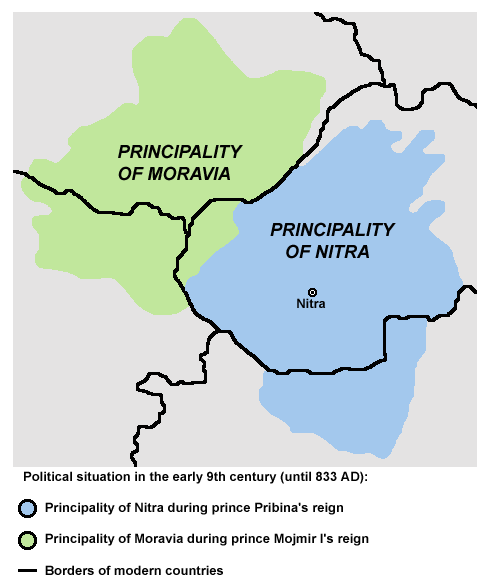
The Principality of Nitra (Slovak: Nitrianske kniežatstvo, Nitriansko, Nitrava, lit. 'Duchy of Nitra, Nitravia, Nitrava'; Hungarian: Nyitrai Fejedelemség), also known as the Duchy of Nitra, was a West Slavic polity encompassing a group of settlements that developed in the 9th century around Nitra, in present-day Slovakia. Its history remains uncertain because of a lack of contemporary sources. The territory's status is subject to scholarly debate: some modern historians describe it as an independent polity that was annexed either around 833 or 870[undue weight? – discuss] by the Principality of Moravia, while others say that it was under the influence of the neighbouring West Slavs from Moravia from its inception.
Modern-day Slovakia was dominated for centuries by Germanic peoples, including the Quadi and the Longobards, who were there until the middle of the 6th century. A new material culture characterized by handmade pottery, cremation burials and small, square, sunken huts that typically featured a corner stone oven appeared in the plains along the Middle Danube around that time. The new culture, with its "spartan and egalitarian" nature, sharply differed from the earlier archaeological cultures of Central Europe. According to Barford, a report by the Byzantine historian Procopius is the first certain reference to Early Slav groups inhabiting parts of present-day Slovakia. Procopius wrote that an exiled Lombard prince named Hildigis mustered an army, "taking with him not only those of the Lombards who had followed him, but also many of the Sclaveni" in the 540s.
The nomadic Avars, who arrived from the Eurasian steppes, invaded the Carpathian Basin and subjugated the local inhabitants in the second half of the 6th century. Thereafter, Slavic groups inhabiting areas around the core regions of the Avar Khaganate paid tribute to the Avars. The khaganate experienced a series of internal conflicts in the 630s. According to the Chronicle of Fredegar, the "Slavs who are known as Wends" rebelled against the Avars and elected a Frankish trader named Samo as their king in the early 7th century. Samo's realm, which emerged in the northern or northwestern regions of the Carpathian Basin, existed for more than three decades. It disintegrated soon after its founder's death and Avar control of the region was restored.
The Avar Khaganate collapsed around 803 as a result of several successful military campaigns launched by the Franks against it. The fall of the Khaganate contributed to the rise of new polities among the Slavs in the region. The shift in political control was accompanied by changes in military strategy and equipment. According to Curta, swords and other items of the "Blatnica-Mikulčice horizon" show "a shift from the mounted combat tactics typical of nomadic warfare to heavy cavalry equipment", and the development of a local elite in the regions to the north of the river Danube and the Great Hungarian Plain in the early 9th century.
The remains of a 9th-century fortress covering 12 hectares (30 acres), the age of which has not been determined, were unearthed in the centre of Nitra.[dubious – discuss] Beeby writes that the fortress belongs to the "Great Moravian period". According to Steinhübel, the fortress may have been named after the river Nitra, which flows below the hill upon which it stood. Archaeological research shows that a settlement inhabited by blacksmiths, goldsmiths and other artisans developed at the fortress. An extensive network of settlements emerged around it in the 9th century.
The main source of information about the polity now known as the Principality of Nitra is the Conversion of the Bavarians and Carantanians, a document compiled around 870 to promote the interests of the Archdiocese of Salzburg in Pannonia. The manuscripts state that "one Pribina", who had been "driven across the Danube by Mojmir, duke of the Moravians", fled to Radbod, Margrave of Pannonia (c. 833–856) in East Francia around 833. Radbod introduced him to King Louis the German, who ordered that Pribina should be "instructed in the faith and baptized". According to a sentence in three of the eleven extant manuscripts of the Conversion, Archbishop Adalram of Salzburg (r. 821–836) consecrated a church for Pribina "on his estate at a place over the Danube called Nitrava" at an unspecified date. Modern historians debate whether this sentence was part of the original text or was only a marginal note which was interpolated into the main text in the 12th century.
According to a widely accepted interpretation of the Conversion, Pribina was initially the ruler of an independent polity which was centered on Nitra. For instance, Barford writes that Pribina "was apparently prince of Nitra". Pribina's assumed realm is described as the "first demonstrable Slavic state north of the middle Danube" by Lukačka. Lukačka also says that Pribina had a retinue and that most its members "certainly descended from the former tribal aristocracy" but some of them "could have come from the free strata of the mass of the people". Richard Marsina says that it "can hardly be unambiguously decided whether Pribina was a prince of a greater tribe or of two or three smaller joined tribes". He adds that Pribina may have belonged to the second or third generation of the heads of this polity, which emerged in the valleys of the rivers Hron, Nitra, and Váh.
Scholars who write that Pribina was an independent ruler also say that his principality was united with Moravia after he was exiled from his homeland. Kirschbaum and Steinhübel add that the forced unification of the two principalities – Mojmir's Moravia and Pribina's Nitra – under Mojmir gave rise to the empire of Great Moravia. According to Marsina, the inhabitants of Pribina's principality who "definitely were aware of their difference from the Moravian Slavs" preserved their "specific consciousness" even within Great Moravia, which contributed to the development of the common consciousness of the ancestors of the Slovak people.
Hub AI
Principality of Nitra AI simulator
(@Principality of Nitra_simulator)
Principality of Nitra
The Principality of Nitra (Slovak: Nitrianske kniežatstvo, Nitriansko, Nitrava, lit. 'Duchy of Nitra, Nitravia, Nitrava'; Hungarian: Nyitrai Fejedelemség), also known as the Duchy of Nitra, was a West Slavic polity encompassing a group of settlements that developed in the 9th century around Nitra, in present-day Slovakia. Its history remains uncertain because of a lack of contemporary sources. The territory's status is subject to scholarly debate: some modern historians describe it as an independent polity that was annexed either around 833 or 870[undue weight? – discuss] by the Principality of Moravia, while others say that it was under the influence of the neighbouring West Slavs from Moravia from its inception.
Modern-day Slovakia was dominated for centuries by Germanic peoples, including the Quadi and the Longobards, who were there until the middle of the 6th century. A new material culture characterized by handmade pottery, cremation burials and small, square, sunken huts that typically featured a corner stone oven appeared in the plains along the Middle Danube around that time. The new culture, with its "spartan and egalitarian" nature, sharply differed from the earlier archaeological cultures of Central Europe. According to Barford, a report by the Byzantine historian Procopius is the first certain reference to Early Slav groups inhabiting parts of present-day Slovakia. Procopius wrote that an exiled Lombard prince named Hildigis mustered an army, "taking with him not only those of the Lombards who had followed him, but also many of the Sclaveni" in the 540s.
The nomadic Avars, who arrived from the Eurasian steppes, invaded the Carpathian Basin and subjugated the local inhabitants in the second half of the 6th century. Thereafter, Slavic groups inhabiting areas around the core regions of the Avar Khaganate paid tribute to the Avars. The khaganate experienced a series of internal conflicts in the 630s. According to the Chronicle of Fredegar, the "Slavs who are known as Wends" rebelled against the Avars and elected a Frankish trader named Samo as their king in the early 7th century. Samo's realm, which emerged in the northern or northwestern regions of the Carpathian Basin, existed for more than three decades. It disintegrated soon after its founder's death and Avar control of the region was restored.
The Avar Khaganate collapsed around 803 as a result of several successful military campaigns launched by the Franks against it. The fall of the Khaganate contributed to the rise of new polities among the Slavs in the region. The shift in political control was accompanied by changes in military strategy and equipment. According to Curta, swords and other items of the "Blatnica-Mikulčice horizon" show "a shift from the mounted combat tactics typical of nomadic warfare to heavy cavalry equipment", and the development of a local elite in the regions to the north of the river Danube and the Great Hungarian Plain in the early 9th century.
The remains of a 9th-century fortress covering 12 hectares (30 acres), the age of which has not been determined, were unearthed in the centre of Nitra.[dubious – discuss] Beeby writes that the fortress belongs to the "Great Moravian period". According to Steinhübel, the fortress may have been named after the river Nitra, which flows below the hill upon which it stood. Archaeological research shows that a settlement inhabited by blacksmiths, goldsmiths and other artisans developed at the fortress. An extensive network of settlements emerged around it in the 9th century.
The main source of information about the polity now known as the Principality of Nitra is the Conversion of the Bavarians and Carantanians, a document compiled around 870 to promote the interests of the Archdiocese of Salzburg in Pannonia. The manuscripts state that "one Pribina", who had been "driven across the Danube by Mojmir, duke of the Moravians", fled to Radbod, Margrave of Pannonia (c. 833–856) in East Francia around 833. Radbod introduced him to King Louis the German, who ordered that Pribina should be "instructed in the faith and baptized". According to a sentence in three of the eleven extant manuscripts of the Conversion, Archbishop Adalram of Salzburg (r. 821–836) consecrated a church for Pribina "on his estate at a place over the Danube called Nitrava" at an unspecified date. Modern historians debate whether this sentence was part of the original text or was only a marginal note which was interpolated into the main text in the 12th century.
According to a widely accepted interpretation of the Conversion, Pribina was initially the ruler of an independent polity which was centered on Nitra. For instance, Barford writes that Pribina "was apparently prince of Nitra". Pribina's assumed realm is described as the "first demonstrable Slavic state north of the middle Danube" by Lukačka. Lukačka also says that Pribina had a retinue and that most its members "certainly descended from the former tribal aristocracy" but some of them "could have come from the free strata of the mass of the people". Richard Marsina says that it "can hardly be unambiguously decided whether Pribina was a prince of a greater tribe or of two or three smaller joined tribes". He adds that Pribina may have belonged to the second or third generation of the heads of this polity, which emerged in the valleys of the rivers Hron, Nitra, and Váh.
Scholars who write that Pribina was an independent ruler also say that his principality was united with Moravia after he was exiled from his homeland. Kirschbaum and Steinhübel add that the forced unification of the two principalities – Mojmir's Moravia and Pribina's Nitra – under Mojmir gave rise to the empire of Great Moravia. According to Marsina, the inhabitants of Pribina's principality who "definitely were aware of their difference from the Moravian Slavs" preserved their "specific consciousness" even within Great Moravia, which contributed to the development of the common consciousness of the ancestors of the Slovak people.
Recent media