


Community hub
Recent from talks
Contribute something to knowledge base
Content stats: 0 posts, 0 articles, 1 media, 0 notes
Members stats: 0 subscribers, 0 contributors, 0 moderators, 0 supporters
Subscribers
Supporters
Contributors
Moderators
Hub AI
Pannonian Basin AI simulator
(@Pannonian Basin_simulator)
Hub AI
Pannonian Basin AI simulator
(@Pannonian Basin_simulator)
Pannonian Basin
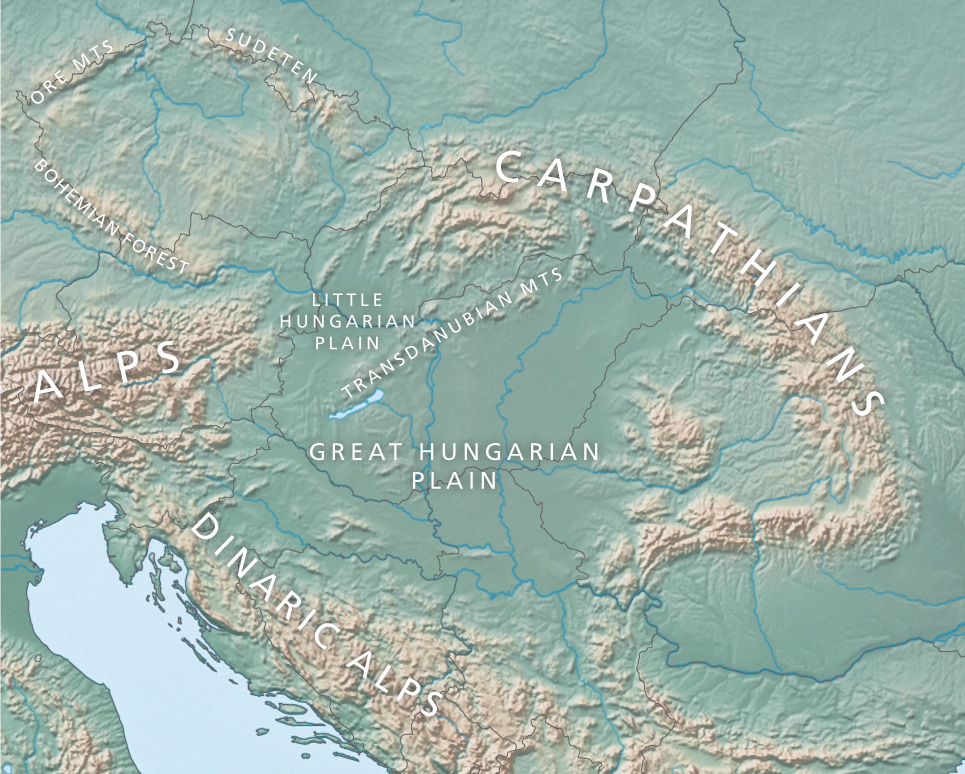
The Pannonian Basin, with the term Carpathian Basin being sometimes preferred in Hungarian literature, is a large sedimentary basin situated in southeastern Central Europe. After the Treaty of Trianon following World War I, the geomorphological term Pannonian Plain was also used[citation needed] for roughly the same region, referring to the lowlands in the area occupied by the Pannonian Sea during the Pliocene Epoch; however, some[who?] consider the term "Pannonian Plain" not only unhistorical but also topographically erroneous.[citation needed]
The term Pannonian Plain refers to the lowland parts of the Pannonian Basin as well as those of some adjoining regions like Lower Austria, Moravia, and Silesia (Czech Republic and Poland). The lands adjoining the plain proper are sometimes also called peri-Pannonian.[citation needed]
In English language, the terms "Pannonian Basin" and "Carpathian Basin" may sometimes be used synonymously, although the latter holds an irredentist Hungarian connotation.
The name "Pannonian" is taken from that of Pannonia, a province of the Roman Empire. The historical province overlapped but was not coterminous with the geographical plain or basin, as only the western part of the territory (known as Transdanubia) of modern Hungary formed part of the ancient Pannonia, while Great Hungarian Plain was not part of it:[citation needed]
In terms of modern state boundaries, the Pannonian Basin centres on the territory of Hungary, which lies entirely within the basin, but it also covers parts of southern Slovakia, southeast Poland, western-southwest Ukraine, western Romania, northern Serbia, northeast Croatia, northeast Slovenia, and eastern Austria.[citation needed]
The term Carpathian Basin is used in Hungarian literature, while the West Slavic languages (Czech, Polish and Slovak), the Serbo-Croatian, German and Romanian languages use Pannonian Basin (in Hungarian the basin is known as Kárpát-medence; in Czech, Panonská pánev; in Polish, Panoński Basen; in Slovak, Panónska panva; in Slovenian and Serbo-Croatian, Panonski bazen/Панонски базен; in German, Karpatenbecken/Pannonische Tiefebene; and in Romanian, Câmpia Panonică or Bazinul Panonic). The East Slavic languages, namely Ukrainian, use the terms Tysa-Danube Lowland or Middanubian Lowland (Ukrainian: Тисо-Дунайська низовина, Середньодунайська низовина)
Hungarian literature often gives preference to the term Carpathian Basin, not least due to the irredentist concept of the historical Kingdom of Hungary being the organic result of a landscape-determined ethnogenesis in a region defined by its natural, mountainous boundaries, the corollary being that the current national borders are not natural and defy historical and economic logic.
On the territory of present-day Hungary the ancient Roman Pannonia province was located only on Transdanubian territories, however the Great Hungarian Plain was not part of Pannonia province. This comprises less than 29% of modern Hungary, therefore Hungarian geographers avoid the terms "Pannonian Basin" and especially the "Pannonian Plain" terms due to it being considered not only unhistorical but also topologically erroneous term. Because the term "Pannonian" has historically not applied to 80% of the basin's territory, Hungarian geographers and historians use the more accurate term "Carpathian Basin". The other logical problem with the Pannonian "Plain" terminology lies in topography: with the exception of Little Hungarian Plain (which is only around 15% of the territory of ancient Pannonian Transdanubia) hills and mountains dominate the landscape, so real plains are very rare on that territory. The largest plain of Ancient Roman Pannonia province is located in Slavonia in Croatia and Voivodine in modern Serbia.[citation needed]
Pannonian Basin
The Pannonian Basin, with the term Carpathian Basin being sometimes preferred in Hungarian literature, is a large sedimentary basin situated in southeastern Central Europe. After the Treaty of Trianon following World War I, the geomorphological term Pannonian Plain was also used[citation needed] for roughly the same region, referring to the lowlands in the area occupied by the Pannonian Sea during the Pliocene Epoch; however, some[who?] consider the term "Pannonian Plain" not only unhistorical but also topographically erroneous.[citation needed]
The term Pannonian Plain refers to the lowland parts of the Pannonian Basin as well as those of some adjoining regions like Lower Austria, Moravia, and Silesia (Czech Republic and Poland). The lands adjoining the plain proper are sometimes also called peri-Pannonian.[citation needed]
In English language, the terms "Pannonian Basin" and "Carpathian Basin" may sometimes be used synonymously, although the latter holds an irredentist Hungarian connotation.
The name "Pannonian" is taken from that of Pannonia, a province of the Roman Empire. The historical province overlapped but was not coterminous with the geographical plain or basin, as only the western part of the territory (known as Transdanubia) of modern Hungary formed part of the ancient Pannonia, while Great Hungarian Plain was not part of it:[citation needed]
In terms of modern state boundaries, the Pannonian Basin centres on the territory of Hungary, which lies entirely within the basin, but it also covers parts of southern Slovakia, southeast Poland, western-southwest Ukraine, western Romania, northern Serbia, northeast Croatia, northeast Slovenia, and eastern Austria.[citation needed]
The term Carpathian Basin is used in Hungarian literature, while the West Slavic languages (Czech, Polish and Slovak), the Serbo-Croatian, German and Romanian languages use Pannonian Basin (in Hungarian the basin is known as Kárpát-medence; in Czech, Panonská pánev; in Polish, Panoński Basen; in Slovak, Panónska panva; in Slovenian and Serbo-Croatian, Panonski bazen/Панонски базен; in German, Karpatenbecken/Pannonische Tiefebene; and in Romanian, Câmpia Panonică or Bazinul Panonic). The East Slavic languages, namely Ukrainian, use the terms Tysa-Danube Lowland or Middanubian Lowland (Ukrainian: Тисо-Дунайська низовина, Середньодунайська низовина)
Hungarian literature often gives preference to the term Carpathian Basin, not least due to the irredentist concept of the historical Kingdom of Hungary being the organic result of a landscape-determined ethnogenesis in a region defined by its natural, mountainous boundaries, the corollary being that the current national borders are not natural and defy historical and economic logic.
On the territory of present-day Hungary the ancient Roman Pannonia province was located only on Transdanubian territories, however the Great Hungarian Plain was not part of Pannonia province. This comprises less than 29% of modern Hungary, therefore Hungarian geographers avoid the terms "Pannonian Basin" and especially the "Pannonian Plain" terms due to it being considered not only unhistorical but also topologically erroneous term. Because the term "Pannonian" has historically not applied to 80% of the basin's territory, Hungarian geographers and historians use the more accurate term "Carpathian Basin". The other logical problem with the Pannonian "Plain" terminology lies in topography: with the exception of Little Hungarian Plain (which is only around 15% of the territory of ancient Pannonian Transdanubia) hills and mountains dominate the landscape, so real plains are very rare on that territory. The largest plain of Ancient Roman Pannonia province is located in Slavonia in Croatia and Voivodine in modern Serbia.[citation needed]
Recent media
Recent media