



Community hub
Recent from talks
Contribute something
Nothing was collected or created yet.
Box topology
View on WikipediaIn topology, the cartesian product of topological spaces can be given several different topologies. One of the more natural choices is the box topology, where a base is given by the Cartesian products of open sets in the component spaces.[1] Another possibility is the product topology, where a base is also given by the Cartesian products of open sets in the component spaces, but only finitely many of which can be unequal to the entire component space.
While the box topology has a somewhat more intuitive definition than the product topology, it satisfies fewer desirable properties. In particular, if all the component spaces are compact, the box topology on their Cartesian product will not necessarily be compact, although the product topology on their Cartesian product will always be compact. In general, the box topology is finer than the product topology, although the two agree in the case of finite direct products (or when all but finitely many of the factors are trivial).
Definition
[edit]Given such that

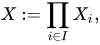
or the (possibly infinite) Cartesian product of the topological spaces , indexed by , the box topology on is generated by the base


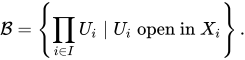
The name box comes from the case of Rn, in which the basis sets look like boxes. The set endowed with the box topology is sometimes denoted by


Properties
[edit]Box topology on Rω:[2]
- The box topology is completely regular
- The box topology is neither compact nor connected
- The box topology is not first countable (hence not metrizable)
- The box topology is not separable
- The box topology is paracompact (and hence normal) if the continuum hypothesis is true
Example — failure of continuity
[edit]The following example is based on the Hilbert cube. Let Rω denote the countable cartesian product of R with itself, i.e. the set of all sequences in R. Equip R with the standard topology and Rω with the box topology. Define:
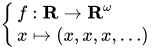
So all the component functions are the identity and hence continuous, however we will show f is not continuous. To see this, consider the open set

Suppose f were continuous. Then, since:

there should exist such that But this would imply that



which is false since for Thus f is not continuous even though all its component functions are.


Example — failure of compactness
[edit]Consider the countable product where for each i, with the discrete topology. The box topology on will also be the discrete topology. Since discrete spaces are compact if and only if they are finite, we immediately see that is not compact, even though its component spaces are.


is not sequentially compact either: consider the sequence given by

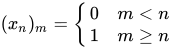
Since no two points in the sequence are the same, the sequence has no limit point, and therefore is not sequentially compact.
Convergence in the box topology
[edit]Topologies are often best understood by describing how sequences converge. In general, a Cartesian product of a space with itself over an indexing set is precisely the space of functions from to , denoted . The product topology yields the topology of pointwise convergence; sequences of functions converge if and only if they converge at every point of .

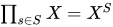
Because the box topology is finer than the product topology, convergence of a sequence in the box topology is a more stringent condition. Assuming is Hausdorff, a sequence of functions in converges in the box topology to a function if and only if it converges pointwise to and there is a finite subset and there is an such that for all the sequence in is constant for all . In other words, the sequence is eventually constant for nearly all and in a uniform way.[3]


Comparison with product topology
[edit]The basis sets in the product topology have almost the same definition as the above, except with the qualification that all but finitely many Ui are equal to the component space Xi. The product topology satisfies a very desirable property for maps fi : Y → Xi into the component spaces: the product map f: Y → X defined by the component functions fi is continuous if and only if all the fi are continuous. As shown above, this does not always hold in the box topology. This actually makes the box topology very useful for providing counterexamples—many qualities such as compactness, connectedness, metrizability, etc., if possessed by the factor spaces, are not in general preserved in the product with this topology.
See also
[edit]Notes
[edit]- ^ Willard, 8.2 pp. 52–53,
- ^ Steen, Seebach, 109. pp. 128–129.
- ^ Scott, Brian M. "Difference between the behavior of a sequence and a function in product and box topology on same set". math.stackexchange.com.
References
[edit]- Steen, Lynn A. and Seebach, J. Arthur Jr.; Counterexamples in Topology, Holt, Rinehart and Winston (1970). ISBN 0030794854.
- Willard, Stephen (2004). General Topology. Dover Publications. ISBN 0-486-43479-6.