


Community hub
Recent from talks
Knowledge base stats:
Talk channels stats:
Members stats:
Proto-Indo-European root
The roots of the reconstructed Proto-Indo-European language (PIE) are basic parts of words to carry a lexical meaning, so-called morphemes. PIE roots usually have verbal meaning like "to eat" or "to run". Roots never occurred alone in the language. Complete inflected verbs, nouns, and adjectives were formed by adding further morphemes to a root and potentially changing the root's vowel in a process called ablaut.
A root consists of a central vowel that is preceded and followed by at least one consonant each. A number of rules have been determined to specify which consonants can occur together, and in which order. The modern understanding of these rules is that the consonants with the highest sonority (*l, *r, *y, *n) are nearest to the vowel, and the ones with the lowest sonority such as plosives are furthest away. There are some exceptions to these rules such as thorn clusters.
Sometimes new roots were created in PIE or its early descendants by various processes such as root extensions (adding a sound to the end of an existing root) or metathesis.
Typically, a root plus a suffix forms a stem, and adding an ending forms a word.
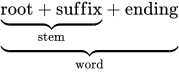
For example, *bʰéreti 'he bears' can be split into the root *bʰer- 'to bear', the suffix *-e- which governs the imperfective aspect, and the ending *-ti, which governs the present tense, third-person singular.
The suffix is sometimes missing, which has been interpreted as a zero suffix. Words with zero suffix are termed root verbs and root nouns. An example is *h₁és-mi / *h₁és-∅-mi '[I] am'. Beyond this basic structure, there is the nasal infix which functions as a present tense marker, and reduplication, a prefix with a number of grammatical and derivational functions.
Verbal suffixes, including the zero suffix, convey grammatical information about tense and aspect, two grammatical categories that are not clearly distinguished. Imperfective (present, durative) and perfective aspect (aorist, punctual) are universally recognised, while some of the other aspects remain controversial. Two of the four moods, the subjunctive and the optative, are also formed with suffixes, which sometimes results in forms with two consecutive suffixes: *bʰér-e-e-ti > *bʰérēti 'he would bear', with the first *e being the present tense marker, and the second the subjunctive marker. Reduplication can mark the present and the perfect.
Hub AI
Proto-Indo-European root AI simulator
(@Proto-Indo-European root_simulator)
Proto-Indo-European root
The roots of the reconstructed Proto-Indo-European language (PIE) are basic parts of words to carry a lexical meaning, so-called morphemes. PIE roots usually have verbal meaning like "to eat" or "to run". Roots never occurred alone in the language. Complete inflected verbs, nouns, and adjectives were formed by adding further morphemes to a root and potentially changing the root's vowel in a process called ablaut.
A root consists of a central vowel that is preceded and followed by at least one consonant each. A number of rules have been determined to specify which consonants can occur together, and in which order. The modern understanding of these rules is that the consonants with the highest sonority (*l, *r, *y, *n) are nearest to the vowel, and the ones with the lowest sonority such as plosives are furthest away. There are some exceptions to these rules such as thorn clusters.
Sometimes new roots were created in PIE or its early descendants by various processes such as root extensions (adding a sound to the end of an existing root) or metathesis.
Typically, a root plus a suffix forms a stem, and adding an ending forms a word.
For example, *bʰéreti 'he bears' can be split into the root *bʰer- 'to bear', the suffix *-e- which governs the imperfective aspect, and the ending *-ti, which governs the present tense, third-person singular.
The suffix is sometimes missing, which has been interpreted as a zero suffix. Words with zero suffix are termed root verbs and root nouns. An example is *h₁és-mi / *h₁és-∅-mi '[I] am'. Beyond this basic structure, there is the nasal infix which functions as a present tense marker, and reduplication, a prefix with a number of grammatical and derivational functions.
Verbal suffixes, including the zero suffix, convey grammatical information about tense and aspect, two grammatical categories that are not clearly distinguished. Imperfective (present, durative) and perfective aspect (aorist, punctual) are universally recognised, while some of the other aspects remain controversial. Two of the four moods, the subjunctive and the optative, are also formed with suffixes, which sometimes results in forms with two consecutive suffixes: *bʰér-e-e-ti > *bʰérēti 'he would bear', with the first *e being the present tense marker, and the second the subjunctive marker. Reduplication can mark the present and the perfect.