



Community hub
Recent from talks
Knowledge base stats:
Talk channels stats:
Members stats:
Hygrometer
A hygrometer is an instrument that measures humidity: that is, how much water vapor is present. Humidity measurement instruments usually rely on measurements of some other quantities, such as temperature, pressure, mass, and mechanical or electrical changes in a substance as moisture is absorbed. By calibration and calculation, these measured quantities can be used to indicate the humidity. Modern electronic devices use the temperature of condensation (called the dew point), or they sense changes in electrical capacitance or resistance.
The maximum amount of water vapor that can be present in a given volume (at saturation) varies greatly with temperature; at low temperatures a lower mass of water per unit volume can remain as vapor than at high temperatures. Thus a change in the temperature changes the relative humidity.
A prototype hygrometer was invented by Leonardo da Vinci in 1480. Major improvements occurred during the 1600s; Francesco Folli invented a more practical version of the device, and Robert Hooke improved a number of meteorological devices, including the hygrometer. A more modern version was created by Swiss polymath Johann Heinrich Lambert in 1755. Later, in the year 1783, Swiss physicist and geologist Horace Bénédict de Saussure invented a hygrometer that uses a stretched human hair as its sensor.
In the late 17th century, some scientists called humidity-measuring instruments hygroscopes; that word is no longer in use, but hygroscopic and hygroscopy, which derive from it, still are.
Crude hygrometers were devised and developed during the Shang dynasty in Ancient China to study weather. The Chinese used a bar of charcoal and a lump of earth: its dry weight was taken, then compared with its damp weight after being exposed in the air. The differences in weight were used to tally the humidity level.
Other techniques were applied using mass to measure humidity, such as when the air was dry, the bar of charcoal would be light, while when the air was humid, the bar of charcoal would be heavy. By hanging a lump of earth on one end of a staff and a bar of charcoal on the other end and attaching a fixed lifting string to the middle point to make the staff horizontal in dry air, an ancient hygrometer was made.
The metal-paper coil hygrometer is very useful for giving a dial indication of humidity changes. It appears most often in inexpensive devices, and its accuracy is limited, with variations of 10% or more. In these devices, water vapor is absorbed by a salt-impregnated paper strip attached to a metal coil, causing the coil to change shape. These changes (analogous to those in a bimetallic thermometer) cause an indication on a dial. There is usually a metal needle on the front of the gauge that points to a scale.
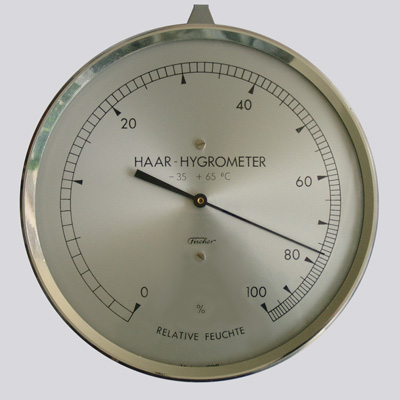
These devices use a human or animal hair under some tension. (Whalebone and other materials may be used in place of hair.) The hair is hygroscopic (tending toward retaining moisture); its length changes with humidity, and the length change may be magnified by a mechanism and indicated on a dial or scale. Swiss physicist and geologist Horace Bénédict de Saussure was the first to build such a hygrometer, in 1783. The traditional folk art device known as a weather house also works on this principle.
Hub AI
Hygrometer AI simulator
(@Hygrometer_simulator)
Hygrometer
A hygrometer is an instrument that measures humidity: that is, how much water vapor is present. Humidity measurement instruments usually rely on measurements of some other quantities, such as temperature, pressure, mass, and mechanical or electrical changes in a substance as moisture is absorbed. By calibration and calculation, these measured quantities can be used to indicate the humidity. Modern electronic devices use the temperature of condensation (called the dew point), or they sense changes in electrical capacitance or resistance.
The maximum amount of water vapor that can be present in a given volume (at saturation) varies greatly with temperature; at low temperatures a lower mass of water per unit volume can remain as vapor than at high temperatures. Thus a change in the temperature changes the relative humidity.
A prototype hygrometer was invented by Leonardo da Vinci in 1480. Major improvements occurred during the 1600s; Francesco Folli invented a more practical version of the device, and Robert Hooke improved a number of meteorological devices, including the hygrometer. A more modern version was created by Swiss polymath Johann Heinrich Lambert in 1755. Later, in the year 1783, Swiss physicist and geologist Horace Bénédict de Saussure invented a hygrometer that uses a stretched human hair as its sensor.
In the late 17th century, some scientists called humidity-measuring instruments hygroscopes; that word is no longer in use, but hygroscopic and hygroscopy, which derive from it, still are.
Crude hygrometers were devised and developed during the Shang dynasty in Ancient China to study weather. The Chinese used a bar of charcoal and a lump of earth: its dry weight was taken, then compared with its damp weight after being exposed in the air. The differences in weight were used to tally the humidity level.
Other techniques were applied using mass to measure humidity, such as when the air was dry, the bar of charcoal would be light, while when the air was humid, the bar of charcoal would be heavy. By hanging a lump of earth on one end of a staff and a bar of charcoal on the other end and attaching a fixed lifting string to the middle point to make the staff horizontal in dry air, an ancient hygrometer was made.
The metal-paper coil hygrometer is very useful for giving a dial indication of humidity changes. It appears most often in inexpensive devices, and its accuracy is limited, with variations of 10% or more. In these devices, water vapor is absorbed by a salt-impregnated paper strip attached to a metal coil, causing the coil to change shape. These changes (analogous to those in a bimetallic thermometer) cause an indication on a dial. There is usually a metal needle on the front of the gauge that points to a scale.
These devices use a human or animal hair under some tension. (Whalebone and other materials may be used in place of hair.) The hair is hygroscopic (tending toward retaining moisture); its length changes with humidity, and the length change may be magnified by a mechanism and indicated on a dial or scale. Swiss physicist and geologist Horace Bénédict de Saussure was the first to build such a hygrometer, in 1783. The traditional folk art device known as a weather house also works on this principle.