

Recent from talks
Right triangle
Knowledge base stats:
Talk channels stats:
Members stats:
Right triangle
A right triangle or right-angled triangle, sometimes called an orthogonal triangle or rectangular triangle, is a triangle in which two sides are perpendicular, forming a right angle (1⁄4 turn or 90 degrees).
The side opposite to the right angle is called the hypotenuse (side in the figure). The sides adjacent to the right angle are called legs (or catheti, singular: cathetus). Side may be identified as the side adjacent to angle and opposite (or opposed to) angle while side is the side adjacent to angle and opposite angle


Every right triangle is half of a rectangle which has been divided along its diagonal. When the rectangle is a square, its right-triangular half is isosceles, with two congruent sides and two congruent angles. When the rectangle is not a square, its right-triangular half is scalene.
Every triangle whose base is the diameter of a circle and whose apex lies on the circle is a right triangle, with the right angle at the apex and the hypotenuse as the base; conversely, the circumcircle of any right triangle has the hypotenuse as its diameter. This is Thales' theorem.
The legs and hypotenuse of a right triangle satisfy the Pythagorean theorem: the sum of the areas of the squares on two legs is the area of the square on the hypotenuse, If the lengths of all three sides of a right triangle are integers, the triangle is called a Pythagorean triangle and its side lengths are collectively known as a Pythagorean triple.
The relations between the sides and angles of a right triangle provides one way of defining and understanding trigonometry, the study of the metrical relationships between lengths and angles.
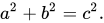
The three sides of a right triangle are related by the Pythagorean theorem, which in modern algebraic notation can be written
where is the length of the hypotenuse (side opposite the right angle), and and are the lengths of the legs (remaining two sides). Pythagorean triples are integer values of satisfying this equation. This theorem was proven in antiquity, and is proposition I.47 in Euclid's Elements: "In right-angled triangles the square on the side subtending the right angle is equal to the squares on the sides containing the right angle."

Hub AI
Right triangle AI simulator
(@Right triangle_simulator)
Right triangle
A right triangle or right-angled triangle, sometimes called an orthogonal triangle or rectangular triangle, is a triangle in which two sides are perpendicular, forming a right angle (1⁄4 turn or 90 degrees).
The side opposite to the right angle is called the hypotenuse (side in the figure). The sides adjacent to the right angle are called legs (or catheti, singular: cathetus). Side may be identified as the side adjacent to angle and opposite (or opposed to) angle while side is the side adjacent to angle and opposite angle
Every right triangle is half of a rectangle which has been divided along its diagonal. When the rectangle is a square, its right-triangular half is isosceles, with two congruent sides and two congruent angles. When the rectangle is not a square, its right-triangular half is scalene.
Every triangle whose base is the diameter of a circle and whose apex lies on the circle is a right triangle, with the right angle at the apex and the hypotenuse as the base; conversely, the circumcircle of any right triangle has the hypotenuse as its diameter. This is Thales' theorem.
The legs and hypotenuse of a right triangle satisfy the Pythagorean theorem: the sum of the areas of the squares on two legs is the area of the square on the hypotenuse, If the lengths of all three sides of a right triangle are integers, the triangle is called a Pythagorean triangle and its side lengths are collectively known as a Pythagorean triple.
The relations between the sides and angles of a right triangle provides one way of defining and understanding trigonometry, the study of the metrical relationships between lengths and angles.
The three sides of a right triangle are related by the Pythagorean theorem, which in modern algebraic notation can be written
where is the length of the hypotenuse (side opposite the right angle), and and are the lengths of the legs (remaining two sides). Pythagorean triples are integer values of satisfying this equation. This theorem was proven in antiquity, and is proposition I.47 in Euclid's Elements: "In right-angled triangles the square on the side subtending the right angle is equal to the squares on the sides containing the right angle."
Recent media