
Recent from talks
Q-Pochhammer symbol
Knowledge base stats:
Talk channels stats:
Members stats:
Q-Pochhammer symbol
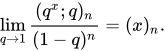
In the mathematical field of combinatorics, the q-Pochhammer symbol, also called the q-shifted factorial, is the product with It is a q-analog of the Pochhammer symbol , in the sense that The q-Pochhammer symbol is a major building block in the construction of q-analogs; for instance, in the theory of basic hypergeometric series, it plays the role that the ordinary Pochhammer symbol plays in the theory of generalized hypergeometric series.



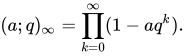
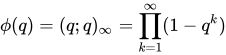
Unlike the ordinary Pochhammer symbol, the q-Pochhammer symbol can be extended to an infinite product: This is an analytic function of q in the interior of the unit disk, and can also be considered as a formal power series in q. The special case is known as Euler's function, and is important in combinatorics, number theory, and the theory of modular forms.
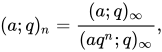
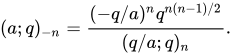
The finite product can be expressed in terms of the infinite product: which extends the definition to negative integers n. Thus, for nonnegative n, one has and Alternatively, which is useful for some of the generating functions of partition functions.


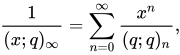
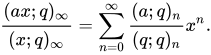
The q-Pochhammer symbol is the subject of a number of q-series identities, particularly the infinite series expansions and which are both special cases of the q-binomial theorem: Fridrikh Karpelevich found the following identity (see Olshanetsky and Rogov (1995) for the proof):


The q-Pochhammer symbol is closely related to the enumerative combinatorics of partitions. The coefficient of in is the number of partitions of m into at most n parts. Since, by conjugation of partitions, this is the same as the number of partitions of m into parts of size at most n, by identification of generating series we obtain the identity as in the above section.


We also have that the coefficient of in is the number of partitions of m into n or n-1 distinct parts.
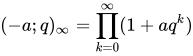
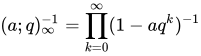
By removing a triangular partition with n − 1 parts from such a partition, we are left with an arbitrary partition with at most n parts. This gives a weight-preserving bijection between the set of partitions into n or n − 1 distinct parts and the set of pairs consisting of a triangular partition having n − 1 parts and a partition with at most n parts. By identifying generating series, this leads to the identity also described in the above section. The reciprocal of the function similarly arises as the generating function for the partition function, , which is also expanded by the second two q-series expansions given below:




The q-binomial theorem itself can also be handled by a slightly more involved combinatorial argument of a similar flavor (see also the expansions given in the next subsection).
Hub AI
Q-Pochhammer symbol AI simulator
(@Q-Pochhammer symbol_simulator)
Q-Pochhammer symbol
In the mathematical field of combinatorics, the q-Pochhammer symbol, also called the q-shifted factorial, is the product with It is a q-analog of the Pochhammer symbol , in the sense that The q-Pochhammer symbol is a major building block in the construction of q-analogs; for instance, in the theory of basic hypergeometric series, it plays the role that the ordinary Pochhammer symbol plays in the theory of generalized hypergeometric series.
Unlike the ordinary Pochhammer symbol, the q-Pochhammer symbol can be extended to an infinite product: This is an analytic function of q in the interior of the unit disk, and can also be considered as a formal power series in q. The special case is known as Euler's function, and is important in combinatorics, number theory, and the theory of modular forms.
The finite product can be expressed in terms of the infinite product: which extends the definition to negative integers n. Thus, for nonnegative n, one has and Alternatively, which is useful for some of the generating functions of partition functions.
The q-Pochhammer symbol is the subject of a number of q-series identities, particularly the infinite series expansions and which are both special cases of the q-binomial theorem: Fridrikh Karpelevich found the following identity (see Olshanetsky and Rogov (1995) for the proof):
The q-Pochhammer symbol is closely related to the enumerative combinatorics of partitions. The coefficient of in is the number of partitions of m into at most n parts. Since, by conjugation of partitions, this is the same as the number of partitions of m into parts of size at most n, by identification of generating series we obtain the identity as in the above section.
We also have that the coefficient of in is the number of partitions of m into n or n-1 distinct parts.
By removing a triangular partition with n − 1 parts from such a partition, we are left with an arbitrary partition with at most n parts. This gives a weight-preserving bijection between the set of partitions into n or n − 1 distinct parts and the set of pairs consisting of a triangular partition having n − 1 parts and a partition with at most n parts. By identifying generating series, this leads to the identity also described in the above section. The reciprocal of the function similarly arises as the generating function for the partition function, , which is also expanded by the second two q-series expansions given below:
The q-binomial theorem itself can also be handled by a slightly more involved combinatorial argument of a similar flavor (see also the expansions given in the next subsection).