Hubbry Logo
Unit diskUnit diskMain
Open search
Unit disk
Community hub
Unit disk
logo
8 pages, 0 posts
0 subscribers
Be the first to start a discussion here.
Unit disk
Unit disk
from Wikipedia
An open Euclidean unit disk

In mathematics, the open unit disk (or disc) around P (where P is a given point in the plane), is the set of points whose distance from P is less than 1:

The closed unit disk around P is the set of points whose distance from P is less than or equal to one:

Unit disks are special cases of disks and unit balls; as such, they contain the interior of the unit circle and, in the case of the closed unit disk, the unit circle itself.

Without further specifications, the term unit disk is used for the open unit disk about the origin, , with respect to the standard Euclidean metric. It is the interior of a circle of radius 1, centered at the origin. This set can be identified with the set of all complex numbers of absolute value less than one. When viewed as a subset of the complex plane (C), the open unit disk is often denoted . Unlike the notationally similar circle group , the (open) unit disk is not a multiplicative group.


The open unit disk, the plane, and the upper half-plane

[edit]

The function

is an example of a real analytic and bijective function from the open unit disk to the plane; its inverse function is also analytic. Considered as a real 2-dimensional analytic manifold, the open unit disk is therefore isomorphic to the whole plane. In particular, the open unit disk is homeomorphic to the whole plane.

There is however no conformal bijective map between the open unit disk and the plane. Considered as a Riemann surface, the open unit disk is therefore different from the complex plane.

There are conformal bijective maps between the open unit disk and the open upper half-plane. So considered as a Riemann surface, the open unit disk is isomorphic ("biholomorphic", or "conformally equivalent") to the upper half-plane, and the two are often used interchangeably.

Much more generally, the Riemann mapping theorem states that every simply connected open subset of the complex plane that is different from the complex plane itself admits a conformal and bijective map to the open unit disk.

One bijective conformal map from the open unit disk to the open upper half-plane is the Möbius transformation

  which is the inverse of the Cayley transform.
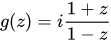
Geometrically, one can imagine the real axis being bent and shrunk so that the upper half-plane becomes the disk's interior and the real axis forms the disk's circumference, save for one point at the top, the "point at infinity". A bijective conformal map from the open unit disk to the open upper half-plane can also be constructed as the composition of two stereographic projections: first the unit disk is stereographically projected upward onto the unit upper half-sphere, taking the "south-pole" of the unit sphere as the projection center, and then this half-sphere is projected sideways onto a vertical half-plane touching the sphere, taking the point on the half-sphere opposite to the touching point as projection center.

The unit disk and the upper half-plane are not interchangeable as domains for Hardy spaces. Contributing to this difference is the fact that the unit circle has finite (one-dimensional) Lebesgue measure while the real line does not.

Hyperbolic plane

[edit]

The open unit disk forms the set of points for the Poincaré disk model of the hyperbolic plane. Circular arcs perpendicular to the unit circle form the "lines" in this model. The unit circle is the Cayley absolute that determines a metric on the disk through use of cross-ratio in the style of the Cayley–Klein metric. In the language of differential geometry, the circular arcs perpendicular to the unit circle are geodesics that show the shortest distance between points in the model. The model includes motions which are expressed by the special unitary group SU(1,1). The disk model can be transformed to the Poincaré half-plane model by the mapping g given above.

Both the Poincaré disk and the Poincaré half-plane are conformal models of the hyperbolic plane, which is to say that angles between intersecting curves are preserved by motions of their isometry groups.

Another model of hyperbolic space is also built on the open unit disk: the Beltrami–Klein model. It is not conformal, but has the property that the geodesics are straight lines.

Unit disks with respect to other metrics

[edit]
From top to bottom: open unit disk in the Euclidean metric, taxicab metric, and Chebyshev metric.

One also considers unit disks with respect to other metrics. For instance, with the taxicab metric and the Chebyshev metric disks look like squares (even though the underlying topologies are the same as the Euclidean one).

The area of the Euclidean unit disk is π and its perimeter is 2π. In contrast, the perimeter (relative to the taxicab metric) of the unit disk in the taxicab geometry is 8. In 1932, Stanisław Gołąb proved that in metrics arising from a norm, the perimeter of the unit disk can take any value in between 6 and 8, and that these extremal values are obtained if and only if the unit disk is a regular hexagon or a parallelogram, respectively.

See also

[edit]

References

[edit]
[edit]
Revisions and contributorsEdit on WikipediaRead on Wikipedia
from Grokipedia
The unit disk, also known as the unit disc, is a fundamental geometric object in , defined as the of points in the C\mathbb{C} satisfying z<1|z| < 1, where z|z| denotes the modulus of the complex number zz. Equivalently, in the Euclidean plane R2\mathbb{R}^2, it is the interior of the circle centered at the origin with radius 1, excluding the boundary. The closed unit disk extends this to include the boundary, forming the set {zC:z1}\{z \in \mathbb{C} : |z| \leq 1\}. In complex analysis, the unit disk plays a central role as a prototype for bounded domains, enabling the study of holomorphic functions through power series expansions and conformal mappings. The Riemann mapping theorem establishes its universality by stating that any simply connected open subset of the complex plane, other than the entire plane itself, admits a biholomorphic (conformal and bijective) map onto the open unit disk, highlighting its role as a canonical model for such domains. This theorem, stated by Bernhard Riemann in 1851, underpins much of modern function theory and geometric analysis. Key results like the further illustrate its importance: if ff is a holomorphic function on the unit disk with f(0)=0f(0) = 0 and f(z)1|f(z)| \leq 1 for all zz in the disk, then f(z)z|f(z)| \leq |z| and f(0)1|f'(0)| \leq 1, with equality implying f(z)=czf(z) = cz for some constant c=1|c| = 1. This provides sharp bounds on the growth and derivatives of analytic functions, with applications in operator theory and approximation. Extensions such as the Schwarz-Pick theorem generalize these estimates to hyperbolic distances within the disk. Beyond complex analysis, the unit disk models hyperbolic geometry in the Poincaré disk model, where geodesics are circular arcs orthogonal to the boundary, and the metric ds=2dz1z2ds = \frac{2|dz|}{1 - |z|^2} defines distances invariant under Möbius transformations preserving the disk. This representation is essential for studying non-Euclidean geometries and has connections to relativity and tiling problems. The unit disk also appears in Hardy spaces, which consist of holomorphic functions on the disk with bounded LpL^p-norms on circles approaching the boundary, forming a cornerstone of harmonic analysis and signal processing.

Definitions

In the Euclidean Plane

The open unit disk in the Euclidean plane is defined as the set of all points (x,y)R2(x, y) \in \mathbb{R}^2 satisfying x2+y2<1x^2 + y^2 < 1. This represents the collection of points strictly within distance 1 from the origin, forming an open ball in two-dimensional Euclidean space. The closed unit disk extends this by including the boundary, defined as the set (x,y)R2(x, y) \in \mathbb{R}^2 where x2+y21x^2 + y^2 \leq 1. Together, these describe the interior and the full disk (interior plus boundary) centered at the origin with radius 1, serving as a fundamental bounded region in plane geometry. The boundary of both the open and closed unit disks is the unit circle, topologically denoted as S1S^1, which consists of all points at exactly distance 1 from the origin. The area of the unit disk—whether open or closed—is π\pi, as the boundary has measure zero under the Lebesgue measure and does not contribute to the total area. This value follows from the general formula for the area of a disk of radius rr, which is πr2\pi r^2, specialized to r=1r = 1.

In the Complex Plane

In the complex plane, the open unit disk, denoted D\mathbb{D}, is defined as the set {zC:z<1}\{ z \in \mathbb{C} : |z| < 1 \}, where z|z| is the modulus (or absolute value) of the complex number z=x+iyz = x + iy. The corresponding closed unit disk, denoted D\overline{\mathbb{D}}, includes the boundary and is given by {zC:z1}\{ z \in \mathbb{C} : |z| \leq 1 \}. Any complex number zz can be expressed in polar form as z=reiθz = r e^{i\theta}, where r=z0r = |z| \geq 0 is the modulus and θ=arg(z)\theta = \arg(z) is the argument (angle from the positive real axis). For the open unit disk, this corresponds to 0r<10 \leq r < 1 and θR\theta \in \mathbb{R}; for the closed unit disk, rr extends to 1\leq 1. The boundary of both is the unit circle {zC:z=1}\{ z \in \mathbb{C} : |z| = 1 \}, consisting of all points at distance exactly 1 from the origin. The unit disk comprises all complex numbers lying inside this unit circle in the Argand plane (also known as the complex plane), providing a fundamental two-dimensional domain in C\mathbb{C}. Unlike the unit interval [0,1][0, 1], which is a one-dimensional subset of the real numbers R\mathbb{R}, the unit disk captures the full planar structure of complex numbers and distinguishes itself from other domains like half-planes or annuli by its bounded, circular symmetry centered at the origin.

Basic Properties

Topological Aspects

The open unit disk, defined as the set D={xR2:x2<1}D = \{ x \in \mathbb{R}^2 : \|x\|_2 < 1 \}, inherits the subspace topology from R2\mathbb{R}^2 and is itself an open set in this topology. As a convex subset of R2\mathbb{R}^2, it is connected and path-connected, with any two points joinable by a straight-line path lying entirely within DD. Moreover, DD is simply connected, being path-connected with trivial fundamental group π1(D)={e}\pi_1(D) = \{e\}, which implies that every closed loop in DD is homotopic to a constant loop. This simply connectedness arises from the contractibility of DD, as it admits a continuous deformation retract to any single point within it, rendering its homotopy type equivalent to that of a point. The open unit disk is homeomorphic to the standard open 2-ball in R2\mathbb{R}^2, preserving all these topological invariants under the homeomorphism. Due to its simply connectedness, the universal covering space of DD is DD itself, with the identity map serving as the covering projection. In contrast, the closed unit disk D={xR2:x21}\overline{D} = \{ x \in \mathbb{R}^2 : \|x\|_2 \leq 1 \} is compact in the subspace topology, as it is closed and bounded in R2\mathbb{R}^2 by the Heine-Borel theorem. It remains connected and path-connected, inheriting convexity from the Euclidean structure. Like its open counterpart, D\overline{D} is simply connected, with π1(D)={e}\pi_1(\overline{D}) = \{e\}, and contractible to a point. Removing the origin (an interior point) from either the open or closed unit disk yields a punctured disk that is path-connected but no longer simply connected, possessing fundamental group π1Z\pi_1 \cong \mathbb{Z} due to non-contractible loops encircling the puncture. However, removing a point from the boundary of the closed unit disk preserves both path-connectedness and simply connectedness, as the resulting space deformation retracts to a point, though it loses compactness.

Analytic Aspects

The maximum modulus principle states that if ff is a holomorphic function on the open unit disk D\mathbb{D} and continuous up to the boundary, then the maximum of f(z)|f(z)| on the closed unit disk is attained on the boundary D\partial \mathbb{D}. Moreover, if ff is non-constant, the maximum cannot be attained in the interior of D\mathbb{D}. This principle follows from the mean value property of holomorphic functions and applies specifically to the unit disk as a bounded domain, ensuring that interior values are strictly less than the boundary supremum unless ff is constant. The Schwarz lemma provides a sharp bound for holomorphic functions mapping the unit disk to itself and fixing the origin. Specifically, if f:DDf: \mathbb{D} \to \mathbb{D} is holomorphic with f(0)=0f(0) = 0, then f(z)z|f(z)| \leq |z| for all zDz \in \mathbb{D} and f(0)1|f'(0)| \leq 1. Equality holds in f(z)z|f(z)| \leq |z| for some z0z \neq 0 if and only if f(z)=eiθzf(z) = e^{i\theta} z for some real θ\theta, and equality in f(0)1|f'(0)| \leq 1 implies the same form. This result relies on the maximum modulus principle applied to the function g(z)=f(z)/zg(z) = f(z)/z (extended holomorphically at 0) and is a cornerstone for estimates in the unit disk. Hardy spaces Hp(D)H^p(\mathbb{D}), for 0<p0 < p \leq \infty, consist of holomorphic functions ff on the open unit disk D\mathbb{D} such that the pp-means on circles of radius r<1r < 1 remain bounded as r1r \to 1^-, i.e., sup0<r<112π02πf(reiθ)pdθ<\sup_{0 < r < 1} \frac{1}{2\pi} \int_0^{2\pi} |f(re^{i\theta})|^p \, d\theta < \infty for p<p < \infty, with the obvious modification for p=p = \infty. Equivalently, the integral z=rf(z)pdz\int_{|z|=r} |f(z)|^p |dz| is bounded as r1r \to 1^-, since dz=rdθdθ|dz| = r \, d\theta \approx d\theta near the boundary. These spaces form Banach spaces (Hilbert for p=2p=2) and capture functions with bounded boundary behavior in the LpL^p sense on D\partial \mathbb{D}. Bergman spaces A2(D)A^2(\mathbb{D}) are the Hilbert spaces of holomorphic functions on D\mathbb{D} that are square-integrable with respect to the area measure dA(z)=dxdyπdA(z) = \frac{dx \, dy}{\pi}, normalized so that 1A2=1\|1\|_{A^2} = 1, i.e., Df(z)2dA(z)<\int_{\mathbb{D}} |f(z)|^2 \, dA(z) < \infty. More generally, Ap(D)A^p(\mathbb{D}) for 1p<1 \leq p < \infty consists of holomorphic ff with Df(z)pdA(z)<\int_{\mathbb{D}} |f(z)|^p \, dA(z) < \infty. These spaces are reproducing kernel Hilbert spaces, with the Bergman kernel K(z,w)=1(1wz)2K(z, w) = \frac{1}{(1 - \overline{w} z)^2} providing point evaluations via f(z)=f,K(,z)A2f(z) = \langle f, K(\cdot, z) \rangle_{A^2}. The Poisson kernel facilitates the representation of harmonic functions on D\mathbb{D} as integrals over the boundary. For a harmonic function uu on D\mathbb{D} continuous up to D\partial \mathbb{D}, u(reiθ)=12π02πPr(θϕ)u(eiϕ)dϕ,u(re^{i\theta}) = \frac{1}{2\pi} \int_0^{2\pi} P_r(\theta - \phi) u(e^{i\phi}) \, d\phi, where the Poisson kernel is Pr(α)=1r212rcosα+r2,0r<1.P_r(\alpha) = \frac{1 - r^2}{1 - 2r \cos \alpha + r^2}, \quad 0 \leq r < 1. This kernel is positive, integrates to 1 over [0,2π][0, 2\pi], and arises as the real part of the Cauchy kernel for the unit disk, solving the Dirichlet problem for the Laplace equation.

Role in Complex Analysis

Conformal Mappings to Other Domains

The open unit disk D={zC:z<1}\mathbb{D} = \{ z \in \mathbb{C} : |z| < 1 \} plays a central role in complex analysis as a canonical simply connected domain, with explicit conformal mappings establishing its equivalence to other fundamental regions such as the upper half-plane H={wC:Imw>0}\mathbb{H} = \{ w \in \mathbb{C} : \operatorname{Im} w > 0 \}. A standard biholomorphic map from D\mathbb{D} to H\mathbb{H} is given by the bilinear transformation ψ(z)=i1z1+z,\psi(z) = i \frac{1 - z}{1 + z}, which preserves angles and maps the unit circle D\partial \mathbb{D} to the real axis H\partial \mathbb{H}, while sending the origin to ii. This transformation is a variant of the , ensuring biholomorphicity on the respective interiors. A related map, ϕ(z)=1+z1z\phi(z) = \frac{1 + z}{1 - z}, conformally maps D\mathbb{D} onto the right half-plane {w:Rew>0}\{ w : \operatorname{Re} w > 0 \}, highlighting the disk's flexibility in mapping to unbounded simply connected domains via Möbius transformations. The underscores the unit disk's universality: any simply connected domain UCU \subset \mathbb{C} with UCU \neq \mathbb{C} admits a unique biholomorphic map to D\mathbb{D} normalized to send a specified point to 0 with positive there. This implies that D\mathbb{D} serves as a standard model for all proper simply connected regions, facilitating the study of analytic functions through normalization and extension properties. The theorem, originally stated by in 1851 and rigorously proved by William F. Osgood in 1900, relies on techniques like the to establish existence and uniqueness. In the context of uniformization, fixed-point-free automorphisms of D\mathbb{D} form the building blocks for constructing conformal mappings to more general Riemann surfaces. These automorphisms, which are hyperbolic Möbius transformations without fixed points in D\mathbb{D}, generate discrete groups whose quotients yield conformal structures on surfaces of hyperbolic type. Historically, and developed this framework in the 1880s, conjecturing the uniformization theorem, which was rigorously proved in by Poincaré and Paul Koebe; this classifies simply connected Riemann surfaces as conformally equivalent to D\mathbb{D}, C\mathbb{C}, or the , with the disk serving as the model for those admitting non-constant bounded holomorphic functions. Poincaré's 1882 work on Fuchsian groups emphasized the disk's in realizing these equivalences through group actions.

Möbius Transformations and Equivalence

The Aut(D)\operatorname{Aut}(\mathbb{D}) of the unit disk D={zC:z<1}\mathbb{D} = \{ z \in \mathbb{C} : |z| < 1 \} consists of all biholomorphic maps from D\mathbb{D} to itself. These automorphisms are precisely the Möbius transformations of the form ϕ(z)=eiθza1aˉz,\phi(z) = e^{i\theta} \frac{z - a}{1 - \bar{a} z}, where θR\theta \in \mathbb{R} and a<1|a| < 1. Such transformations map D\mathbb{D} bijectively onto itself and are conformal, preserving angles and the orientation of the domain. These maps also preserve the hyperbolic metric on D\mathbb{D}, acting as isometries that maintain distances defined by the Poincaré metric, thereby establishing a group action transitive on D\mathbb{D}. The basic building blocks of these automorphisms are the Blaschke factors za1aˉz\frac{z - a}{1 - \bar{a} z} (up to multiplication by a unimodular constant), which are the degree-one finite Blaschke products; higher-degree finite Blaschke products, formed by products of such factors, are rational holomorphic functions mapping D\mathbb{D} to itself but are not biholomorphic unless of degree one. The group Aut(D)\operatorname{Aut}(\mathbb{D}) is isomorphic to the projective special unitary group PSU(1,1)=SU(1,1)/{±I}\operatorname{PSU}(1,1) = \operatorname{SU}(1,1)/\{\pm I\}, where SU(1,1)\operatorname{SU}(1,1) comprises 2×22 \times 2 complex matrices (αββˉαˉ)\begin{pmatrix} \alpha & \beta \\ \bar{\beta} & \bar{\alpha} \end{pmatrix} with α2β2=1|\alpha|^2 - |\beta|^2 = 1, and its Lie algebra is su(1,1)\mathfrak{su}(1,1). This structure highlights the non-compact nature of the group, reflecting the hyperbolic geometry of D\mathbb{D}. Furthermore, Aut(D)\operatorname{Aut}(\mathbb{D}) is equivalent to the automorphism group Aut(H)\operatorname{Aut}(\mathbb{H}) of the upper half-plane H\mathbb{H}, via conjugation by the Cayley transform, which maps disk automorphisms to actions of PSL(2,R)\operatorname{PSL}(2,\mathbb{R}) on H\mathbb{H}. The Cayley transform, discussed in the context of conformal mappings to other domains, provides this explicit biholomorphic equivalence between D\mathbb{D} and H\mathbb{H}.

Applications in Hyperbolic Geometry

Poincaré Disk Model

The Poincaré disk model is a conformal representation of the two-dimensional hyperbolic plane, constructed within the open unit disk D={zC:z<1}\mathbb{D} = \{ z \in \mathbb{C} : |z| < 1 \}, where the geometry endows the disk with constant negative curvature. In this model, geodesics—the shortest paths between points—are depicted as either straight diameters passing through the origin or as arcs of Euclidean circles that intersect the boundary unit circle at right angles. This visualization allows hyperbolic geometry to be embedded in the familiar Euclidean plane, facilitating the study of non-Euclidean phenomena like the divergence of parallel lines. The unit circle bounding D\mathbb{D} serves as the ideal boundary, comprising points at infinity that geodesics approach asymptotically but never reach within the disk; these ideal points enable the extension of the geometry to include limiting behaviors at the horizon. Horocycles, which are curves equidistant from a geodesic in the hyperbolic sense, appear as Euclidean circles tangent to the unit circle from the interior, providing a natural way to visualize wavefronts or levels of constant distance from ideal points. The isometries of the Poincaré disk model, which preserve distances and the overall structure, are generated by Möbius transformations that map D\mathbb{D} to itself, including rotations around the origin, "translations" toward points inside the disk, inversions with respect to circles orthogonal to the boundary, and reflections across geodesics. These transformations form the automorphism group of D\mathbb{D}, acting transitively on the space and enabling any point or geodesic to be mapped to any other. For visualization, Euclidean straight lines through the origin correspond directly to hyperbolic geodesics as diameters, offering an intuitive radial symmetry; the entire model exhibits constant Gaussian curvature K=1K = -1, which underlies properties like the exponential growth of area and the possibility of infinite tilings fitting within the bounded disk. In comparison to the Klein-Beltrami model, which also utilizes the unit disk D\mathbb{D}, the Poincaré model distinguishes itself by rendering geodesics as curved circular arcs interior to the disk rather than as straight Euclidean chords, while maintaining conformality to preserve local angles accurately.

Hyperbolic Metric and Curvature

The hyperbolic metric on the unit disk D={zC:z<1}\mathbb{D} = \{ z \in \mathbb{C} : |z| < 1 \} is defined by the Riemannian metric ds2=4dz2(1z2)2,ds^2 = \frac{4 \, |dz|^2}{(1 - |z|^2)^2}, which endows D\mathbb{D} with the structure of the hyperbolic plane. This metric, introduced by Poincaré in his foundational work on Fuchsian groups, is complete and conformal to the Euclidean metric, with the density function λ(z)=2/(1z2)\lambda(z) = 2 / (1 - |z|^2). It remains invariant under the action of the automorphism group Aut(D)\mathrm{Aut}(\mathbb{D}), consisting of Möbius transformations that map D\mathbb{D} to itself, ensuring that geodesics and distances are preserved under these symmetries. The hyperbolic distance dh(z,w)d_h(z, w) between two points z,wDz, w \in \mathbb{D} is the length of the shortest geodesic connecting them with respect to this metric, given by dh(z,w)=2artanhzw1wz.d_h(z, w) = 2 \, \mathrm{artanh} \left| \frac{z - w}{1 - \overline{w} z} \right|.
Add your contribution
Related Hubs
User Avatar
No comments yet.