



Community hub
Recent from talks
Contribute something
Nothing was collected or created yet.
Q (number format)
View on Wikipedia
The Q notation is a way to specify the parameters of a binary fixed point number format. Specifically, how many bits are allocated for the integer portion, how many for the fractional portion, and whether there is a sign-bit.
For example, in Q notation, Q7.8 means that the signed fixed point numbers in this format have 7 bits for the integer part and 8 bits for the fraction part. One extra bit is implicitly added for signed numbers.[1] Therefore, Q7.8 is a 16-bit word, with the most significant bit representing the two's complement sign bit.
| Q7.8 | Sign bit | 7-bit integer | 8-bit fraction | |||||||||||||
| Bit Value | ||||||||||||||||


There is an ARM variation of the Q notation that explicitly adds the sign bit to the integer part. In ARM Q notation, the above format would be called Q8.8.
A number of other notations have been used for the same purpose.
Definition
[edit]General Format
[edit]

Texas Instruments version
[edit]The Q notation, as defined by Texas Instruments,[1] consists of the letter Q followed by a pair of numbers m.n, where m is the number of bits used for the integer part of the value, and n is the number of fraction bits.
By default, the notation describes signed binary fixed point format, with the unscaled integer being stored in two's complement format, used in most binary processors. As such, the first bit always gives the sign of the value (1 = negative, 0 = non-negative), and it is not counted in the m parameter. Thus, the total number w of bits used is 1 + m + n.
For example, the specification Q3.12 describes a signed binary fixed-point number with word-size w = 16 bits in total, comprising the sign bit, three bits for the integer part, and 12 bits that are the fraction. This can be seen as a 16-bit signed (two's complement) integer, that is implicitly multiplied by the scaling factor .

In particular, when n is zero, the numbers are just integers. If m is zero, all bits except the sign bit are fraction bits; then the range of the stored number is from −1.0 (inclusive) to +1.0 (exclusive).
The m and the dot may be omitted, in which case they are inferred from the size of the variable or register where the value is stored. Thus, Q12 means a signed integer with any number of bits, that is implicitly multiplied by .
The letter U can be prefixed to the Q to denote an unsigned binary fixed-point format. For example, UQ1.15 describes values represented as unsigned 16-bit integers with an implicit scaling factor of , which range from to .


ARM version
[edit]A variant of the Q notation has been in use by ARM in which the m number also counts the sign bit. For example, a 16-bit signed integer which the TI variant denotes as Q15.0, would be Q16.0 in the ARM variant.[2][3] Unsigned numbers are the same across both variants.
While technically the sign-bit belongs just as much to the fractional part as the integer part, ARM's notation has the benefit that there are no implicit bits, so the size of the word is always .

Characteristics
[edit]The resolution (difference between successive values) of a Qm.n or UQm.n format is always 2−n. The range of representable values depends on the notation used:
| Format | TI Notation | ARM Notation |
|---|---|---|
| Signed Qm.n | −2m to +2m − 2−n | −2m−1 to +2m−1 − 2−n |
| Unsigned UQm.n | 0 to 2m − 2−n | 0 to 2m − 2−n |
For example, a Q14.1 format number requires 14+1+1 = 16 bits, has resolution 2−1 = 0.5, and the representable values range from −214 = −16384.0 to +214 − 2−1 = +16383.5. In hexadecimal, the negative values range from 0x8000 to 0xFFFF followed by the non-negative ones from 0x0000 to 0x7FFF.
Math operations
[edit]Q numbers are a ratio of two integers: the numerator is kept in storage, the denominator is equal to 2n.

Consider the following example:
- The Q8 denominator equals 28 = 256
- 1.5 equals 384/256
- 384 is stored, 256 is inferred because it is a Q8 number.
If the Q number's base is to be maintained (n remains constant) the Q number math operations must keep the denominator constant. The following formulas show math operations on the general Q numbers and . (If we consider the example as mentioned above, is 384 and is 256.)


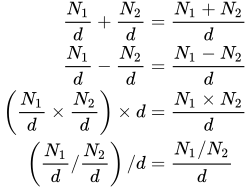
Because the denominator is a power of two, the multiplication can be implemented as an arithmetic shift to the left and the division as an arithmetic shift to the right; on many processors shifts are faster than multiplication and division.
To maintain accuracy, the intermediate multiplication and division results must be double precision and care must be taken in rounding the intermediate result before converting back to the desired Q number.
Using C the operations are (note that here, Q refers to the fractional part's number of bits) :
Addition
[edit]int16_t q_add(int16_t a, int16_t b)
{
return a + b;
}
With saturation
int16_t q_add_sat(int16_t a, int16_t b)
{
    int16_t result;
    int32_t tmp;

    tmp = (int32_t)a + (int32_t)b;
    if (tmp > 0x7FFF)
        tmp = 0x7FFF;
    if (tmp < -1 * 0x8000)
        tmp = -1 * 0x8000;
    result = (int16_t)tmp;

    return result;
}
Unlike floating point ±Inf, saturated results are not sticky and will unsaturate on adding a negative value to a positive saturated value (0x7FFF) and vice versa in that implementation shown. In assembly language, the Signed Overflow flag can be used to avoid the typecasts needed for that C implementation.
Subtraction
[edit]int16_t q_sub(int16_t a, int16_t b)
{
return a - b;
}
Multiplication
[edit]// precomputed value:
#define K (1 << (Q - 1))
// saturate to range of int16_t
int16_t sat16(int32_t x)
{
if (x > 0x7FFF) return 0x7FFF;
else if (x < -0x8000) return -0x8000;
else return (int16_t)x;
}
int16_t q_mul(int16_t a, int16_t b)
{
int16_t result;
int32_t temp;
temp = (int32_t)a * (int32_t)b; // result type is operand's type
// Rounding; mid values are rounded up
temp += K;
// Correct by dividing by base and saturate result
result = sat16(temp >> Q);
return result;
}
Division
[edit]int16_t q_div(int16_t a, int16_t b)
{
/* pre-multiply by the base (Upscale to Q16 so that the result will be in Q8 format) */
int32_t temp = (int32_t)a << Q;
/* Rounding: mid values are rounded up (down for negative values). */
/* OR compare most significant bits i.e. if (((temp >> 31) & 1) == ((b >> 15) & 1)) */
if ((temp >= 0 && b >= 0) || (temp < 0 && b < 0)) {
temp += b / 2; /* OR shift 1 bit i.e. temp += (b >> 1); */
} else {
temp -= b / 2; /* OR shift 1 bit i.e. temp -= (b >> 1); */
}
return (int16_t)(temp / b);
}
See also
[edit]References
[edit]- ^ a b "Appendix A.2". TMS320C64x DSP Library Programmer's Reference (PDF). Dallas, Texas, USA: Texas Instruments Incorporated. October 2003. SPRU565. Archived (PDF) from the original on 2022-12-22. Retrieved 2022-12-22. (150 pages)
- ^ "ARM Developer Suite AXD and armsd Debuggers Guide". 1.2. ARM Limited. 2001 [1999]. Chapter 4.7.9. AXD > AXD Facilities > Data formatting > Q-format. ARM DUI 0066D. Archived from the original on 2017-11-04.
- ^ "Chapter 4.7.9. AXD > AXD Facilities > Data formatting > Q-format". RealView Development Suite AXD and armsd Debuggers Guide (PDF). 3.0. ARM Limited. 2006 [1999]. pp. 4–24. ARM DUI 0066G. Archived (PDF) from the original on 2017-11-04.
Further reading
[edit]- Oberstar, Erick L. (2007-08-30) [2004]. "Fixed Point Representation & Fractional Math" (PDF). 1.2. Oberstar Consulting. Archived from the original (PDF) on 2017-11-04. Retrieved 2017-11-04. (Note: the accuracy of the article is in dispute; see discussion.)
External links
[edit]- "Q-Number-Format Java Implementation". GitHub. Archived from the original on 2017-11-04. Retrieved 2017-11-04.
- "Q-format Converter". Archived from the original on 2021-06-25. Retrieved 2021-06-25.
- "Q Library (C implementation)". GitHub. Retrieved 2024-03-05.
Q (number format)
View on GrokipediaIntroduction
Definition and Notation
Fixed-point arithmetic provides an efficient method for representing and processing fractional numbers in digital systems, serving as a practical alternative to floating-point arithmetic in resource-constrained environments like embedded processors and field-programmable gate arrays (FPGAs), where it reduces hardware overhead and power usage compared to the more complex floating-point units. The Q format is a widely adopted notation for specifying fixed-point representations, denoted as Qm.n for signed numbers, where m indicates the number of bits dedicated to the integer portion—including the sign bit—and n specifies the bits for the fractional portion, resulting in a total bit width of m + n.[5] This convention uses two's complement encoding, with the binary point implied after the m-th bit from the left (most significant bit). The numerical value is obtained by interpreting the entire bit string as a signed integer and dividing it by the scaling factor , which aligns the fractional bits correctly.[5] For instance, the Q1.3 format employs 4 bits total: 1 for the integer part (encompassing the sign) and 3 for the fractional part. The bit pattern 0011 in binary represents the signed integer 3, scaled by , yielding in decimal; similarly, 1011 (two's complement for -5) scales to .[5] Vendor-specific implementations may introduce minor adaptations to this standard notation for particular hardware or software ecosystems.[1]Historical Development
The Q number format emerged in the 1980s alongside the development of early digital signal processors (DSPs), driven by the need for efficient numerical representation in resource-constrained environments where floating-point hardware was prohibitively expensive and power-hungry.[6] The notation was defined by Texas Instruments for use in their DSP products. Fixed-point arithmetic, including early forms of Q notation, enabled real-time signal processing by leveraging integer operations to approximate fractional values, thus avoiding the complexity of dedicated floating-point units.[7] A key milestone occurred in 1982 when Texas Instruments introduced the TMS32010, the first commercial fixed-point DSP in the TMS320 series, which popularized fixed-point formats for embedded applications and laid the groundwork for standardized notations like Qm.n.[8] This adoption was motivated by fixed-point's advantages in embedded systems, including lower hardware costs, reduced power consumption compared to floating-point alternatives, and more predictable, deterministic behavior that minimized issues like rounding variability in time-critical tasks.[9] In the early 2000s, ARM extended the use of Q formats through software support in its Cortex-M processor family, beginning with the Cortex-M3 in 2004 and further solidified by the CMSIS-DSP library's inclusion of fixed-point functions (such as Q7, Q15, and Q31) starting around 2010, facilitating broader integration in low-power microcontrollers.[10] Although IEEE 754 focused on floating-point standards without formalizing fixed-point, the Q notation gained traction post-1990s through DSP literature and discussions on portable fixed-point arithmetic, establishing it as a widely recognized convention in the field.[11]Format Specifications
General Qm.n Notation
The Qm.n notation provides a standardized way to describe fixed-point binary representations, where m denotes the number of bits allocated to the integer portion excluding the sign bit for signed variants and n denotes the number of bits for the fractional portion, resulting in a total of 1 + m + n bits including the sign bit.[1][12] Note that conventions vary: in some (e.g., certain FPGA implementations), m includes the sign bit, leading to total m + n bits; the exclusion convention is common in DSP contexts. In this format, the binary point is fixed between the integer and fractional bits, allowing for efficient hardware implementation in resource-constrained environments like digital signal processors.[2] For signed Qm.n formats, the MSB serves as the sign bit, followed by m bits representing the integer magnitude, and then n bits for the fractional part, with negative values encoded using two's complement arithmetic to facilitate straightforward operations.[13][12] Unsigned variants, often denoted as UQm.n or similar, omit the sign bit and allocate m + n bits to the unsigned integer and fractional parts, restricting representation to non-negative values without two's complement.[13][1] This distinction ensures compatibility with both positive-only and bipolar signal processing needs, such as in audio or control systems. The flexibility of Qm.n lies in selecting m and n to balance dynamic range and precision according to application requirements; for instance, in 16-bit DSP for audio processing with signals in [-1, 1), Q1.15 (1 sign bit, 0 additional integer bits, 15 fractional bits, total 16 bits) provides high fractional resolution with range -1 to almost 1 and resolution .[2] Such choices stem from early digital signal processing practices, where fixed-point formats optimized for 16- or 32-bit architectures.[2] Conversion between integer and Qm.n formats follows simple bit manipulation rules: to represent an integer k in Qm.n, left-shift its binary form by n bits (effectively multiplying by ) and truncate or round to fit the bit width, preserving the implied scaling.[1][2] Conversely, extracting the integer part from a Qm.n value involves right-shifting by n bits using arithmetic shift for signed numbers (to maintain the sign extension) or logical shift for unsigned, with overflow handled via saturation or wrapping depending on the implementation, though the core rule ensures the fractional bits are discarded.[1][12]Vendor-Specific Variants
Texas Instruments implements Q formats in its digital signal processors (DSPs), particularly emphasizing saturation arithmetic to prevent overflow wrap-around by clipping results to the maximum or minimum representable values. In the TMS320C55x family of 16-bit fixed-point DSPs, the Q15 format is commonly used, where arithmetic operations support saturation mode via the SATD bit in the status register, ensuring results stay within the range of -1 to 0.999969482421875 for 16-bit signed fractional representation. This saturation feature is integral to the DSP library (DSPLIB), which optimizes functions like addition and multiplication for Q15 data, saturating outputs to 0x7FFF or 0x8000 as needed.[14] For higher-performance applications, the C6000 series, including the TMS320C64x and C67x devices, supports Q formats through the IQmath library, which provides scalable fixed-point routines in Q15, Q31, and other variants with optional saturation during operations like multiplication and scaling. These libraries leverage the C6000's 32-bit architecture and 40-bit extended-precision accumulators in earlier models for intermediate computations, enhancing precision before final Q-format storage.[15][16] ARM's implementation of Q formats is standardized in the CMSIS-DSP library for Cortex-M processors, focusing on efficient fixed-point arithmetic for embedded systems. The library defines Q7, Q15, and Q31 as purely fractional formats (Qm.n with m=0), where the sign bit is implied, and the remaining bits represent the fractional part scaled by ; for example, Q31 uses 32 bits with 31 fractional bits, mapping integer values from to to the real range -1 to almost 1. These formats are optimized for Cortex-M4 and M7 cores with DSP extensions, supporting operations like vector multiplication and filtering with built-in saturation to avoid overflow. The Q31.0 variant treats 32-bit signed integers as fractions by implying a binary point after the sign bit, facilitating seamless scaling in signal processing tasks without explicit integer-to-fractional conversion.[17] NXP (formerly Freescale) adapts Q formats in its automotive microcontrollers and digital signal controllers, particularly through the Automotive Math and Motor Control Library (AMMCLib) for families like S32K and MPC57xx. This library employs fixed-point fractional formats equivalent to Q15 (16-bit signed fractional) and Q31 (32-bit signed fractional) for high-performance computations in motor control and powertrain applications, with saturation arithmetic in core math functions to clip overflows. A notable variant in 16-bit contexts is Q2.14 for balanced integer-fractional representation, allowing a range up to approximately ±2 with 14-bit fractional precision for tasks like angle calculations or PID control. Differences in implementation include support for little-endian byte order in ARM-based NXP devices and variable accumulator widths, such as 40-bit extensions in legacy Freescale DSP cores for intermediate results.[18] Vendor-specific Q formats generally align with the general Qm.n notation but introduce compatibility challenges due to implied scaling and overflow behaviors. For instance, ARM's Q15 corresponds to the general Q0.15, requiring sign extension when interfacing with standard integer types, while TI's Q15 in saturation mode may produce clipped results incompatible with wrap-around expectations in non-TI environments. These mappings necessitate careful bit manipulation and scaling factors during data exchange between vendor ecosystems.[17][14]Numerical Properties
Representable Range
In the Qm.n fixed-point format, signed numbers are represented using two's complement arithmetic, where m denotes the number of bits allocated to the integer portion (including the sign bit) and n the fractional portion. The representable range for signed Qm.n is from to .[1] For example, in Q1.3 format, the range spans from -1 to 0.875.[1] For unsigned variants, denoted as UQm.n, the format omits the sign bit and uses m bits for the integer part and n for the fractional part, yielding a total of m + n bits. The representable range is from 0 to .[3] An example is the unsigned Q0.3 format, which covers 0 to 0.875.[3] The total bit width in Qm.n formats directly influences the dynamic range, particularly in signal processing applications where it quantifies the span from the smallest nonzero representable value to the maximum magnitude. For signed formats, this dynamic range is approximately 6.02(m + n - 1) dB, highlighting how additional bits exponentially expand the achievable magnitude span relative to the resolution. In general Qm.n implementations using two's complement, overflow results in wrap-around behavior, where values exceeding the representable bounds modularly revert to the opposite end of the range (e.g., from maximum positive to minimum negative), distinguishing it from saturation modes employed in some vendor-specific hardware.[19]Precision and Rounding
In the Qm.n fixed-point number format, the fractional resolution, or the smallest distinguishable positive fractional value, is given by , where is the number of bits allocated to the fractional part.[1] For instance, in the common Q1.15 format with 16 total bits (1 integer bit including the sign bit and 15 fractional bits), the resolution is .[1] This resolution determines the granularity with which real numbers can be approximated, directly impacting the accuracy of representations in applications like digital signal processing. When converting a real number to its Qm.n representation, quantization error arises due to the finite resolution. For rounding to the nearest representable value, the maximum quantization error is bounded by half the resolution, or .[20] Truncation, a simpler mode that discards excess fractional bits toward zero, introduces a maximum error of up to and a systematic bias, as positive errors are always less than the full resolution while negative values may accumulate offsets.[21] To achieve rounding to nearest, a common implementation adds (half the least significant bit) to the value before performing a right shift or truncation, minimizing the average error magnitude.[21] In digital signal processors (DSPs), such as those from Texas Instruments, convergent rounding (also known as round-to-nearest-even) is often employed for values exactly halfway between representable numbers; it rounds to the nearest even integer to further reduce long-term bias in iterative computations.[22] These modes balance computational efficiency with error control, though truncation remains prevalent in resource-constrained embedded systems due to its simplicity. A key trade-off in Qm.n design is the allocation of bits between the integer part () and fractional part () for a fixed total bit width. Increasing enhances fractional precision and reduces quantization error but correspondingly decreases , limiting the representable integer range and increasing overflow risk for larger magnitudes.[2] This necessitates careful selection based on the expected dynamic range and required accuracy of the application.Arithmetic Operations
Addition and Subtraction
Addition and subtraction of numbers in Q format are performed by treating them as scaled integers, leveraging the fixed position of the binary point to simplify operations compared to floating-point arithmetic. When both operands share the same scale (i.e., identical m and n in Qm.n), the binary points are already aligned, allowing direct integer addition or subtraction on the underlying bit representations using two's complement arithmetic. The result retains the same Qm.n format, provided no overflow occurs, as the scaling factor (2^n) applies uniformly to both inputs and the output.[23] For operands with differing scales, alignment is achieved by shifting one number to match the other's binary point position. If the fractional parts differ (different n), the number with the smaller n is left-shifted by the difference in fractional bits to increase its precision, while the number with the larger n may be right-shifted to match, though this risks losing least significant bits and precision. The integer parts are aligned by sign-extending the shorter one if necessary. The resulting sum or difference uses the maximum of the input scales, Q_max(m_a, m_b).max(n_a, n_b), potentially requiring an extra bit for the integer part to accommodate carry or borrow. Subtraction follows the same alignment but negates one operand via two's complement before addition.[1][2][24] Consider two numbers in Q2.2 format (5 bits total: sign + 2 integer + 2 fractional, scaling by 2^2 = 4). The binary representation 00110 (decimal integer 6) represents 6/4 = 1.5, and 11011 (two's complement -5) represents -5/4 = -1.25. Adding them: 00110 + 11011 = 00001 (1 in decimal), or 1/4 = 0.25 in Q2.2. For scale mismatch, say Q2.2 (1.5 as 00110) and Q2.1 (0.5 as 0001 in 4 bits, integer 1, scaled by 2^1 = 2). Left-shift the Q2.1 to Q2.2 by 1 bit, sign-extending to 5 bits: 00010 (integer 2, value 2/4 = 0.5). Adding: 00110 + 00010 = 01000 (8 in decimal, value 8/4 = 2.0), but this requires an extended format like Q3.2 to avoid integer overflow, as Q2.2 max is 1.75.[1] Overflow detection is critical, as the result must stay within the representable range [-2^{m}, 2^{m}-2^{-n}]. For addition, monitor the sign bits: if both inputs have the same sign but the result differs, overflow has occurred. Underflow for subtraction is similar. To mitigate, use a wider format (e.g., Q(m+1).n) for intermediate results or saturation arithmetic to clamp extremes.[2][23]Multiplication and Scaling
In fixed-point arithmetic with the Qm.n format, multiplication begins by interpreting the operands as integers and performing a standard integer multiplication, yielding a product with doubled bit precision: specifically, up to 2m integer bits (excluding sign) and 2n fractional bits for unsigned representations, or adjusted for sign extension in signed cases.[25] This intermediate result represents the true product scaled by , as each operand is implicitly scaled by .[25] To restore the Qm.n format and preserve fractional precision, the product is right-shifted by n bits, effectively dividing by and aligning the scaling factor. For two operands in Qa.b and Qc.d formats, the unscaled product is in Q(a+c).(b+d); shifting right by (b + d - n) bits fits it into the target Qm.n, where the integer bits may expand to up to 2m before potential truncation or clipping.[25] This process discards the least significant n bits of the fractional part, introducing potential precision loss through truncation, though rounding can be applied by adding prior to shifting for improved accuracy.[15] For example, multiplying two numbers in Q1.3 format (each as 4-bit unsigned integers scaled by ) produces an 8-bit product in Q2.6 format; right-shifting by 3 bits yields a result in Q2.3 format, with the expanded integer bits accommodating the doubled range.[25] Consider operands 1.5 (, binary 1100) and 0.875 (, binary 0111): their integer product is (binary 1010100); shifting right by 3 bits gives (binary 1010), representing approximately 1.25 in Q2.3 (exact value 1.3125, with truncation error).[25] If the product overflows the target bit width before or after scaling—such as exceeding the representable range in the integer part—saturation is applied in vendor-specific implementations to clip the result to the maximum or minimum value, preventing wrap-around errors common in modular arithmetic.[15] For instance, Texas Instruments' IQmath library functions like _IQNrsmpy perform multiplication with built-in rounding and saturation to the Q format limits (e.g., ±32 for Q26), ensuring numerical stability in digital signal processing applications.[15] This approach contrasts with simple truncation, prioritizing bounded errors over unbounded overflow.[15]Division and Reciprocals
Division in Q format fixed-point arithmetic is typically approximated by computing the reciprocal of the divisor and then multiplying it by the dividend, leveraging multiplication hardware for efficiency in resource-constrained environments like digital signal processors (DSPs).[26] This reciprocal multiplication method avoids the complexity of direct long division, which is costly in fixed-point implementations without dedicated divider units.[27] Lookup tables or iterative approximations are used to estimate the reciprocal (1/divisor), with the result scaled to match the Q format's fractional bits.[28] The Newton's method, also known as Newton-Raphson iteration, provides a quadratic convergence approach for reciprocal computation in fixed-point arithmetic. Starting with an initial guess for the reciprocal of the divisor (normalized to [0.5, 1) in Q1.m format for simplicity), subsequent estimates are refined using the iteration where operations are performed in an extended precision format (e.g., doubling the bit width to prevent overflow) and then scaled back.[27] The initial guess can be obtained from a small lookup table based on the leading bits of , providing 4-8 bits of accuracy. Each iteration roughly doubles the number of correct bits, making it suitable for Q formats with 16 or fewer bits.[28] For a practical example in Q1.15 format (16-bit total, 1 integer bit, 15 fractional bits), consider dividing a dividend by a divisor (both in Q1.15). Compute the reciprocal of in Q1.15 such that (using Newton's method with normalized ). Multiply by in extended precision (e.g., 32-bit, yielding a Q2.30 intermediate), and right-shift the product by 15 bits to obtain the Q1.15 quotient.[29][27] Using Newton's method, an initial 4-bit guess refined over 3 iterations achieves the full 15-bit fractional precision required.[28] Error analysis of iterative reciprocal methods in 16-bit Q formats shows that 3-4 Newton-Raphson steps from a modest initial approximation (e.g., 8-bit table lookup) suffice to reach full machine precision, with relative errors bounded by after convergence. Quadratic convergence ensures rapid error reduction, though one bit of precision may be lost per iteration due to fixed-point rounding, necessitating a final correction step via multiplication scaling.[27] This approach yields higher signal-to-quantization-noise ratios (SQNR > 55 dB) compared to alternatives like CORDIC in DSP applications.[26]Practical Applications
In Digital Signal Processing
In digital signal processing (DSP), Q formats enable efficient implementation of algorithms on fixed-point hardware, supporting real-time operations such as filtering and transforms in resource-constrained environments.[7] Common formats like Q15 (or Q1.15) are widely used for finite impulse response (FIR) and infinite impulse response (IIR) filters, where the single integer bit and 15 fractional bits provide sufficient resolution for signals normalized to the range (-1, 1).[13] These formats are also applied in fast Fourier transform (FFT) computations within audio and video codecs, leveraging the fixed scaling to maintain precision during frequency-domain processing.[30] The primary benefits of Q formats in DSP include predictable execution timing and absence of denormalization issues that plague floating-point arithmetic. Unlike floating-point operations, which can incur performance penalties from handling subnormal numbers near zero, fixed-point Q formats perform uniform integer-like arithmetic, ensuring consistent cycle counts essential for real-time applications.[31] This efficiency supports implementations in MP3 decoding, where fixed-point processors handle inverse discrete cosine transforms and bit allocation without floating-point overhead, and in acoustic echo cancellation, where adaptive filters converge reliably on low-power devices.[32][33] A key challenge in applying Q formats to DSP filters is coefficient scaling to prevent overflow during accumulation. Filter taps must often be scaled by dividing by (where is chosen based on the maximum expected sum of absolute coefficients) to keep intermediate results within the representable range, such as ensuring the accumulator does not exceed the word length in Q31 operations.[34] This technique, known as headroom scaling, trades some dynamic range for stability but is critical in cascaded IIR structures to avoid wraparound errors.[35] A notable case study is the use of Texas Instruments (TI) DSPs in mobile phones from the 1990s to 2010s, where Q31 formats facilitated 32-bit accumulators for convolution operations in voice and audio processing. TI's TMS320 family, dominant in early digital cell phones, employed Q31 for efficient fixed-point convolution in tasks like channel equalization and speech coding, enabling the widespread adoption of DSP in portable devices during that era.[36][37]In Embedded and Microcontroller Systems
In embedded and microcontroller systems, the Q number format is widely adopted for its efficiency in resource-constrained environments, particularly in ARM Cortex-M processors. The CMSIS-DSP library provides optimized functions for Q7, Q15, and Q31 formats, enabling fixed-point arithmetic in applications such as motor control and sensor fusion without relying on floating-point hardware. For instance, the library includes PID controller functions likearm_pid_init_q15 and arm_pid_reset_q15, which process Q15 data for real-time feedback loops in brushless DC motor drives, achieving cycle-accurate performance on Cortex-M4 and M7 cores. In sensor fusion tasks, such as combining accelerometer and gyroscope data for attitude estimation, fixed-point formats facilitate low-latency Kalman filter implementations, reducing computational overhead compared to floating-point alternatives.
A key advantage of Q formats in these systems is the elimination of the need for a floating-point unit (FPU), which lowers microcontroller die size and manufacturing costs while minimizing power consumption—critical for battery-powered IoT devices. Cortex-M0 and M3 cores, lacking FPUs, leverage Q formats to maintain precision in control algorithms, with fixed-point hardware occupying significantly less silicon area than equivalent floating-point accelerators. Q formats are commonly used in PID controllers for temperature or position regulation on such microcontrollers, ensuring deterministic execution times essential for real-time systems.[38][39]
Implementation in C code for microcontrollers often involves bit shifting for fixed-point arithmetic, such as in multiplications, to maintain scaling and handle mixed integer and fixed-point operations. Saturation and overflow checks help prevent wrapping in control loops, ensuring stability in mixed-precision code.
Developments since 2019 have extended quantized formats to RISC-V microcontrollers for edge AI, where libraries such as PULP-NN optimize INT8 convolutions on clusters like the GAP8 for neural network inference tasks like keyword spotting, providing energy efficiency improvements over other fixed-point implementations.[40] This trend supports scalable deployment in IoT sensors, balancing accuracy and efficiency in post-training quantization workflows. As of 2023, hybrid Q formats have been applied in neuromorphic processors to enable energy-efficient fixed-point multiplication for AI inference.[41]