Hubbry Logo
QuadrupoleQuadrupoleMain
Open search
Quadrupole
Community hub
Quadrupole
logo
7 pages, 0 posts
0 subscribers
Be the first to start a discussion here.
Quadrupole
Quadrupole
from Wikipedia
Not found
Revisions and contributorsEdit on WikipediaRead on Wikipedia
from Grokipedia
A quadrupole is a fundamental configuration in the of physical fields, such as electric, magnetic, or gravitational fields, representing the second-order term beyond the monopole (net charge or mass) and (separation of opposites) moments, typically characterized by four alternating poles or a symmetric distribution of sources with zero net monopole and contributions. This arrangement arises in systems where higher-order asymmetries in charge, current, or mass distributions produce effects that diminish more rapidly with distance, such as an varying as 1/r41/r^4. In electrostatics, the electric quadrupole moment is defined as a traceless, symmetric second-rank tensor that quantifies the deviation from spherical symmetry in a charge distribution lacking net charge or dipole moment, with components given by integrals over the charge density ρ\rho such as Qij=(3xixjδijr2)ρdVQ_{ij} = \int (3x_i x_j - \delta_{ij} r^2) \rho \, dV for continuous distributions. It can be visualized as two oppositely oriented dipoles in close proximity, and its effects become prominent in non-uniform fields where it induces forces or torques on the system. Similarly, magnetic quadrupoles involve current distributions or magnetic moments arranged in a quadrupolar pattern, while mass quadrupoles describe gravitational asymmetries in mass distributions. Quadrupoles have diverse applications across physics; for instance, quadrupole magnets in particle accelerators generate linear gradients to focus and defocus beams in alternating planes, essential for maintaining beam stability in facilities like the . In , quadrupole mass analyzers use four parallel rods with applied radiofrequency and voltages to filter ions by their based on trajectory stability in oscillating electric fields, enabling precise for gas analysis and molecular identification. In , time-varying mass quadrupole moments are the primary source of detectable , as described by the , which relates wave amplitude to the second time derivative of the quadrupole tensor, powering observations from events like mergers.

Fundamentals

Definition

A quadrupole represents the second-order term in the of scalar or vector potentials generated by non-uniform distributions of sources, such as charges, currents, or masses. This term emerges when the leading monopole (net source) and (first moment) contributions vanish, capturing the next level of asymmetry in the source distribution. Intuitively, a quadrupole can be visualized as a configuration of point sources where opposite pairs cancel out lower-order moments: for instance, two positive charges flanked by two negative charges in a linear or planar arrangement yields zero net charge (no monopole) and zero dipole moment, but produces a characteristic potential that falls off as 1/r^3 at large distances. Similarly, for masses, an arrangement like alternating positive and negative deviations from uniformity creates a quadrupolar without net or dipole imbalance. In three dimensions, the quadrupole is described by a second-rank tensor that exhibits properties, including being traceless for electric and gravitational cases, which reduces the number of independent components to five. This traceless nature arises from the tensor's construction to eliminate isotropic contributions, emphasizing pure quadrupolar deviations. The framework, in which the quadrupole plays this role, provides a systematic way to approximate fields far from the sources.

Mathematical Formulation

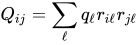
The quadrupole moment tensor provides a mathematical description of the second-order deviation in a charge or distribution from spherical . For a continuous distribution with ρ(r)\rho(\mathbf{r}), the Cartesian components of the quadrupole tensor are defined as Qij=(3xixjr2δij)ρ(r)dV,Q_{ij} = \int \left(3x_i x_j - r^2 \delta_{ij}\right) \rho(\mathbf{r}) \, dV, where r2=xkxkr^2 = x_k x_k is the squared distance from the origin, δij\delta_{ij} is the , and the integral is over the volume containing the distribution. This tensor is symmetric (Qij=QjiQ_{ij} = Q_{ji}) and traceless (Qii=0Q_{ii} = 0), reducing the number of independent components from nine to five. In spherical tensor notation, the quadrupole moment is represented as an irreducible tensor of rank 2, with five independent components Q2mQ_{2m} (for m=2,,2m = -2, \dots, 2) that transform under rotations according to the of the rotation group for =2\ell = 2. These components are related to the Cartesian tensor via linear combinations involving Y2m(θ,ϕ)Y_{2m}(\theta, \phi). The scalar potential due to a quadrupole in the far-field approximation (rr \gg size of the distribution) is given by Φ(r)=12Qij2xixj(1r),\Phi(\mathbf{r}) = \frac{1}{2} Q_{ij} \frac{\partial^2}{\partial x_i \partial x_j} \left( \frac{1}{r} \right), where the derivatives act on the unprimed coordinates, and in Gaussian units, this expression holds without additional constants. This can equivalently be written as Φ(r)=12r3Qij(3r^ir^jδij),\Phi(\mathbf{r}) = \frac{1}{2r^3} Q_{ij} \left( 3\hat{r}_i \hat{r}_j - \delta_{ij} \right), with r^i=xi/r\hat{r}_i = x_i / r. This formulation arises from the Taylor expansion of the potential around the origin for a localized distribution. The full electrostatic potential is Φ(r)=ρ(r)rrdV,\Phi(\mathbf{r}) = \int \frac{\rho(\mathbf{r}')}{|\mathbf{r} - \mathbf{r}'|} \, dV', and expanding 1/rr1/|\mathbf{r} - \mathbf{r}'| in powers of r\mathbf{r}' yields 1rr=1r+rkxk(1r)+12rirj2xixj(1r)+.\frac{1}{|\mathbf{r} - \mathbf{r}'|} = \frac{1}{r} + r'_k \frac{\partial}{\partial x_k} \left( \frac{1}{r} \right) + \frac{1}{2} r'_i r'_j \frac{\partial^2}{\partial x_i \partial x_j} \left( \frac{1}{r} \right) + \cdots. Integrating term by term, the monopole term is ρdV/r\int \rho \, dV' / r, which vanishes if the total charge or mass is zero. The dipole term is (rρdV)(1/r)\left( \int \mathbf{r}' \rho \, dV' \right) \cdot \nabla (1/r), which vanishes if the dipole moment is zero. The leading contribution then comes from the second-order term: Φ(r)12(rirjρ(r)dV)2xixj(1r).\Phi(\mathbf{r}) \approx \frac{1}{2} \left( \int r'_i r'_j \rho(\mathbf{r}') \, dV' \right) \frac{\partial^2}{\partial x_i \partial x_j} \left( \frac{1}{r} \right). Redefining the integral via integration by parts or symmetry arguments leads to the traceless form involving QijQ_{ij}, confirming the quadrupole potential expression.

Physical Manifestations

Electric Quadrupole

The electric quadrupole arises in the of the electrostatic potential generated by a localized charge distribution lacking net charge and dipole moment, representing the leading non-trivial term beyond the monopole. This configuration describes deviations from spherical symmetry in the , such as elongated or flattened distributions, and produces that decay more rapidly with distance than those of lower-order multipoles. The electric quadrupole moment is quantified by the traceless symmetric tensor Qij=kqk(3xk,ixk,jrk2δij)Q_{ij} = \sum_k q_k (3 x_{k,i} x_{k,j} - r_k^2 \delta_{ij}), where the sum is over discrete charges qkq_k at positions rk=(xk,1,xk,2,xk,3)\mathbf{r}_k = (x_{k,1}, x_{k,2}, x_{k,3}), and δij\delta_{ij} is the Kronecker delta. In the far-field approximation, the scalar potential due to this moment scales as 1/r31/r^3, and the resulting electric field E\mathbf{E} falls off as 1/r41/r^4, in contrast to the 1/r31/r^3 decay of the dipole field. This slower decay for lower multipoles underscores the quadrupole's role in long-range interactions when monopole and dipole terms vanish. Common configurations include the linear quadrupole, formed by two oppositely oriented electric dipoles whose positive (or negative) charges coincide, such as charges +q+q at z=dz = d, 2q-2q at the origin, and +q+q at z=dz = -d. Another typical setup is the planar quadrupole, consisting of four charges arranged at the corners of a square in the xy-plane with alternating signs, for example, +q+q at (a,a)(a, a), q-q at (a,a)(a, -a), q-q at (a,a)(-a, a), and +q+q at (a,a)(-a, -a), yielding a tensor with dominant off-diagonal components and zero net dipole moment. Measurements of electric quadrupole moments, particularly nuclear ones, are obtained through by analyzing hyperfine splitting in spectral lines, where the interaction between the nuclear quadrupole and the atomic electric field shifts energy levels. For instance, the quadrupole moment of the 209Bi^{209}\mathrm{Bi} nucleus ground state, Q=0.422(22)Q = -0.422(22) , was determined from the hyperfine constant in its atomic spectrum as of March 2025. In ion traps, quadrupole moments of trapped atomic or molecular ions are probed via state-dependent shifts in the trapping potential, as seen in studies of alkaline-earth ions like 40Ca+^{40}\mathrm{Ca}^+. These techniques provide precise values essential for understanding nuclear shapes in isotopes across the periodic table.

Magnetic Quadrupole

A magnetic quadrupole refers to the second-order term in the multipole expansion of the magnetic field produced by a localized distribution of currents or magnetization, when the net magnetic dipole moment is zero. This configuration arises when the current loops or magnetic moments are arranged in a way that their first moments cancel, leaving the quadrupole as the leading contribution. The magnetic field associated with a quadrupole term falls off as 1/r41/r^4 in the far-field region, faster than the 1/r31/r^3 decay of the dipole field, making it less dominant at large distances but significant in close proximity or for precise control applications. The magnetic quadrupole tensor MijM_{ij} can be expressed in terms of the current density J(r)\mathbf{J}(\mathbf{r}) as Mij=12[xiJj+xjJi23δijxkJk]dV,M_{ij} = \frac{1}{2} \int \left[ x_i J_j + x_j J_i - \frac{2}{3} \delta_{ij} x_k J_k \right] dV, or equivalently from m=12×(r×J)\mathbf{m} = \frac{1}{2} \nabla \times (\mathbf{r} \times \mathbf{J}), resulting in a symmetric traceless tensor. This formulation parallels the electric quadrupole tensor but reflects the vector nature of magnetic sources, resulting in a pseudotensor behavior under parity transformations due to the role of the in generating the B=×A\mathbf{B} = \nabla \times \mathbf{A}. Configurations producing pure magnetic quadrupoles often involve toroidal current arrangements, where the cancels lower-order moments. In particle accelerators, magnetic quadrupoles are realized through specialized electromagnets that generate a field with linear variation, such as Bx=GyB_x = G y and By=GxB_y = G x, where GG is the field gradient, enabling focusing of beams via the . These magnets are crucial for beam optics, with examples including the superconducting quadrupoles in the , which achieve gradients of approximately 200 T/m to maintain high-energy proton beams within the 27 km ring. In , the magnetic quadrupole moment of atomic nuclei influences the through higher-order interactions in the atomic Hamiltonian, particularly for nuclei with spin I>1I > 1, contributing to splittings observable in and providing data on nuclear deformation. Unlike the electric quadrupole, which derives from charge asymmetry, the magnetic variant stems from current or spin asymmetries, leading to distinct selection rules in transitions.

Gravitational Quadrupole

The gravitational quadrupole characterizes the leading non-spherical deviation in the produced by an asymmetric mass distribution, playing a central role in weak-field approximations of both in Newtonian theory and . Unlike the monopole term, which dominates for spherical , the quadrupole term arises from the second moment of the mass and becomes significant for elongated or flattened bodies, influencing phenomena such as orbital and emission. In the weak-field limit, this tensorial description allows for a of the or metric, where the quadrupole contribution provides the primary correction beyond the point-mass approximation. The gravitational quadrupole tensor IijI_{ij} is defined for a mass distribution with density ρ(r)\rho(\mathbf{r}) as Iij=(3xixjr2δij)ρ(r)dV,I_{ij} = \int \left( 3 x_i x_j - r^2 \delta_{ij} \right) \rho(\mathbf{r}) \, dV, where δij\delta_{ij} is the Kronecker delta, r2=xkxkr^2 = x_k x_k, and the integral extends over the volume of the source. This expression yields a symmetric, traceless tensor that vanishes for spherically symmetric distributions, emphasizing its sensitivity to quadrupolar asymmetries. In Newtonian gravity, the quadrupole term contributes to the scalar gravitational potential Φ\Phi at large distances rr from the source as Φ=G2r3Iijninj,\Phi = -\frac{G}{2 r^3} I_{ij} n_i n_j, where GG is the gravitational constant and n\mathbf{n} is the unit vector from the source center to the field point. This form establishes the scale of quadrupolar perturbations, which fall off as 1/r31/r^3 and induce tidal forces that deform nearby objects or alter trajectories. In linearized , the quadrupole moment drives the dominant mode of gravitational through the metric perturbation hijh_{ij}, which describes weak spacetime ripples propagating at the . Specifically, in the transverse-traceless (TT) gauge far from the source, the field is given by the quadrupole term hijTT=2Gc4rI¨ijTT(trc),h_{ij}^{\rm TT} = \frac{2G}{c^4 r} \ddot{I}_{ij}^{\rm TT} \left( t - \frac{r}{c} \right), where the double dot denotes the second time derivative, cc is the , and IijTTI_{ij}^{\rm TT} is the projected traceless part of the quadrupole tensor transverse to the propagation direction. This expression, derived under the slow-motion and weak-field assumptions, highlights how time-varying quadrupolar mass motions—such as orbital accelerations—generate detectable , with amplitude scaling inversely with distance and proportional to the and orbital velocity squared. A prominent example is Earth's oblateness, arising from its rotational flattening, which produces a non-zero IijI_{ij} dominated by the zonal harmonic J21.08×103J_2 \approx 1.08 \times 10^{-3}, the leading quadrupole coefficient in its expansion. This asymmetry induces tidal perturbations in orbits, contributing to effects like the geoid's irregular shape and long-term variations in and atmospheric loading. In astrophysical contexts, the PSR B1913+16 exemplifies dynamic quadrupolar radiation: the orbiting neutron stars form a time-varying IijI_{ij} due to their compact masses and relativistic speeds, emitting that dissipate orbital energy at a rate matching predictions to within 0.2%, as confirmed by observed periastron advance and .

Multipole Expansions

Role in Series Expansion

The multipole expansion provides a systematic way to approximate the scalar potential Φ(r)\Phi(\mathbf{r}) generated by a localized charge distribution ρ(r)\rho(\mathbf{r}') in the far-field region, where rrr \gg r' for all charges within the distribution. The expansion decomposes the potential into irreducible terms of increasing angular complexity, with the monopole (l=0), dipole (l=1), and quadrupole (l=2) as the leading contributions: Φ(r)=14πϵ0[Qr+pr^r2+12i,jQijij(1r)+],\Phi(\mathbf{r}) = \frac{1}{4\pi\epsilon_0} \left[ \frac{Q}{r} + \frac{\mathbf{p} \cdot \hat{\mathbf{r}}}{r^2} + \frac{1}{2} \sum_{i,j} Q_{ij} \partial_i \partial_j \left(\frac{1}{r}\right) + \cdots \right], where Q=ρ(r)dVQ = \int \rho(\mathbf{r}') dV' is the total charge (monopole moment), p=rρ(r)dV\mathbf{p} = \int \mathbf{r}' \rho(\mathbf{r}') dV' is the dipole moment, and Qij=(32xixj12δijr2)ρ(r)dVQ_{ij} = \int \left( \frac{3}{2} x'_i x'_j - \frac{1}{2} \delta_{ij} r'^2 \right) \rho(\mathbf{r}') dV' is the traceless quadrupole tensor. The quadrupole term, corresponding to the l=2 multipole, captures the leading non-spherical deviation when the monopole and dipole vanish, scaling as 1/r31/r^3. This expansion is valid under the far-field approximation, where the observation point r\mathbf{r} is much farther from the charge distribution than its spatial extent, ensuring the series converges by treating the distribution as effectively point-like. Additionally, the choice of expansion origin is crucial: for systems with zero net charge (Q=0Q=0), the origin can be selected at the center of charge to nullify the dipole moment, making the quadrupole the dominant term; similar adjustments apply for higher symmetries. In spherical coordinates, the multipole expansion is equivalently expressed using for full angular resolution: Φ(r)==0m=AmYm(θ,ϕ)r+1,\Phi(\mathbf{r}) = \sum_{\ell=0}^\infty \sum_{m=-\ell}^\ell A_{\ell m} \frac{Y_{\ell m}(\theta, \phi)}{r^{\ell+1}}, where the coefficients AmA_{\ell m} are the multipole moments, and the quadrupole corresponds to the =2\ell=2 terms involving the five independent Y2mY_{2m} harmonics (m = -2 to 2). This form highlights the quadrupole's five , reflecting the traceless symmetric nature of the QijQ_{ij} tensor. The series converges absolutely outside the smallest enclosing the charge distribution, with the rate depending on the multipole moments' magnitudes and the ratio r/ar / a (where aa is the distribution's radius). In systems with high , such as those where lower-order moments vanish due to parity or centering (e.g., neutral atoms or symmetric mass distributions in ), the quadrupole term often dominates the far-field behavior, allowing truncation after l=2 for practical approximations while higher multipoles contribute negligibly.

Relation to Higher Multipoles

In the of electromagnetic potentials, the terms form a ordered by the ll, beginning with the monopole (l=0l=0), followed by the (l=1l=1), quadrupole (l=2l=2), octupole (l=3l=3), and higher-order multipoles. Each successive multipole captures increasingly complex spatial variations in the source distribution, with the far-field potential decaying as 1/rl+11/r^{l+1}, making lower-order terms dominant at large distances unless they vanish due to . This hierarchical structure ensures that the quadrupole term provides the leading correction beyond the for systems lacking net charge or dipole moment, while higher multipoles like the octupole become relevant only for more intricate asymmetries. In , the interaction strength between multipoles and radiation fields follows selection rules derived from conservation and parity, with electric (E1) transitions dominating due to their to the field and allowance of parity change with ΔL = 0, ±1. transitions (E2) are weaker by a factor of approximately (ka)2(k a)^2, where kk is the wave number and aa the system size, as they require ΔL = 0, ±2 and preserve parity. Higher multipoles, such as E3 octupole transitions, are even feebler, scaling as (ka)2l(k a)^{2l}, and couple only under stricter selection rules like ΔL = 0, ±1, ±3 with parity change. The mathematical description of multipoles generalizes through traceless, symmetric tensors, where the quadrupole (l=2l=2) has five independent components forming a rank-2 tensor with zero trace and under index exchange. For higher ll, this extends to rank-ll tensors with 2l+12l + 1 irreducible components, ensuring rotational invariance and eliminating redundant scalar contributions that would otherwise mix lower-order terms. These properties facilitate the of arbitrary charge distributions into orthogonal multipole contributions, with the traceless condition projecting out monopole-like traces to isolate pure higher-order effects. Higher multipoles beyond the quadrupole are essential when lower moments vanish or are insufficient for describing the source, particularly in asymmetric charge distributions where the lack of spherical excites multiple terms in the expansion. For instance, in non-centrosymmetric configurations, octupole and beyond terms provide necessary corrections to the potential, preventing unphysical truncation errors in far-field approximations and ensuring accuracy for elongated or irregular geometries.

Applications

In Electromagnetic Devices

Quadrupole ion traps, also known as Paul traps, utilize oscillating radiofrequency (RF) to confine charged particles in three dimensions, enabling precise control and analysis of . Invented by in the 1950s, these devices consist of a hyperbolic ring electrode and two end-cap electrodes, where the applied RF potential creates a time-averaged that stabilizes ion trajectories for masses within a specific range. In , quadrupole ion traps serve as key components for ion storage, isolation, and sequential ejection based on , facilitating techniques for molecular identification in complex samples. This confinement mechanism relies on the dynamic balance between RF-driven ponderomotive forces and electrostatic repulsion, allowing high-resolution analysis without the need for magnetic fields. Magnetic quadrupole lenses play a crucial role in particle accelerators by focusing charged particle beams, analogous to optical lenses in imaging systems. These devices generate a linear magnetic field gradient that provides focusing in one transverse plane while defocusing in the orthogonal plane, with the net effect achieved through alternating quadrupole orientations in a lattice. The magnetic field configuration is described by B=G(xy^yx^)\mathbf{B} = G (x \hat{y} - y \hat{x}), where GG is the field gradient strength, directing particles toward the beam axis via the Lorentz force. In cyclotrons and synchrotrons, such lenses maintain beam emittance and prevent divergence, essential for high-intensity operations at facilities like CERN's Large Hadron Collider. The concept of strong focusing with quadrupoles, enabling compact accelerator designs, emerged in the mid-20th century, building on early linear accelerator principles to support energies exceeding gigaelectronvolts. In (NMR) and (MRI), electric interactions arise in nuclei with I>1/2I > 1/2, which possess a non-spherical charge distribution that couples to local gradients. This interaction perturbs the Zeeman splitting, leading to broadened lines and altered relaxation rates, particularly T1 and T2, in or viscous samples where gradients are significant. Over 75% of NMR-active nuclei, such as 27^{27}Al (I=5/2I = 5/2) and 23^{23}Na (I=3/2I = 3/2), exhibit these effects, complicating quantification but providing insights into molecular environments. In MRI applications, residual quadrupole interactions in biological tissues, like brain white matter, contribute to signal decay and , influencing diffusion-weighted imaging and relaxation-based contrast mechanisms. Techniques such as magic-angle spinning mitigate these effects in solid-state NMR, enhancing resolution for quadrupolar nuclei in and biomolecular studies. The historical development of quadrupole-based electromagnetic devices traces back to early 20th-century innovations in particle acceleration, where Norwegian physicist Rolf Widerøe proposed radiofrequency structures that laid groundwork for focused beam transport in cyclotrons. Widerøe's 1928 demonstration of ion acceleration to 50 keV using drift tubes anticipated the integration of focusing elements, evolving into quadrupole magnets by the 1950s to enable stable orbits in circular accelerators. These advancements, combined with Paul's ion trap work, revolutionized instrumentation from analytical chemistry to high-energy physics.

In Astrophysics and Gravity

In general relativity, the emission of gravitational waves from astrophysical sources is predominantly governed by the quadrupole moment of the mass distribution, as higher-order multipoles contribute negligibly at leading order. The average power radiated is given by the quadrupole formula P=G5c5\dddotIij\dddotIij,P = \frac{G}{5c^5} \left\langle \dddot{I}_{ij} \dddot{I}^{ij} \right\rangle, where GG is the , cc is the , IijI_{ij} is the mass quadrupole moment tensor, and the third time derivatives indicate the rate of change of the quadrupole, with angle brackets denoting a time average over several cycles. This expression, derived from the linearized , quantifies the energy loss due to gravitational radiation and is essential for modeling compact binary systems. In binary mergers, such as those involving stars or black holes, the accelerating masses produce a time-varying quadrupole that drives the inspiral phase, with the radiated power increasing dramatically as the objects approach coalescence. The oblateness of massive bodies like and the Sun manifests as a non-zero J2 component of their gravitational quadrupole moment, arising from rotational deformation that flattens the equatorial plane. For , J2 ≈ 1.08263 × 10^{-3}, which induces significant perturbations on satellite orbits, including the regression of the ascending node () at rates up to several degrees per day for low- orbits and advances in the argument of perigee, necessitating inclusion in precise trajectory predictions for missions like those of the . The Sun's J2 is much smaller, on the order of (2.25 ± 0.45) × 10^{-7}, yet it subtly affects planetary orbits, contributing to long-term variations in eccentricity and inclination, as seen in dynamical models of the inner solar system. These quadrupole effects highlight how rotational dynamics imprint on gravitational fields at solar system scales. Gravitational wave detectors like have observed quadrupole-dominated signals from binary mergers, providing direct empirical validation of the theory. The event , detected on August 17, 2017, by the LIGO-Virgo network, originated from a binary inspiral at a of approximately 40 Mpc, with the matching predictions from the quadrupole during the early inspiral, transitioning to merger and ringdown phases. This observation not only confirmed the power-law scaling of but also enabled multimessenger astronomy through associated electromagnetic counterparts, constraining the equation of state of matter. In cosmology, quadrupole moments associated with large-scale galaxy distributions influence interpretations of () anisotropies, revealing potential deviations from the standard isotropic early model. The quadrupole (l=2 multipole) exhibits an anomalously low power compared to predictions from the Lambda-CDM paradigm, with amplitude about 30% below expectations, possibly linked to foreground effects from galactic quadrupole distortions or superhorizon perturbations during . Galaxy surveys, such as those from the Baryon Oscillation Spectroscopic Survey (BOSS), measure quadrupole moments in the void-galaxy correlation function, which correlate with anomalies and suggest early-universe anisotropies driven by non-standard initial conditions or late-time effects like weak lensing. These features underscore the quadrupole's role in probing cosmic homogeneity on the largest scales.

References

Add your contribution
Related Hubs
User Avatar
No comments yet.