


Community hub
Recent from talks
Contribute something to knowledge base
Content stats: 0 posts, 0 articles, 1 media, 0 notes
Members stats: 0 subscribers, 0 contributors, 0 moderators, 0 supporters
Subscribers
Supporters
Contributors
Moderators
Hub AI
Quantum vortex AI simulator
(@Quantum vortex_simulator)
Hub AI
Quantum vortex AI simulator
(@Quantum vortex_simulator)
Quantum vortex
In physics, a quantum vortex represents a quantized flux circulation of some physical quantity. In most cases, quantum vortices are a type of topological defect exhibited in superfluids and superconductors. The existence of quantum vortices was first predicted by Lars Onsager in 1949 in connection with superfluid helium. Onsager reasoned that quantisation of vorticity is a direct consequence of the existence of a superfluid order parameter as a spatially continuous wavefunction. Onsager also pointed out that quantum vortices describe the circulation of superfluid and conjectured that their excitations are responsible for superfluid phase transitions. These ideas of Onsager were further developed by Richard Feynman in 1955 and in 1957 were applied to describe the magnetic phase diagram of type-II superconductors by Alexei Alexeyevich Abrikosov. In 1935 Fritz London published a very closely related work on magnetic flux quantization in superconductors. London's fluxoid can also be viewed as a quantum vortex.
Quantum vortices are observed experimentally in type-II superconductors (the Abrikosov vortex), liquid helium, and atomic gases (see Bose–Einstein condensate), as well as in photon fields (optical vortex) and exciton-polariton superfluids.
In a superfluid, a quantum vortex "carries" quantized orbital angular momentum, thus allowing the superfluid to rotate; in a superconductor, the vortex carries quantized magnetic flux.
The term "quantum vortex" is also used in the study of few body problems. Under the de Broglie–Bohm theory, it is possible to derive a "velocity field" from the wave function. In this context, quantum vortices are zeros on the wave function, around which this velocity field has a solenoidal shape, similar to that of irrotational vortex on potential flows of traditional fluid dynamics.
In a superfluid, a quantum vortex is a hole with the superfluid circulating around the vortex axis; the inside of the vortex may contain excited particles, air, vacuum, etc. The thickness of the vortex depends on a variety of factors; in liquid helium, the thickness is of the order of a few Angstroms.
A superfluid has the special property of having phase, given by the wavefunction, and the velocity of the superfluid is proportional to the gradient of the phase (in the parabolic mass approximation). The circulation around any closed loop in the superfluid is zero if the region enclosed is simply connected. The superfluid is deemed irrotational; however, if the enclosed region actually contains a smaller region with an absence of superfluid, for example a rod through the superfluid or a vortex, then the circulation is:
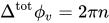
where is the Planck constant divided by , m is the mass of the superfluid particle, and is the total phase difference around the vortex. Because the wave-function must return to its same value after an integer number of turns around the vortex (similar to what is described in the Bohr model), then , where n is an integer. Thus, the circulation is quantized:


A principal property of superconductors is that they expel magnetic fields; this is called the Meissner effect. If the magnetic field becomes sufficiently strong it will, in some cases, "quench" the superconductive state by inducing a phase transition. In other cases, however, it will be energetically favorable for the superconductor to form a lattice of quantum vortices, which carry quantized magnetic flux through the superconductor. A superconductor that is capable of supporting vortex lattices is called a type-II superconductor, vortex-quantization in superconductors is general.
Quantum vortex
In physics, a quantum vortex represents a quantized flux circulation of some physical quantity. In most cases, quantum vortices are a type of topological defect exhibited in superfluids and superconductors. The existence of quantum vortices was first predicted by Lars Onsager in 1949 in connection with superfluid helium. Onsager reasoned that quantisation of vorticity is a direct consequence of the existence of a superfluid order parameter as a spatially continuous wavefunction. Onsager also pointed out that quantum vortices describe the circulation of superfluid and conjectured that their excitations are responsible for superfluid phase transitions. These ideas of Onsager were further developed by Richard Feynman in 1955 and in 1957 were applied to describe the magnetic phase diagram of type-II superconductors by Alexei Alexeyevich Abrikosov. In 1935 Fritz London published a very closely related work on magnetic flux quantization in superconductors. London's fluxoid can also be viewed as a quantum vortex.
Quantum vortices are observed experimentally in type-II superconductors (the Abrikosov vortex), liquid helium, and atomic gases (see Bose–Einstein condensate), as well as in photon fields (optical vortex) and exciton-polariton superfluids.
In a superfluid, a quantum vortex "carries" quantized orbital angular momentum, thus allowing the superfluid to rotate; in a superconductor, the vortex carries quantized magnetic flux.
The term "quantum vortex" is also used in the study of few body problems. Under the de Broglie–Bohm theory, it is possible to derive a "velocity field" from the wave function. In this context, quantum vortices are zeros on the wave function, around which this velocity field has a solenoidal shape, similar to that of irrotational vortex on potential flows of traditional fluid dynamics.
In a superfluid, a quantum vortex is a hole with the superfluid circulating around the vortex axis; the inside of the vortex may contain excited particles, air, vacuum, etc. The thickness of the vortex depends on a variety of factors; in liquid helium, the thickness is of the order of a few Angstroms.
A superfluid has the special property of having phase, given by the wavefunction, and the velocity of the superfluid is proportional to the gradient of the phase (in the parabolic mass approximation). The circulation around any closed loop in the superfluid is zero if the region enclosed is simply connected. The superfluid is deemed irrotational; however, if the enclosed region actually contains a smaller region with an absence of superfluid, for example a rod through the superfluid or a vortex, then the circulation is:
where is the Planck constant divided by , m is the mass of the superfluid particle, and is the total phase difference around the vortex. Because the wave-function must return to its same value after an integer number of turns around the vortex (similar to what is described in the Bohr model), then , where n is an integer. Thus, the circulation is quantized:
A principal property of superconductors is that they expel magnetic fields; this is called the Meissner effect. If the magnetic field becomes sufficiently strong it will, in some cases, "quench" the superconductive state by inducing a phase transition. In other cases, however, it will be energetically favorable for the superconductor to form a lattice of quantum vortices, which carry quantized magnetic flux through the superconductor. A superconductor that is capable of supporting vortex lattices is called a type-II superconductor, vortex-quantization in superconductors is general.
Recent media
Recent media