


Community hub
Recent from talks
Contribute something
Nothing was collected or created yet.
Physical quantity
View on Wikipedia | This article needs additional citations for verification. (March 2022) |

A physical quantity (or simply quantity)[1][a] is a property of a material or system that can be quantified by measurement. A physical quantity can be expressed as a value, which is the algebraic multiplication of a numerical value and a unit of measurement. For example, the physical quantity mass, symbol m, can be quantified as m=n kg, where n is the numerical value and kg is the unit symbol (for kilogram). Vector quantities have, besides numerical value and unit, direction or orientation in space.
Principles
[edit]Dimensions
[edit]The notion of dimension of a physical quantity was introduced by Joseph Fourier in 1822.[2] By convention, physical quantities are organized in a dimensional system built upon base quantities, each of which is regarded as having its own dimension. The dimension of a quantity Z is denoted dim Z or dim(Z).[1]
Kind
[edit]Dimensional homogeneity is not necessarily sufficient for quantities to be comparable;[1] for example, both kinematic viscosity and thermal diffusivity have dimension of square length per time (in units of m2/s). Quantities of the same kind share extra commonalities beyond their dimension and units allowing their comparison; for example, not all dimensionless quantities are of the same kind[1] ().
Unit
[edit]There is often a choice of unit, though SI units are usually used in scientific contexts due to their ease of use, international familiarity and prescription. For example, a quantity of mass might be represented by the symbol m, and could be expressed in the units kilograms (kg), pounds (lb), or daltons (Da). The unit of a quantity Z is denoted [Z].[1]
Numerical value
[edit]Following ISO 80000-1,[1] any value or magnitude of a physical quantity is expressed as a comparison to a unit of that quantity. The value of a physical quantity Z is expressed as the product of a numerical value {Z} (a pure number) and a unit [Z]:
![{\displaystyle Z=\{Z\}\times [Z]}](https://wikimedia.org/api/rest_v1/media/math/render/svg/def9bab2222172f53c7a8becf5e4185293817ff6)
For example, let be "2 metres"; then, is the numerical value and is the unit. Conversely, the numerical value expressed in an arbitrary unit can be obtained as:


![{\displaystyle [Z]=\mathrm {metre} }](https://wikimedia.org/api/rest_v1/media/math/render/svg/f6a8ec250d9a5d8cc852b7f4f0942e1753dbffd7)
![{\displaystyle \{Z\}=Z/[Z]}](https://wikimedia.org/api/rest_v1/media/math/render/svg/3f34ded144b10ed1870ed60970d3e48a6a968381)
The multiplication sign is usually left out, just as it is left out between variables in the scientific notation of formulas. The convention used to express quantities is referred to as quantity calculus. In formulas, the unit [Z] can be treated as if it were a specific magnitude of a kind of physical dimension: see Dimensional analysis for more on this treatment.
Typography
[edit]International recommendations for the use of symbols for quantities are set out in ISO/IEC 80000, the IUPAP red book and the IUPAC green book. For example, the recommended symbol for the physical quantity "mass" is m, and the recommended symbol for the quantity "electric charge" is Q.
Physical quantities are normally typeset in italics. Purely numerical quantities, even those denoted by letters, are usually printed in roman (upright) type, though sometimes in italics. Symbols for elementary functions (circular trigonometric, hyperbolic, logarithmic etc.), changes in a quantity like Δ in Δy or operators like d in dx, are also recommended to be printed in roman type.
Examples:
- Real numbers, such as 1 or √2,
- e, the base of natural logarithms,
- i, the imaginary unit,
- π for the ratio of a circle's circumference to its diameter, 3.14159265...
- δx, Δy, dz, representing differences (finite or otherwise) in the quantities x, y and z
- sin α, sinh γ, log x
Support
[edit]Scalars
[edit]A scalar is a physical quantity that has magnitude but no direction. Symbols for physical quantities are usually chosen to be a single letter of the Latin or Greek alphabet, and are printed in italic type.
Vectors
[edit]Vectors are physical quantities that possess both magnitude and direction and whose operations obey the axioms of a vector space. Symbols for physical quantities that are vectors are in bold type, underlined or with an arrow above. For example, if u is the speed of a particle, then the straightforward notations for its velocity are u, u, or .

Tensors
[edit]Scalar and vector quantities are the simplest tensor quantities, which are tensors that can be used to describe more general physical properties. For example, the Cauchy stress tensor possesses magnitude, direction, and orientation qualities.
Base and derived quantities
[edit]Base quantities
[edit]A system of quantities relates physical quantities, and due to this dependence, a limited number of quantities can serve as a basis in terms of which the dimensions of all the remaining quantities of the system can be defined. A set of mutually independent quantities may be chosen by convention to act as such a set, and are called base quantities. The seven base quantities of the International System of Quantities (ISQ) and their corresponding SI units and dimensions are listed in the following table.[3]: 136 Other conventions may have a different number of base units (e.g. the CGS and MKS systems of units).
| Quantity | SI unit | Dimension symbol | ||
|---|---|---|---|---|
| Name(s) | (Common) symbol(s) | Name | Symbol | |
| Length | l, x, r | metre | m | L |
| Time | t | second | s | T |
| Mass | m | kilogram | kg | M |
| Thermodynamic temperature | T | kelvin | K | Θ |
| Amount of substance | n | mole | mol | N |
| Electric current | i, I | ampere | A | I |
| Luminous intensity | Iv | candela | cd | J |
The angular quantities, plane angle and solid angle, are defined as derived dimensionless quantities in the SI. For some relations, their units radian and steradian can be written explicitly to emphasize the fact that the quantity involves plane or solid angles.[3]: 137
General derived quantities
[edit]Derived quantities are those whose definitions are based on other physical quantities (base quantities).
Space
[edit]Important applied base units for space and time are below. Area and volume are thus, of course, derived from the length, but included for completeness as they occur frequently in many derived quantities, in particular densities.
| Quantity | SI unit | Dimensions | |
|---|---|---|---|
| Description | Symbols | ||
| (Spatial) position (vector) | r, R, a, d | m | L |
| Angular position, angle of rotation (can be treated as vector or scalar) | θ, θ | rad | None |
| Area, cross-section | A, S, Ω | m2 | L2 |
| Vector area (Magnitude of surface area, directed normal to tangential plane of surface) | m2 | L2 | |
| Volume | τ, V | m3 | L3 |

Densities, flows, gradients, and moments
[edit]Important and convenient derived quantities such as densities, fluxes, flows, currents are associated with many quantities. Sometimes different terms such as current density and flux density, rate, frequency and current, are used interchangeably in the same context; sometimes they are used uniquely.
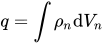
To clarify these effective template-derived quantities, we use q to stand for any quantity within some scope of context (not necessarily base quantities) and present in the table below some of the most commonly used symbols where applicable, their definitions, usage, SI units and SI dimensions – where [q] denotes the dimension of q.
For time derivatives, specific, molar, and flux densities of quantities, there is no one symbol; nomenclature depends on the subject, though time derivatives can be generally written using overdot notation. For generality we use qm, qn, and F respectively. No symbol is necessarily required for the gradient of a scalar field, since only the nabla/del operator ∇ or grad needs to be written. For spatial density, current, current density and flux, the notations are common from one context to another, differing only by a change in subscripts.
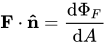
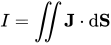
For current density, is a unit vector in the direction of flow, i.e. tangent to a flowline. Notice the dot product with the unit normal for a surface, since the amount of current passing through the surface is reduced when the current is not normal to the area. Only the current passing perpendicular to the surface contributes to the current passing through the surface, no current passes in the (tangential) plane of the surface.

The calculus notations below can be used synonymously.
- If X is a n-variable function , then

- Differential The differential n-space volume element is ,

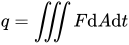
- Integral: The multiple integral of X over the n-space volume is .

| Quantity | Typical symbols | Definition | Meaning, usage | Dimensions |
|---|---|---|---|---|
| Quantity | q | q | Amount of a property | [q] |
| Rate of change of quantity, time derivative | Rate of change of property with respect to time | [q]T−1 | ||
| Quantity spatial density | ρ = volume density (n = 3), σ = surface density (n = 2), λ = linear density (n = 1)
No common symbol for n-space density, here ρn is used. |
Amount of property per unit n-space (length, area, volume or higher dimensions) |
[q]L−n | |
| Specific quantity | qm | Amount of property per unit mass | [q]M−1 | |
| Molar quantity | qn | Amount of property per mole of substance | [q]N−1 | |
| Quantity gradient (if q is a scalar field). | Rate of change of property with respect to position | [q]L−1 | ||
| Spectral quantity (for EM waves) | qv, qν, qλ | Two definitions are used, for frequency and wavelength:
|
Amount of property per unit wavelength or frequency. | [q]L−1 (qλ) [q]T (qν) |
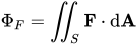
| Flux, flow (synonymous) | ΦF, F | Two definitions are used: |
Flow of a property though a cross-section/surface boundary. | [q]T−1L−2, [F]L2 |
| Flux density | F | Flow of a property though a cross-section/surface boundary per unit cross-section/surface area | [F] | |
| Current | i, I | Rate of flow of property through a cross-section/surface boundary | [q]T−1 | |
| Current density (sometimes called flux density in transport mechanics) | j, J | Rate of flow of property per unit cross-section/surface area | [q]T−1L−2 | |
| Moment of quantity | m, M |
k-vector q:
|
Quantity at position r has a moment about a point or axes, often relates to tendency of rotation or potential energy. | [q]L |







See also
[edit]Notes
[edit]- ^ "The concept 'quantity' may be generically divided into, e.g. 'physical quantity', 'chemical quantity', and 'biological quantity', or 'base quantity' and 'derived quantity'."[1]
- ^ via Hodge duality
References
[edit]- ^ a b c d e f g "ISO 80000-1:2009(en) Quantities and units — Part 1: General". International Organization for Standardization. Retrieved 2023-05-12.
- ^ Fourier, Joseph. Théorie analytique de la chaleur, Firmin Didot, Paris, 1822. (In this book, Fourier introduces the concept of physical dimensions for the physical quantities.)
- ^ a b International Bureau of Weights and Measures (20 May 2019), The International System of Units (SI) (PDF) (9th ed.), ISBN 978-92-822-2272-0, archived from the original on 18 October 2021
Further reading
[edit]- Cook, Alan H. The observational foundations of physics, Cambridge, 1994. ISBN 0-521-45597-9
- Essential Principles of Physics, P.M. Whelan, M.J. Hodgson, 2nd Edition, 1978, John Murray, ISBN 0-7195-3382-1
- Encyclopedia of Physics, R.G. Lerner, G.L. Trigg, 2nd Edition, VHC Publishers, Hans Warlimont, Springer, 2005, pp 12–13
- Physics for Scientists and Engineers: With Modern Physics (6th Edition), P.A. Tipler, G. Mosca, W.H. Freeman and Co, 2008, 9-781429-202657
External links
[edit]- Computer implementations
- DEVLIB project in C# Language and Delphi Language
- Physical Quantities Archived 2014-01-01 at the Wayback Machine project in C# Language at Code Plex
- Physical Measure C# library Archived 2014-01-01 at the Wayback Machine project in C# Language at Code Plex
- Ethical Measures Archived 2014-01-01 at the Wayback Machine project in C# Language at Code Plex
- Engineer JS online calculation and scripting tool supporting physical quantities.
- physical-quantity a web component (custom HTML element) for expressing physical quantities on the web/Internet, featuring self-contained unit conversion, a compact and clean UI, no redundant dual units, and seamless integration across all websites and platforms. Demo
| International | |
|---|---|
| National | |
| Other | |

Physical quantity
View on GrokipediaFundamentals
Definition
According to the International Vocabulary of Metrology (VIM), a physical quantity, or simply quantity, is "a property of a phenomenon, body, or substance, where the property has a magnitude that can be expressed as a number and a reference."[4] This sets it apart from purely qualitative descriptions. Examples include length, mass, and temperature, which describe observable attributes in numerical form rather than vague terms like "large" or "hot."[1] This quantification enables the formulation of scientific laws and predictions based on empirical data.[5] Key attributes of physical quantities include their measurability using standardized procedures, reproducibility under controlled conditions, and expression in numerical terms, often with associated units.[6] These properties ensure that measurements can be compared across experiments and contexts, forming the foundation of scientific reproducibility.[7] A physical quantity typically consists of a magnitude expressed numerically alongside a unit, though the focus here is on the conceptual essence rather than structural breakdown. The concept originated in classical physics, where pioneers like Galileo and Newton emphasized the importance of quantification to describe natural phenomena precisely, moving away from qualitative Aristotelian explanations.[8] Galileo advocated for mathematical descriptions of motion through experiments, while Newton formalized these ideas in his laws of motion, integrating measurement into the core of mechanics.[9] This approach evolved into modern physics, where physical quantities underpin theories from relativity to quantum mechanics, always rooted in empirical validation. Unlike mathematical quantities, which are abstract constructs like pure numbers or variables defined axiomatically without reference to the physical world, physical quantities are intrinsically linked to real-world phenomena and thus subject to inherent uncertainties arising from measurement limitations and experimental variability.[10][11] These uncertainties reflect the probabilistic nature of observations, distinguishing physical science from pure mathematics where exactness prevails.[12]Components
A physical quantity is fundamentally composed of a numerical value, which represents its magnitude, and a unit of measurement, which specifies the scale relative to a defined standard; in some contexts, a dimension or kind of quantity may also be included to categorize the property being measured.[13] The numerical value can be a simple scalar number for quantities like mass or length, or it may take a more complex form, such as multiple components for directional quantities like velocity, though the core idea remains a quantifiable measure of size or extent.[14] Units play a crucial role by providing a standardized reference that scales the numerical value to ensure comparability across measurements; for instance, the unit meter defines the reference length such that a numerical value of 1 corresponds to that exact span.[1] This scaling allows physical quantities to be expressed consistently within agreed-upon systems, facilitating communication and calculation in science and engineering. The concept of quantity calculus formalizes this decomposition, treating physical quantities as products of their numerical values and units, independent of specific choices of units. In this framework, a physical quantity is expressed as , where denotes the numerical value (a dimensionless number) and the unit (a quantity of dimension one in the chosen system). This relation arises because the full quantity must remain invariant under changes in the unit; if the unit is altered by a factor, the numerical value adjusts inversely to preserve . For example, a length of 5 meters is written as , where 5 is the numerical value and meters () the unit; equivalently, the same length could be 500 centimeters, with .[13][14] This product structure underpins algebraic operations on quantities, ensuring dimensional consistency in equations. Dimensions serve as an abstract framework for these components, classifying quantities by their fundamental attributes like length or time, though detailed analysis of dimensions is covered separately.Notation
Symbols and Nomenclature
In physical sciences, standard symbols for quantities are typically single uppercase or lowercase letters from the Latin or Greek alphabets, printed in an italic font to distinguish them from units and constants.[15] For instance, the symbol m denotes mass, v represents velocity, and t indicates time, as recommended in the ISO 80000 series, which provides comprehensive guidelines for quantities across disciplines like mechanics, thermodynamics, and electromagnetism. These conventions ensure clarity and consistency in scientific communication by avoiding ambiguity in notation.[16] Nomenclature rules emphasize a clear distinction between symbols for physical quantities and those for units: quantity symbols are italicized variables, while unit symbols are upright (roman) type and often derived from proper names or abbreviations.[15] For example, t (italic) symbolizes the quantity of time, whereas s (roman) denotes the unit second; similarly, m (italic) for mass contrasts with kg (roman) for kilogram. This separation prevents misinterpretation, as quantity symbols represent variables that can take numerical values, whereas unit symbols are fixed and invariant.[17] International standards from organizations like the International Bureau of Weights and Measures (BIPM) and the International Union of Pure and Applied Physics (IUPAP) promote uniform usage to facilitate cross-disciplinary and global collaboration. The BIPM's SI Brochure outlines base and derived quantity symbols aligned with the International System of Units (SI), while IUPAP's recommendations in its "Red Book" extend these to advanced physics contexts, ensuring symbols like E for energy or p for momentum are consistently applied.[16] These guidelines are harmonized with ISO 80000 to cover all major fields, reducing variability in publications and education. Common pitfalls in nomenclature include confusion between similar symbols, such as using u for scalar speed versus v (or bold v) for the velocity vector, which can lead to errors in interpreting directionality or magnitude.[16] Adherence to standards mitigates such issues by reserving v primarily for velocity and advising explicit vector notation where needed. The evolution of nomenclature transitioned from ad hoc notations in 19th-century physics—where figures like James Clerk Maxwell employed inconsistent symbols across treatises—to unified systems following the 1960 adoption of the SI by the General Conference on Weights and Measures (CGPM). This standardization, bolstered by the ISO 31 series (precursor to ISO 80000) in the 1970s, addressed fragmentation from competing systems like CGS and MKS, establishing a coherent framework that persists today.Typography
In scientific writing, symbols representing physical quantities are conventionally printed in italic type to distinguish them from surrounding text, such as the velocity symbol v or mass m.[18] In contrast, symbols for units are set in upright Roman typeface, as in the expression for speed v = 5 m/s, where "m/s" remains upright.[19][20] For vectors, common conventions include boldface italic type, such as v, or an arrow diacritic in handwritten or inline contexts, denoted as .[21] Tensors are typically represented using boldface variants, often sans-serif bold italic for higher-order tensors to differentiate them from vectors, though double boldface or other extensions may be employed in specialized fields. Subscripts and superscripts follow specific rules based on their semantic role: those denoting quantities, variables, or indices, such as component xi, are italicized, while descriptive labels, such as the molar subscript m in the heat capacity , appear in upright Roman type.[19][22] Powers and exponents representing mathematical operations are also upright when they are constants or labels, ensuring clarity in expressions like energy or force calculations.[18] The International Organization for Standardization (ISO) outlines these conventions in ISO 80000 and related directives, recommending italic serif fonts for quantities in print media, with bold italics for vectors and tensors, and consistent spacing around symbols to enhance readability in both print and digital formats.[22] The American Mathematical Society (AMS) aligns closely in its style guide, favoring boldface for vectors over arrows in typeset mathematics to streamline production, while advising upright fonts for units and labels across digital and print contexts.[21] These typographic standards evolved from 19th-century handwritten scripts, where arrows and underlining denoted vectors, to standardized printed conventions in the 20th century, facilitated by advances in typesetting technologies like linotype machines that enabled italic and bold variants for precise mathematical expression.[23]Mathematical Representation
Scalars
In physics, a scalar quantity is defined as a physical quantity that possesses only magnitude and no direction, remaining unchanged regardless of the observer's coordinate system.[24] Such quantities are invariant under coordinate transformations, including rotations, meaning their value does not depend on the orientation or position of the reference frame.[25] Scalar quantities exhibit properties of additivity and scalar multiplication, allowing them to be combined through basic arithmetic operations when dimensionally compatible. For instance, the sum of two scalars and is given by , and their product by , provided the principle of dimensional homogeneity is satisfied—ensuring that all terms in an equation share the same dimensions to maintain physical consistency.[26] Common examples include mass (), temperature (), and energy (), each describable by a single numerical value with appropriate units.[27] These quantities form the foundational building blocks for many derived physical quantities in physics, such as work or potential energy, which emerge from scalar operations on more complex forms.[27] In contrast to non-scalar quantities like vectors, scalars alone cannot capture directional aspects of phenomena. Their primary limitation lies in their inability to represent oriented physical effects, such as the motion of an object, which requires additional directional information.[24]Vectors
In physics, a vector quantity is defined as a physical entity that possesses both magnitude and direction, and transforms in a specific manner under spatial rotations, maintaining its directional integrity relative to the coordinate system.[28] Unlike scalar quantities, which have only magnitude and remain invariant under rotations, vectors such as displacement or momentum change their components predictably when the reference frame is rotated.[29] Classic examples include velocity , which describes the rate of change of position with direction, and force , which imparts directional influence on an object's motion.[30][31] Vector quantities obey specific algebraic properties that enable their manipulation in physical equations. Vector addition follows the parallelogram law, where the resultant vector is obtained by placing the tail of one vector at the head of the other and drawing the diagonal of the parallelogram formed by them, such that .[32] Additionally, vectors can be combined using the dot product, which yields a scalar representing the projection of one vector onto another (e.g., work as ), and the cross product, which produces a vector perpendicular to both operands, useful for quantities like torque ().[33] These operations are foundational for resolving forces and motions in multi-dimensional systems.[34] Vectors are typically represented in a chosen basis, such as the Cartesian coordinate system, where a three-dimensional vector is expressed as a linear combination of unit vectors: , with , , and as its scalar components along the respective orthogonal axes.[35] This decomposition allows vectors to be analyzed component-wise, simplifying calculations in Newtonian mechanics and beyond. The magnitude of a vector, which is its length and a scalar quantity, is computed using the Euclidean norm: derived from the Pythagorean theorem applied to the right triangle formed by its components.[36] Vector quantities are indispensable in various domains of physics, particularly kinematics, where they describe directional motion (e.g., velocity ), and electromagnetism, where fields like the electric field and magnetic field govern charged particle interactions through directional forces.[37][38] A notable subclass includes pseudovectors, or axial vectors, which transform like ordinary vectors under rotations but acquire an opposite sign under spatial inversion (parity); angular momentum exemplifies this, distinguishing it from polar vectors like linear momentum.[39]Tensors
In physics, tensors are mathematical objects that generalize scalars and vectors to represent physical quantities with multiple directions or orientations, defined as multi-linear maps from vector spaces to scalars or, equivalently, as multi-dimensional arrays whose components transform according to specific rules under changes of coordinates.[40] They are characterized by contravariant and covariant indices, where upper indices denote contravariant components and lower indices denote covariant ones, allowing tensors to describe quantities like forces or stresses that depend on the choice of basis.[41] Tensors are classified by their rank, which is the number of indices required to specify a component; a rank-0 tensor is a scalar, a rank-1 tensor is a vector, a rank-2 tensor has two indices (e.g., the stress tensor or the inertia tensor ), and higher-rank tensors have more indices, such as the rank-4 Riemann curvature tensor .[40] Vectors, as rank-1 tensors, are special cases that handle quantities with a single direction, but tensors extend this to multi-directional interactions essential for complex physical laws.[42] Under a coordinate transformation from to , tensor components obey precise transformation laws to ensure the physical quantity remains invariant; for a rank-2 covariant tensor like the stress tensor, the components transform as , where the partial derivatives form the Jacobian matrix of the transformation.[43] Contravariant tensors transform inversely, using the inverse Jacobian, while mixed tensors combine both.[44] Key properties of tensors include symmetry, where components satisfy for many physical tensors like stress or inertia, reducing the number of independent components from 9 to 6 for rank-2 cases, and the trace, defined as the sum of diagonal elements , which often represents an isotropic part such as hydrostatic pressure in the stress tensor.[45] The Riemann curvature tensor exhibits additional antisymmetries, such as , reflecting the oriented nature of spacetime curvature.[46] Tensors play a crucial role in continuum mechanics, where the stress tensor describes internal forces within materials, quantifying how force acts across surfaces in different directions.[45] In rigid body dynamics, the inertia tensor governs rotational motion by relating angular momentum to angular velocity via , capturing the mass distribution's effect on rotation.[47] In general relativity, the Riemann tensor measures spacetime curvature, encoding gravitational effects as tidal forces in Einstein's field equations.[46] These applications highlight tensors' necessity for formulating covariant physical laws beyond the limitations of scalars and vectors.[40]Dimensions and Measurement
Dimensions
In physics, the dimension of a physical quantity provides an abstract classification of its fundamental nature, expressed as a product of powers of the seven base dimensions in the International System of Units (SI). These base dimensions correspond to the SI base quantities and are denoted by symbols such as L for length, M for mass, T for time, I for electric current, Θ for thermodynamic temperature, N for amount of substance, and J for luminous intensity.[48] Any derived dimension is then a combination of these, such as the dimension of velocity, denoted , which is L T^{-1}, indicating one power of length and negative one power of time.[49] A core principle governing the use of dimensions is dimensional homogeneity, which mandates that every valid physical equation or inequality must balance dimensionally on both sides, ensuring all terms share identical dimensions. For example, in the equation for velocity v = s / t, where s is displacement and t is time, the dimensions satisfy = ^{-1} = L T^{-1}, confirming homogeneity across the equality.[26] This principle extends to additive terms as well, requiring each to possess the same dimensions, thereby preventing nonsensical combinations like adding lengths to masses.[26] The Buckingham π theorem formalizes the role of dimensions in analyzing complex physical systems by reducing them to dimensionless groups. Introduced by Edgar Buckingham in 1914, the theorem asserts that if a problem involves n physical variables expressible in terms of m fundamental dimensions, the solution can be reformulated as a relation among at most n - m independent dimensionless π parameters. These π groups, formed by combinations that eliminate dimensions, enable scaling analysis, such as predicting fluid flow behavior across different sizes without solving full equations. Dimensions find practical applications in verifying the consistency of physical equations and conducting dimensional analysis for model scaling. By checking dimensional homogeneity, researchers can detect errors in derived formulas, as mismatched dimensions immediately signal an inconsistency.[49] In engineering and scientific modeling, dimensional analysis leverages the Buckingham π theorem to identify key dimensionless numbers—like the Reynolds number in fluid dynamics—that govern system behavior, facilitating efficient predictions from scaled prototypes to full-scale systems.Units
A unit is a particular physical quantity, defined and adopted by convention, with which other quantities of the same kind are compared to express their magnitudes relative to that unit.[1] For example, the metre (m) is defined as the length of the path travelled by light in vacuum during a time interval of of a second.[50] The International System of Units (SI), established in 1960 and coordinated by the International Bureau of Weights and Measures (BIPM), comprises seven base units from which all other units are derived: the second (s) for time, metre (m) for length, kilogram (kg) for mass, ampere (A) for electric current, kelvin (K) for thermodynamic temperature, mole (mol) for amount of substance, and candela (cd) for luminous intensity.[51] Derived units are formed by combining these base units through multiplication and division; for instance, the newton (N), the unit of force, is defined as .[52] Historically, SI units relied on physical artifacts for realization, such as the platinum-iridium metre bar deposited in 1889 and the international prototype kilogram maintained at the BIPM since 1889. Over time, definitions shifted toward natural phenomena for greater stability: the metre was redefined in 1983 using the speed of light, and the second in 1967 using caesium-133 hyperfine transition frequency.[53] The 2019 revision, effective from 20 May 2019, anchored all seven base units to fixed values of fundamental constants—such as the speed of light , Planck constant , and elementary charge —eliminating artifact dependencies entirely and ensuring universal reproducibility.[54] In the SI, coherent units form a system where derived units are exact products or quotients of base units without additional numerical factors other than unity, preserving the form of physical equations when expressed numerically.[15] This coherence simplifies calculations; for example, the joule (J) for energy is simply , requiring no conversion coefficients in formulas like kinetic energy .[55] Unit conversions between systems rely on dimensional analysis, ensuring consistency by treating units as algebraic quantities that cancel appropriately. For instance, to convert miles to kilometres, multiply by the factor , yielding .Quantity Kinds
In the International System of Quantities (ISQ) as defined by ISO 80000, quantity kinds represent semantic categories that classify physical quantities based on their intrinsic physical meanings, grouping those with comparable properties while distinguishing them from others even if they share the same dimensional structure. A quantity kind specifies the type of measurable property, such as length, mass, or electric charge, enabling consistent interpretation across scientific disciplines; for instance, all lengths—whether height, width, or radius—belong to the same kind despite varying contexts. This classification ensures that quantities within a kind can be directly compared or combined mathematically, while those of different kinds require careful consideration to avoid misapplication. The distinction between quantity kinds and dimensions is crucial, as quantities of the same dimension may belong to different kinds, reflecting their unique physical interpretations. According to ISO 80000-1, quantities of different dimensions are always of different kinds, but the converse does not hold: for example, torque (or moment of force) and energy both possess the dimension ML²T⁻² yet are conventionally regarded as distinct kinds, preventing the use of the joule for torque despite dimensional compatibility. Similarly, heat and work share the same dimension but are treated as separate kinds to preserve conceptual clarity in thermodynamic processes. Another illustration is entropy and heat capacity, both quantified in joules per kelvin (J/K) with dimension ML²T⁻²Θ⁻¹, but representing fundamentally different properties—disorder versus energy storage per temperature change—thus requiring kind-specific handling in equations. Quantity kinds play a vital role in international standards by promoting precise communication and avoiding ambiguities in measurement and calculation. In fields like engineering, this separation ensures that interchangeable units do not imply physical equivalence; for example, while specific units apply to particular kinds, such as the farad for capacitance, the framework discourages conflating dimensionally similar but semantically distinct quantities like certain electrical susceptibilities and mechanical flexibilities. This structured typology underpins the ISQ's coherence, facilitating error-free applications in complex systems. Dimensionless kinds form a special category within this system, encompassing pure numbers or ratios that lack dimensional exponents but still require kind-specific identification to convey meaning. As outlined in ISO 80000-11, these are physical quantities of unit one, often called characteristic numbers, such as the Reynolds number, which characterizes fluid flow regimes as a ratio of inertial to viscous forces. Distinguishing these kinds prevents misinterpretation in analyses where, for instance, the Reynolds number (flow dynamics) differs from the Mach number (compressibility effects), both dimensionless yet contextually unique. In modern applications, quantity kinds are integral to computational physics and data standards, enabling robust software implementations for simulations and interoperability. Libraries like mp-units enforce kind-based type checking to catch errors in unit conversions and equation validations, ensuring that dimensionally compatible but kind-distinct quantities, such as torque and energy, are not erroneously equated in numerical models. This approach supports high-fidelity data exchange in interdisciplinary fields, from climate modeling to engineering design.[56]Classification
Base Quantities
Base quantities represent the fundamental, irreducible physical entities chosen as the independent foundations of a measurement system, from which all other physical quantities can be derived through mathematical combinations such as products and quotients of powers. These quantities are selected to ensure mutual dimensional independence, meaning no base quantity can be expressed in terms of the others, while collectively providing a complete framework for describing the full range of observable physical phenomena.[54][15] In the International System of Units (SI), established by the General Conference on Weights and Measures, seven base quantities form this foundation, each associated with a specific symbol as standardized in the SI Brochure. These are:- Length (), essential for spatial extent and geometry.
- Mass (), fundamental to inertia and gravitational interactions.
- Time (), critical for sequencing events and rates of change in dynamics.
- Electric current (), key to electromagnetic phenomena and charge flow.
- Thermodynamic temperature (), describing thermal equilibrium and energy distributions.
- Amount of substance (), quantifying the number of elementary entities in chemical systems.
- Luminous intensity (), pertaining to the perception of light in photometry.