
Recent from talks
Quattro (four-wheel-drive system)
Knowledge base stats:
Talk channels stats:
Members stats:
Quattro (four-wheel-drive system)
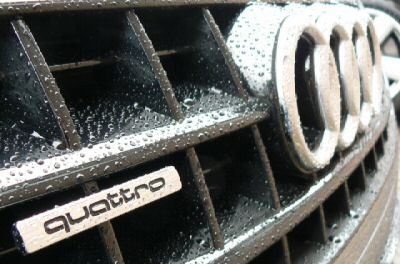
Quattro (meaning four in Italian and stylized as quattro) is the trademark used by the automotive brand Audi to indicate that all-wheel drive (AWD) technologies or systems are used on specific models of its automobiles.
The word "quattro" is a registered trademark of Audi AG, a subsidiary of the German automotive enterprise, Volkswagen Group.
Quattro was first introduced in 1980 on the permanent four-wheel drive Audi Quattro model, often referred to as the Ur-Quattro (meaning "original" or "first"). The term quattro has since been applied to all subsequent Audi AWD models. Due to the nomenclature rights derived from the trademark, the word quattro is now always spelled with a lower case "q" by the manufacturer, in honour of its former namesake.[citation needed]
Other companies in the Volkswagen Group have used different trademarks for their 4WD vehicles. While Audi has always used the term "quattro", Volkswagen-branded cars initially used "syncro", but more recently,[when?] VW uses "4motion". Škoda simply uses the nomenclature "4x4" after the model name, whereas SEAT uses merely "4" ("4Drive" more recently[when?]). None of the above trademarks or nomenclatures defines the operation or type of 4WD system, as detailed below.
Volkswagen Group has been developing four-wheel drive (4WD) systems almost since its inception during the Second World War. The Volkswagen Kübelwagen, Volkswagen Schwimmwagen, and Volkswagen Kommandeurswagen were all military vehicles which required all four road wheels to be "driven", the latter being a 4WD Volkswagen Beetle. Their military and four-wheel drive experiences later aided them in designing the Volkswagen Iltis for the German military (Bundeswehr) in the 1970s. The Iltis utilized an early form of 4WD, which would later become synonymous with "quattro".
In that original quattro system, later found in road-going passenger cars, the engine and transmission are situated in a longitudinal position. Torque is sent through the transmission to a mechanical centre differential (commonly abbreviated to "diff") which apportions (distributes) the torque between front and rear driven axles. 4WD was permanently active.
After 1987, Audi replaced a manually locking centre differential with the Torsen (torque sensing) Type 1 ("T1") centre differential. This allowed engine torque to be automatically directed to individual axles as driving conditions and grip warranted. Under 'normal' conditions (where grip in both front and rear axles is equal), torque is split between front and rear with a 'default" 50:50 distribution in many, though not all, versions. In adverse conditions (i.e., when there is variation in grip between front and rear), a maximum of 90-100% (depending on the transmission, or model of Torsen diff) of the engine's torque can be directed to the front or rear axles. The fully automated mechanical nature of the Torsen centre differential helps prevent wheel slippage from occurring, by diverting torque instantly, without any discernible notice to the vehicle occupants, to the axle which has more grip. This method of operation can be described as proactive. Furthermore, unlike the various types of electronically operated differentials, Torsen has no requirement for electronic data from sources such as road wheel speed sensors; it, therefore, has an element of "fail-safe", unlike designs such as Haldex Traction, should one of the wheel speed sensors develop a fault. In comparison, viscous coupling and electronically controlled centre differentials that are used in other four-wheel drive systems are reactive, since they only redirect torque after wheel slippage has occurred. The advantage is felt under hard acceleration, including whilst cornering, since the torque transfer between axles is seamless, thus maintaining stable vehicle dynamics, and considerably reducing the chance of losing control of the vehicle.
The Torsen-based quattro system also offers an advantage in the opposite function of distributing torque to the road wheels, namely engine braking. When engine braking is used to slow the car down, with Torsen-based systems, the resulting "reverse-torque" loads on the front and rear axle are equally stabilized, in exactly the same way that engine "propulsion" torque is apportioned fully mechanically autonomously. This allows the spreading of the engine braking effect to all four wheels and tyres. The Torsen-based quattro-equipped vehicle is able to execute a more stable high-speed turn under deceleration, with less risk of losing control due to loss of grip in the front or rear axles.
Hub AI
Quattro (four-wheel-drive system) AI simulator
(@Quattro (four-wheel-drive system)_simulator)
Quattro (four-wheel-drive system)
Quattro (meaning four in Italian and stylized as quattro) is the trademark used by the automotive brand Audi to indicate that all-wheel drive (AWD) technologies or systems are used on specific models of its automobiles.
The word "quattro" is a registered trademark of Audi AG, a subsidiary of the German automotive enterprise, Volkswagen Group.
Quattro was first introduced in 1980 on the permanent four-wheel drive Audi Quattro model, often referred to as the Ur-Quattro (meaning "original" or "first"). The term quattro has since been applied to all subsequent Audi AWD models. Due to the nomenclature rights derived from the trademark, the word quattro is now always spelled with a lower case "q" by the manufacturer, in honour of its former namesake.[citation needed]
Other companies in the Volkswagen Group have used different trademarks for their 4WD vehicles. While Audi has always used the term "quattro", Volkswagen-branded cars initially used "syncro", but more recently,[when?] VW uses "4motion". Škoda simply uses the nomenclature "4x4" after the model name, whereas SEAT uses merely "4" ("4Drive" more recently[when?]). None of the above trademarks or nomenclatures defines the operation or type of 4WD system, as detailed below.
Volkswagen Group has been developing four-wheel drive (4WD) systems almost since its inception during the Second World War. The Volkswagen Kübelwagen, Volkswagen Schwimmwagen, and Volkswagen Kommandeurswagen were all military vehicles which required all four road wheels to be "driven", the latter being a 4WD Volkswagen Beetle. Their military and four-wheel drive experiences later aided them in designing the Volkswagen Iltis for the German military (Bundeswehr) in the 1970s. The Iltis utilized an early form of 4WD, which would later become synonymous with "quattro".
In that original quattro system, later found in road-going passenger cars, the engine and transmission are situated in a longitudinal position. Torque is sent through the transmission to a mechanical centre differential (commonly abbreviated to "diff") which apportions (distributes) the torque between front and rear driven axles. 4WD was permanently active.
After 1987, Audi replaced a manually locking centre differential with the Torsen (torque sensing) Type 1 ("T1") centre differential. This allowed engine torque to be automatically directed to individual axles as driving conditions and grip warranted. Under 'normal' conditions (where grip in both front and rear axles is equal), torque is split between front and rear with a 'default" 50:50 distribution in many, though not all, versions. In adverse conditions (i.e., when there is variation in grip between front and rear), a maximum of 90-100% (depending on the transmission, or model of Torsen diff) of the engine's torque can be directed to the front or rear axles. The fully automated mechanical nature of the Torsen centre differential helps prevent wheel slippage from occurring, by diverting torque instantly, without any discernible notice to the vehicle occupants, to the axle which has more grip. This method of operation can be described as proactive. Furthermore, unlike the various types of electronically operated differentials, Torsen has no requirement for electronic data from sources such as road wheel speed sensors; it, therefore, has an element of "fail-safe", unlike designs such as Haldex Traction, should one of the wheel speed sensors develop a fault. In comparison, viscous coupling and electronically controlled centre differentials that are used in other four-wheel drive systems are reactive, since they only redirect torque after wheel slippage has occurred. The advantage is felt under hard acceleration, including whilst cornering, since the torque transfer between axles is seamless, thus maintaining stable vehicle dynamics, and considerably reducing the chance of losing control of the vehicle.
The Torsen-based quattro system also offers an advantage in the opposite function of distributing torque to the road wheels, namely engine braking. When engine braking is used to slow the car down, with Torsen-based systems, the resulting "reverse-torque" loads on the front and rear axle are equally stabilized, in exactly the same way that engine "propulsion" torque is apportioned fully mechanically autonomously. This allows the spreading of the engine braking effect to all four wheels and tyres. The Torsen-based quattro-equipped vehicle is able to execute a more stable high-speed turn under deceleration, with less risk of losing control due to loss of grip in the front or rear axles.
Recent media