Hubbry Logo
3D tic-tac-toe3D tic-tac-toeMain
Open search
3D tic-tac-toe
Community hub
3D tic-tac-toe
logo
8 pages, 0 posts
0 subscribers
Be the first to start a discussion here.
3D tic-tac-toe
3D tic-tac-toe
from Wikipedia

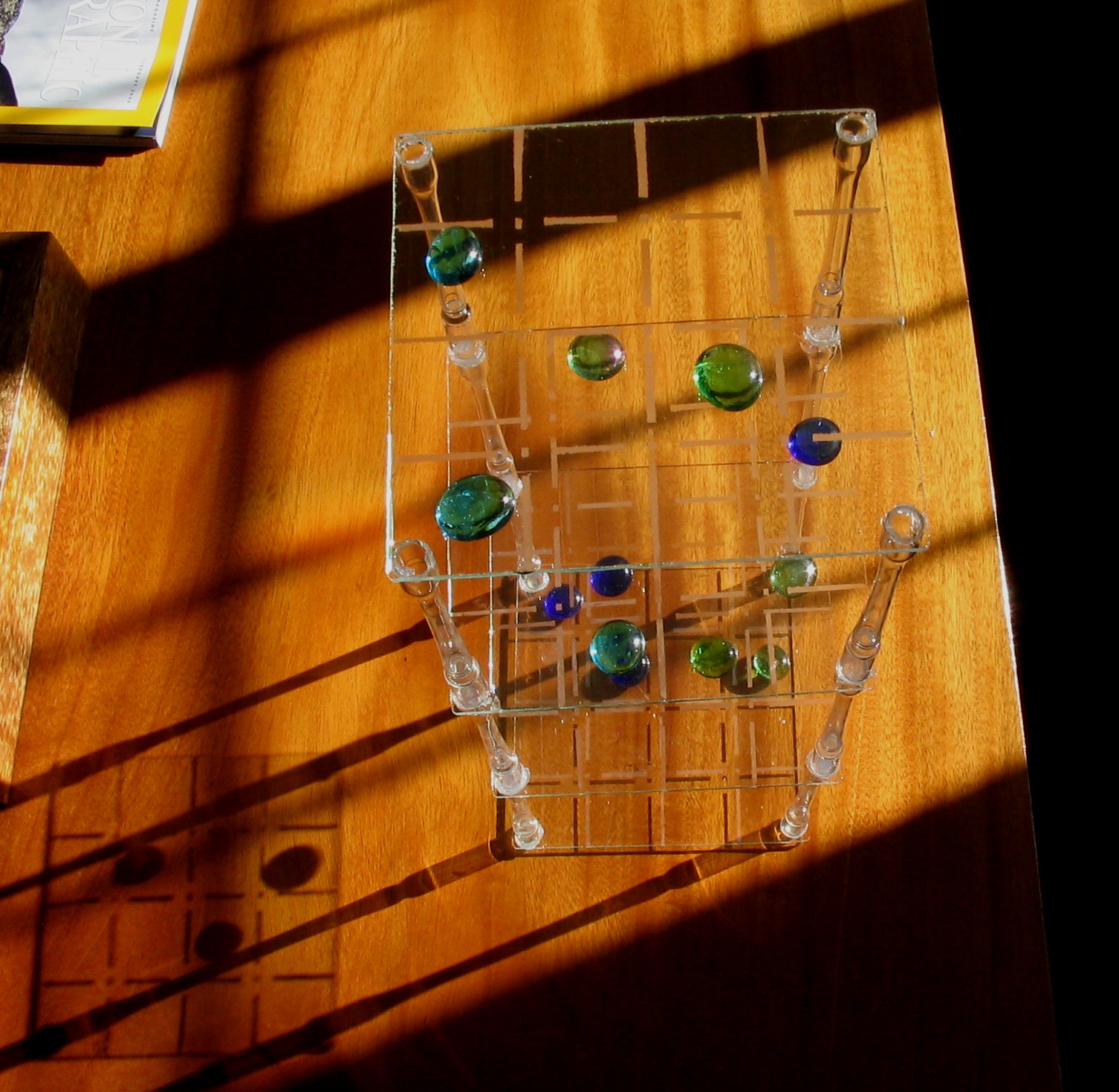
3-D Tic-Tac-Toe played with glass beads

3D tic-tac-toe, also known by the trade name Qubic, is an abstract strategy board game, generally for two players. It is similar in concept to traditional tic-tac-toe but is played in a cubical array of cells, usually 4×4×4. Players take turns placing their markers in blank cells in the array. The first player to achieve four of their own markers in a row wins. The winning row can be horizontal, vertical, or diagonal on a single board as in regular tic-tac-toe, or vertically in a column, or a diagonal line through four boards.

As with traditional tic-tac-toe, several commercial sets of apparatus have been sold for the game, and it may also be played with pencil and paper with a hand-drawn board.

The game has been analyzed mathematically and a first-player-win strategy was developed and published. However, the strategy is too complicated for most human players to memorize and apply.

Pencil and paper

[edit]

Like traditional 3×3 tic-tac-toe, the game may be played with pencil and paper. A game board can easily be drawn by hand, with players using the usual "naughts and crosses" to mark their moves.

In the 1970s, 3M Games (a division of 3M Corporation) sold a series of "Paper Games", including "3 Dimensional Tic Tac Toe". Buyers received a pad of 50 sheets with preprinted game boards.[1]

Marker sizes variation

[edit]

Gobblets Gobbler[2] and Otrio,[3] use marker sizes (small, medium, large) as the replacement of the third element. Players can 'steal' the opponent spot by placing larger marker at the top of the opponent smaller marker or just simply competing with overlapping spot.

"Qubic"

[edit]

"Qubic" is the brand name of equipment for the 4×4×4 game that was manufactured and marketed by Parker Brothers, starting in 1964.[4] It was reissued in 1972 with a more modern design. Both versions described the game as "Parker Brothers 3D Tic Tac Toe Game".

In the original issue, the bottom level board was opaque plastic, and the upper three clear, all of simple square design. The 1972 reissue used four clear plastic boards with rounded corners. Whereas pencil and paper play almost always involves just two players, Parker Brothers' rules said that up to three players could play. The circular playing pieces resembled small poker chips in red, blue, and yellow.

The game is no longer manufactured.

Reviews

[edit]

Gameplay and analysis

[edit]

3×3×3, two-player

[edit]

The 3×3×3 version of the game cannot end in a draw[6] and is easily won by the first player unless a rule is adopted that prevents the first player from taking the center cell on his first step. In that case, the game is easily won by the second player. By banning the use of the center cell altogether, the game is easily won by the first player. By including a 3rd player, the perfect game will be played out to a draw. By including stochasticity in the choosing of the side the player must use, the game becomes fair and winnable by all players but is subject to chance. By making the choice of the player piece (× or ⚬) subject to chance, the game becomes fair and winnable by all players.[7]

4×4×4, two-player

[edit]

On the 4×4×4 board, there are 76 winning lines: 48 that are parallel to an edge of the cube, 24 that are parallel to a face diagonal, and finally 4 body diagonals of the cube.

The 16 cells lying on these latter four lines (that is, the eight corner cells and eight internal cells) are each included in seven different winning lines; the other 48 cells (24 face cells and 24 edge cells) are each included in four winning lines.

The corner cells and the internal cells are actually equivalent via an automorphism; likewise for face and edge cells. The group of automorphisms of the game contains 192 automorphisms. It is made up of combinations of the usual rotations and reflections that reorient or reflect the cube, plus two that scramble the order of cells on each line. If a line comprises cells A, B, C and D in that order, one of these exchanges inner cells for outer ones (such as B, A, D, C) for all lines of the cube, and the other exchanges cells of either the inner or the outer cells (A, C, B, D or equivalently D, B, C, A) for all lines of the cube. Combinations of these basic automorphisms generate the entire group of 192 as shown by R. Silver in 1967.[8]

3D tic-tac-toe was weakly solved, meaning that the existence of a winning strategy was proven but without actually presenting such a strategy, by Eugene Mahalko in 1976.[9] He proved that in two-person play, the first player will win if there are two optimal players.

A more complete analysis, including the announcement of a complete first-player-win strategy, was published by Oren Patashnik in 1980.[10] Patashnik used a computer-assisted proof that consumed 1500 hours of computer time. The strategy comprised move choices for 2929 difficult "strategic" positions, plus assurances that all other positions that could arise could be easily won with a sequence entirely made up of forcing moves. It was further asserted that the strategy had been independently verified. As computer storage became cheaper and the internet made it possible, these positions and moves were made available online.[11]

The game was solved again by Victor Allis using proof-number search.[12]

Computer implementations

[edit]
3-D Tic-Tac-Toe
Atari 2600 box art
DeveloperAtari, Inc.
PublishersAtari, Inc.
ProgrammerCarol Shaw
PlatformsAtari 2600, Atari 8-bit
ReleaseJuly 1980[13]
ModesSingle-player, multiplayer

Several computer programs that play the game against a human opponent have been written. The earliest of these used console lights and switches, text terminals, or similar interaction: the human player would enter moves numerically (for example, using "4 2 3" for fourth level, second row, third column) and the program would respond similarly, as graphics displays were uncommon.

A program written for the IBM 650 used front panel switches and lights for the user interface.[citation needed]

William Daly Jr. wrote and described a Qubic-playing program as part of his Master's program at the Massachusetts Institute of Technology. The program was written in assembler language for the TX-0 computer. It included lookahead to 12 moves and kept a history of previous games with each opponent, modifying its strategy according to their past behavior.[14]

An implementation in Fortran was written by Robert K. Louden and presented, with an extensive description of its design, in his book Programming the IBM 1130 and 1800. Its strategy involved looking for combinations of one or two free cells shared among two or three rows with particular contents.[15]

A Qubic program in a DEC dialect of BASIC appeared in 101 BASIC Computer Games by David H. Ahl.[16] Ahl said the program "showed up", author unknown, on a G.E. timesharing system in 1968.

Gameplay of 3-D Tic-Tac-Toe

Atari released a 4x4x4 graphical version of the game for the Atari 2600 console and Atari 8-bit computers in 1980.[17][18] The program was written by Carol Shaw, who went on to greater fame as the creator of Activision's River Raid.[19] It uses the standard joystick controller. It can be played by two players against each other, or one player can play against the program on one of eight different difficulty settings.[20] The product code for the Atari game was CX-2618.[21]

Three-dimensional tic-tac-toe on a 4x4x4 board (optionally 3x3x3) was included in the Microsoft Windows Entertainment Pack in the 1990s under the name TicTactics. In 2010, Microsoft made the game available on its Game Room service for its Xbox 360 console.

A program library named Qubist, and front-end for the GTK 2 window library are a project on SourceForge.[22]

See also

[edit]

References

[edit]
[edit]
Revisions and contributorsEdit on WikipediaRead on Wikipedia
from Grokipedia
3D is a two-player abstract strategy board game that generalizes the traditional two-dimensional into a , played on a cubic grid measuring 3×3×3, consisting of 27 cells arranged in three stacked layers. Players alternate turns marking empty cells with their symbols—conventionally X for the first player and O for the second—with the objective of aligning three of their symbols in a straight line. This winning line can extend horizontally or vertically within a single layer, vertically through the stacked layers (pillars), or diagonally across layers in any of the three spatial dimensions, resulting in 49 possible winning combinations. The game concludes with a victory for the player who achieves such an alignment or a draw if the board fills completely without one. First commercially released in 1953, 3D emerged as a mid-20th-century building on the ancient roots of its 2D predecessor, which dates to at least 1300 BCE in . has fully solved the game, demonstrating that with perfect play, the first player possesses a winning strategy by initially occupying the central cell. Early computer versions appeared in the on mainframe systems, and the game gained wider popularity through adaptations, such as the 1980 release developed by , which featured an AI opponent using lookahead algorithms. A related variant, Qubic, expands the board to 4×4×4 with a requirement for four in a row and has been proven to favor the first player under optimal conditions.

Introduction and Basics

Definition and Setup

3D tic-tac-toe is a direct three-dimensional analog of the classic two-dimensional game, expanding the play into a spatial volume. The game is played on a ×3 cube grid, consisting of 27 distinct positions available for markers. The board is structured as three stacked layers, forming a cubic arrangement that allows placements across horizontal planes, vertical stacks, and diagonal paths through the depth. Two players participate, alternating turns to place their markers, with the first player using the symbol X and the second using O; X begins by selecting any empty position. The primary objective is for a player to be the first to align three of their own markers in a straight line along any direction—horizontal, vertical, or diagonal—which may traverse across the layers of the cube.

Core Rules and Winning Lines

In the standard 3×3×3 version of 3D , two players alternate turns, with the first player placing their marker (typically X) in any empty cell of the 27-cell cubic grid, followed by the second player (typically O) doing the same in a different empty cell, and so on until the board is full or a winner emerges. Each turn consists of placing exactly one marker, with no option to pass or remove pieces. The game follows turn-based alternation without additional mechanics, ensuring sequential occupation of cells. A player wins by being the first to occupy all three positions in any straight line of three cells, where "straight" encompasses lines parallel to the grid axes, diagonals on planes parallel to the faces, or full space diagonals through the cube's interior. There are precisely 49 such winning lines in total, derived from the formula for the number of k-in-a-row lines in an n-dimensional k×k×...×k grid: ((k+2)nkn)/2((k + 2)^n - k^n)/2, which for k=3 and n=3 yields (125 - 27)/2 = 49. This count breaks down into 27 straight lines (9 parallel to each of the three axes: 9 rows across the three layers, 9 columns across the three layers, and 9 vertical pillars through the three layers), 18 face diagonals (2 per 3×3 plane × 3 planes per pair of axes × 3 pairs), and 4 space diagonals (connecting opposite corners of the cube). If all 27 cells are filled without either player achieving three markers in any winning line, the game ends in a draw.

Variants and Adaptations

Board Size Variations

The 4×4×4 board variant of 3D tic-tac-toe expands the standard 3×3×3 grid to 64 cells, with players aiming to align four markers in any straight line, including rows, columns, diagonals across planes, and space diagonals through the . This adjustment scales the winning condition to match the board size, increasing strategic depth compared to the baseline three-in-a-row requirement. The configuration features 76 distinct , comprising 48 orthogonal lines parallel to the axes, 24 face diagonals, and 4 space diagonals. These additional lines heighten complexity, as players must defend and pursue opportunities across more pathways, often leading to longer games under optimal play. Generalizations to n×n×n boards follow similar scaling rules, where victory requires n markers in a collinear sequence along any direction, extending the orthogonal, planar diagonal, and volumetric diagonal possibilities. For instance, the 5×5×5 variant utilizes 125 cells and demands five in a row, further amplifying the number of potential winning lines—calculated generally as \frac{(n+2)^3 - n^3}{2} for the total in three dimensions—while maintaining the core alternation of turns between two players. Such larger grids introduce exponential growth in board states, with computational analysis becoming demanding even for modest lookahead depths, as seen in efforts to program intelligent agents for these setups. Implementing n>4 boards physically presents notable difficulties, as the expanded volume requires robust stacking mechanisms or transparent layers to access and view internal cells without instability, often rendering manual play cumbersome beyond 4×4×4. While these variants emphasize two-player competition to mirror the original game's balance, brief adaptations for multiple players—such as assigning distinct markers and adjusting win conditions—have been explored in computational contexts but remain secondary to the standard format.

Marker and Player Variations

In 3D tic-tac-toe, marker size variations modify the standard win condition of three aligned markers to require k-in-a-row, where k differs from 3, altering game length and difficulty while maintaining the 3×3×3 board structure. For quicker games, k=2 enables wins with just two consecutive markers in any direction, reducing the total moves needed and emphasizing rapid positioning over extended strategy. Conversely, setting k=4 on a 3×3×3 board increases challenge by demanding longer alignments, though this often leads to draws or impossibilities due to board constraints, promoting defensive play. Multi-player versions extend the game beyond two participants, typically accommodating 3 or 4 players with distinct markers such as X, O, △, and □ to differentiate ownership. In these adaptations, players alternate turns placing their unique markers, with the first to complete their required k-in-a-row (often retaining k=3) declared the winner; simultaneous completions may result in shared victories or continued play until resolution. For 3 players, each uses a separate color or shape, ensuring clear identification of lines amid the shared board. Balancing multi-player games addresses overcrowding on the standard 3×3×3 board, where additional players accelerate filling of the 27 cells, potentially leading to early draws before any win. To mitigate this, rules may adjust board size—such as expanding to for 3 or 4 players—to provide more space, allowing fair opportunities for each to form lines without immediate congestion. A representative example is the 3-player variant on a board with 4-in-a-row per player (known as Qubic), where distinct markers prevent confusion, and turns cycle strictly to maintain equity; this setup suits casual play but highlights the need for larger grids in competitive scenarios to sustain engagement.

History and Cultural Impact

Origins and Early Development

3D tic-tac-toe originated as a natural extension of the classic two-dimensional game, with conceptual roots in recreational mathematics and puzzle-solving communities during the early 20th century. By the late 1940s and into the 1950s, 3D tic-tac-toe appeared in recreational mathematics circles, often described in books and articles as "three-dimensional noughts and crosses" to explore combinatorial challenges beyond the 2D plane. These early mentions emphasized theoretical play through pen-and-paper sketches, as physical boards were cumbersome to construct and visualize. The game's complexity grew with discussions of winning lines across planes, diagonals, and depths, but it remained largely abstract without a dominant formalization. The first commercial release of the 3×3×3 version occurred in 1953 by Greer Co. under the name "Third Dimension Tic-Tac-Toe." Pioneering computer implementations further advanced its development; similarly, "Three Dimensional Tick-Tack-Toe" was featured in an IBM catalog in April 1962 for the IBM 650 system, marking one of the first commercial software references. The mid-1960s saw the game's initial popularization through commercial design, with releasing Qubic in 1965 as a physical 4×4×4 set using colored pegs in a vertical tower structure (following earlier versions in 1947 by Duplicon and 1953 by Qubic Games). This edition, supporting up to four players, built on prior abstract experiments but introduced accessible for home play. No single inventor is credited, as the game evolved organically from and early experiments rather than a patented . Into the 1970s, further formalization occurred via patents, such as one in 1975 for a modular tray-based apparatus to facilitate compartment-based play and rotation. Early adoption faced significant challenges due to the inherent difficulty of physical and spatial visualization, often confining the game to theoretical descriptions or simplified diagrams in mathematical texts. Players struggled with tracking lines through multiple layers without aids, leading to variants that prioritized conceptual understanding over tangible setups. These hurdles delayed widespread play until commercial products like Qubic provided structured boards, bridging the gap between idea and practice.

Notable Implementations and Media

One of the most notable implementations of 3D tic-tac-toe is Qubic, a commercial produced by . Released by in 1965 (following earlier versions in 1947 by Duplicon and 1953 by Qubic Games), it features a cubic grid where players aim to align four markers in a row along any orthogonal or diagonal line, expanding the traditional game's complexity with 76 possible winning lines. The game was reissued in 1965 and 1972, marketed explicitly as "Parker Brothers 3D Tic Tac Toe Game," and included plastic stacks for the four layers, making it accessible for home play. Digital adaptations of Qubic emerged in the late 1970s, with a text-based version for the in 1978 that simulated the 4×4×4 board through coordinate inputs, allowing single-player practice against a computer opponent. This version highlighted the game's strategic depth, as analyzed in Oren Patashnik's 1980 paper in Mathematics Magazine, which proved the first player can force a win using computer-assisted —a finding that praised Qubic's mathematical richness and influenced early computational explorations. Computing magazines of the era, such as those covering early microcomputers, lauded such implementations for their engaging blend of simplicity and challenge, often recommending them for educational programming exercises. The game gained further prominence through mathematical literature, notably in Martin Gardner's 1959 book Hexaflexagons and Other Mathematical Diversions, where he described several marketed 3D tic-tac-toe variants on cubical boards, emphasizing wins along orthogonal or diagonal paths and sparking interest in their combinatorial properties. Commercial versions proliferated in the 1980s and 1990s, including adaptations like the 1980 Atari 2600 cartridge 3-D Tic-Tac-Toe, which rendered four stacked 4×4 grids graphically and supported two-player mode, though critics noted its basic AI limited replayability. In , 3D has appeared as a metaphor for multidimensional strategy, such as in the franchise, where a holographic 3D version is played aboard the Enterprise in episodes like "The Cage" (1965), symbolizing advanced intellectual pursuits. Post-2000, the game has seen renewed interest through mobile and online platforms, with apps like Qubic — 3D tic tac toe (2019) on offering multiplayer over networks and AI opponents on a 4×4×4 board, and 3D on (2024) supporting up to three players with adjustable AI difficulty, facilitating casual online play worldwide.

Mathematical Analysis

Strategy in 3×3×3 Games

In the standard 3×3×3 game, the first player has a winning under optimal play, allowing them to force a regardless of the second player's responses. This result stems from computer-assisted analysis that explores the game's , confirming that perfect execution leads to a win for the starter. Key to this is securing control of the central position in the middle layer early on, as this spot participates in 13 potential winning lines—far more than the 3 to 5 lines accessible from edge or corner positions—enabling the creation of multiple simultaneous threats that the opponent cannot fully block. Common tactics revolve around fork creation, where the first player positions markers to threaten wins in two or more directions at once, often spanning layers or diagonals in three dimensions. For instance, after claiming the central middle-layer spot, the first player can respond to the second player's move by occupying a symmetric position in an adjacent layer, forcing the opponent into a defensive block while setting up a across vertical and diagonal axes. Blocking opponent lines requires vigilance in all dimensions: players must anticipate threats not just on a single plane but across stacked layers, vertical pillars, and space diagonals. Examples of forced wins occur in as few as five moves, such as when the first player establishes a two-marker line in one layer and simultaneously aligns a threat in a direction through the center, compelling blocks that open a third winning path by the seventh move at latest. These maneuvers exploit the board's , where the abundance of intersecting lines (49 in total) amplifies the advantage of central dominance. Draws are impossible under optimal play in 3×3×3 , contrasting sharply with the two-dimensional version where perfect strategy results in a tie. Exhaustive case analysis of initial responses shows that any deviation allowing a full board without a win favors the first player, who can always maneuver to complete a line before all 27 positions fill. This outcome underscores the game's bias toward the starter due to its odd number of spaces and the expanded winning opportunities in three dimensions, making stalemates rare even in suboptimal play.

Complexity for Larger Boards

The 4×4×4 variant of 3D , commonly known as Qubic, presents significantly greater analytical challenges than smaller boards due to its expanded state space. The game consists of 64 cells, leading to a total of approximately 3^{64} possible configurations, though the reachable under legal play is still on the order of 10^{20} to 10^{30} nodes without optimization, rendering exhaustive enumeration computationally prohibitive even with mid-20th-century hardware. Weak solvability was established in 1980 through a demonstrating that the first player possesses a winning strategy under optimal play, achieved via extensive of the to explore only strategic branches over 1,500 hours of computation on a system. This analysis highlighted the intensive resource demands, as naive search would expand to billions of positions per ply, necessitating symmetry reductions and forced-win detections to make progress feasible. For general n×n×n boards, the theoretical complexity escalates dramatically with board size. The state space expands exponentially as 3^{n^3}, creating an unmanageable explosion in possible positions that defies complete enumeration for n > 4 without specialized techniques. The number of potential winning lines—straight, planar diagonal, and space diagonal sequences of length n—grows quadratically as O(n^2), specifically 3n^2 + 6n + 4, but verifying wins across these lines remains efficient at O(n^2) time per check. However, determining whether a given position admits a forced win for the current player in such generalized 3D tic-tac-toe involves hard combinatorial search challenges, complicating automated solution beyond small cases. In multi-player extensions of 3D , where three or more players alternate turns on larger boards, the complexity compounds through a higher and non-zero-sum dynamics, resulting in a state space explosion that renders exact solving intractable. Practical AI implementations rely on approximations, such as functions scoring board control and threat levels combined with alpha-beta , to navigate the vast search space effectively. These methods prioritize immediate wins or blocks over exhaustive foresight, as full exploration becomes infeasible due to the multiplied permutations per turn. Several open problems persist in the theoretical analysis of larger boards as of 2025. Notably, the exact outcome under optimal play for n×n×n 3D tic-tac-toe with n ≥ 5—whether the first player can force a win, the second player a , or another result—remains unsolved, with no proven strategies despite advances in computational . This uncertainty stems from the prohibitive scale of the game trees, outpacing current solving techniques for impartial beyond n=4.

Practical Implementations

Physical and Manual Play

3D tic-tac-toe can be played manually using pencil and paper by drawing three 3×3 grids stacked vertically to represent the three layers of the cubic board, resulting in 27 total cells. Players alternate placing their symbols—typically X for one and O for the other—in unoccupied cells across any layer, following the standard rules of achieving three in a row along any straight line, including those spanning multiple layers. To facilitate move specification without ambiguity, layers are often labeled sequentially from 1 to 3 (bottom to top), with each layer's cells numbered 1 through 9 in a standard tic-tac-toe pattern, allowing players to call positions like "layer 2, position 5." For enhanced visualization beyond flat drawings, physical aids such as stacked index cards or wooden tiers can simulate the depth, where each card or tier represents a layer and markers are placed or pinned accordingly. Custom 3D-printed cubes or modular boards provide a tangible structure, enabling pieces to be inserted into slots across layers for a more interactive experience. These aids help maintain the board state during play, particularly for longer sessions. Practical tips for manual play include using layer-by-layer notation to record moves systematically, which aids in verifying wins without redrawing the entire board repeatedly. A key challenge lies in tracking diagonal lines that traverse multiple depths, as two-dimensional representations can obscure these paths, requiring players to mentally project the third dimension or use auxiliary sketches. The game is primarily suited for two players but can be adapted for up to four by assigning distinct symbols per player or rotating turns in teams. Its reliance on shapes like X and O rather than colors makes it inherently accessible for color-blind individuals, with further adaptations possible by using varied geometric tokens such as circles, squares, or triangles on physical boards.

Digital and Computational Versions

One of the earliest digital implementations of 3D tic-tac-toe appeared in 1968 as a program for mainframe computers, allowing two players to compete on a 4×4×4 board known as Qubic, with a simple computer opponent for single-player mode. By 1980, the version of 3-D Tic-Tac-Toe incorporated a minimax-based AI opponent capable of looking up to nine moves ahead, demonstrating early computational play on consumer hardware, though computation times could reach several minutes for complex positions. Modern ports of these classic versions have been adapted to web browsers and mobile devices, preserving the original while adding graphical enhancements and online accessibility. Efficient win-checking in digital versions of 3D tic-tac-toe typically involves enumerating all possible winning lines across the board. For a 4×4×4 Qubic board, this requires checking 76 lines, including rows, columns, pillars, face diagonals, and space diagonals, often implemented by mapping the 64 positions to a 1D array and iterating over predefined direction vectors to verify if all four positions in a line are occupied by the same player. For the standard 3×3×3 variant, 76 lines are enumerated similarly, using loops over the three dimensions and diagonal directions to detect three-in-a-row alignments. AI for these games commonly employs the minimax algorithm with alpha-beta pruning to evaluate optimal moves, which prunes irrelevant branches of the game tree to make computation feasible; in 3×3×3 3D tic-tac-toe, this approach solves the game completely, revealing that the first player can force a win by starting at the center, with average evaluations of around 38,000 positions per decision under random ordering. Digital platforms for 3D tic-tac-toe have proliferated since the 2010s, with mobile apps available on and Android offering single-player AI modes, local multiplayer, and varying board sizes. Examples include the Qubic app, released in 2019 for , which supports online play against human opponents or AI bots tuned for different difficulty levels using variants. Online multiplayer implementations often leverage frameworks like Unity for cross-platform support or for browser-based games, enabling real-time sessions over networks with features such as and turn . These platforms emphasize , with web versions allowing instant play without downloads. Advanced digital versions incorporate immersive technologies for enhanced visualization and AI sophistication. (AR) apps, such as 3D Tic Tac Toe - AR Game for iOS (2024), overlay a 3D cube board on real-world surfaces using device cameras, supporting local multiplayer and AI opponents for intuitive interaction. (VR) adaptations, like those developed in Unity for Meta Quest headsets, provide spatial 3D environments where players gesture to place markers, often including sandbox modes for experimentation. For larger boards beyond 3×3×3 or 4×4×4, where exact becomes computationally prohibitive, techniques such as with neural networks approximate strong play; a 2015 study applied multilayer perceptrons to 3×3×3 3D tic-tac-toe, achieving near-optimal performance through self-play training, with extensions viable for scaled boards via .

References

Add your contribution
Related Hubs
User Avatar
No comments yet.