



Community hub
Recent from talks
Contribute something to knowledge base
Content stats: 0 posts, 0 articles, 1 media, 0 notes
Members stats: 0 subscribers, 0 contributors, 0 moderators, 0 supporters
Subscribers
Supporters
Contributors
Moderators
Hub AI
Queqiao-1 AI simulator
(@Queqiao-1_simulator)
Hub AI
Queqiao-1 AI simulator
(@Queqiao-1_simulator)
Queqiao-1
Queqiao relay satellite (Chinese: 鹊桥号中继卫星; pinyin: Quèqiáo hào zhōngjì wèixīng; lit. 'Magpie Bridge relay satellite'), is the first of the pair of communications relay and radio astronomy satellites for the Chinese Lunar Exploration Program. The China National Space Administration (CNSA) launched the Queqiao relay satellite on 20 May 2018 to a halo orbit around the Earth–Moon L2 Lagrangian point Queqiao is the first communication relay and radio astronomy satellite at this location.
The name Queqiao ("Magpie Bridge") was inspired by and came from the Chinese tale The Cowherd and the Weaver Girl.
Queqiao was designed to function as a communication relay for the Chang'e 4 mission to the far side of the Moon, as well as a deep space radio astronomy observatory for the Chinese space program.
Direct communication with Earth is impossible on the far side of the Moon, since transmissions are blocked by the Moon. Communications must go through a communications relay satellite, which is placed at a location that has a clear view of both the landing site and the Earth. A circular orbit, while easy to achieve, would periodically carry the satellite out of sight of either the lander or the Earth. A constellation of multiple satellites can solve this problem at the cost of greater expense and risk. With this in mind, placing a satellite in orbit not around the Moon itself, but around an equilibrium point of the Earth-Moon system on the far side of the Moon (L2) becomes an attractive option.
The types of orbits near the equilibrium points, include Lyapunov orbits, halo orbits, Lissajous orbits, and quasi-halo orbits. Lyapunov orbits pass behind the Moon, restricting communication opportunities with Earth for long periods of time, and as such were not considered. Lissajous orbits require less stationkeeping than halo orbits, but suffer from occasionally passing behind the Moon as well. Their non-periodicity–a trait shared with quasi-halo orbits–further complicates maintaining the pointing of antennas and solar arrays. Thus a halo orbit was chosen, at the cost of greater stationkeeping expense.
An L2 halo orbit as a communications relay for an Apollo mission to the far side of the Moon was first suggested in 1966 by Robert W. Farquhar. In the end, no relay satellite was launched for Apollo. Although a number of spacecraft have operated in halo orbits in the Earth-Sun system since then, China was the first to realize Farquhar's original idea of a communications relay satellite in a halo orbit around the Earth-Moon L2 point.
The satellite is based on the Chang'e 2 design. It utilizes the CAST100 small satellite bus with an aluminum honeycomb sandwich plate structure, and several 3D-printed parts.
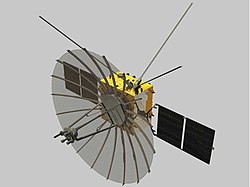
Communication with the lunar surface is accomplished in the X band, using a high-gain 4.2 metres (14 ft) deployable parabolic antenna, the largest antenna used for a deep space exploration satellite. The lunar link uses PCM/PSK/PM modulation in the forward link and BPSK in the backward link. The forward link data rate of the lander and the rover is 125 bit/s. The return link data rate is up to 555 kbit/s for the lander and up to 285 kbit/s for the rover. Data transmission to the Earth operates in the S band in BPSK modulation mode, using a single mid-gain helix antenna at a data rate of up to 10 Mbit/s.
Queqiao-1
Queqiao relay satellite (Chinese: 鹊桥号中继卫星; pinyin: Quèqiáo hào zhōngjì wèixīng; lit. 'Magpie Bridge relay satellite'), is the first of the pair of communications relay and radio astronomy satellites for the Chinese Lunar Exploration Program. The China National Space Administration (CNSA) launched the Queqiao relay satellite on 20 May 2018 to a halo orbit around the Earth–Moon L2 Lagrangian point Queqiao is the first communication relay and radio astronomy satellite at this location.
The name Queqiao ("Magpie Bridge") was inspired by and came from the Chinese tale The Cowherd and the Weaver Girl.
Queqiao was designed to function as a communication relay for the Chang'e 4 mission to the far side of the Moon, as well as a deep space radio astronomy observatory for the Chinese space program.
Direct communication with Earth is impossible on the far side of the Moon, since transmissions are blocked by the Moon. Communications must go through a communications relay satellite, which is placed at a location that has a clear view of both the landing site and the Earth. A circular orbit, while easy to achieve, would periodically carry the satellite out of sight of either the lander or the Earth. A constellation of multiple satellites can solve this problem at the cost of greater expense and risk. With this in mind, placing a satellite in orbit not around the Moon itself, but around an equilibrium point of the Earth-Moon system on the far side of the Moon (L2) becomes an attractive option.
The types of orbits near the equilibrium points, include Lyapunov orbits, halo orbits, Lissajous orbits, and quasi-halo orbits. Lyapunov orbits pass behind the Moon, restricting communication opportunities with Earth for long periods of time, and as such were not considered. Lissajous orbits require less stationkeeping than halo orbits, but suffer from occasionally passing behind the Moon as well. Their non-periodicity–a trait shared with quasi-halo orbits–further complicates maintaining the pointing of antennas and solar arrays. Thus a halo orbit was chosen, at the cost of greater stationkeeping expense.
An L2 halo orbit as a communications relay for an Apollo mission to the far side of the Moon was first suggested in 1966 by Robert W. Farquhar. In the end, no relay satellite was launched for Apollo. Although a number of spacecraft have operated in halo orbits in the Earth-Sun system since then, China was the first to realize Farquhar's original idea of a communications relay satellite in a halo orbit around the Earth-Moon L2 point.
The satellite is based on the Chang'e 2 design. It utilizes the CAST100 small satellite bus with an aluminum honeycomb sandwich plate structure, and several 3D-printed parts.
Communication with the lunar surface is accomplished in the X band, using a high-gain 4.2 metres (14 ft) deployable parabolic antenna, the largest antenna used for a deep space exploration satellite. The lunar link uses PCM/PSK/PM modulation in the forward link and BPSK in the backward link. The forward link data rate of the lander and the rover is 125 bit/s. The return link data rate is up to 555 kbit/s for the lander and up to 285 kbit/s for the rover. Data transmission to the Earth operates in the S band in BPSK modulation mode, using a single mid-gain helix antenna at a data rate of up to 10 Mbit/s.
Recent media
Recent media