


Community hub
Recent from talks
Knowledge base stats:
Talk channels stats:
Members stats:
Quintic threefold
In mathematics, a quintic threefold is a 3-dimensional hypersurface of degree 5 in 4-dimensional projective space . Non-singular quintic threefolds are Calabi–Yau manifolds.

The Hodge diamond of a non-singular quintic 3-fold is
Physicist Robbert Dijkgraaf said "One number which every algebraic geometer knows is the number 2,875 because obviously, that is the number of lines on a quintic."
A quintic threefold is a special class of Calabi–Yau manifolds defined by a degree projective variety in . Many examples are constructed as hypersurfaces in , or complete intersections lying in , or as a smooth variety resolving the singularities of another variety. As a set, a Calabi-Yau manifold iswhere is a degree homogeneous polynomial. One of the most studied examples is from the polynomialcalled a Fermat polynomial. Proving that such a polynomial defines a Calabi-Yau requires some more tools, like the Adjunction formula and conditions for smoothness.

![{\displaystyle X=\{x=[x_{0}:x_{1}:x_{2}:x_{3}:x_{4}]\in \mathbb {CP} ^{4}:p(x)=0\}}](https://wikimedia.org/api/rest_v1/media/math/render/svg/2d4da81588faa99bb60eee1bcb2aca69e5332b6c)


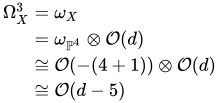
Recall that a homogeneous polynomial (where is the Serre-twist of the hyperplane line bundle) defines a projective variety, or projective scheme, , from the algebrawhere is a field, such as . Then using the adjunction formula to compute its canonical bundle, we havehence in order for the variety to be Calabi-Yau, meaning it has a trivial canonical bundle, its degree must be . It is then a Calabi-Yau manifold if in addition this variety is smooth. This can be checked by looking at the zeros of the polynomialsand making sure the setis empty.



![{\displaystyle {\frac {k[x_{0},\ldots ,x_{4}]}{(f)}}}](https://wikimedia.org/api/rest_v1/media/math/render/svg/99e477dc0669b5df2e51d0495f274cc6304e16d0)



![{\displaystyle \{x=[x_{0}:\cdots :x_{4}]|f(x)=\partial _{0}f(x)=\cdots =\partial _{4}f(x)=0\}}](https://wikimedia.org/api/rest_v1/media/math/render/svg/590c63bebbe79f14d7359f4f2c8dca64343326d0)
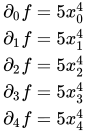
One of the easiest examples to check of a Calabi-Yau manifold is given by the Fermat quintic threefold, which is defined by the vanishing locus of the polynomialComputing the partial derivatives of gives the four polynomialsSince the only points where they vanish is given by the coordinate axes in , the vanishing locus is empty since is not a point in .


![{\displaystyle [0:0:0:0:0]}](https://wikimedia.org/api/rest_v1/media/math/render/svg/eac07a25e3f98e75e0859f957d195943ed36d76e)
Another application of the quintic threefold is in the study of the infinitesimal generalized Hodge conjecture where this difficult problem can be solved in this case. In fact, all of the lines on this hypersurface can be found explicitly.
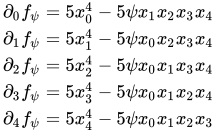
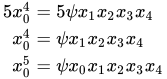
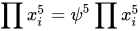
Another popular class of examples of quintic three-folds, studied in many contexts, is the Dwork family. One popular study of such a family is from Candelas, De La Ossa, Green, and Parkes, when they discovered mirror symmetry. This is given by the family pages 123-125where is a single parameter not equal to a 5-th root of unity. The smoothness of the quintic for these parameters can be found by computing the partial derivates of and evaluating their zeros. The partial derivatives are given byAt a point where the partial derivatives are all zero, this gives the relation . For example, in we getby dividing out the and multiplying each side by . From multiplying these families of equations together we have the relationshowing a solution is either given by an or . But in the first case, these give a smooth sublocus since the varying term in vanishes, so a singular point must lie in . Given such a , the singular points are then of the form such that where . For example, the pointis a solution of both and its partial derivatives since , and .








![{\displaystyle [\mu _{5}^{a_{0}}:\cdots :\mu _{5}^{a_{4}}]}](https://wikimedia.org/api/rest_v1/media/math/render/svg/9f0030352e8def77a46367c7ab52a865bbc61f96)


![{\displaystyle [\mu _{5}^{4}:\mu _{5}^{-1}:\mu _{5}^{-1}:\mu _{5}^{-1}:\mu _{5}^{-1}]}](https://wikimedia.org/api/rest_v1/media/math/render/svg/b92741012079cf593b3c1bd629ad4920aeb88fa6)



Hub AI
Quintic threefold AI simulator
(@Quintic threefold_simulator)
Quintic threefold
In mathematics, a quintic threefold is a 3-dimensional hypersurface of degree 5 in 4-dimensional projective space . Non-singular quintic threefolds are Calabi–Yau manifolds.
The Hodge diamond of a non-singular quintic 3-fold is
Physicist Robbert Dijkgraaf said "One number which every algebraic geometer knows is the number 2,875 because obviously, that is the number of lines on a quintic."
A quintic threefold is a special class of Calabi–Yau manifolds defined by a degree projective variety in . Many examples are constructed as hypersurfaces in , or complete intersections lying in , or as a smooth variety resolving the singularities of another variety. As a set, a Calabi-Yau manifold iswhere is a degree homogeneous polynomial. One of the most studied examples is from the polynomialcalled a Fermat polynomial. Proving that such a polynomial defines a Calabi-Yau requires some more tools, like the Adjunction formula and conditions for smoothness.
Recall that a homogeneous polynomial (where is the Serre-twist of the hyperplane line bundle) defines a projective variety, or projective scheme, , from the algebrawhere is a field, such as . Then using the adjunction formula to compute its canonical bundle, we havehence in order for the variety to be Calabi-Yau, meaning it has a trivial canonical bundle, its degree must be . It is then a Calabi-Yau manifold if in addition this variety is smooth. This can be checked by looking at the zeros of the polynomialsand making sure the setis empty.
One of the easiest examples to check of a Calabi-Yau manifold is given by the Fermat quintic threefold, which is defined by the vanishing locus of the polynomialComputing the partial derivatives of gives the four polynomialsSince the only points where they vanish is given by the coordinate axes in , the vanishing locus is empty since is not a point in .
Another application of the quintic threefold is in the study of the infinitesimal generalized Hodge conjecture where this difficult problem can be solved in this case. In fact, all of the lines on this hypersurface can be found explicitly.
Another popular class of examples of quintic three-folds, studied in many contexts, is the Dwork family. One popular study of such a family is from Candelas, De La Ossa, Green, and Parkes, when they discovered mirror symmetry. This is given by the family pages 123-125where is a single parameter not equal to a 5-th root of unity. The smoothness of the quintic for these parameters can be found by computing the partial derivates of and evaluating their zeros. The partial derivatives are given byAt a point where the partial derivatives are all zero, this gives the relation . For example, in we getby dividing out the and multiplying each side by . From multiplying these families of equations together we have the relationshowing a solution is either given by an or . But in the first case, these give a smooth sublocus since the varying term in vanishes, so a singular point must lie in . Given such a , the singular points are then of the form such that where . For example, the pointis a solution of both and its partial derivatives since , and .