Hubbry Logo
Projective varietyProjective varietyMain
Open search
Projective variety
Community hub
Projective variety
logo
8 pages, 0 posts
0 subscribers
Be the first to start a discussion here.
Projective variety
Projective variety
from Wikipedia
An elliptic curve is a smooth projective curve of genus one.

In algebraic geometry, a projective variety is an algebraic variety that is a closed subvariety of a projective space. That is, it is the zero-locus in of some finite family of homogeneous polynomials that generate a prime ideal, the defining ideal of the variety.

A projective variety is a projective curve if its dimension is one; it is a projective surface if its dimension is two; it is a projective hypersurface if its dimension is one less than the dimension of the containing projective space; in this case it is the set of zeros of a single homogeneous polynomial.

If X is a projective variety defined by a homogeneous prime ideal I, then the quotient ring

is called the homogeneous coordinate ring of X. Basic invariants of X such as the degree and the dimension can be read off the Hilbert polynomial of this graded ring.

Projective varieties arise in many ways. They are complete, which roughly can be expressed by saying that there are no points "missing". The converse is not true in general, but Chow's lemma describes the close relation of these two notions. Showing that a variety is projective is done by studying line bundles or divisors on X.

A salient feature of projective varieties are the finiteness constraints on sheaf cohomology. For smooth projective varieties, Serre duality can be viewed as an analog of Poincaré duality. It also leads to the Riemann–Roch theorem for projective curves, i.e., projective varieties of dimension 1. The theory of projective curves is particularly rich, including a classification by the genus of the curve. The classification program for higher-dimensional projective varieties naturally leads to the construction of moduli of projective varieties.[1] Hilbert schemes parametrize closed subschemes of with prescribed Hilbert polynomial. Hilbert schemes, of which Grassmannians are special cases, are also projective schemes in their own right. Geometric invariant theory offers another approach. The classical approaches include the Teichmüller space and Chow varieties.

A particularly rich theory, reaching back to the classics, is available for complex projective varieties, i.e., when the polynomials defining X have complex coefficients. Broadly, the GAGA principle says that the geometry of projective complex analytic spaces (or manifolds) is equivalent to the geometry of projective complex varieties. For example, the theory of holomorphic vector bundles (more generally coherent analytic sheaves) on X coincide with that of algebraic vector bundles. Chow's theorem says that a subset of projective space is the zero-locus of a family of holomorphic functions if and only if it is the zero-locus of homogeneous polynomials. The combination of analytic and algebraic methods for complex projective varieties lead to areas such as Hodge theory.

Variety and scheme structure

[edit]

Variety structure

[edit]

Let k be an algebraically closed field. The basis of the definition of projective varieties is projective space , which can be defined in different, but equivalent ways:

  • as the set of all lines through the origin in (i.e., all one-dimensional vector subspaces of )
  • as the set of tuples , with not all zero, modulo the equivalence relation for any . The equivalence class of such a tuple is denoted by This equivalence class is the general point of projective space. The numbers are referred to as the homogeneous coordinates of the point.


A projective variety is, by definition, a closed subvariety of , where closed refers to the Zariski topology.[2] In general, closed subsets of the Zariski topology are defined to be the common zero-locus of a finite collection of homogeneous polynomial functions. Given a polynomial , the condition

does not make sense for arbitrary polynomials, but only if f is homogeneous, i.e., the degrees of all the monomials (whose sum is f) are the same. In this case, the vanishing of

is independent of the choice of .

Therefore, projective varieties arise from homogeneous prime ideals I of , and setting

Moreover, the projective variety X is an algebraic variety, meaning that it is covered by open affine subvarieties and satisfies the separation axiom. Thus, the local study of X (e.g., singularity) reduces to that of an affine variety. The explicit structure is as follows. The projective space is covered by the standard open affine charts

which themselves are affine n-spaces with the coordinate ring

Say i = 0 for the notational simplicity and drop the superscript (0). Then is a closed subvariety of defined by the ideal of generated by

for all f in I. Thus, X is an algebraic variety covered by (n+1) open affine charts .

Note that X is the closure of the affine variety in . Conversely, starting from some closed (affine) variety , the closure of V in is the projective variety called the projective completion of V. If defines V, then the defining ideal of this closure is the homogeneous ideal[3] of generated by

for all f in I.

For example, if V is an affine curve given by, say, in the affine plane, then its projective completion in the projective plane is given by

Projective schemes

[edit]

For various applications, it is necessary to consider more general algebro-geometric objects than projective varieties, namely projective schemes. The first step towards projective schemes is to endow projective space with a scheme structure, in a way refining the above description of projective space as an algebraic variety, i.e., is a scheme which it is a union of (n + 1) copies of the affine n-space kn. More generally,[4] projective space over a ring A is the union of the affine schemes

in such a way the variables match up as expected. The set of closed points of , for algebraically closed fields k, is then the projective space in the usual sense.

An equivalent but streamlined construction is given by the Proj construction, which is an analog of the spectrum of a ring, denoted "Spec", which defines an affine scheme.[5] For example, if A is a ring, then

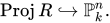
If R is a quotient of by a homogeneous ideal I, then the canonical surjection induces the closed immersion

Compared to projective varieties, the condition that the ideal I be a prime ideal was dropped. This leads to a much more flexible notion: on the one hand the topological space may have multiple irreducible components. Moreover, there may be nilpotent functions on X.

Closed subschemes of correspond bijectively to the homogeneous ideals I of that are saturated; i.e., [6] This fact may be considered as a refined version of projective Nullstellensatz.

We can give a coordinate-free analog of the above. Namely, given a finite-dimensional vector space V over k, we let

where is the symmetric algebra of .[7] It is the projectivization of V; i.e., it parametrizes lines in V. There is a canonical surjective map , which is defined using the chart described above.[8] One important use of the construction is this (cf., § Duality and linear system). A divisor D on a projective variety X corresponds to a line bundle L. One then set

;

it is called the complete linear system of D.

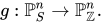
Projective space over any scheme S can be defined as a fiber product of schemes

If is the twisting sheaf of Serre on , we let denote the pullback of to ; that is, for the canonical map

A scheme XS is called projective over S if it factors as a closed immersion

followed by the projection to S.

A line bundle (or invertible sheaf) on a scheme X over S is said to be very ample relative to S if there is an immersion (i.e., an open immersion followed by a closed immersion)

for some n so that pullbacks to . Then a S-scheme X is projective if and only if it is proper and there exists a very ample sheaf on X relative to S. Indeed, if X is proper, then an immersion corresponding to the very ample line bundle is necessarily closed. Conversely, if X is projective, then the pullback of under the closed immersion of X into a projective space is very ample. That "projective" implies "proper" is deeper: the main theorem of elimination theory.

Relation to complete varieties

[edit]

By definition, a variety is complete, if it is proper over k. The valuative criterion of properness expresses the intuition that in a proper variety, there are no points "missing".

There is a close relation between complete and projective varieties: on the one hand, projective space and therefore any projective variety is complete. The converse is not true in general. However:

Some properties of a projective variety follow from completeness. For example,
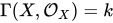
for any projective variety X over k.[10] This fact is an algebraic analogue of Liouville's theorem (any holomorphic function on a connected compact complex manifold is constant). In fact, the similarity between complex analytic geometry and algebraic geometry on complex projective varieties goes much further than this, as is explained below.

Quasi-projective varieties are, by definition, those which are open subvarieties of projective varieties. This class of varieties includes affine varieties. Affine varieties are almost never complete (or projective). In fact, a projective subvariety of an affine variety must have dimension zero. This is because only the constants are globally regular functions on a projective variety.

Examples and basic invariants

[edit]

By definition, any homogeneous ideal in a polynomial ring yields a projective scheme (required to be prime ideal to give a variety). In this sense, examples of projective varieties abound. The following list mentions various classes of projective varieties which are noteworthy since they have been studied particularly intensely. The important class of complex projective varieties, i.e., the case , is discussed further below.

The product of two projective spaces is projective. In fact, there is the explicit immersion (called Segre embedding)
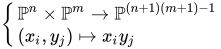
As a consequence, the product of projective varieties over k is again projective. The Plücker embedding exhibits a Grassmannian as a projective variety. Flag varieties such as the quotient of the general linear group modulo the subgroup of upper triangular matrices, are also projective, which is an important fact in the theory of algebraic groups.[11]

Homogeneous coordinate ring and Hilbert polynomial

[edit]

As the prime ideal P defining a projective variety X is homogeneous, the homogeneous coordinate ring

is a graded ring, i.e., can be expressed as the direct sum of its graded components:

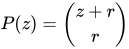
There exists a polynomial P such that for all sufficiently large n; it is called the Hilbert polynomial of X. It is a numerical invariant encoding some extrinsic geometry of X. The degree of P is the dimension r of X and its leading coefficient times r! is the degree of the variety X. The arithmetic genus of X is (−1)r (P(0) − 1) when X is smooth.

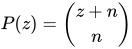
For example, the homogeneous coordinate ring of is and its Hilbert polynomial is ; its arithmetic genus is zero.
If the homogeneous coordinate ring R is an integrally closed domain, then the projective variety X is said to be projectively normal. Note, unlike normality, projective normality depends on R, the embedding of X into a projective space. The normalization of a projective variety is projective; in fact, it's the Proj of the integral closure of some homogeneous coordinate ring of X.

Degree

[edit]

Let be a projective variety. There are at least two equivalent ways to define the degree of X relative to its embedding. The first way is to define it as the cardinality of the finite set


where d is the dimension of X and Hi's are hyperplanes in "general positions". This definition corresponds to an intuitive idea of a degree. Indeed, if X is a hypersurface, then the degree of X is the degree of the homogeneous polynomial defining X. The "general positions" can be made precise, for example, by intersection theory; one requires that the intersection is proper and that the multiplicities of irreducible components are all one.

The other definition, which is mentioned in the previous section, is that the degree of X is the leading coefficient of the Hilbert polynomial of X times (dim X)!. Geometrically, this definition means that the degree of X is the multiplicity of the vertex of the affine cone over X.[12]

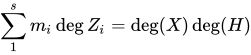
Let be closed subschemes of pure dimensions that intersect properly (they are in general position). If mi denotes the multiplicity of an irreducible component Zi in the intersection (i.e., intersection multiplicity), then the generalization of Bézout's theorem says:[13]

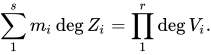
The intersection multiplicity mi can be defined as the coefficient of Zi in the intersection product in the Chow ring of .

In particular, if is a hypersurface not containing X, then

where Zi are the irreducible components of the scheme-theoretic intersection of X and H with multiplicity (length of the local ring) mi.

A complex projective variety can be viewed as a compact complex manifold; the degree of the variety (relative to the embedding) is then the volume of the variety as a manifold with respect to the metric inherited from the ambient complex projective space. A complex projective variety can be characterized as a minimizer of the volume (in a sense).

The ring of sections

[edit]

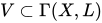
Let X be a projective variety and L a line bundle on it. Then the graded ring
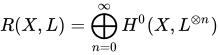
is called the ring of sections of L. If L is ample, then Proj of this ring is X. Moreover, if X is normal and L is very ample, then is the integral closure of the homogeneous coordinate ring of X determined by L; i.e., so that pulls-back to L.[14]

For applications, it is useful to allow for divisors (or -divisors) not just line bundles; assuming X is normal, the resulting ring is then called a generalized ring of sections. If is a canonical divisor on X, then the generalized ring of sections

is called the canonical ring of X. If the canonical ring is finitely generated, then Proj of the ring is called the canonical model of X. The canonical ring or model can then be used to define the Kodaira dimension of X.

Projective curves

[edit]

Projective schemes of dimension one are called projective curves. Much of the theory of projective curves is about smooth projective curves, since the singularities of curves can be resolved by normalization, which consists in taking locally the integral closure of the ring of regular functions. Smooth projective curves are isomorphic if and only if their function fields are isomorphic. The study of finite extensions of

or equivalently smooth projective curves over is an important branch in algebraic number theory.[15]

A smooth projective curve of genus one is called an elliptic curve. As a consequence of the Riemann–Roch theorem, such a curve can be embedded as a closed subvariety in . In general, any (smooth) projective curve can be embedded in (for a proof, see Secant variety#Examples). Conversely, any smooth closed curve in of degree three has genus one by the genus formula and is thus an elliptic curve.

A smooth complete curve of genus greater than or equal to two is called a hyperelliptic curve if there is a finite morphism of degree two.[16]

Projective hypersurfaces

[edit]

Every irreducible closed subset of of codimension one is a hypersurface; i.e., the zero set of some homogeneous irreducible polynomial.[17]

Abelian varieties

[edit]

Another important invariant of a projective variety X is the Picard group of X, the set of isomorphism classes of line bundles on X. It is isomorphic to and therefore an intrinsic notion (independent of embedding). For example, the Picard group of is isomorphic to via the degree map. The kernel of is not only an abstract abelian group, but there is a variety called the Jacobian variety of X, Jac(X), whose points equal this group. The Jacobian of a (smooth) curve plays an important role in the study of the curve. For example, the Jacobian of an elliptic curve E is E itself. For a curve X of genus g, Jac(X) has dimension g.

Varieties, such as the Jacobian variety, which are complete and have a group structure are known as abelian varieties, in honor of Niels Abel. In marked contrast to affine algebraic groups such as , such groups are always commutative, whence the name. Moreover, they admit an ample line bundle and are thus projective. On the other hand, an abelian scheme may not be projective. Examples of abelian varieties are elliptic curves, Jacobian varieties and K3 surfaces.

Projections

[edit]

Let be a linear subspace; i.e., for some linearly independent linear functionals si. Then the projection from E is the (well-defined) morphism


The geometric description of this map is as follows:[18]

  • We view so that it is disjoint from E. Then, for any , where denotes the smallest linear space containing E and x (called the join of E and x.)
  • where are the homogeneous coordinates on
  • For any closed subscheme disjoint from E, the restriction is a finite morphism.[19]

Projections can be used to cut down the dimension in which a projective variety is embedded, up to finite morphisms. Start with some projective variety If the projection from a point not on X gives Moreover, is a finite map to its image. Thus, iterating the procedure, one sees there is a finite map

This result is the projective analog of Noether's normalization lemma. (In fact, it yields a geometric proof of the normalization lemma.)

The same procedure can be used to show the following slightly more precise result: given a projective variety X over a perfect field, there is a finite birational morphism from X to a hypersurface H in [20] In particular, if X is normal, then it is the normalization of H.

Duality and linear system

[edit]

While a projective n-space parameterizes the lines in an affine n-space, the dual of it parametrizes the hyperplanes on the projective space, as follows. Fix a field k. By , we mean a projective n-space

equipped with the construction:

, a hyperplane on

where is an L-point of for a field extension L of k and
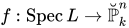
For each L, the construction is a bijection between the set of L-points of and the set of hyperplanes on . Because of this, the dual projective space is said to be the moduli space of hyperplanes on .

A line in is called a pencil: it is a family of hyperplanes on parametrized by .

If V is a finite-dimensional vector space over k, then, for the same reason as above, is the space of hyperplanes on . An important case is when V consists of sections of a line bundle. Namely, let X be an algebraic variety, L a line bundle on X and a vector subspace of finite positive dimension. Then there is a map:[21]

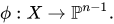
determined by the linear system V, where B, called the base locus, is the intersection of the divisors of zero of nonzero sections in V (see Linear system of divisors#A map determined by a linear system for the construction of the map).

Cohomology of coherent sheaves

[edit]

Let X be a projective scheme over a field (or, more generally over a Noetherian ring A). Cohomology of coherent sheaves on X satisfies the following important theorems due to Serre:

  1. is a finite-dimensional k-vector space for any p.
  2. There exists an integer (depending on ; see also Castelnuovo–Mumford regularity) such that for all and p > 0, where is the twisting with a power of a very ample line bundle

These results are proven reducing to the case using the isomorphism

where in the right-hand side is viewed as a sheaf on the projective space by extension by zero.[22] The result then follows by a direct computation for n any integer, and for arbitrary reduces to this case without much difficulty.[23]
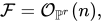
As a corollary to 1. above, if f is a projective morphism from a noetherian scheme to a noetherian ring, then the higher direct image is coherent. The same result holds for proper morphisms f, as can be shown with the aid of Chow's lemma.

Sheaf cohomology groups Hi on a noetherian topological space vanish for i strictly greater than the dimension of the space. Thus the quantity, called the Euler characteristic of ,
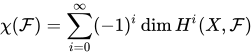
is a well-defined integer (for X projective). One can then show for some polynomial P over rational numbers.[24] Applying this procedure to the structure sheaf , one recovers the Hilbert polynomial of X. In particular, if X is irreducible and has dimension r, the arithmetic genus of X is given by

which is manifestly intrinsic; i.e., independent of the embedding.

The arithmetic genus of a hypersurface of degree d is in . In particular, a smooth curve of degree d in has arithmetic genus . This is the genus formula.


Smooth projective varieties

[edit]

Let X be a smooth projective variety where all of its irreducible components have dimension n. In this situation, the canonical sheaf ωX, defined as the sheaf of Kähler differentials of top degree (i.e., algebraic n-forms), is a line bundle.

Serre duality

[edit]

Serre duality states that for any locally free sheaf on X,

where the superscript prime refers to the dual space and is the dual sheaf of . A generalization to projective, but not necessarily smooth schemes is known as Verdier duality.

Riemann–Roch theorem

[edit]

For a (smooth projective) curve X, H2 and higher vanish for dimensional reason and the space of the global sections of the structure sheaf is one-dimensional. Thus the arithmetic genus of X is the dimension of . By definition, the geometric genus of X is the dimension of H0(X, ωX). Serre duality thus implies that the arithmetic genus and the geometric genus coincide. They will simply be called the genus of X.

Serre duality is also a key ingredient in the proof of the Riemann–Roch theorem. Since X is smooth, there is an isomorphism of groups
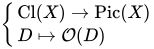
from the group of (Weil) divisors modulo principal divisors to the group of isomorphism classes of line bundles. A divisor corresponding to ωX is called the canonical divisor and is denoted by K. Let l(D) be the dimension of . Then the Riemann–Roch theorem states: if g is a genus of X,
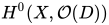

for any divisor D on X. By the Serre duality, this is the same as:

which can be readily proved.[25] A generalization of the Riemann–Roch theorem to higher dimension is the Hirzebruch–Riemann–Roch theorem, as well as the far-reaching Grothendieck–Riemann–Roch theorem.

Hilbert schemes

[edit]

Hilbert schemes parametrize all closed subvarieties of a projective scheme X in the sense that the points (in the functorial sense) of H correspond to the closed subschemes of X. As such, the Hilbert scheme is an example of a moduli space, i.e., a geometric object whose points parametrize other geometric objects. More precisely, the Hilbert scheme parametrizes closed subvarieties whose Hilbert polynomial equals a prescribed polynomial P.[26] It is a deep theorem of Grothendieck that there is a scheme[27] over k such that, for any k-scheme T, there is a bijection


The closed subscheme of that corresponds to the identity map is called the universal family.

For , the Hilbert scheme is called the Grassmannian of r-planes in and, if X is a projective scheme, is called the Fano scheme of r-planes on X.[28]
Complex projective varieties

[edit]

In this section, all algebraic varieties are complex algebraic varieties. A key feature of the theory of complex projective varieties is the combination of algebraic and analytic methods. The transition between these theories is provided by the following link: since any complex polynomial is also a holomorphic function, any complex variety X yields a complex analytic space, denoted . Moreover, geometric properties of X are reflected by the ones of . For example, the latter is a complex manifold if and only if X is smooth; it is compact if and only if X is proper over .

Relation to complex Kähler manifolds

[edit]

Complex projective space is a Kähler manifold. This implies that, for any projective algebraic variety X, is a compact Kähler manifold. The converse is not in general true, but the Kodaira embedding theorem gives a criterion for a Kähler manifold to be projective.

In low dimensions, there are the following results:

GAGA and Chow's theorem

[edit]

Chow's theorem provides a striking way to go the other way, from analytic to algebraic geometry. It states that every analytic subvariety of a complex projective space is algebraic. The theorem may be interpreted to saying that a holomorphic function satisfying certain growth condition is necessarily algebraic: "projective" provides this growth condition. One can deduce from the theorem the following:

  • Meromorphic functions on the complex projective space are rational.
  • If an algebraic map between algebraic varieties is an analytic isomorphism, then it is an (algebraic) isomorphism. (This part is a basic fact in complex analysis.) In particular, Chow's theorem implies that a holomorphic map between projective varieties is algebraic. (consider the graph of such a map.)
  • Every holomorphic vector bundle on a projective variety is induced by a unique algebraic vector bundle.[30]
  • Every holomorphic line bundle on a projective variety is a line bundle of a divisor.[31]

Chow's theorem can be shown via Serre's GAGA principle. Its main theorem states:

Let X be a projective scheme over . Then the functor associating the coherent sheaves on X to the coherent sheaves on the corresponding complex analytic space Xan is an equivalence of categories. Furthermore, the natural maps
are isomorphisms for all i and all coherent sheaves on X.[32]

Complex tori vs. complex abelian varieties

[edit]

The complex manifold associated to an abelian variety A over is a compact complex Lie group. These can be shown to be of the form

and are also referred to as complex tori. Here, g is the dimension of the torus and L is a lattice (also referred to as period lattice).

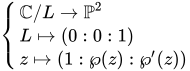
According to the uniformization theorem already mentioned above, any torus of dimension 1 arises from an abelian variety of dimension 1, i.e., from an elliptic curve. In fact, the Weierstrass's elliptic function attached to L satisfies a certain differential equation and as a consequence it defines a closed immersion:[33]

There is a p-adic analog, the p-adic uniformization theorem.

For higher dimensions, the notions of complex abelian varieties and complex tori differ: only polarized complex tori come from abelian varieties.

Kodaira vanishing

[edit]

The fundamental Kodaira vanishing theorem states that for an ample line bundle on a smooth projective variety X over a field of characteristic zero,

for i > 0, or, equivalently by Serre duality for i < n.[34] The first proof of this theorem used analytic methods of Kähler geometry, but a purely algebraic proof was found later. The Kodaira vanishing in general fails for a smooth projective variety in positive characteristic. Kodaira's theorem is one of various vanishing theorems, which give criteria for higher sheaf cohomologies to vanish. Since the Euler characteristic of a sheaf (see above) is often more manageable than individual cohomology groups, this often has important consequences about the geometry of projective varieties.[35]

[edit]

See also

[edit]

Notes

[edit]

References

[edit]
[edit]
Revisions and contributorsEdit on WikipediaRead on Wikipedia
from Grokipedia
A projective variety is an irreducible closed subset of Pn\mathbb{P}^n over an , defined as the zero set of a collection of homogeneous polynomials, equipped with the induced . Pn\mathbb{P}^n itself consists of lines through the origin in affine (n+1)(n+1)-space, with points represented by [x0::xn][x_0 : \cdots : x_n], where not all coordinates vanish. This structure ensures that projective varieties are "compact" in the classical sense when defined over the complex numbers, analogous to compact Riemann surfaces, and they incorporate points at infinity, making them suitable for studying global geometric properties without boundary issues inherent in affine varieties. The coordinate ring of a projective variety XPnX \subseteq \mathbb{P}^n is the homogeneous k[X]=k[x0,,xn]/I(X)k[X] = k[x_0, \dots, x_n]/I(X), where I(X)I(X) is the homogeneous of polynomials vanishing on XX, and by the projective Nullstellensatz, this ideal is the radical of the vanishing ideal for non-empty sets. Projective varieties can be covered by finitely many affine open sets via the standard affine charts Ui=XD(xi)U_i = X \cap D(x_i), where D(xi)D(x_i) is the principal excluding the V(xi)V(x_i), allowing the use of affine techniques while preserving projective properties. Regular functions on the entire variety are constant, reflecting their rigidity, with the sheaf of regular functions OX\mathcal{O}_X providing a local description. In , projective varieties form the core objects for investigating phenomena like , (defined as the transcendence degree of the function field), and (where the Zariski tangent space dimension equals the variety's at smooth points). Notable examples include projective curves such as elliptic curves in P2\mathbb{P}^2, defined by homogeneous cubics, and higher-dimensional objects like hypersurfaces. Their study traces back to foundational work by figures like Dedekind on ideals (1876), , and Noether's developments, evolving into modern tools for and moduli problems. Theorems like Bézout's, stating that two plane curves of degrees mm and nn without common components intersect in mnmn points ( multiplicity), underscore their role in counting geometric invariants.

Definitions and Basic Constructions

Projective Space and Homogenization

Projective space Pkn\mathbb{P}^n_k over an kk is defined as the set of all one-dimensional subspaces (lines through the origin) of the kn+1k^{n+1}, or equivalently, the quotient space (kn+1{0})/k×(k^{n+1} \setminus \{0\}) / k^\times, where k×k^\times acts by . Points in Pkn\mathbb{P}^n_k are represented using [x0:x1::xn][x_0 : x_1 : \dots : x_n], where not all xi=0x_i = 0, and two tuples (x0,,xn)(x_0, \dots, x_n) and (y0,,yn)(y_0, \dots, y_n) represent the same point if there exists λk×\lambda \in k^\times such that xi=λyix_i = \lambda y_i for all ii. This construction identifies Pkn\mathbb{P}^n_k with the space of lines in kn+1k^{n+1}, providing a geometric interpretation that generalizes the classical . To define projective varieties from affine ones, the process of homogenization extends polynomials from affine space Akn\mathbb{A}^n_k to projective space Pkn\mathbb{P}^n_k. For a polynomial fk[x1,,xn]f \in k[x_1, \dots, x_n] of degree dd, its homogenization FF with respect to a new variable X0X_0 is obtained by writing f=fd+fd1++f0f = f_d + f_{d-1} + \dots + f_0, where each fif_i is the homogeneous component of degree ii, and setting F(X0,x1,,xn)=X0df(x1/X0,,xn/X0)=fd(x1,,xn)+X0fd1(x1,,xn)++X0df0F(X_0, x_1, \dots, x_n) = X_0^d f(x_1/X_0, \dots, x_n/X_0) = f_d(x_1, \dots, x_n) + X_0 f_{d-1}(x_1, \dots, x_n) + \dots + X_0^d f_0. For an affine variety VAknV \subset \mathbb{A}^n_k defined by an ideal I(V)=(f1,,fm)I(V) = (f_1, \dots, f_m), the projective closure VPkn\overline{V} \subset \mathbb{P}^n_k is the zero set of the ideal generated by the homogenizations F1,,FmF_1, \dots, F_m, ensuring VAkn=V\overline{V} \cap \mathbb{A}^n_k = V. For example, the affine curve V(y2x3)Ak2V(y^2 - x^3) \subset \mathbb{A}^2_k homogenizes to V(y2zx3)Pk2V(y^2 z - x^3) \subset \mathbb{P}^2_k, where zz is the homogenizing variable. Homogenization incorporates points at infinity into the affine variety, which are points in V\overline{V} where the homogenizing coordinate vanishes (e.g., z=0z = 0 in Pk2\mathbb{P}^2_k). These points resolve behaviors at "infinity" in the affine setting, such as asymptotic directions of curves. For instance, the homogenization of the hyperbola V(xy1)Ak2V(xy - 1) \subset \mathbb{A}^2_k adds two points at infinity, [1:0:0][1:0:0] and [0:1:0][0:1:0], closing the curve in Pk2\mathbb{P}^2_k. Topologically, Pkn\mathbb{P}^n_k serves as a compactification of Akn\mathbb{A}^n_k, embedding Akn\mathbb{A}^n_k as the dense where x00x_0 \neq 0 (via the chart [1:x1::xn][1 : x_1 : \dots : x_n]), with the at infinity Pkn1=V(x0)\mathbb{P}^{n-1}_k = V(x_0) compactifying the in the . This structure ensures that projective varieties, as closed subsets of Pkn\mathbb{P}^n_k, are compact in the classical topology when k=Ck = \mathbb{C}, providing a foundation for studying global properties.

Homogeneous Ideals and Proj Construction

A graded ring SS is a commutative ring equipped with a direct sum decomposition S=d0SdS = \bigoplus_{d \geq 0} S_d, where each SdS_d is an abelian group and the multiplication map satisfies SmSnSm+nS_m \cdot S_n \subseteq S_{m+n} for all m,n0m, n \geq 0. Elements of SdS_d are called homogeneous of degree dd, and the decomposition allows for a natural Z0\mathbb{Z}_{\geq 0}-grading on the ring. A prototypical example is the polynomial ring S=k[x0,,xn]S = k[x_0, \dots, x_n] over a field kk, graded by total degree, where each SdS_d consists of homogeneous polynomials of degree dd. A homogeneous ideal II in a SS is an ideal generated by homogeneous elements, equivalently, I=d0(ISd)I = \bigoplus_{d \geq 0} (I \cap S_d). The irrelevant ideal, denoted S+S_+, is the homogeneous ideal d>0Sd\bigoplus_{d > 0} S_d, which consists of all elements of positive degree. For the k[x0,,xn]k[x_0, \dots, x_n], S+S_+ is the ideal generated by x0,,xnx_0, \dots, x_n. Homogeneous ideals play a central role in defining subschemes, as the S/IS/I inherits a grading whenever II is homogeneous. The Proj construction associates to a graded ring SS (with S+SS_+ \neq S) the space ProjS\operatorname{Proj} S, defined as the set of all homogeneous prime ideals of SS that do not contain S+S_+. This set is equipped with the , whose basic open sets are the standard opens D+(f)={pProjSfp}D_+(f) = \{ p \in \operatorname{Proj} S \mid f \notin p \} for homogeneous elements fSdf \in S_d with d1d \geq 1. Each D+(f)D_+(f) is homeomorphic to SpecS(f)\operatorname{Spec} S_{(f)}, where S(f)S_{(f)} denotes the degree-zero part of the localization of SS at the multiplicative set generated by ff. To endow ProjS\operatorname{Proj} S with a scheme structure, the affine schemes SpecS(f)\operatorname{Spec} S_{(f)} on the D+(f)D_+(f) are glued along their intersections: D+(f)D+(g)=D+(fg)D_+(f) \cap D_+(g) = D_+(fg) for homogeneous f,gf, g, with the natural localization maps S(f)S(fg)S_{(f)} \to S_{(fg)} and S(g)S(fg)S_{(g)} \to S_{(fg)} ensuring compatibility. The structure sheaf OProjS\mathcal{O}_{\operatorname{Proj} S} is defined by Γ(D+(f),OProjS)=S(f)\Gamma(D_+(f), \mathcal{O}_{\operatorname{Proj} S}) = S_{(f)} on basic opens, extended uniquely to all opens, yielding a ringed space that is a scheme. For twisting, the sheaf OProjS(d)\mathcal{O}_{\operatorname{Proj} S}(d) arises from the graded SS-module S(d)S(d) with components S(d)i=Sd+iS(d)_i = S_{d+i}, and it satisfies OProjS(m)OProjS(n)OProjS(m+n)\mathcal{O}_{\operatorname{Proj} S}(m) \otimes \mathcal{O}_{\operatorname{Proj} S}(n) \cong \mathcal{O}_{\operatorname{Proj} S}(m+n); in the case of projective space Pn=Projk[x0,,xn]\mathbb{P}^n = \operatorname{Proj} k[x_0, \dots, x_n], these are the invertible sheaves OPn(d)\mathcal{O}_{\mathbb{P}^n}(d). Projective schemes are precisely those schemes isomorphic to ProjS\operatorname{Proj} S for some SS, and there is an equivalence between closed subschemes of Pn\mathbb{P}^n and quotients of k[x0,,xn]k[x_0, \dots, x_n] by saturated homogeneous ideals, where saturation ensures the ideal is properly defined modulo units in degree zero. Specifically, a homogeneous ideal II in k[x0,,xn]k[x_0, \dots, x_n] defines a closed immersion Projk[x0,,xn]/IPn\operatorname{Proj} k[x_0, \dots, x_n]/I \hookrightarrow \mathbb{P}^n.

Relation to Affine Varieties

Projective space Pn\mathbb{P}^n over an kk admits a standard affine open cover consisting of n+1n+1 sets Ui={[x0::xn]xi0}U_i = \{ [x_0 : \cdots : x_n] \mid x_i \neq 0 \} for i=0,,ni = 0, \dots, n, where each UiU_i is isomorphic to affine nn-space An\mathbb{A}^n via the map sending [x0::xn][x_0 : \cdots : x_n] to (x0/xi,,xi^/xi,,xn/xi)(x_0/x_i, \dots, \hat{x_i}/x_i, \dots, x_n/x_i). This cover demonstrates that is locally affine, allowing the study of projective varieties through their intersections with these affine opens. Dehomogenization provides a explicit isomorphism between a projective variety XPnX \subset \mathbb{P}^n intersected with UiU_i and an in An\mathbb{A}^n. For a point in XUiX \cap U_i, setting the ii-th homogeneous coordinate to 1 yields affine coordinates, and the defining homogeneous equations of XX restrict to polynomial equations on this affine chart after dehomogenization. Conversely, any embeds into via homogenization of its ideal, yielding its projective closure. Projective varieties serve as compactifications of affine varieties by adjoining a " at ." Specifically, for the affine open U0AnU_0 \cong \mathbb{A}^n in Pn\mathbb{P}^n, the complement is the H={x0=0}Pn1H_\infty = \{x_0 = 0\} \cong \mathbb{P}^{n-1}, which adds points at to "complete" the affine space in the . The projective closure Y~\tilde{Y} of an affine variety YAnY \subset \mathbb{A}^n is thus obtained by homogenizing the equations of YY and taking the zero set in Pn\mathbb{P}^n, with Y=Y~U0Y = \tilde{Y} \cap U_0 and the points at forming Y~H\tilde{Y} \cap H_\infty. This construction ensures that Y~\tilde{Y} is proper (compact in the classical sense over C\mathbb{C}), unlike the non-compact affine YY. Quasi-projective varieties are defined as open subsets of , bridging the gap between and . For instance, every is quasi-projective, as it arises as the of its projective closure with an affine open in . This class includes all varieties that can be embedded locally into while retaining affine-like behavior on opens.

Fundamental Properties

Completeness and Projective Morphisms

In , a variety XX over a field kk is defined to be complete if, for every variety YY over kk, the projection pY:X×kYYp_Y: X \times_k Y \to Y is a closed map. This ensures that the image of any from a complete variety XX to another variety YY is closed in YY. Equivalently, over an , completeness implies that regular functions on a connected complete variety are constant. Properness generalizes completeness to morphisms. A morphism f:XYf: X \to Y of varieties over a field kk is proper if it is of finite type, separated, and universally closed, meaning that for any base change YYY' \to Y, the induced morphism XYX' \to Y' (where X=X×YYX' = X \times_Y Y') has closed image. An equivalent characterization, known as the valuative criterion of properness, states that for Noetherian schemes (or varieties), ff is proper if and only if, for every RR with fraction field KK and any involving a SpecKX\operatorname{Spec} K \to X and SpecRY\operatorname{Spec} R \to Y, there exists a unique lift SpecRX\operatorname{Spec} R \to X making the diagram commute. This criterion captures the "rigidity" of proper morphisms under extensions of valuation rings. Over an kk, every projective variety is complete. Specifically, if XPknX \subset \mathbb{P}^n_k is a closed subvariety, then the projection Pkn×YY\mathbb{P}^n_k \times Y \to Y is closed for any YY, implying that XX inherits this property as a closed subscheme. A f:XYf: X \to Y is projective if XX is a closed subscheme of a bundle over YY, or equivalently, if there exists an on XX such that ff factors through the associated projective bundle. Projective s are proper: any such ff is of finite type, separated, and universally closed, as the projection from satisfies these conditions. This properness yields a universal property for morphisms into projective varieties. If ZZ is a proper variety over an algebraically closed field kk and f:ZXf: Z \to X is a to a projective variety XPknX \subset \mathbb{P}^n_k, then the f(Z)f(Z) is closed in XX, and ff factors uniquely through the closed of f(Z)f(Z) into XX. Properness can be verified locally using affine covers of the target variety.

Homogeneous Coordinate Ring

For a projective variety XX embedded in the projective space Pkn\mathbb{P}^n_k over an kk, the homogeneous coordinate ring is the graded kk- S(X)=d0H0(X,OX(d))S(X) = \bigoplus_{d \geq 0} H^0(X, \mathcal{O}_X(d)), where OX(d)\mathcal{O}_X(d) denotes the dd-th power of the Serre twisting sheaf associated to the embedding, and H0(X,OX(d))H^0(X, \mathcal{O}_X(d)) is the kk-vector space of global sections of this sheaf. This ring encodes the algebraic structure of XX compatibly with its projective embedding, as the applied to S(X)S(X) recovers XX by quotienting out the irrelevant ideal generated by the degree-1 elements. The defining XX in the k[x0,,xn]k[x_0, \dots, x_n] is a saturated homogeneous ideal, meaning it equals its saturation with respect to the maximal irrelevant (x0,,xn)(x_0, \dots, x_n), which ensures that the associated sheaf I~(X)\tilde{I}(X) on Pn\mathbb{P}^n is the ideal sheaf of XX. Consequently, S(X)S(X) is isomorphic to k[x0,,xn]/I(X)k[x_0, \dots, x_n]/I(X), where I(X)I(X) is this saturated ideal. The ring S(X)S(X) is particularly relevant when it is generated as a kk- by its degree-1 component, a condition equivalent to XX being projectively normal in the ; in this case, higher-degree sections are generated by linear forms, facilitating computations of invariants. The Hilbert function of XX is defined as hX(d)=dimkS(X)dh_X(d) = \dim_k S(X)_d, measuring the dimension of the degree-dd graded piece of the homogeneous coordinate ring. For small dd, hX(d)h_X(d) grows combinatorially, reflecting the initial constraints imposed by the , but for sufficiently large dd, it stabilizes to a behavior that captures asymptotic growth related to the of XX. This ring relates to the ideal sheaf I~(X)\tilde{I}(X) via the graded module structure, where the minimal number of generators of I(X)I(X) as a homogeneous ideal determines the of XX in Pn\mathbb{P}^n, providing a measure of how the variety sits in the ambient space.

Hilbert Polynomial and Degree

The Hilbert function hX(d)h_X(d) of a projective variety XPnX \subset \mathbb{P}^n over an is defined as the of the degree-dd component of its homogeneous coordinate ring S(X)=k[x0,,xn]/I(X)S(X) = k[x_0, \dots, x_n]/I(X), where I(X)I(X) is the homogeneous ideal of XX. This function measures the growth of sections of the OX(d)\mathcal{O}_X(d). For large dd, hX(d)h_X(d) stabilizes and equals a PX(t)QP_X(t) \in \mathbb{Q} of degree equal to dimX\dim X, known as the Hilbert of XX. The leading coefficient of PX(t)P_X(t) encodes key geometric invariants, specifically with leading term degX(dimX)!tdimX\frac{\deg X}{(\dim X)!} t^{\dim X}. The degree degX\deg X of an rr-dimensional projective variety XX is the integer such that the leading coefficient of PX(t)P_X(t) is degXr!\frac{\deg X}{r!}. Geometrically, this is the intersection multiplicity of XX with a general linear subspace of complementary dimension nrn - r, or the number of points in a general such intersection counted with multiplicity. This definition aligns the algebraic Hilbert polynomial with classical intersection theory on projective space. For curves (dimX=1\dim X = 1), the Hilbert polynomial takes the form PX(t)=(degX)t+1pa(X)P_X(t) = (\deg X) t + 1 - p_a(X), where pa(X)p_a(X) is the arithmetic genus, an invariant reflecting the topology of XX via pa(X)=1χ(OX)p_a(X) = 1 - \chi(\mathcal{O}_X). The arithmetic genus is non-negative and vanishes if and only if XP1X \cong \mathbb{P}^1. Representative examples illustrate these concepts. The , the image of the Veronese embedding ν2:P2P5\nu_2: \mathbb{P}^2 \to \mathbb{P}^5, is a surface of degree 4, so its Hilbert polynomial has leading term 42!t2=2t2\frac{4}{2!} t^2 = 2 t^2. Likewise, the Gr(2,5)\mathrm{Gr}(2,5), parametrizing 2-planes in C5\mathbb{C}^5 and embedded via the Plücker map into P9\mathbb{P}^9, is 6-dimensional with degree 5, yielding leading term 56!t6\frac{5}{6!} t^6.

Examples and Invariants

Projective Curves

Projective curves are one-dimensional projective varieties, typically realized as closed subschemes of Pn\mathbb{P}^n defined by homogeneous equations. These objects provide foundational examples in , bridging affine curves to compact settings through homogenization and exhibiting rich invariants like and degree. Unlike higher-dimensional varieties, curves admit complete by , with ensuring they are Riemann surfaces over the complex numbers. The simplest projective curve is the rational curve, exemplified by the projective line P1\mathbb{P}^1, which has genus 0 and serves as the model for all smooth projective curves of genus 0. P1\mathbb{P}^1 embeds into P2\mathbb{P}^2 as a line, a degree 1 curve, and any birational map from P1\mathbb{P}^1 to a plane curve of degree dd parametrizes rational curves of that degree. Rational curves are characterized by their parametrization by rational functions, reflecting the function field isomorphic to k(t)k(t) for a field kk. Elliptic curves represent the next level of complexity, defined as smooth projective curves of genus 1 equipped with a base point, though the often omits explicit reference to the point. A standard into P2\mathbb{P}^2 arises from homogenizing the affine Weierstrass form y2=x3+ax+by^2 = x^3 + ax + b (with discriminant nonzero to ensure smoothness), yielding the projective equation Y2Z=X3+aXZ2+bZ3Y^2 Z = X^3 + a X Z^2 + b Z^3. This cubic model has degree 3 and genus 1, capturing the curve's complete structure in . For smooth plane projective curves embedded in P2\mathbb{P}^2, the genus gg relates directly to the degree dd via the formula g=(d1)(d2)2.g = \frac{(d-1)(d-2)}{2}. This relation, classical in , quantifies how higher-degree embeddings increase topological complexity, with d=1d=1 or d=2d=2 yielding genus 0 (lines and conics, isomorphic to P1\mathbb{P}^1) and d=3d=3 giving genus 1 (elliptic curves). The degree here aligns with the Hilbert polynomial's leading coefficient, aiding genus computations through . Singular projective curves, defined by homogeneous ideals where the scheme has non-reduced structure or self-intersections, require normalization to recover a smooth model. The normalization C~C\tilde{C} \to C is the unique birational from a smooth projective curve C~\tilde{C} (the integral closure of the coordinate ring) that resolves singularities, such as nodes or cusps, by separating branches at singular points. For instance, both a nodal cubic and a cuspidal cubic in P2\mathbb{P}^2 normalize to P1\mathbb{P}^1 ( 0), preserving the arithmetic genus but adjusting the geometric genus to reflect the smooth . This process is always possible for curves, as singularities lie in codimension 1.

Projective Hypersurfaces

A projective hypersurface in Pn\mathbb{P}^n over an kk is defined as the zero locus V(f)={[x0::xn]Pnf(x0,,xn)=0}V(f) = \{ [x_0 : \cdots : x_n] \in \mathbb{P}^n \mid f(x_0, \dots, x_n) = 0 \}, where fk[x0,,xn]f \in k[x_0, \dots, x_n] is a of positive degree.$$] If ff is irreducible, then V(f)V(f) is an irreducible projective variety of n1n-1 and degree deg(f)\deg(f). These arise naturally from affine hypersurfaces via homogenization, where an affine g(y1,,yn)=0g(y_1, \dots, y_n) = 0 in An\mathbb{A}^n is extended to the projective closure by setting f(x1,,xn,x0)=x0deg(g)g(x1/x0,,xn/x0)f(x_1, \dots, x_n, x_0) = x_0^{\deg(g)} g(x_1/x_0, \dots, x_n/x_0). Singularities on a projective hypersurface V(f)V(f) occur at points where ff and all its partial derivatives f/xi\partial f / \partial x_i vanish simultaneously. For an isolated hypersurface singularity at the origin in the local affine model, the Milnor number μ(f)\mu(f) quantifies the topological complexity of the singularity and is given by μ(f)=dimkOn,0/(f,f/x1,,f/xn)\mu(f) = \dim_k \mathcal{O}_{n,0} / (f, \partial f / \partial x_1, \dots, \partial f / \partial x_n), where On,0\mathcal{O}_{n,0} is the local ring of the germ at the origin in Cn\mathbb{C}^n; this invariant is constant under small deformations and equals the rank of the middle homology of the Milnor fiber.[ The Tyurina algebra, associated to the versal deformation of the singularity, is the quotient $\mathcal{O}_{n,0} / T(f)$, where the Tyurina ideal $T(f)$ is generated by $f$ and the partial derivatives together with relations from the [embedding](/page/Embedding); its dimension, the Tjurina number $\tau(f)$, satisfies $\tau(f) \leq \mu(f)$, with equality holding for quasi-homogeneous singularities.] These numbers classify the local equisingularity type and bound the dimension of the of deformations. Resolution of singularities for projective hypersurfaces over fields of characteristic zero can be achieved through a finite sequence of blow-ups along nonsingular subvarieties, yielding a smooth proper birational model V~V(f)\tilde{V} \to V(f) with exceptional divisors that are themselves projective hypersurfaces.[Hironakastheoremguaranteessucharesolutionexistsforanyalgebraicvariety,butforhypersurfaces,theprocessoftensimplifiesduetocodimensionone,withblowupscenteredatthesingularlocusiterativelyreducingmultiplicityuntilsmoothnessisattained;forexample,blowingupthemaximalidealatapointsingularityreplacesitwithaprojectivespacebundleovertheexceptionaldivisor. Hironaka's theorem guarantees such a resolution exists for any algebraic variety, but for hypersurfaces, the process often simplifies due to codimension one, with blow-ups centered at the singular locus iteratively reducing multiplicity until smoothness is attained; for example, blowing up the maximal ideal at a point singularity replaces it with a projective space bundle over the exceptional divisor.] The scheme F1(V(f))F_1(V(f)) of a projective parametrizes the 1-dimensional linear subspaces (lines) contained in V(f)V(f), constructed as the zero locus of a universal section of a on the Gr(2,n+1)\mathrm{Gr}(2, n+1).[ For a smooth cubic [hypersurface](/page/Hypersurface) in $\mathbb{P}^4$, this Fano surface is a smooth projective surface of geometric [genus](/page/Genus) 5 whose [geometry](/page/Geometry) encodes [rationality](/page/Rationality) properties of the threefold, as studied via its relation to the intermediate Jacobian.] In higher dimensions, such as cubics in P5\mathbb{P}^5, the Fano scheme of lines is a fourfold that aids in understanding birational invariants and period domains.

Abelian Varieties

An over a field kk is defined as a nonsingular projective AA that is also a commutative algebraic group, meaning the group operations of addition and inversion are given by morphisms of varieties. This structure ensures that AA is complete and geometrically connected, inheriting projectivity from its proper morphism properties as a . The commutativity follows from the rigidity of group laws on projective varieties, making the addition map symmetric. A key feature of abelian varieties is the notion of polarization, which provides a positivity structure compatible with the group law. A polarization on an abelian variety AA of dimension gg is an ample line bundle LL on AA, up to translation by points of AA, that induces a homomorphism λL:AA^\lambda_L: A \to \hat{A} to the dual abelian variety A^=\Pic0(A)\hat{A} = \Pic^0(A), where the kernel is finite and the induced map on the NN-torsion is an isogeny of degree N2gN^{2g}. A principal polarization occurs when this homomorphism is an isomorphism, corresponding to a degree-1 ample line bundle; in such cases, the zero section of LL defines an effective ample divisor known as the theta divisor Θ\Theta, which embeds AA into projective space via the complete linear system nΘ|n\Theta| for sufficiently large nn. For example, on a principally polarized abelian variety, the theta divisor Θ\Theta is ample and its associated line bundle L(Θ)L(\Theta) satisfies χ(L(Θ))=1\chi(L(\Theta)) = 1, highlighting the principal nature. A fundamental example of an is the of a smooth projective CC of g1g \geq 1 over kk. The J(C)J(C) is the parametrizing degree-zero line bundles on CC, realized as a projective variety of gg with a natural principal polarization induced by the theta divisor, which corresponds to the of effective divisors of degree g1g-1 on CC. This construction shows that every abelian variety over an infinite field admits a surjective from some , underscoring their role in the of s. Abelian varieties have dimension g1g \geq 1, where the tangent space at the identity is a vector space of that dimension, and the group law is analytic in local coordinates. The endomorphism ring \End(A)\End(A) consists of all morphisms from AA to itself as a group scheme, forming a ring that acts faithfully on the tangent space at the identity; over algebraically closed fields of characteristic zero, \End(A)Q\End(A) \otimes \mathbb{Q} is a semisimple Q\mathbb{Q}-algebra of finite rank, often commutative for simple abelian varieties. For instance, when AA is an elliptic curve (dimension 1), \End(A)\End(A) is either Z\mathbb{Z} or an order in a quadratic imaginary field.

Morphisms and Embeddings

Projections and Veronese Embeddings

Projections from a point or provide essential rational maps in the study of projective varieties, allowing reduction of embedding dimensions while preserving key geometric properties. Consider a projective variety XPnX \subset \mathbb{P}^n over an and CPnC \subset \mathbb{P}^n disjoint from XX. The projection πC:PnPndimC1\pi_C: \mathbb{P}^n \dashrightarrow \mathbb{P}^{n - \dim C - 1} with center CC is a rational map defined by sending a point pPnCp \in \mathbb{P}^n \setminus C to the intersection of the line joining pp to a generic point in CC with a complementary linear subspace. Restricting to XX, this induces a rational map πCX:XYPndimC1\pi_C|_X: X \dashrightarrow Y \subset \mathbb{P}^{n - \dim C - 1}, where YY is the closure of the image, provided the center avoids the tangent spaces to XX. Such projections are undefined along the cone over XX with vertex CC, but resolve to morphisms after blowing up the center. The Veronese embedding offers a canonical method to embed Pn\mathbb{P}^n into a higher-dimensional using homogeneous polynomials of fixed degree. For d1d \geq 1, the dd-th Veronese map vd:PnPNv_d: \mathbb{P}^n \to \mathbb{P}^N, where N=(n+dd)1N = \binom{n+d}{d} - 1, sends [x0::xn][x_0 : \cdots : x_n] to the point whose coordinates are all monomials of degree dd in the xix_i, up to scalar. This morphism is defined by the complete linear system OPn(d)| \mathcal{O}_{\mathbb{P}^n}(d) |, and the image vd(Pn)v_d(\mathbb{P}^n) is a projective variety of dimension nn and degree dnd^n. The map vdv_d is an , hence very ample, meaning OPn(d)\mathcal{O}_{\mathbb{P}^n}(d) generates the embedding and separates points and tangent vectors. More generally, for a projective variety XPnX \subset \mathbb{P}^n, the restriction of vdv_d to XX yields an embedding if the restriction of OPn(d)\mathcal{O}_{\mathbb{P}^n}(d) to XX is very ample. A line bundle LL on a projective variety XX is very ample if the associated morphism ϕL:XPH\phi_{|L|}: X \to \mathbb{P}^H to , given by a basis of global sections H0(X,L)H^0(X, L), is an . While the Nakai-Moishezon criterion characterizes ampleness—a prerequisite for very ampleness—via intersection numbers, stating that LL is ample LdimVV>0L^{\dim V} \cdot V > 0 for every irreducible subvariety VXV \subset X, very ampleness requires additional separation conditions. Briefly, LL is very ample if it is ample and the map separates points and tangents, with the criterion providing a numerical test for the underlying positivity. Birational projections, particularly generic linear projections from a point or subspace outside the variety, play a key role in studying invariants under birational equivalence. For a non-degenerate projective variety XPrX \subset \mathbb{P}^r of nn and c2c \geq 2, a generic projection from a point not on XX or its spaces induces a birational map onto its image in Pr1\mathbb{P}^{r-1}, provided c2c \geq 2. Such projections preserve the birational type of XX, and consequently, the degree of XX—defined as the multiplicity with a general of complementary —remains unchanged, as birational morphisms between smooth projective varieties of the same are degree-preserving isomorphisms in 1. This invariance facilitates computations of degrees in lower embeddings without altering intrinsic properties.

Linear Systems and Dual Varieties

In , the complete linear system associated to a Cartier divisor DD on a projective variety XX is the PH0(X,OX(D))\mathbb{P} H^0(X, \mathcal{O}_X(D)), parametrizing the effective divisors linearly equivalent to DD. This space consists of all global sections of the line bundle OX(D)\mathcal{O}_X(D), up to scalar multiple, and its dimension is h0(X,OX(D))1h^0(X, \mathcal{O}_X(D)) - 1. If the linear system is basepoint-free, it defines a ϕD:XPH\phi_{|D|}: X \to \mathbb{P}^H, where H=h0(X,OX(D))1H = h^0(X, \mathcal{O}_X(D)) - 1, embedding XX into via the evaluation map that sends a point xXx \in X to the of sections vanishing at xx. By the on very ample line bundles, if OX(D)\mathcal{O}_X(D) is very ample, this morphism is an . The dual variety of a projective variety XPNX \subset \mathbb{P}^N is defined as the closure in the dual (PN)(\mathbb{P}^N)^\vee of the set of all s tangent to XX at some smooth point. A H(PN)H \in (\mathbb{P}^N)^\vee is tangent to XX at xXsmoothx \in X_{\text{smooth}} if it contains the embedded TxXT_x X. For a smooth irreducible XX, the dual variety XX^\vee is typically a , but its in (PN)(\mathbb{P}^N)^\vee may exceed 1, leading to the notion of defect. The defect of XX, denoted δ(X)\delta(X), is given by δ(X)=dim(PN)dimX1\delta(X) = \dim(\mathbb{P}^N)^\vee - \dim X^\vee - 1. Varieties with positive defect are ruled by linear spaces of dimension δ(X)\delta(X), and δ(X)>0\delta(X) > 0 implies that the KXK_X is not nef. For smooth projective varieties, the biduality theorem asserts that the dual of the dual variety recovers the original: X=XX^{\vee\vee} = X. This reflexivity holds because the Gauss map γ:XGr(dimX+1,N+1)\gamma: X \to \mathrm{Gr}(\dim X + 1, N + 1), sending each smooth point to its , is finite and birational onto its image when XX is smooth, ensuring the incidence correspondence between points and tangent hyperplanes is proper. If both XX and XX^\vee are smooth, then dimX=dimX\dim X = \dim X^\vee. Examples of varieties achieving biduality with positive defect include quadrics and certain Segre embeddings, such as Pn×P1\mathbb{P}^n \times \mathbb{P}^1. Bertini's theorem provides a genericity result for s on projective varieties. For a basepoint-free D|D| on a smooth projective variety XX over an of characteristic zero, there exists a Zariski-open dense UDU \subset |D| such that every effective EUE \in U is smooth of codimension 1 in XX. More generally, the theorem applies to ample line bundles, ensuring that general sections are smooth and connected, away from the base locus. This result relies on the properness of the induced by D|D| and the of the of singular loci in families. In positive characteristic, additional hypotheses like reducedness may be needed to avoid pathologies.

Coherent Sheaves and Cohomology

Structure of Coherent Sheaves

A coherent sheaf on a projective variety XX is a sheaf F\mathcal{F} of OX\mathcal{O}_X-modules that is locally of finite presentation, meaning that on every affine open subset U=Spec(A)U = \operatorname{Spec}(A) of XX, the restriction FU\mathcal{F}|_U is a finitely presented AA-module. Since projective varieties are Noetherian schemes, coherent sheaves arise as the sheafification of finitely generated graded modules over the homogeneous coordinate ring of XX, and they can be either locally free (vector bundles) or torsion (supported on proper subvarieties). This structure ensures that coherent sheaves capture the essential algebraic data of subschemes and bundles on XX, forming the category Coh(X)\operatorname{Coh}(X) which is abelian. The Hilbert syzygy theorem provides a key resolution property for coherent sheaves on projective space Pn\mathbb{P}^n. It states that every coherent sheaf F\mathcal{F} on Pn\mathbb{P}^n admits a finite resolution by locally free sheaves of length at most n+1n+1, where nn is the dimension of Pn\mathbb{P}^n. More precisely, associating to F\mathcal{F} the graded module E=mH0(Pn,F(m))E = \bigoplus_m H^0(\mathbb{P}^n, \mathcal{F}(m)) over the polynomial ring S=k[z0,,zn]S = k[z_0, \dots, z_n], the projective dimension of EE is bounded by n+1n+1, reflecting the global generation of sheaves on projective varieties embedded in Pn\mathbb{P}^n. This bound extends to coherent sheaves on arbitrary projective varieties via embeddings, limiting the complexity of syzygies in their minimal free resolutions. For vector bundles on Pn\mathbb{P}^n, the Beilinson monad offers an explicit resolution using exterior powers of the tautological bundle. Specifically, any coherent sheaf F\mathcal{F} on Pn\mathbb{P}^n can be resolved by a monad of the form [ 0 \to \bigoplus_i \Omega^j(n_j) \to \bigoplus_i \mathcal{O}{\mathbb{P}^n}(m_i) \to \bigoplus_i \mathcal{O}{\mathbb{P}^n}(l_i) \to \mathcal{F} \to 0, where $\Omega^j$ denotes the $j$-th exterior power of the [cotangent bundle](/page/Cotangent_bundle), and the shifts are determined by the [cohomology](/page/Cohomology) of $\mathcal{F}$.[](https://link.springer.com/article/10.1007/BF01681436) This construction, derived from the bounded [derived category](/page/Derived_category) of coherent sheaves, provides a uniform way to describe indecomposable vector bundles and facilitates computations of Ext groups.[](https://link.springer.com/article/10.1007/BF01681436) Stability notions refine the structure of coherent sheaves, enabling the study of moduli spaces. Slope stability, introduced for vector bundles, defines a torsion-free sheaf $\mathcal{E}$ on a polarized projective variety $(X, \mathcal{O}_X(1))$ as $\mu$-stable if for every proper subsheaf $\mathcal{F} \subset \mathcal{E}$, the slope $\mu(\mathcal{F}) < \mu(\mathcal{E})$, where $\mu(\mathcal{F}) = \frac{c_1(\mathcal{F}) \cdot H}{\operatorname{rk}(\mathcal{F})}$ with $H$ the hyperplane class.[](https://www.dam.brown.edu/people/mumford/alg_geom/papers/1977a--StabilityLecturesIHES-Swiss.pdf) Gieseker stability generalizes this to a Hilbert polynomial comparison: a sheaf $\mathcal{E}$ is Gieseker-stable if for every proper subsheaf $\mathcal{F} \subset \mathcal{E}$, the normalized Hilbert polynomial $P(\mathcal{F}, m)/\operatorname{rk}(\mathcal{F}) < P(\mathcal{E}, m)/\operatorname{rk}(\mathcal{E})$ for large $m$, prioritizing higher-degree terms over slope alone.[](https://projecteuclid.org/journals/journal-of-differential-geometry/volume-27/issue-1/A-construction-of-stable-bundles-on-an-algebraic-surface/10.4310/jdg/1214441654.pdf) These conditions ensure boundedness and the existence of projective moduli spaces for semistable sheaves on smooth projective varieties.[](https://projecteuclid.org/journals/journal-of-differential-geometry/volume-27/issue-1/A-construction-of-stable-bundles-on-an-algebraic-surface/10.4310/jdg/1214441654.pdf) ### Cohomology Groups on Projective Varieties Sheaf cohomology provides a fundamental tool for studying global properties of coherent sheaves on projective varieties, extending the notion of cohomology from topology to algebraic geometry. On a projective variety $X$, such as the projective space $\mathbb{P}^n$, sheaf cohomology groups $H^i(X, \mathcal{F})$ for a coherent sheaf $\mathcal{F}$ can be computed using Čech cohomology with respect to a suitable open cover. Specifically, Čech cohomology is defined via an open cover $\mathcal{U} = \{U_\alpha\}$ of $X$, where the Čech complex is formed by taking alternating sums of sections over intersections: the 0-th term is $\prod_\alpha \mathcal{F}(U_\alpha)$, the 1-st term is $\prod_{\alpha < \beta} \mathcal{F}(U_{\alpha\beta})$, and higher terms similarly, with the cohomology of this complex yielding the Čech groups $\check{H}^i(\mathcal{U}, \mathcal{F})$. For projective space $\mathbb{P}^n$ over an algebraically closed field $k$, the standard affine cover $\mathcal{U} = \{D(x_i)\}_{i=0}^n$, where $D(x_i)$ are the principal open sets defined by the homogeneous coordinates $x_i$, has the property that all intersections $U_{i_0 \dots i_j} = D(x_{i_0}) \cap \cdots \cap D(x_{i_j})$ are affine schemes. Since higher cohomology vanishes on affine schemes (i.e., $H^j(U, \mathcal{G}) = 0$ for $j > 0$ and quasi-coherent $\mathcal{G}$), the Leray theorem ensures that $\check{H}^i(\mathcal{U}, \mathcal{F}) \cong H^i(\mathbb{P}^n, \mathcal{F})$ for coherent $\mathcal{F}$, allowing explicit computations via the finite-dimensional Čech complex.[](https://stacks.math.columbia.edu/tag/01XS) A key result is the finite-dimensionality of these cohomology groups on projective varieties. For $\mathbb{P}^n$ over a field $k$ and [coherent sheaf](/page/Coherent_sheaf) $\mathcal{F}$, each $H^i(\mathbb{P}^n, \mathcal{F})$ is a finite-dimensional $k$-[vector space](/page/Vector_space), and moreover, $H^i(\mathbb{P}^n, \mathcal{F}) = 0$ for all $i > n$. This follows from the structure of the Čech complex for the standard affine cover, which has length $n+1$ (yielding potential non-zero cohomology up to degree $n$), combined with the vanishing of higher [cohomology](/page/Cohomology) on the affine intersections; the argument proceeds by induction on the [dimension](/page/Dimension) $n$, reducing to lower-dimensional projective spaces via exact sequences or spectral sequences associated to the cover. More generally, on any projective variety $X$ of [dimension](/page/Dimension) $d$ over $k$, Serre's theorem asserts that $H^i(X, \mathcal{F})$ is finite-dimensional for coherent $\mathcal{F}$ and vanishes for $i > d$, establishing the cohomological [dimension](/page/Dimension) bounded by the geometry of $X$. These properties distinguish projective varieties from affine ones, where higher [cohomology](/page/Cohomology) always vanishes, and enable inductive computations across [algebraic geometry](/page/Algebraic_geometry). Explicit computations of cohomology groups are available for important classes of sheaves on $\mathbb{P}^n$, such as the twisted differentials $\Omega^p(k) = \Omega^p_{\mathbb{P}^n} \otimes \mathcal{O}_{\mathbb{P}^n}(k)$, where $\Omega^p_{\mathbb{P}^n}$ is the sheaf of holomorphic (or algebraic) $p$-forms. The Bott formula provides the precise dimensions: for $k = 0$, $\dim H^q(\mathbb{P}^n, \Omega^p) = 1$ if $p = q$ and 0 otherwise; for $k > 0$, $H^q(\mathbb{P}^n, \Omega^p(k)) = 0$ unless $q = 0$ and $k > p$, in which case $\dim H^0(\mathbb{P}^n, \Omega^p(k)) = \binom{n + k - p}{k} \binom{k - 1}{p}$; for $k < 0$, $H^q(\mathbb{P}^n, \Omega^p(k)) = 0$ unless $q = n$ and $k < p - n$, in which case $\dim H^n(\mathbb{P}^n, \Omega^p(k)) = \binom{-k + p - 1}{-k} \binom{-k - 1}{n - p}$. This formula, derived using the Euler sequence and induction on $p$, highlights strong vanishing phenomena, such as $H^q(\mathbb{P}^n, \Omega^p(k)) = 0$ for $q > 0$ and $k \gg 0$, and is crucial for studying deformations and obstructions in moduli problems.[](https://arxiv.org/pdf/math/9904110) The long exact sequence in cohomology arises from short exact sequences of sheaves and is instrumental for relating cohomology groups across extensions. Given a short exact sequence $0 \to \mathcal{A} \to \mathcal{B} \to \mathcal{C} \to 0$ of coherent sheaves on $\mathbb{P}^n$, the associated long exact sequence is \cdots \to H^{i-1}(\mathbb{P}^n, \mathcal{C}) \to H^i(\mathbb{P}^n, \mathcal{A}) \to H^i(\mathbb{P}^n, \mathcal{B}) \to H^i(\mathbb{P}^n, \mathcal{C}) \to H^{i+1}(\mathbb{P}^n, \mathcal{A}) \to \cdots, which preserves exactness and finiteness. This sequence applies to study extensions of sheaves: the extensions of $\mathcal{C}$ by $\mathcal{A}$ (i.e., short exact sequences with middle term varying) are classified up to isomorphism by the cohomology group $H^1(\mathbb{P}^n, \mathcal{E}xt^0(\mathcal{C}, \mathcal{A}))$, where $\mathcal{E}xt^0(\mathcal{C}, \mathcal{A}) = \underline{\Hom}(\mathcal{C}, \mathcal{A})$ is the sheaf Hom; for locally free sheaves (vector bundles), this simplifies to $H^1(\mathbb{P}^n, \mathcal{C}^\vee \otimes \mathcal{A})$. Such applications allow inductive determination of cohomology for more complex sheaves from simpler ones, as in resolving a coherent sheaf via a finite free resolution and using the sequence repeatedly. ### Ring of Global Sections The ring of global sections $ H^0(X, \mathcal{O}_X(d)) $ for a projective variety $ X \subset \mathbb{P}^N $ over [an algebraically closed field](/page/Algebraically_closed_field) forms the degree-$ d $ component of the homogeneous coordinate ring $ S(X) = \bigoplus_{d=0}^\infty H^0(X, \mathcal{O}_X(d)) $, which encodes the algebraic structure of $ X $ as a subvariety.[](https://www.college-de-france.fr/media/jean-pierre-serre/UPL5435398796951750634_Serre_FAC.pdf) This [graded ring](/page/Graded_ring) is finitely generated as [an algebra](/page/Algebra) over the [polynomial ring](/page/Polynomial_ring) $ k[x_0, \dots, x_N] $, with the irrelevant ideal defining $ X $ as its Proj.[](https://www.college-de-france.fr/media/jean-pierre-serre/UPL5435398796951750634_Serre_FAC.pdf) When $ X $ is embedded via a very ample line bundle $ \mathcal{L} $, identified with $ \mathcal{O}_X(1) $, the global sections $ H^0(X, \mathcal{L}^{\otimes d}) $ generate the [symmetric algebra](/page/Symmetric_algebra) $ \mathrm{Sym}(H^0(X, \mathcal{L})) $ in degree $ d $, providing the relations that cut out $ X $ in the [projective space](/page/Projective_space) $ \mathbb{P}(H^0(X, \mathcal{L})^*) $.[](https://www.college-de-france.fr/media/jean-pierre-serre/UPL5435398796951750634_Serre_FAC.pdf) For normal projective varieties, Serre's [theorem](/page/Theorem) asserts that there exists an integer $ d_0 $ such that for all $ d \geq d_0 $, the sheaf $ \mathcal{O}_X(d) $ is generated by its global sections $ H^0(X, \mathcal{O}_X(d)) $ at every point, meaning the evaluation map $ \mathcal{O}_X \otimes H^0(X, \mathcal{O}_X(d)) \to \mathcal{O}_X(d) $ is surjective.[](https://www.college-de-france.fr/media/jean-pierre-serre/UPL5435398796951750634_Serre_FAC.pdf) Moreover, the higher [cohomology](/page/Cohomology) groups vanish: $ H^i(X, \mathcal{O}_X(d)) = 0 $ for all $ i > 0 $ and $ d \gg 0 $, ensuring that the global sections fully capture the sheaf without cohomological obstructions.[](https://www.college-de-france.fr/media/jean-pierre-serre/UPL5435398796951750634_Serre_FAC.pdf) This vanishing of higher cohomology for large twists parallels later analytic results like Kodaira's vanishing theorem in the complex case. The generation property implies that for sufficiently large $ d $, the complete [linear system](/page/Linear_system) $ |\mathcal{O}_X(d)| $ is very ample, yielding an [embedding](/page/Embedding) of $ X $ into [projective space](/page/Projective_space) that realizes $ X $ as a closed subvariety defined by the relations among the sections.[](https://www.college-de-france.fr/media/jean-pierre-serre/UPL5435398796951750634_Serre_FAC.pdf) In the context of singularities, the normalization $ \tilde{X} $ of a projective variety $ X $ is itself projective, as the normalization morphism is finite, preserving projectivity; the global sections of $ \tilde{\mathcal{O}}_{\tilde{X}}(d) $, pulled back from ample bundles on $ X $, generate an [embedding](/page/Embedding) of the resolved variety, allowing singularities to be addressed while maintaining the projective structure.[](https://stacks.math.columbia.edu/tag/0GK4) ## Advanced Theorems for Smooth Varieties ### Serre Duality Serre duality establishes a profound connection between the cohomology groups of coherent sheaves on a smooth projective variety and those of their duals twisted by the canonical sheaf. This theorem, originally proved by [Jean-Pierre Serre](/page/Jean-Pierre_Serre) in 1955, applies to a smooth projective variety $X$ of dimension $n$ over an [algebraically closed field](/page/Algebraically_closed_field) $k$, and a [coherent sheaf](/page/Coherent_sheaf) $\mathcal{F}$ on $X$. The duality asserts that there is a natural [isomorphism](/page/Isomorphism) of [vector space](/page/Vector_space)s H^i(X, \mathcal{F})^\vee \cong H^{n-i}(X, \mathcal{H}om(\mathcal{F}, \mathcal{O}_X) \otimes \omega_X), where the superscript $\vee$ on the left denotes the $k$-dual vector space, $\mathcal{H}om(\mathcal{F}, \mathcal{O}_X)$ is the sheaf Hom to the structure sheaf, and $\omega_X$ is the canonical sheaf of $X$.[](https://www.college-de-france.fr/media/jean-pierre-serre/UPL5435398796951750634_Serre_FAC.pdf) This isomorphism is functorial in $\mathcal{F}$ and compatible with the cup-product structure on [cohomology](/page/Cohomology).[](https://www.college-de-france.fr/media/jean-pierre-serre/UPL5435398796951750634_Serre_FAC.pdf) The canonical sheaf $\omega_X$ is defined as the [line bundle](/page/Line_bundle) $\det \Omega_X^1 = \bigwedge^n \Omega_X^1$, where $\Omega_X^1$ is the cotangent sheaf of $X$; locally, it is generated by a nowhere-vanishing $n$-form serving as a [volume element](/page/Volume_element).[](https://www.college-de-france.fr/media/jean-pierre-serre/UPL5435398796951750634_Serre_FAC.pdf) A sketch of the proof relies on [Čech cohomology](/page/Čech_cohomology) computed with respect to an open affine cover of $X$. The key construction involves a non-degenerate bilinear [pairing](/page/Pairing) between $H^i(X, \mathcal{F})$ and $H^{n-i}(X, \mathcal{H}om(\mathcal{F}, \mathcal{O}_X) \otimes \omega_X)$, induced by residue maps. These residue maps are defined locally using a system of parameters and Thom-like residues along coordinate hyperplanes, extending to global [cohomology](/page/Cohomology) via the trace map from $H^n(X, \omega_X)$ to $k$. The pairing's non-degeneracy follows from the vanishing of cohomology on affines and the projective embedding properties, yielding the desired [isomorphism](/page/Isomorphism).[](https://www.college-de-france.fr/media/jean-pierre-serre/UPL5435398796951750634_Serre_FAC.pdf) One immediate application arises in the study of [canonical](/page/Canonical) divisors: Serre duality implies that $H^n(X, \omega_X) \cong k$, identifying the top [cohomology](/page/Cohomology) of the [canonical](/page/Canonical) sheaf with the ground field, which reflects the [existence](/page/Existence) of a global [volume form](/page/Volume_form) up to scalar.[](https://www.college-de-france.fr/media/jean-pierre-serre/UPL5435398796951750634_Serre_FAC.pdf) For smooth hypersurfaces, the [adjunction formula](/page/Adjunction_formula) computes the [canonical](/page/Canonical) sheaf explicitly: if $Y \subset X$ is a smooth effective Cartier divisor on a smooth projective variety $X$, then $\omega_Y \cong (\omega_X \otimes \mathcal{O}_X(Y))|_Y$. This relation derives from the short [exact sequence](/page/Exact_sequence) of cotangent sheaves $0 \to \mathcal{O}_X(-Y) \to \Omega_X^1|_Y \to \Omega_Y^1 \to 0$, taking determinants and using the identification $\det \mathcal{O}_X(-Y) = \mathcal{O}_X(-Y)$.[](https://www.college-de-france.fr/media/jean-pierre-serre/UPL5435398796951750634_Serre_FAC.pdf) In the case of a smooth [hypersurface](/page/Hypersurface) of degree $d$ in $\mathbb{P}^{n+1}$, this yields $\omega_Y \cong \mathcal{O}_Y(d - n - 2)$, highlighting how duality constrains the geometry of embeddings.[](https://www.college-de-france.fr/media/jean-pierre-serre/UPL5435398796951750634_Serre_FAC.pdf) ### Riemann-Roch Theorem The Hirzebruch-Riemann-Roch theorem provides a formula for the Euler characteristic of a coherent sheaf on a smooth projective variety, generalizing the classical Riemann-Roch theorem from dimension one to arbitrary dimensions. For a smooth projective variety $X$ over the complex numbers and a coherent sheaf $\mathcal{F}$ on $X$, the theorem states that \chi(X, \mathcal{F}) = \int_X \operatorname{ch}(\mathcal{F}) \operatorname{td}(T_X), where $\chi(X, \mathcal{F})$ is the Euler characteristic, defined via Serre duality as the alternating sum of dimensions of cohomology groups $\sum_i (-1)^i h^i(X, \mathcal{F})$, $\operatorname{ch}(\mathcal{F})$ is the Chern character of $\mathcal{F}$, $T_X$ is the tangent sheaf of $X$, and $\operatorname{td}(T_X)$ is the Todd class of $T_X$. This integral is taken in the Chow ring or cohomology ring of $X$, yielding a rational number equal to the holomorphic Euler characteristic. The theorem was proved by Friedrich Hirzebruch using topological methods involving the $\hat{A}$-genus and cobordism theory. In the special case where $X$ is a smooth projective curve of genus $g$ and $\mathcal{F} = \mathcal{L}$ is a line bundle of degree $d$, the formula simplifies to \chi(X, \mathcal{L}) = d + 1 - g. This classical form, originally established by [Bernhard Riemann](/page/Bernhard_Riemann) and Gustav Roch, relates the topology of the curve (via [genus](/page/Genus)) to the arithmetic of [line bundle](/page/Line_bundle)s and underpins much of the theory of divisors on curves. Hirzebruch's proof relies on characteristic classes in [topology](/page/Topology): it reduces the problem to computing the index of the Dolbeault operator on vector bundles using the Todd genus, which agrees with the $\hat{A}$-genus for complex manifolds via the Hirzebruch signature theorem. An alternative analytic proof follows from the Atiyah-Singer index theorem, which equates the analytic index of an elliptic operator (such as the $\bar{\partial}$-complex for $\mathcal{F}$) to a topological index expressed via the Chern character and Todd class. For singular projective varieties, the theorem extends by replacing the tangent sheaf with a suitable notion of tangent complex or using homology theories; the [Euler characteristic](/page/Euler_characteristic) is then given by integration against a homology Todd class defined via blow-ups or [resolution of singularities](/page/Resolution_of_singularities). This generalization, which preserves the multiplicative structure over proper morphisms, was developed using [intersection theory](/page/Intersection_theory) on singular schemes. ### Kodaira Vanishing Theorem The Kodaira vanishing theorem provides a fundamental result on the [cohomology](/page/Cohomology) of coherent sheaves twisted by [ample line bundle](/page/Ample_line_bundle)s on smooth projective varieties over the complex numbers. Specifically, let $X$ be a smooth projective variety over $\mathbb{C}$ and $L$ an [ample line bundle](/page/Ample_line_bundle) on $X$. Then $H^i(X, \omega_X \otimes L) = 0$ for all $i > 0$.[](https://math.uchicago.edu/~amathew/kodaira.pdf) This vanishing implies, in particular, that the global sections of $\omega_X \otimes L$ generate the sheaf, facilitating embeddings and computations in [algebraic geometry](/page/Algebraic_geometry).[](https://people.math.harvard.edu/~mpopa/483-3/notes.pdf) The proof of the theorem relies on the analytic structure of complex projective varieties, which are Kähler manifolds, and employs [Hodge theory](/page/Hodge_theory) to analyze [Dolbeault cohomology](/page/Dolbeault_cohomology). One identifies the sheaf cohomology $H^i(X, \omega_X \otimes L)$ with the [Dolbeault cohomology](/page/Dolbeault_cohomology) $H^{n,i}(X, L)$, resolved via the $\bar{\partial}$-complex. The key step involves the $\bar{\partial}$-Laplacian operator $\Delta_{\bar{\partial}} = \bar{\partial} \bar{\partial}^* + \bar{\partial}^* \bar{\partial}$, whose positivity is established using the Chern connection on $L$ and the Kähler metric. Since $L$ is ample, its curvature form is a positive (1,1)-form, ensuring that the [commutator](/page/Commutator) $[\nabla^2, \Lambda]$ (where $\Lambda$ is the adjoint of the Lefschetz operator) contributes a positive term via the Kodaira-Nakano identity $\Delta_{\bar{\partial}} = \Delta'' + i [\bar{\partial}, \bar{\partial}^*] + \sqrt{-1} [\nabla^2, \Lambda]$. This positivity implies no nonzero [harmonic](/page/Harmonic) forms exist in degrees $i > 0$, hence the vanishing.[](https://math.uchicago.edu/~amathew/kodaira.pdf) The argument extends to higher powers $L^k$ for $k \geq 1$ directly due to ampleness.[](https://people.math.harvard.edu/~mpopa/papers/oxford.pdf) A significant generalization is the Akizuki–Nakano vanishing theorem, which refines the result for bundles of holomorphic forms. For the same $X$ and ample $L$, the cohomology satisfies $H^q(X, \Omega^p_X \otimes L) = 0$ whenever $p + q > \dim X$.[](https://math.uchicago.edu/~amathew/kodaira.pdf) This follows from a similar Hodge-theoretic argument, applying the positivity of the Laplacian to (p,q)-forms with values in $\Omega^p_X \otimes L$, and leverages the full Kähler identities to control the degrees. The theorem plays a crucial role in computations involving the [cotangent bundle](/page/Cotangent_bundle) and deformations of varieties.[](https://arxiv.org/pdf/1912.12074) While the theorem holds over $\mathbb{C}$, it does not generalize to arbitrary fields. In characteristic $p > 0$, counterexamples exist; for instance, Raynaud constructed smooth projective surfaces $X$ in characteristic $p$ with an [ample line bundle](/page/Ample_line_bundle) $L$ such that $H^1(X, \omega_X \otimes L) \neq 0$, violating the expected vanishing.[](https://www.ias.ac.in/article/fulltext/pmsc/107/01/0021-0025) These examples, often involving ruled surfaces over curves with specific Frobenius actions, highlight the role of transcendental methods in the original proof, which fail algebraically in positive characteristic.[](https://www.math.utah.edu/~schwede/frob/Notes12-7-2010.pdf) ## Moduli and Parameter Spaces ### Hilbert Schemes The [Hilbert scheme](/page/Hilbert_scheme) $\Hilb^P(\mathbb{P}^n)$, where $P$ is a fixed [polynomial](/page/Polynomial) with integer coefficients, is the [moduli space](/page/Moduli_space) parametrizing closed subschemes of $\mathbb{P}^n$ whose structure sheaves have [Hilbert polynomial](/page/Hilbert_scheme) $P$. It represents the contravariant [functor](/page/Functor) from the category of schemes to sets that associates to any scheme $S$ the set of $S$-flat families of closed subschemes $Z \hookrightarrow \mathbb{P}^n \times_S S$ such that for every point $s \in S$, the fiber $Z_s$ is a closed subscheme of $\mathbb{P}^n$ with [Hilbert polynomial](/page/Hilbert_scheme) $P$. This [functor](/page/Functor) is representable by a projective scheme over the base field, as shown by Grothendieck in his construction using the theory of quot schemes and flattening stratifications.[](https://www.numdam.org/article/PMIHES_1966__29__5_0.pdf) A point $[Z]$ in $\Hilb^P(\mathbb{P}^n)$ corresponds to a closed subscheme $Z \subset \mathbb{P}^n$ with $\chi(\mathcal{O}_Z(m)) = P(m)$ for all sufficiently large $m$. The Zariski tangent space at $[Z]$ is $\Ext^1_{\mathcal{O}_{\mathbb{P}^n}}(I_Z, \mathcal{O}_Z)$, or equivalently $H^0(\mathcal{N}_{Z/\mathbb{P}^n})$ for smooth locally complete intersection $Z$, which governs first-order infinitesimal deformations of $Z$.[](https://gauss.math.yale.edu/~il282/Benjamin_S16.pdf) The Hilbert scheme is smooth (hence unobstructed) at $[Z]$ if the dimension of this tangent space equals the expected dimension (e.g., $\chi(\mathcal{N}_{Z/\mathbb{P}^n})$ for smooth $Z$) and if the obstruction space $\Ext^2_{\mathcal{O}_{\mathbb{P}^n}}(I_Z, \mathcal{O}_Z)$ (or $H^1(\mathcal{N}_{Z/\mathbb{P}^n})$) vanishes.[](https://gauss.math.yale.edu/~il282/Benjamin_S16.pdf) A prominent example is the Hilbert scheme $\Hilb^n(X)$ of $n$ points on a smooth projective surface $X \subset \mathbb{P}^N$. This scheme is a smooth, irreducible, projective variety of dimension $2n$, providing a desingularization of the symmetric product $X^{(n)}$ via the Hilbert-Chow morphism.[](https://www.jstor.org/stable/2373541) The Hilbert scheme $\Hilb^P(\mathbb{P}^n)$ relates to the Chow variety parametrizing effective cycles of class determined by $P$ through the Hilbert-Chow morphism, which sends each subscheme $Z$ to its associated cycle class $[Z]$ in the Chow group.[](https://link.springer.com/chapter/10.1007/978-3-662-03276-3_2) ### Chow Varieties and Cycles The Chow variety $\operatorname{Chow}^k(\mathbb{P}^n)$ is a projective algebraic variety that parametrizes effective algebraic $k$-cycles of fixed degree $d$ on the projective space $\mathbb{P}^n$ over an algebraically closed field, such as $\mathbb{C}$. More precisely, for each $d \geq 1$, the component $\operatorname{Chow}^{k,d}(\mathbb{P}^n)$ parametrizes effective $k$-dimensional cycles of degree $d$, including irreducible subvarieties with multiplicity one, with the full space obtained by taking the disjoint union over degrees and including multiplicities for non-reduced cycles. This construction relies on Chow forms, which are homogeneous polynomials encoding the geometry of a cycle via its intersections with generic linear subspaces; for a $k$-cycle $\nu = \sum m_i [V_i]$, the Chow form is $F_\nu(u) = \prod F_{V_i}(u)^{m_i}$, where each $F_{V_i}$ is of degree $\deg(V_i)$. The variety is projective and of finite type. The points of the Chow variety correspond to effective cycles, and there is a natural cycle class map from these cycles to the Chow groups $A^k(\mathbb{P}^n)$, which are the free abelian groups generated by irreducible $k$-dimensional subvarieties modulo rational equivalence. Rational equivalence identifies two cycles if their difference is the boundary of a rational family of cycles, formally defined via divisors on curves: a cycle $\partial f = \sum_{\eta \in \mathbb{P}^1} (f_* [Z_\eta] - [Z_{\eta_\infty}])$ for a rational map $f: Z \to \mathbb{P}^n$ from a variety $Z$ with a distinguished point at infinity. This quotient yields $A^k(\mathbb{P}^n) \cong \mathbb{Z}$, generated by the class of a linear subspace of dimension $k$, reflecting the rigidity of projective space. The map preserves degrees and induces the structure on intersection products in the Chow ring. In [intersection theory](/page/Intersection_theory), the Chow variety facilitates basic computations via the moving lemma, which asserts that any two cycles on a projective variety can be deformed—while preserving their classes in the Chow group—into proper intersection position with a given cycle, ensuring transverse intersections generically. This lemma underpins degree computations, such as [Bézout's theorem](/page/Bézout's_theorem): the degree of the intersection of two cycles of complementary dimensions in $\mathbb{P}^n$ equals the product of their degrees, computable as the pushforward to a point in $A^0(\operatorname{pt}) \cong \mathbb{Z}$. For example, two curves of degrees $d_1$ and $d_2$ in $\mathbb{P}^3$ intersect in $d_1 d_2$ points, counted with multiplicity. These tools enable [enumerative geometry](/page/Enumerative_geometry) without resolving singularities. The Chow variety relates to the Hilbert scheme $\Hilb^P(\mathbb{P}^n)$ (where $P$ corresponds to $k$-dimensional degree $d$ subschemes), via the Hilbert-Chow morphism, a proper map that resolves the singularities of the Chow variety. For reduced cycles—those supported on reduced subvarieties—this morphism provides a dense [embedding](/page/Embedding) of the open locus of reduced points in the Chow variety into the [Hilbert scheme](/page/Hilbert_scheme), where it is an [isomorphism](/page/Isomorphism) over smooth points; non-reduced cycles map to singular loci. This [embedding](/page/Embedding) highlights the Chow variety's role in studying algebraic equivalence classes within the more refined [Hilbert scheme](/page/Hilbert_scheme).[](https://link.springer.com/chapter/10.1007/978-3-662-03276-3_2) ## Analytic Aspects over the Complex Numbers ### Relation to Kähler Manifolds A complex projective variety $X \subset \mathbb{CP}^n$ over $\mathbb{C}$, when smooth, is a compact complex submanifold that inherits a Kähler structure from the ambient projective space. The Fubini-Study metric on $\mathbb{CP}^n$, defined via the quotient of the standard Hermitian metric on $\mathbb{C}^{n+1}$ by the $\mathbb{C}^*$-action, induces a Hermitian metric on $X$ whose associated Kähler form $\omega_{FS}$ is the restriction of the closed positive (1,1)-form on $\mathbb{CP}^n$. This form is given locally by $\omega = i \partial \bar{\partial} \log \det(1 + |w|^2)$ in homogeneous coordinates, ensuring $X$ is a Kähler manifold with constant holomorphic sectional curvature inherited from the ambient space.[](https://people.maths.ox.ac.uk/joyce/Nairobi2019/BallmannKahlerManifolds.pdf) Positive line bundles on such varieties play a central role in connecting algebraic and [analytic geometry](/page/Analytic_geometry) through their correspondence to Kähler forms. A holomorphic [line bundle](/page/Line_bundle) $L$ on $X$ is positive if it admits a Hermitian metric $h$ whose curvature form $\frac{i}{2\pi} \Theta_h(L)$ is a positive definite Kähler form, representing the first [Chern class](/page/Chern_class) $c_1(L) > 0$. In pluripotential theory, this positivity relates to the existence of plurisubharmonic potentials whose Monge-Ampère measures encode volume forms compatible with the Kähler structure; for ample $L = \mathcal{O}(d)|_X$ with $d > 0$, high powers $L^{\otimes k}$ yield sections generating embeddings, as per Kodaira's criterion. This framework underpins vanishing theorems and embedding results, distinguishing projective varieties among compact Kähler manifolds.[](https://people.maths.ox.ac.uk/~joyce/KahlerGeom2022/KG9%2B10.pdf)[](http://mcs.unife.it/alex.massarenti/files/Kodaira.pdf) The Hard Lefschetz theorem manifests differently in algebraic and analytic contexts for these varieties, yet aligns via [Hodge theory](/page/Hodge_theory). In the analytic setting, for a [Kähler manifold](/page/Kähler_manifold) $X$ of dimension $n$ with Kähler class $[\omega]$, the operator $L: H^{k}(X, \mathbb{C}) \to H^{k+2}(X, \mathbb{C})$ given by wedging with $[\omega]$ induces isomorphisms $L^{n-k}: H^{k}(X, \mathbb{C}) \to H^{2n-k}(X, \mathbb{C})$ for $k \leq n$, polarizing primitive cohomology via the [Hodge-Riemann bilinear form](/page/Bilinear_form). The algebraic Hard Lefschetz theorem provides an analogous statement: for a smooth projective variety $X$ of dimension $n$ and [ample line bundle](/page/Ample_line_bundle) $L$, the Lefschetz operator $L: H^k(X, \mathbb{C}) \to H^{k+2}(X, \mathbb{C})$ given by [cup product](/page/Cup_product) with $c_1(L)$ induces isomorphisms $L^{n-k}: H^k(X, \mathbb{C}) \to H^{2n-k}(X, \mathbb{C})$ for $k \leq n$, aligning with the analytic version via [Hodge theory](/page/Hodge_theory) and GAGA principles.[](https://www.numdam.org/article/ASENS_2002_4_35_5_759_0.pdf) Hodge structures on the cohomology of projective varieties incorporate periods and the transcendental lattice to capture transcendental aspects beyond algebraic cycles. The period map sends families of varieties to the [classifying space](/page/Classifying_space) of polarized Hodge structures, where periods are integrals $\int_\gamma \omega$ over cycles $\gamma \in H_k(X, \mathbb{Z})$ and holomorphic forms $\omega \in H^{p,q}(X)$, parametrizing the Hodge filtration via the Gauss-Manin connection. The transcendental lattice $T(X) \subset H^k(X, \mathbb{Z})$ is the [orthogonal complement](/page/Orthogonal_complement) to the algebraically trivial classes (NS lattice for $k=2$), forming a sublattice whose [Hodge structure](/page/Hodge_structure) encodes non-algebraic invariants; for example, in K3 surfaces, it determines the moduli via the period domain, preserving integrality under [monodromy](/page/Monodromy).[](https://cmsa.fas.harvard.edu/media/Voisin_HSTAVharvardrevision.pdf) ### GAGA Principles and Chow's Theorem The GAGA principles, established by Jean-Pierre Serre, provide a foundational bridge between algebraic geometry and complex analytic geometry for projective varieties over the complex numbers. Specifically, these principles assert an equivalence between the categories of coherent algebraic sheaves and coherent analytic sheaves on a projective algebraic variety $X \subset \mathbb{P}^n$ and its associated analytic space $X_h$. Under this equivalence, the natural map from global sections $\Gamma(X, \mathcal{F})$ to $\Gamma(X_h, \mathcal{F}_h)$ is an isomorphism for any coherent algebraic sheaf $\mathcal{F}$ on $X$, and cohomology groups satisfy $H^q(X, \mathcal{F}) \cong H^q(X_h, \mathcal{F}_h)$ for all $q \geq 0$.[](http://faculty.bicmr.pku.edu.cn/~qizheng/files/hodge/GAGA_en.pdf) Furthermore, every coherent analytic sheaf on $X_h$ is the analytification of a unique coherent algebraic sheaf on $X$, and morphisms between analytified sheaves lift uniquely to algebraic morphisms.[](http://faculty.bicmr.pku.edu.cn/~qizheng/files/hodge/GAGA_en.pdf) A key consequence of the GAGA principles is an analytic analogue of [Hilbert's Nullstellensatz](/page/Hilbert's_Nullstellensatz). In the algebraic setting, [Hilbert's Nullstellensatz](/page/Hilbert's_Nullstellensatz) describes the radical of an ideal in terms of the zero set of its generators in affine or [projective space](/page/Projective_space). Analytically, for a coherent ideal sheaf $\mathcal{I}$ on the analytification $X_h$ of a projective variety $X$, the zero locus $Z(\mathcal{I})$ coincides with the zero locus of the associated algebraic ideal, ensuring that zeros of coherent analytic sections define algebraic subvarieties.[](http://faculty.bicmr.pku.edu.cn/~qizheng/files/hodge/GAGA_en.pdf) This correspondence implies that coherent analytic ideals on projective embeddings are generated by algebraic polynomials, mirroring the algebraic Nullstellensatz structure.[](http://faculty.bicmr.pku.edu.cn/~qizheng/files/hodge/GAGA_en.pdf) Chow's theorem extends this analytic-algebraic correspondence to subsets of analytic spaces. In particular, for closed analytic subsets of [projective space](/page/Projective_space) $\mathbb{P}^n$, Chow's [theorem](/page/Theorem) asserts that they are precisely the algebraic subvarieties defined by homogeneous ideals, as the preimage under the quotient map from $\mathbb{C}^{n+1} \setminus \{0\}$ yields a cone whose ideal is finitely generated by homogeneous polynomials.[](https://www.math.stonybrook.edu/~cschnell/mat545/class26.pdf)[](https://scispace.com/pdf/on-compact-complex-analytic-varieties-2t5677vqez.pdf) These principles and theorems have significant applications in uniformization and embedding problems for projective varieties. The GAGA correspondence enables uniformization results by ensuring that analytic uniformizations of projective varieties admit algebraic counterparts, preserving the projective structure.[](http://faculty.bicmr.pku.edu.cn/~qizheng/files/hodge/GAGA_en.pdf) Similarly, embedding theorems benefit, as analytic embeddings into [projective space](/page/Projective_space) can be algebraized, allowing compact complex manifolds satisfying certain coherence conditions to be realized as projective algebraic varieties.[](http://faculty.bicmr.pku.edu.cn/~qizheng/files/hodge/GAGA_en.pdf) ### Complex Tori versus Abelian Varieties A [complex torus](/page/Complex_torus) of [dimension](/page/Dimension) $g$ is defined as the [quotient](/page/Quotient) [space](/page/Space) $\mathbb{C}^g / \Lambda$, where $\Lambda \subset \mathbb{C}^g$ is a discrete [subgroup](/page/Subgroup) isomorphic to $\mathbb{Z}^{2g}$, known as a lattice.[](https://people.reed.edu/~jerry/311/tori.pdf) This construction endows the torus with the structure of a compact complex [Lie group](/page/Lie_group), inheriting a flat Kähler metric from the standard Euclidean structure on $\mathbb{C}^g$.[](https://people.reed.edu/~jerry/311/tori.pdf) Unlike [projective varieties](/page/Projective_variety), [complex tori](/page/Complex_torus) are not necessarily algebraic or embeddable into [projective space](/page/Projective_space), as their complex structure is parameterized by the period matrix of the lattice, which may not satisfy conditions for projectivity.[](https://math.uchicago.edu/~amathew/287y.pdf) The projectivity of a complex torus hinges on the existence of an ample line bundle. A line bundle on the torus admits an ample structure if and only if its associated Riemann form—a Hermitian form on $\mathbb{C}^g$ that is integer-valued on the lattice—has positive definite imaginary part.[](https://wstein.org/edu/Fall2003/252/lectures/10-08-03/10-08-03-Riemann_form.pdf) Equivalently, the period matrix $\Omega$, whose columns form a basis for the lattice together with the standard basis, must lie in the Siegel upper half-space, where the imaginary part $\operatorname{Im} \Omega$ is positive definite; this ensures the torus carries a Kähler metric compatible with an embedding into projective space.[](https://math.uchicago.edu/~amathew/287y.pdf) Without this positivity condition, the torus remains a purely analytic object without algebraic structure. Poincaré's theorem establishes that a [complex torus](/page/Complex_torus) is projective—and thus an [abelian variety](/page/Abelian_variety)—precisely when it admits a nondegenerate Riemann form with positive definite imaginary part.[](https://www.math.stonybrook.edu/~cschnell/pdf/notes/abelian-varieties.pdf) This criterion links the [analytic geometry](/page/Analytic_geometry) of tori to [algebraic geometry](/page/Algebraic_geometry), showing that only those tori with a suitable polarization can be realized as projective varieties over $\mathbb{C}$.[](https://wstein.org/edu/Fall2003/252/lectures/10-08-03/10-08-03-Riemann_form.pdf) In dimension $g=1$, every complex torus is projective and isomorphic to an elliptic curve, as the moduli space reduces to the upper half-plane, where all points yield elliptic curves via the Weierstrass embedding.[](https://people.dm.unipi.it/lombardo/Teaching/VarietaAbeliane1718/Notes.pdf) However, for $g \geq 2$, most complex tori are non-projective; for instance, in dimension 2, the 3-dimensional moduli space of tori includes regions where no positive definite Riemann form exists, yielding non-algebraic examples like certain quotients $\mathbb{C}^2 / \Lambda$ with period matrices outside the principally polarized locus.[](https://www.math.stonybrook.edu/~sunscorch/examples/Complex_Geo_Examples.pdf) These non-algebraic tori highlight the distinction between analytic complex structures and algebraic varieties in higher dimensions.

References

Add your contribution
Related Hubs
User Avatar
No comments yet.