Hubbry Logo
Complete intersectionComplete intersectionMain
Open search
Complete intersection
Community hub
Complete intersection
logo
7 pages, 0 posts
0 subscribers
Be the first to start a discussion here.
Complete intersection
from Wikipedia

In mathematics, an algebraic variety V in projective space is a complete intersection if the ideal of V is generated by exactly codim V elements. That is, if V has dimension m and lies in projective space Pn, there should exist nm homogeneous polynomials:[1]

in the homogeneous coordinates Xj, which generate all other homogeneous polynomials that vanish on V.

Geometrically, each Fi defines a hypersurface; the intersection of these hypersurfaces should be V. The intersection of nm hypersurfaces will always have dimension at least m, assuming that the field of scalars is an algebraically closed field such as the complex numbers. The question is essentially, can we get the dimension down to m, with no extra points in the intersection? This condition is fairly hard to check as soon as the codimension nm ≥ 2. When nm = 1 then V is automatically a hypersurface and there is nothing to prove.

Examples

[edit]

Easy examples of complete intersections are given by hypersurfaces which are defined by the vanishing locus of a single polynomial. For example,

gives an example of a quintic threefold. It can be difficult to find explicit examples of complete intersections of higher dimensional varieties using two or more explicit examples (bestiary), but, there is an explicit example of a 3-fold of type given by


Non-examples

[edit]

Twisted cubic

[edit]

One method for constructing local complete intersections is to take a projective complete intersection variety and embed it into a higher dimensional projective space. A classic example of this is the twisted cubic in : it is a smooth local complete intersection meaning in any chart it can be expressed as the vanishing locus of two polynomials, but globally it is expressed by the vanishing locus of more than two polynomials. We can construct it using the very ample line bundle over giving the embedding

by

Note that . If we let the embedding gives the following relations:

Hence the twisted cubic is the projective scheme

Union of varieties differing in dimension

[edit]

Another convenient way to construct a non complete intersection, which can never be a local complete intersection, is by taking the union of two different varieties where their dimensions do not agree. For example, the union of a line and a plane intersecting at a point is a classic example of this phenomenon. It is given by the scheme

Multidegree

[edit]

A complete intersection has a multidegree, written as the tuple (properly though a multiset) of the degrees of defining hypersurfaces. For example, taking quadrics in P3 again, (2,2) is the multidegree of the complete intersection of two of them, which when they are in general position is an elliptic curve. The Hodge numbers of complex smooth complete intersections were worked out by Kunihiko Kodaira.

General position

[edit]

For more refined questions, the nature of the intersection has to be addressed more closely. The hypersurfaces may be required to satisfy a transversality condition (like their tangent spaces being in general position at intersection points). The intersection may be scheme-theoretic, in other words here the homogeneous ideal generated by the Fi(X0, ..., Xn) may be required to be the defining ideal of V, and not just have the correct radical. In commutative algebra, the complete intersection condition is translated into regular sequence terms, allowing the definition of local complete intersection, or after some localization an ideal has defining regular sequences.

Topology

[edit]

Homology

[edit]

Since complete intersections of dimension in are the intersection of hyperplane sections, we can use the Lefschetz hyperplane theorem to deduce that

for . In addition, it can be checked that the homology groups are always torsion-free using the universal coefficient theorem. This implies that the middle homology group is determined by the Euler characteristic of the space.

Euler characteristic

[edit]

Hirzebruch gave a generating function computing the dimension of all complete intersections of multi-degree . It reads


Citation

[edit]
  1. ^ Harris 1992, p. 136, Definition.

References

[edit]
[edit]
Revisions and contributorsEdit on WikipediaRead on Wikipedia
from Grokipedia
In and , a complete intersection refers to an ideal or a subvariety defined by the minimal number of equations necessary to achieve its , ensuring a particularly simple and well-behaved . Specifically, in a commutative Noetherian ring RR, an ideal IRI \neq R is a complete intersection if its height h(I)h(I) equals the minimal number of generators μ(I)\mu(I), meaning II can be generated by a regular sequence of length equal to its height. Geometrically, for a subvariety YXY \subset X in an algebraic variety XX, YY is a complete intersection if the ideal sheaf I(Y)\mathcal{I}(Y) in the structure sheaf O(X)\mathcal{O}(X) is an ideal-theoretic complete intersection, corresponding to YY being the common zero set of codimension-many hypersurfaces. The concept distinguishes between local and global complete intersections: an ideal II is a local complete intersection if, for every mm of RR, the localization ImI_m is a complete intersection in RmR_m. In the geometric setting, a variety is a local complete intersection if it is locally defined this way at every point, which includes all smooth subvarieties but excludes more singular or complicated objects. A related but weaker notion is the set-theoretic complete intersection, where the radical of II is generated by codimension-many elements, allowing for non-ideal-theoretic definitions but still capturing the "minimal intersection" idea geometrically. Complete intersections are fundamental due to their strong homological properties; for instance, quotient rings by complete intersection ideals are Cohen-Macaulay, with depth equal to dimension, and they exhibit finite projective dimension over regular rings. In , they arise naturally in , deformation theory, and enumerative problems, where their simplicity facilitates computations of invariants like Hilbert series or ; for example, the normal bundle of a complete intersection subvariety in is a of line bundles, providing a simple structure that aids in such calculations. These objects contrast with Gorenstein rings or other classes, highlighting their role in classifying rings and varieties with "nice" singularities.

Fundamentals

Definition

In , a closed subvariety XX of an YY is a local complete intersection if the ideal sheaf IX\mathcal{I}_X of XX in YY is locally generated by a whose length equals the of XX in YY. A sequence of elements f1,,fkf_1, \dots, f_k in a AA (such as the stalk of the structure sheaf at a point) forms a if f1f_1 is a non-zerodivisor in AA, f2f_2 is a non-zerodivisor in A/(f1)A/(f_1), and inductively, each fif_i is a non-zerodivisor in A/(f1,,fi1)A/(f_1, \dots, f_{i-1}) for i=2,,ki = 2, \dots, k. This condition implies that the ideal (f1,,fk)(f_1, \dots, f_k) has height exactly kk, ensuring the has the expected dimension. The local complete intersection property is defined pointwise via local rings, but a global complete intersection arises when the ideal is generated globally by such a , often as the intersection of hypersurfaces in the case of projective varieties. In Pn\mathbb{P}^n, for instance, a subvariety is a global complete intersection if its homogeneous ideal is generated by cc homogeneous polynomials forming a , where cc is the . The equality between the length of the and the guarantees that XX is equidimensional, as the minimal number of generators matches the height of the ideal, preventing embedded components or unexpected drops. Local complete intersections are locally Cohen-Macaulay.

Basic properties

A complete intersection ring, defined as the of a by an ideal generated by a , exhibits the Cohen-Macaulay property, wherein the depth equals the . This equality ensures that the ring behaves well homologically, with no discrepancies between local dimensions and the ring's geometric . The ideal of a complete intersection admits a minimal free resolution given by the on its generators. This resolution is exact because the generators form a , providing a concrete and efficient way to compute projective dimensions and other homological invariants. For schemes that are local complete intersections, Serre duality applies directly, pairing groups via the dualizing sheaf, which simplifies due to the regular sequence defining the embedding. This duality manifests straightforwardly without additional complications from non-regular elements, facilitating computations in sheaf . Complete intersection rings are equidimensional, meaning all prime ideals have the same height relative to the , and they contain no embedded points, as the Cohen-Macaulay condition precludes associated primes of lower . This purity of support ensures that the scheme's components are uniformly dimensioned without extraneous lower-dimensional loci.

Illustrative cases

Examples

A in affine or , defined as the zero locus of a single equation, is a complete intersection of 1, as it satisfies the condition with a single generator. For instance, the circle defined by x2+y2=1x^2 + y^2 = 1 in A2\mathbb{A}^2 over the complex numbers is such a hypersurface. The intersection of two hypersurfaces provides another fundamental example, particularly when the defining polynomials form a of length equal to the . In P3\mathbb{P}^3, the zero locus of two homogeneous quadratic polynomials, assuming they intersect transversely, yields a smooth of degree 4 and 1, known as an , which is a complete intersection of 2. This embedding realizes the elliptic curve as the common zeros of the two quadrics, illustrating how complete intersections can capture low-genus curves in . Certain determinantal varieties, which are loci where a generic matrix has rank at most a fixed value, arise as complete intersections in low-dimensional cases. For example, the of P1×P1\mathbb{P}^1 \times \mathbb{P}^1 into P3\mathbb{P}^3 defines a surface as the zero set of a single , corresponding to the 2-by-2 minors of a 2×22 \times 2 matrix of coordinates, making it a determinantal complete intersection of 1. This variety exemplifies how bilinear conditions can produce complete intersections via minor determinants. Over finite fields, complete intersections retain their , with s serving as straightforward instances. The Fermat xd+yd+zd=0x^d + y^d + z^d = 0 in P2\mathbb{P}^2 over Fq\mathbb{F}_q is a complete intersection whose rational points can be enumerated using character sums, highlighting arithmetic applications. Such examples demonstrate the uniformity of the complete intersection property across base fields.

Non-examples

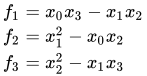
The twisted cubic curve in P3\mathbb{P}^3, parametrized by (1:t:t2:t3)(1 : t : t^2 : t^3), provides a classical example of a curve that is not a complete intersection. This curve has codimension 2 in P3\mathbb{P}^3, so it would be a complete intersection if its homogeneous ideal were generated by exactly two elements forming a regular sequence. However, the ideal is minimally generated by three independent quadrics, specifically the 2×22 \times 2 minors of the matrix (x0x1x2x1x2x3),\begin{pmatrix} x_0 & x_1 & x_2 \\ x_1 & x_2 & x_3 \end{pmatrix}, which are x12x0x2x_1^2 - x_0 x_2, x22x1x3x_2^2 - x_1 x_3, and x0x3x1x2x_0 x_3 - x_1 x_2. This excess of generators over the codimension prevents the ideal from being generated by a regular sequence of length 2. A related non-example is the rational normal curve of degree 4 in P4\mathbb{P}^4, parametrized by (1:t:t2:t3:t4)(1 : t : t^2 : t^3 : t^4). This curve also has 3, but its homogeneous ideal requires six minimal generators, consisting of the 2×22 \times 2 minors of the catalecticant matrix (x0x1x2x3x1x2x3x4).\begin{pmatrix} x_0 & x_1 & x_2 & x_3 \\ x_1 & x_2 & x_3 & x_4 \end{pmatrix}. The number of these minors is (42)=6\binom{4}{2} = 6, exceeding the codimension and thus violating the condition for being a complete intersection, as the generators do not form a of 3. Another illustration of failure arises from schemes that are not equidimensional, such as the union of a and an in P3\mathbb{P}^3. Suppose CC is an irreducible curve of 1 and pp is a point not on CC; their union V=C{p}V = C \cup \{p\} has components of 1 and 0. A complete intersection in projective space must be equidimensional, with all components having the expected equal to the ambient minus the length of the defining . Here, the ideal of VV cannot be generated by a of length 2 (to achieve 2 for the curve part), as the embedded point disrupts the purity of , making the quotient ring non-Cohen--Macaulay in a way incompatible with a complete intersection structure. Rational scroll surfaces offer further examples where the complete intersection condition fails, particularly due to the structure of their ideals and, in singular cases, non-Cohen--Macaulay local rings at certain points. Consider the rational normal S(1,2)P4S(1,2) \subset \mathbb{P}^4, a smooth of dimension 2 and 2, obtained as the union of lines joining corresponding points on rational normal curves of degrees 1 and 2 in disjoint projective spaces. Its homogeneous ideal is generated by the three 2×22 \times 2 minors of a 2×32 \times 3 matrix, exceeding the codimension and preventing generation by a regular sequence of length 2. For singular scrolls like S(0,3)P3S(0,3) \subset \mathbb{P}^3, a over the with vertex at the origin, the local ring at the singular vertex fails to be Cohen--Macaulay, as the depth does not equal the dimension there, further ruling out a complete intersection structure despite the global matching the number of potential generators.

Algebraic invariants

Multidegree

In , a complete intersection XX in a smooth variety YY is often defined as the common zero locus of global sections s1,,sks_1, \dots, s_k of line bundles L1,,LkL_1, \dots, L_k on YY, where the sections form a and k=\codimYXk = \codim_Y X. The cycle class [X]Ak(Y)[X] \in A_k(Y) is given by the of the ambient fundamental class [Y][Y] with the top Chern class of the virtual , which for this setup equals the product i=1kc1(Li)[Y]\prod_{i=1}^k c_1(L_i) \cap [Y]. The multidegree of XX refers to the vector of coefficients of this class when expressed in a basis for the Chow group Ak(Y)A_k(Y). In the specific case of hypersurfaces of degrees d1,,dkd_1, \dots, d_k in Pn\mathbb{P}^n, the line bundles are powers of the bundle O(1)\mathcal{O}(1), so c1(Li)=dihc_1(L_i) = d_i h where hh is the class of a . The Chow ring A(Pn)A^*(\mathbb{P}^n) is Z/(hn+1)\mathbb{Z}/(h^{n+1}), and the class simplifies to [X]=(i=1kdi)hk[Pn][X] = \left( \prod_{i=1}^k d_i \right) h^k \cap [\mathbb{P}^n]. Thus, the multidegree is the scalar coefficient i=1kdi\prod_{i=1}^k d_i, which equals the degree of XX as a subvariety of Pn\mathbb{P}^n. For example, consider a CC in P3\mathbb{P}^3 arising as the complete intersection of two surfaces of degrees aa and bb. The class is [C]=abh2[P3][C] = ab \, h^2 \cap [\mathbb{P}^3], so the multidegree (degree of CC) is abab. This notion generalizes from classical , where the intersection number of k=nk = n hypersurfaces in in Pn\mathbb{P}^n is i=1ndi\prod_{i=1}^n d_i; for a positive-dimensional complete intersection, the degree i=1kdi\prod_{i=1}^k d_i plays an analogous role as the intersection multiplicity with a general linear subspace complementary to the dimension of XX.

General position

In , a collection of hypersurfaces is said to be in if their scheme-theoretic has the expected and is transverse, meaning that at every point of the , the differentials of the defining equations are linearly independent, resulting in a reduced scheme with no multiple components. This condition ensures that the is a smooth complete variety when the ambient is smooth. Bertini's theorem plays a central role in establishing this genericity: for a smooth over an of characteristic zero, a generic section is smooth and thus transverse to the variety. Iterating this result, the of multiple generic hypersurfaces of prescribed degrees in yields a smooth complete intersection of the expected , as the defining sections form a and the remains reduced away from any base locus. Specifically, in Pn\mathbb{P}^n, the generic of rr hypersurfaces of degrees d1,,drd_1, \dots, d_r (with rnr \leq n) is an irreducible smooth complete intersection of rr. When hypersurfaces are not in , their may still be a complete intersection if the defining equations generate an ideal of the correct and form a , but the scheme can have positive-dimensional components with higher multiplicity due to tangencies or singularities. In such cases, the multiplicity at points exceeds one, reflecting non-transversality, though the overall is preserved. This contrasts with the reduced structure guaranteed in the general position scenario.

Topological features

Homology

For a smooth complete intersection XPNX \subset \mathbb{P}^N of dimension nn, the sheaf groups Hi(X,OX)H^i(X, \mathcal{O}_X) vanish for 0<i<n0 < i < n. This intermediate vanishing follows from the Koszul resolution of OX\mathcal{O}_X as an OPN\mathcal{O}_{\mathbb{P}^N}-module, which is a finite complex of locally free sheaves whose is known from Bott's theorem on projective space. An adapted form of Kodaira's vanishing theorem applies to smooth complete intersections in projective space. If the anticanonical bundle ωX-\omega_X is ample (which holds when the multidegree satisfies djN\sum d_j \le N), then Kodaira's theorem implies Hi(X,OXL)=0H^i(X, \mathcal{O}_X \otimes L) = 0 for i>0i > 0 and ample line bundles LL on XX, providing vanishing for twists of the structure sheaf. The topological Betti numbers of smooth complete intersections can be computed using the Koszul complex associated to the defining equations. For a (codimension 1 complete intersection), the states that the in Hi(Pn,Z)Hi(X,Z)H^i(\mathbb{P}^n, \mathbb{Z}) \to H^i(X, \mathbb{Z}) is an for i<n1i < n-1 and surjective for i=n1i = n-1, where dimX=n1\dim X = n-1. Thus, the Betti numbers agree with those of Pn\mathbb{P}^n outside the middle dimension, and the dimension of the primitive cohomology Hn1(X)primH^{n-1}(X)_{\mathrm{prim}} is given by (1)n1(χ(X)n)(-1)^{n-1} (\chi(X) - n), with the χ(X)\chi(X) computed via the . For general , iterative applications of the weak Lefschetz theorem yield isomorphisms in up to degrees i<ni < n, where nn is the dimension of XX, and the provides a converging to the , allowing explicit computation of primitive Betti numbers in terms of the degrees d1,,dcd_1, \dots, d_c. Regarding , the complex points of a smooth complete intersection XX of dimension nn have H2n(X(C),Z)ZH_{2n}(X(\mathbb{C}), \mathbb{Z}) \cong \mathbb{Z}, generated by the fundamental class. For the real points X(R)X(\mathbb{R}), even-dimensional complete intersections often exhibit non-trivial top-dimensional homology. For example, a smooth complete intersection of two quadrics in CP2m+2\mathbb{CP}^{2m+2} (dimension 2m2m) has H2m(X(R),Z)ZkH_{2m}(X(\mathbb{R}), \mathbb{Z}) \cong \mathbb{Z}^k for some k1k \geq 1, depending on the real topology, such as the number of connected components of the real locus. In singular cases with isolated singularities, the top adjusts by the Milnor numbers at singular points, yielding bn(V)=bn(Vsmooth)μ(V,ai)b_n(V) = b_n(V_{\text{smooth}}) - \sum \mu(V, a_i), where μ\mu is the Milnor number.

Euler characteristic

The topological Euler characteristic χ(V)\chi(V) of a complete intersection variety VV is defined as the alternating sum i(1)ibi(V)\sum_{i} (-1)^i b_i(V), where bi(V)b_i(V) are the Betti numbers of VV. For smooth projective complete intersections over C\mathbb{C}, this invariant is determined solely by the dimension of the ambient and the degrees of the defining hypersurfaces, reflecting the rigidity of their topology via the . This theorem implies that the homology of VV agrees with that of the ambient space Pn\mathbb{P}^n outside the middle dimension, with the difference arising from the primitive cohomology in the middle degree, allowing explicit computation of χ(V)\chi(V). For a smooth VPn+1V \subset \mathbb{P}^{n+1} of degree d1d \geq 1 (so dimV=n\dim V = n), the admits the closed-form expression χ(V)=n+21d[1+(1)n+1(d1)n+2].\chi(V) = n + 2 - \frac{1}{d} \left[ 1 + (-1)^{n+1} (d-1)^{n+2} \right]. This formula arises from integrating the top cn(TV)c_n(TV) over VV, using the for the TV=TPn+1VNV/Pn+1TV = TP^{n+1}|_V \otimes N_{V/\mathbb{P}^{n+1}}^\vee and the known Chern classes of Pn+1\mathbb{P}^{n+1} and the normal bundle NV/Pn+1=OV(d)N_{V/\mathbb{P}^{n+1}} = \mathcal{O}_V(d). For instance, when n=1n=1 (plane curves), it recovers χ(V)=d(3d)\chi(V) = d(3-d), consistent with the arithmetic genus formula. When n=2n=2 (surfaces in P3\mathbb{P}^3), a degree-3 hypersurface yields χ(V)=9\chi(V) = 9, reflecting its Picard rank and 27 lines. For general smooth complete intersections defined by hypersurfaces of degrees d1,,drd_1, \dots, d_r in Pn+r\mathbb{P}^{n+r} (with dimV=n\dim V = n), no simple exists for arbitrary rr, but χ(V)\chi(V) can be computed recursively by viewing VV as a in the complete intersection of the first r1r-1 equations, applying the formula iteratively along with the Künneth formula for the Betti numbers. Explicit algorithms for this recursion, based on Segre classes and projective degrees, are available and implementable for computational verification, even extending to mildly singular cases via the Chern-Schwartz-MacPherson class. These computations highlight how χ(V)\chi(V) grows polynomially with the degrees, providing key data for and mirror symmetry applications.
Add your contribution
Related Hubs
User Avatar
No comments yet.