

Recent from talks
RIAA equalization
Knowledge base stats:
Talk channels stats:
Members stats:
RIAA equalization
RIAA equalization is a specification for the recording and playback of phonograph records, established by the Recording Industry Association of America (RIAA). The purposes of the equalization are to permit greater recording times (by decreasing the mean width of each groove), to improve sound quality, and to reduce the groove damage that would otherwise arise during playback.
The RIAA equalization curve was intended to operate as a de facto global industry standard for records since 1954, but when the change actually took place is difficult to determine.
Before then, especially from 1940, each record company applied its own equalization; over 100 combinations of turnover and rolloff frequencies were in use, the main ones being Columbia-78, Decca-U.S., European (various), Victor-78 (various), Associated, BBC, NAB, Orthacoustic, World, Columbia LP, FFRR-78 and microgroove, and AES. The obvious consequence was that different reproduction results were obtained if the recording and playback filtering were not matched.
RIAA equalization is a form of pre-emphasis on recording and de-emphasis on playback. A recording is made with the low frequencies reduced and the high frequencies boosted, and on playback, the opposite occurs. The net result is a flat frequency response, but with attenuation of high-frequency noise such as hiss and clicks that arise from the recording medium. Reducing the low frequencies also limits the excursions the cutter needs to make when cutting a groove. Groove width is thus reduced, allowing more grooves to fit into a given surface area, permitting longer recording times. This also reduces physical stresses on the stylus, which might otherwise cause distortion or groove damage during playback.
A potential drawback of the system is that rumble from the playback turntable's drive mechanism is amplified by the low-frequency boost that occurs on playback. Players must, therefore, be designed to limit rumble, more so than if RIAA equalization did not occur.
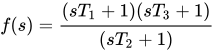
RIAA playback equalization is not a simple low-pass filter. It defines transition points in three places: 75 μs, 318 μs and 3180 μs, which correspond to 2122 Hz, 500.5 Hz and 50.05 Hz. Mathematically, the pre-emphasis transfer function is expressed as follows, where T1=3180 μs, T2=318 μs, T3=75 μs:
Implementing this characteristic is not especially difficult, but is more involved than a simple amplifier. Practically every 20th century hi-fi preamplifier, integrated amplifier and receiver featured a built-in phono stage with the RIAA characteristic. As more modern designs omitted the phonograph inputs, add-on phono preamplifiers with the RIAA equalization curve have become available. These adapt a magnetic phono cartridge to an unbalanced −10 dBv consumer line-level RCA input. Some modern turntables feature built-in preamplification to the RIAA standard. Special preamplifiers are also available for the various equalization curves used on pre-1954 records.
Hub AI
RIAA equalization AI simulator
(@RIAA equalization_simulator)
RIAA equalization
RIAA equalization is a specification for the recording and playback of phonograph records, established by the Recording Industry Association of America (RIAA). The purposes of the equalization are to permit greater recording times (by decreasing the mean width of each groove), to improve sound quality, and to reduce the groove damage that would otherwise arise during playback.
The RIAA equalization curve was intended to operate as a de facto global industry standard for records since 1954, but when the change actually took place is difficult to determine.
Before then, especially from 1940, each record company applied its own equalization; over 100 combinations of turnover and rolloff frequencies were in use, the main ones being Columbia-78, Decca-U.S., European (various), Victor-78 (various), Associated, BBC, NAB, Orthacoustic, World, Columbia LP, FFRR-78 and microgroove, and AES. The obvious consequence was that different reproduction results were obtained if the recording and playback filtering were not matched.
RIAA equalization is a form of pre-emphasis on recording and de-emphasis on playback. A recording is made with the low frequencies reduced and the high frequencies boosted, and on playback, the opposite occurs. The net result is a flat frequency response, but with attenuation of high-frequency noise such as hiss and clicks that arise from the recording medium. Reducing the low frequencies also limits the excursions the cutter needs to make when cutting a groove. Groove width is thus reduced, allowing more grooves to fit into a given surface area, permitting longer recording times. This also reduces physical stresses on the stylus, which might otherwise cause distortion or groove damage during playback.
A potential drawback of the system is that rumble from the playback turntable's drive mechanism is amplified by the low-frequency boost that occurs on playback. Players must, therefore, be designed to limit rumble, more so than if RIAA equalization did not occur.
RIAA playback equalization is not a simple low-pass filter. It defines transition points in three places: 75 μs, 318 μs and 3180 μs, which correspond to 2122 Hz, 500.5 Hz and 50.05 Hz. Mathematically, the pre-emphasis transfer function is expressed as follows, where T1=3180 μs, T2=318 μs, T3=75 μs:
Implementing this characteristic is not especially difficult, but is more involved than a simple amplifier. Practically every 20th century hi-fi preamplifier, integrated amplifier and receiver featured a built-in phono stage with the RIAA characteristic. As more modern designs omitted the phonograph inputs, add-on phono preamplifiers with the RIAA equalization curve have become available. These adapt a magnetic phono cartridge to an unbalanced −10 dBv consumer line-level RCA input. Some modern turntables feature built-in preamplification to the RIAA standard. Special preamplifiers are also available for the various equalization curves used on pre-1954 records.
Recent media