Hubbry Logo
REM IslandREM IslandMain
Open search
REM Island
Community hub
REM Island
logo
8 pages, 0 posts
0 subscribers
Be the first to start a discussion here.
REM Island
REM Island
from Wikipedia

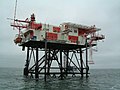
Photograph of REM Island
Photograph of REM Island, taken 16 December 1964

REM Island is a platform built in the Republic of Ireland and towed off the Dutch coast in 1964 as the pirate broadcasting home of Radio and TV Noordzee. Both stations were dismantled by the Netherlands Armed Forces. It was 10 km (6 miles) off Noordwijk.

Construction

[edit]

Radio and TV Noordzee were founded in 1963 with land-based offices and broadcast from the sea. The artificial island was built in the harbour of Cork, Ireland.[1] It was towed to its location and anchored in cement on the seabed. On 12 August 1964, a test broadcast was performed and on 15 August regular broadcasting started. The radio service broadcast on 1400 kHz, while on television, it used Channel E11 (System B).

REM stands for Reclame Exploitatie Maatschappij[2] (Dutch for "Advertising Exploitation Company"). The company intended to broadcast commercial radio and TV. Dutch law at the time did not authorise such broadcasts but the island was outside territorial waters. Other stations, such as Radio Veronica, used a ship.

Raid

[edit]

While Dutch authorities were unhappy with the broadcasts, they did not possess the legal right to stop them. However, on 12 December 1964, the government passed the REM law, which split the North Sea into continental sections. The sea bed under REM Island, to which the structure was attached, was therefore declared Dutch territory. Five days later, Korps Mariniers boarded the platform and ended broadcasting.[citation needed]

Dismantling

[edit]

A year after the raid, Radio Noordzee resumed transmissions legally under the name TROS. After that REM Island was used by the government to measure sea temperature and salt concentration. After a failed attempt to sell the island in 2004, the government dismantled it with a goodbye radio event by amateur radio enthusiasts, with the callsign PB6REM on the platform on 8 June 2006.

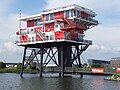
Since March 2011, the platform sits in Amsterdam harbour, at 52°23′55″N 4°53′00″E / 52.3986°N 4.8832°E / 52.3986; 4.8832, where it serves as a restaurant.[3]

[edit]

References

[edit]
Revisions and contributorsEdit on WikipediaRead on Wikipedia
from Grokipedia
REM Island (Dutch: REM-eiland) is an artificial offshore platform constructed in 1964 and anchored 9 kilometers off the coast of , , in the [North Sea](/page/North Sea), originally designed as a base for and broadcasts to bypass strict national regulations against commercial media. Developed by the Reclame Exploitatie Maatschappij (REM), a formed in 1963 by shipbuilder Cornelis Verolme and associates, the 24-meter-high structure resembled a small with concrete-filled legs sunk into the , housing studios for TV Noordzee, which aired programming including advertisements from August 12 to December 14, 1964. Its brief operation sparked controversy as an unauthorized challenge to the state-controlled monopoly, culminating in a marine and that seized equipment and ended transmissions, an event that accelerated public and political pressure for media liberalization, leading to the eventual introduction of commercial . Following the shutdown, the platform stood dormant until 1974, when the Dutch government repurposed it for monitoring and until 2004; it was then dismantled, relocated, and reconstructed in Amsterdam's Haparandadam harbor as a , preserving its historical tower while adapting the site for public dining with panoramic views.

Background and Conception

Pre-1964 Broadcasting Landscape

Prior to 1964, the Dutch broadcasting landscape was characterized by a state-regulated monopoly structured around verzuiling (pillarization), a system dividing society into Protestant, Catholic, socialist, and liberal "pillars" with corresponding broadcasting associations allocated airtime based on membership numbers rather than market demand. This framework, established in the 1920s for radio and extended to television upon its launch on October 2, 1951, via the single channel Nederland 1, enforced strict government licensing that prohibited commercial advertising and prioritized educational, cultural, and informational content over . Broadcasters operated from under oversight from bodies like the Nederlands Omroep Comité, ensuring content aligned with public service ideals that marginalized youth-oriented or programming. Broadcast hours were severely restricted, with radio typically limited to evenings and weekends, often totaling fewer than 50 hours per week per association, while television adhered to even tighter schedules—Nederland 1 airing approximately 20-30 hours weekly in the early , expanding modestly by the early 1960s but still avoiding 24-hour operations. Content regulations banned promotional material and emphasized "elevated" formats such as , news, and documentaries, reflecting a paternalistic view that should edify rather than entertain, which inherently suppressed format innovation and advertiser-supported models that could respond to listener preferences for diverse, timely programming. This scarcity stifled competition, as aspiring stations could not legally transmit without pillar affiliation and governmental approval, concentrating control and reducing incentives for audience engagement beyond ideological constituencies. Growing public frustration with these constraints—evident in surveys showing demand for more varied music amid the global rise of rock 'n' roll—spurred early offshore pirate radio experiments across , beginning with Denmark's Radio Mercur in August 1958, which broadcast commercial pop from a ship in to evade territorial laws. In the Netherlands, this model inspired , which commenced test transmissions on April 21, 1960, from the MV Borkum Riff II anchored 4.8 kilometers off , delivering continuous on 1562 kHz with a 10 kW transmitter and drawing up to 3 million daily listeners by challenging the monopoly's content uniformity. These initiatives highlighted causal tensions between regulated and consumer desires for , as state controls not only limited access but also insulated incumbents from market signals that might otherwise drive programming evolution.

Initiative by Radio Noordzee

In 1963, Dutch businessman I.P. Heerema, Rotterdam shipbuilder Cornelis Verolme, and associates Joseph Brandel and M. Minderop established Reclame Exploitatie Maatschappij (REM), a company aimed at launching commercial radio and television broadcasting to circumvent the Netherlands' state-controlled media monopoly under the Nederlandse Televisie Stichting (NTS). The initiative originated from an idea by Will Hordijk of The Hague, who proposed using an artificial platform for offshore transmissions, enabling ad-supported programming free from government oversight and licensing requirements. This entrepreneurial effort reflected a push for private-sector media alternatives in an era when public broadcasters dominated airwaves, limiting commercial content and viewer choice. REM's strategy centered on positioning the platform in international waters, approximately 9 kilometers (6 miles) off the Noordwijk coast, beyond Dutch territorial limits to exploit legal ambiguities in maritime jurisdiction. The project, branded as Radio and TV Noordzee, sought to deliver programming via medium-wave radio and VHF television signals receivable in the Randstad region, with total estimated costs reaching 9 million Dutch guilders for platform fabrication and setup. Proponents, including free-market advocates, regarded the venture as a democratizing force that expanded access to diverse, advertiser-funded entertainment and challenged state paternalism in information dissemination. Critics, however, contended it undermined public-interest mandates for balanced, non-commercial content enforced by Dutch regulations, prioritizing profit over societal obligations.

Construction and Design

Engineering and Construction Process

The REM Island platform was constructed at a in Cork, , commencing in early 1964, selected for the Republic's neutrality to evade Dutch territorial over infrastructure. The design featured a fully steel-fabricated elevated on six hollow tubular legs, engineered for deployment in the North Sea's variable conditions, with subsequent on-site filling of the legs using to achieve and anchorage. This approach drew from emerging offshore engineering practices, prioritizing structural integrity and minimal footprint over expansive amenities to ensure self-sufficiency against wave forces and currents. Prefabricated components were assembled under tight timelines to preempt regulatory interference, with the complete platform towed by specialized vessels across the and into position off , , arriving on May 3, 1964. Final assembly, including concrete pouring into the legs for stabilization, occurred by mid-May, enabling the 80-meter-high structure to resist typical swells up to several meters. The project, costing approximately 9 million Dutch guilders, overcame maritime constraints through modular fabrication, reflecting a causal focus on seaworthiness as the primary determinant of feasibility in unregulated waters.

Technical Specifications and Features

The REM Island platform consisted of a structure with three decks, weighing approximately 450 tons, elevated on six columns rising 10 meters above . An 80-meter-high radio tower was mounted atop the platform, providing the primary mast and contributing to the overall height of roughly 90 meters. The design incorporated living quarters, broadcast studios, and technical facilities capable of accommodating up to 20 staff members, with a on the roof for access. This purpose-built offshore configuration represented an early innovation in for media transmission, resembling nascent designs but optimized for stability in conditions. Broadcasting capabilities centered on a 1 kW medium-wave radio transmitter operating at 1403 kHz for Radio Noordzee, alongside experimental television transmission on UHF channel E11 for TV Noordzee. The setup supported non-concurrent operations, with radio airing from 9:00 a.m. to 6:15 p.m. followed by television, utilizing directional antennas to target the Dutch mainland from a position 9 kilometers offshore. Power was supplied by onboard diesel generators, essential for independent operation in the absence of grid connections, though specific generator capacities remain undocumented in available records. The platform's elevated and isolated design enhanced signal propagation over water but exposed it to harsh weather, necessitating robust maintenance for structural integrity and equipment reliability.

Operations and Broadcasting

Launch and Programming

Radio Noordzee initiated test transmissions from REM Island on July 19, 1964, using mediumwave frequencies such as 1071 kHz before shifting to 1485 kHz, with a transmitter power of 1 kW. Regular programming commenced on July 23, 1964, marking the platform's operational debut as the first offshore commercial radio station targeting the Dutch audience. This launch introduced continuous , operating around the clock in contrast to the limited hours of the state-run Nederlandse Radio Unie (NRU), which adhered to scheduled formats without advertising. The station's content strategy emphasized tailored to younger listeners, featuring contemporary pop and rock records interspersed with commercial advertisements from Dutch businesses seeking to reach this demographic. Programming avoided the NRU's focus on , news bulletins, and educational content, instead prioritizing entertainment to capitalize on the novelty of ad-supported media. Brief test broadcasts for the accompanying TV Noordzee were planned alongside radio operations but faced technical constraints, including the need for specialized UHF antennas for reception; these began on August 12, 1964, with limited daily hours featuring imported series before full programming started on September 1. Initial audience reception demonstrated rapid uptake, with radio signals drawing significant listenership despite reported attempts by postal authorities to disrupt transmissions through frequency interference using mobile jamming equipment. Early metrics indicated strong appeal among youth, positioning Radio Noordzee as a direct competitor to established onshore stations like , and underscoring demand for commercial alternatives to state media.

Audience Reception and Impact

Radio and TV Noordzee, broadcasting from REM Island starting in August 1964, rapidly garnered substantial audience interest in the , where dominated under a pillarized system emphasizing educational, religious, and political content over popular entertainment. Audience surveys from 1964 indicated that TV Noordzee alone drew approximately 2 million nightly viewers, representing a significant portion of the country's roughly 12 million population and highlighting pent-up demand for commercial, ad-supported programming featuring , variety shows, and absent from public broadcasters. This viewership, coupled with listenership to Radio Noordzee's daily schedule of chart music from 9:00 a.m. to 6:15 p.m., enabled the station to secure advertising revenue, demonstrating the economic appeal of diverse, unregulated content to advertisers seeking broader reach beyond state monopolies. The platforms' reception underscored public preference for alternatives to the rigid, segmented Dutch broadcasting landscape, where listeners tuned in for its focus on youth-oriented and television formats, pressuring authorities to confront the limitations of under existing laws. Supporters, including media entrepreneurs and free-speech advocates, praised the initiative for fostering expression and cultural vibrancy, arguing it filled a void in accessible entertainment that state pillars neglected. Detractors, primarily government officials and public broadcasters, criticized the unregulated as potentially manipulative and the content as risking or low-quality , while viewing the offshore setup as a direct challenge to national sovereignty despite its location in . Short-term societal effects included a cultural nudge toward commercial media viability, as the quick audience buildup evidenced widespread appetite for non-state options, influencing debates on broadcasting reform by exposing the disconnect between official programming and public tastes during its brief four-month operation. This reception not only boosted immediate ad sales but also amplified calls for pluralism, though it drew regulatory backlash over perceived threats to controlled information flow.

Dutch Regulatory Environment

In the early , Dutch broadcasting regulations enforced a state-sanctioned monopoly through organizations operating under a pillarized system, where entities like the and VARA allocated airtime via the (NOS) precursor, explicitly barring commercial advertising and unlicensed transmissions to prioritize non-profit, ideologically segmented content. These restrictions derived from pre-war and post-World War II legislation, including allocation laws under the Telegraph Act and ordinances that criminalized unauthorized emissions interfering with licensed signals, with penalties for possession or operation aimed at preserving control for public welfare. Enforcement philosophy emphasized centralized oversight to avert "anarchic" commercialization, reflecting a causal chain from wartime propaganda controls to peacetime rationales for taxpayer-funded uniformity over market-driven variety, though empirical evidence showed public stations underdelivering on youth-oriented programming like . The territorial sea limit, customarily 3 nautical miles under international norms prior to widespread ratification of the 1958 Geneva Convention on the Territorial Sea and Contiguous Zone, created a contested loophole for offshore operations, as no binding precedent existed for fixed platforms in high seas receivable on national soil. Dutch authorities interpreted regulations to extend over signals targeting domestic audiences, regardless of transmitter , but initial tolerance for mobile pirate ships beyond the limit highlighted enforcement selectivity favoring minimal intervention against non-fixed assets. This approach, while framed as safeguarding public order and frequency integrity, empirically suppressed competitive entry: public monopolies, insulated from revenue pressures, lagged in format innovation, as evidenced by the 1965 launch of Hilversum 3 only after pirate popularity exposed unmet demand for commercial-style content. From first-principles reasoning, such monopolistic controls inherently distort incentives by eliminating price signals and rival experimentation, fostering inefficiencies like overreliance on subsidies—Dutch public broadcasting budgets exceeded market-equivalent efficiencies—while stifling causal pathways to content diversification that would induce. Narratives portraying these regulations as unalloyed public goods overlook how they entrenched bureaucratic , delaying adaptations until external pressures forced concessions, thereby validating critiques of state overreach in media allocation.

Government Opposition and Debates

The Dutch government, under Victor Marijnen, regarded the construction of REM Island as a direct challenge to national sovereignty and the state-regulated broadcasting monopoly, prompting cabinet-level discussions in early 1964 on extending beyond . In May 1964, Justice Minister Johannus Scholten introduced the North Sea Installations Bill, invoking the 1958 Geneva Convention on the Continental Shelf to assert control over artificial structures like REM Island, located approximately two miles offshore, arguing that such platforms constituted unlawful obstructions and threatened the Nederlandse Televisie Stichting (NTS), the public television entity funded by a $10 annual tax on 1.5 million television sets. Parliamentary debates intensified in June 1964 during an order-of-the-day session, where opposition leader (PvdA) lambasted the government's delayed response as emblematic of ineffective policy, likening it to a "test image of poor ," while KVP member Baeten expressed regret over the administration's hesitation amid mounting in commercial alternatives. Further deliberations on September 16, 1964, in the Second Chamber focused on the bill's legal validity under , with jurists divided: some, like Duynstee, deemed the platform an illegal high-seas impediment, while others contended it fell under the freedom of the high seas regime absent seabed resource exploitation. The bill advanced despite liberal objections on jurisdictional grounds, passing the Second Chamber on December 1, 1964, by a 114-19 vote, reflecting broad cross-party consensus to safeguard the pillarized system against revenue erosion and signal interference from unauthorized commercial operations. Proponents of REM Island, including backer Cor Verolme, argued in debates for dismantling the NTS monopoly—mirroring the successful five-year run of offshore commercial —emphasizing public demand for diverse programming free from state control, as evidenced by 250,000 households tuning into test transmissions by August 1964. Government counterarguments prioritized protections, citing risks to maritime safety, potential aviation interference, and fiscal harm to license-fee-dependent public broadcasters, though empirical patterns suggest such regulations often served to entrench incumbents rather than solely advance neutral welfare objectives, akin to critiques of U.S. doctrines that stifled competitive media entry under guise of balance. Public opinion remained divided, with and sectors favoring expanded choice amid the NTS's perceived blandness, yet broader concerns over unregulated and cultural fragmentation bolstered official resistance.

Raid and Seizure

The Marine Corps Operation

On December 17, 1964, units of the Dutch Korps Mariniers, supported by helicopters, executed a coordinated boarding operation on REM Island, located approximately 9 kilometers off the coast of . The assault force approached via air and sea, with descending onto the platform's deck using helicopter-borne insertion tactics, marking one of the earliest documented uses of such methods in a domestic context. The operation followed the enactment of emergency legislation on December 12, 1964, which retroactively classified the artificial structure as Dutch territory, thereby providing legal basis for intervention despite its initial positioning beyond the 3-nautical-mile territorial limit. The takeover proceeded without resistance or violence; the eight staff members on board, including broadcasters and technicians, were peacefully evacuated by the marines and transported to shore via motor launches. Broadcasting equipment, including transmitters for Radio Noordzee (operating on 1071 kHz) and TV Noordzee, was systematically seized and dismantled on site, effectively terminating all transmissions that had commenced in July 1964. Damage to the platform's physical structure was minimal, preserving its integrity for subsequent government use, though the abrupt halt inflicted substantial financial losses on the operators, estimated in the millions of guilders due to sunk construction costs and lost advertising revenue. Tactically, the mission exemplified precision and rapid execution, completed within hours under challenging conditions, with no injuries reported on either side. The Korps Mariniers' involvement underscored the operation's classification as a military-style action, drawing on their expertise in amphibious assaults honed from prior deployments. This event concluded the brief operational phase of REM Island as a pirate platform after roughly five months of intermittent transmissions.

Immediate Aftermath

Following the Dutch Marine Corps raid on December 17, 1964, operations on REM Island were terminated, with authorities confiscating all radio and television transmission equipment to enforce the newly extended territorial jurisdiction. The platform, previously positioned approximately 9 kilometers offshore, fell under Dutch legal control via an enacted on December 12, 1964, which expanded the territorial sea to 9 nautical miles specifically to encompass such structures and deem their activities illegal. Operators faced swift legal repercussions, including fines for violating broadcasting monopolies under the Dutch state system, though the platform itself remained stationary and unused pending further government disposition. Public response included protests from media reform advocates, who organized letter-writing campaigns against the shutdown, citing widespread frustration with the Nederlandse Televisie Stichting's (NTS) limited programming and lack of commercial alternatives. Government officials portrayed the operation as a necessary assertion of sovereignty and , effectively curbing unauthorized signals that competed with public broadcasters. In contrast, pirate radio sympathizers condemned the military intervention as authoritarian overreach, galvanizing support for outlets and highlighting demands for pluralism in Dutch . This polarization intensified short-term debates, contributing to accelerated legislative efforts to fortify anti-pirate measures beyond the immediate jurisdictional extension.

Dismantling and Relocation

Demolition at Sea

After serving as a measurement post for oceanographic data until 2004, the Dutch government agency initiated the demolition of REM Island in 2006, following unsuccessful efforts to sell the structure. The platform, located approximately 9 kilometers off the coast of , posed logistical challenges due to its offshore position in the , where operations were subject to variable weather conditions. Demolition activities were scheduled to begin on September 23, 2006, contingent on favorable weather. The process involved detaching the from the undercarriage using burning techniques, after which it was placed onto a pontoon for to shore. On September 24, 2006, the pontoon carrying the superstructure was towed by a to Vlissingen-Oost harbor. The undercarriage was then dismantled on-site using oxy-acetylene cutting torches, with sections subsequently transported to land. Specialized salvage companies, including the Belgian firm Scaldis in collaboration with Dutch partners, handled the heavy lifting and cutting operations required for the platform. Environmental considerations during the were addressed through standard procedures for offshore structures, with impacts deemed minimal given the platform's limited footprint and the absence of hazardous materials beyond typical and concrete. No significant legal hurdles beyond routine permitting were reported, though the operation highlighted the complexities of removing aging offshore installations, including coordination between maritime authorities and salvage experts to ensure safe and prevent navigation hazards.

Subsequent Uses and Repurposing

Following its dismantling in September 2006, the REM Island structure was towed to Flushing Harbour in the for storage after a failed sale attempt in 2004. The platform, originally constructed from prefabricated elements on steel columns, underwent preservation of key features such as external footbridges, signal lights, and the lifeboat station during subsequent renovations. In 2008, Dutch hospitality entrepreneur Nick van Loon, in collaboration with housing corporation De Principaal, commissioned architectural firm to redesign the platform as a multifunctional venue. The renovated structure was towed to Amsterdam's Houthavens district in 2011 and elevated 22 meters above the water on its original columns, opening as the REM Eiland and bar in 2013. The venue incorporates the platform's historical elements, including restored antennas and control rooms, now repurposed for dining spaces offering panoramic views of the IJmeer. As of 2025, REM Eiland continues to operate as a rooftop and event space, maintaining its role as a preserved artifact of offshore broadcasting history without significant structural alterations since its relocation. While some non-essential components from the original platform were likely recycled as during the 2006 process, the core tower and deck were fully salvaged for this , avoiding complete scrapping.

Legacy and Influence

Influence on Pirate Broadcasting

REM Island's deployment in May 1964 marked the first use of a purpose-built fixed offshore platform for pirate , housing Radio Noordzee from July 29 to December 16 and TV Noordzee from August 12 to December 17, thereby proving the technical viability of stable, high-power transmissions from without reliance on ships. This innovation contrasted with contemporaneous ship-based operations like (from 1960) and (from March 1964), offering greater structural permanence and a 360-foot mast for enhanced signal reach targeting Dutch audiences. However, its rapid seizure by Dutch marines on December 17, 1964, under the Installations Act underscored the legal vulnerabilities of immobile platforms, deterring direct emulation in favor of more evasive vessel-based stations across . The platform's operations demonstrated robust public appetite for unrestricted commercial content, with TV Noordzee attracting approximately 2 million nightly viewers by October 1964—evidence of dissatisfaction with the Dutch public broadcasting monopoly's limited programming. This audience scale catalyzed organizational responses, including the rapid formation of TROS, which amassed 150,000 members prior to the law's enactment, positioning it as a precursor to licensed commercial entities and pressuring regulatory shifts toward liberalization in the by the 1980s. In broader European contexts, REM Island's success validated offshore broadcasting's potential to bypass state controls, sustaining momentum for pirate initiatives that collectively evidenced demand and contributed to the erosion of broadcasting monopolies, though fixed platforms remained rare due to enforcement precedents set by the raid. Technically, the platform's design—prefabricated at a cost of 9 million guilders and towed into position—served as a for resilient sea-based , influencing later conceptualizations of offshore media despite practical reversion to ships for operational flexibility in stations like those in the UK and . Its legacy thus lay not in widespread adoption of fixed structures but in empirically affirming the causal link between unrestricted access and listener engagement, which emboldened to persist amid crackdowns and informed arguments for grounded in verifiable popularity metrics.

Broader Cultural and Regulatory Impact

The REM Island venture exemplified early challenges to the ' broadcasting monopoly, which restricted commercial operations to public pillars organized along ideological lines, thereby prompting legislative responses that initially reinforced state control but ultimately accelerated liberalization. In response to offshore pirates like REM, Dutch authorities enacted measures extending jurisdiction over fixed platforms in the , treating them akin to territorial extensions rather than vessels under , as affirmed in the 1964 raid and subsequent policies. These actions mirrored the UK's Marine Broadcasting Offences Act of 1967 but failed to quell demand; instead, they underscored the monopoly's rigidity, contributing to broader pressures that led to cable-based commercial television in 1989 via RTL4 and full legalization of Dutch-owned commercial radio in 1991, as public dissatisfaction with limited programming variety grew evident through high pirate listenership rates exceeding 10 million in similar European cases. Long-term regulatory impacts favored innovation over suppression, with empirical data post-deregulation revealing expanded channel availability—from three public networks in the to over 20 commercial and public options by the —driving that improved content relevance without eroding public service viability, as measured by audience metrics and ad revenue growth from near-zero commercial sources to billions of euros annually. Critics of the monopoly, including pirate advocates, argued it stifled diversity under the guise of cultural protection, a view validated by outcomes where market entry correlated with higher youth engagement and genre variety, including pop and entertainment formats absent in pillar broadcasts. Culturally, REM Island served as a potent of defiance against centralized media oversight, inspiring libertarian perspectives on speech freedoms by proving technical circumvention could deliver uncensored, audience-preferred content like youth-oriented and ads, which resonated amid countercultural shifts eroding verzuiling. This legacy debunked defenses of state exclusivity—often rooted in elite preservation of "high" —through causal evidence of post-pirate reforms yielding greater pluralism, as commercial entrants diversified programming and boosted listener choice, evidenced by stations like Veronica transitioning from offshore illegality to licensed success with sustained popularity. Short-term chaos from signal interference was outweighed by net gains in expressive and market responsiveness.

References

Add your contribution
Related Hubs
User Avatar
No comments yet.