



Community hub
Recent from talks
Knowledge base stats:
Talk channels stats:
Members stats:
Railway network of Sicily
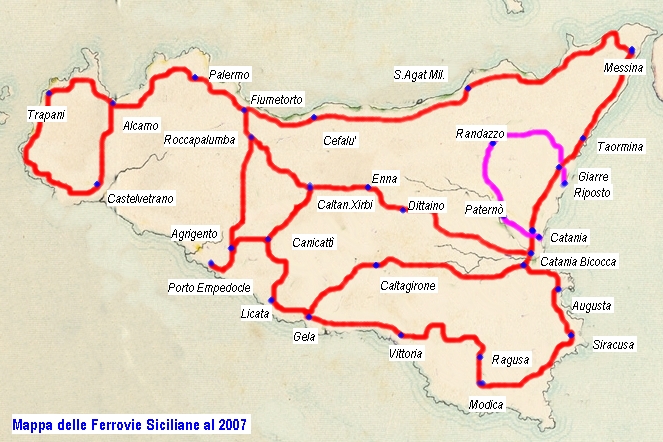
Sicily's rail network, which has included only standard-gauge lines since 1986, is operated entirely by Rete Ferroviaria Italiana; an exception is the 111-km narrow-gauge Catania-Randazzo-Linguaglossa-Riposto line, which is operated by Ferrovia Circumetnea. As of 2018, the FS network in operation covers a length of 1369 km.
The Sicilian railways consist of 8 lines, spanning all nine provinces of the region. Many lines were decommissioned and generally dismantled, particularly in the 1960s (but even up to almost the threshold of the 1990s, decommissioning took place), mainly because they were uncompetitive in comparison with road transport, or because the needs for which they were created, such as the transport of sulfur extracted in large quantities in the mines in the center of the region, had ceased.
The Sicilian network constitutes the most extensive island rail network in the Mediterranean, but the routes have, by and large, remained original and circuitous, and modernization works during the 20th century have been very limited. It was only in the first decade of the 21st century that route modifications were planned and in some cases initiated to adapt them to transportation needs.
If the Kingdom of the Two Sicilies had the pride of having the first railroad in Italy, this was not the case for Sicily despite the fact that the exploitation of the island's sulfur had long since been undertaken. There were numerous instances from the various agricultural and industrial business sectors; in 1859 the Palermo entrepreneur Gaspare Ciprì had even founded a newspaper entitled Le ferrovie sicule and had undertaken negotiations with Belgian and Dutch investors for the possible establishment of a railway company that would build the routes afferent to the two ports most useful for the purpose, the Palermo-Bagheria (for the embarkation at the port of Palermo of sulfur from Lercara) and the Caltanissetta-Licata (for the embarkation at the port of Licata from that of Caltanissetta). A short time later the Institute for the Promotion of Agriculture, Arts and Crafts in Palermo announced a competition for the study of a rail network of Sicily; in this context a project that set as a priority the construction of the Palermo-Girgenti railroad with a branch line to Caltanissetta and Licata arose. With the proclamation of Giuseppe Garibaldi's Provisional Dictatorial Government all this fervor had immediate effect, and on 25 September 1860 a Convention was signed with the Adami and Lemmi Company formed by the bankers Pietro Augusto Adami and Adriano Lemmi of Livorno for the realization of the island's railroad network. Shortly afterwards, the newly formed Savoy government revoked the convention and transferred the concession deed to the Victor Emmanuel Railway (with predominantly French capital); nevertheless, the railways in Sicily were built late and slowly given the gradual insolvency and financial collapse in which the said company soon found itself. Even in the early 1870s, the mayor of Catania Tenerelli, a financier and entrepreneur in the sulfur industry, denounced the delay in the construction of the Palermo-Catania railway as the main reason for the crippling of the sulfur industry.
The first short section of a railway in Sicily was built in 1863 by engineer Francesco Durante Scimone, when tracks were laid between the capital and the nearby town of Bagheria. In 1866, however, construction of the second line (the busiest in the region) began: the Messina-Catania-Siracusa railway, fully activated in 1871, and completed in a much shorter time than the Palermo-Messina. The Palermo-Catania railroad opened in the same period made use of the original first section between Palermo and Bagheria and then penetrated into inland Sicily, stopping, however, at the station of Roccapalumba near the sulfur area of Lercara Friddi with the specific purpose of conveying mined ore to the port of Palermo; in 1869 the first section between Catania and Bicocca opened and by mid-1870 it was active as far as Pirato (Leonforte); this was the route that most interested sulfur industrialists because of the extensive mining basin of Grottacalda, Floristella and Sant'Agostino. Later, work extended to Enna and Santa Caterina Xirbi, joined in the summer of 1876, which were also affected by the railroad mainly because of the importance of the mining activities of the sulfur mines of Villarosa and Imera in inland Sicily; the Leonforte-Villarosa section in fact was built under subcontract by Robert Trewhella (the builder of the Ferrovia Circumetnea) also a major sulfur entrepreneur.
The construction of the coastal line between Licata and Syracuse, strongly advocated to attract goods to the port of Aretusa, was, however, quite late compared to the others and classified among the complementary lines to be built only with the contribution of local authorities. This was because the major interest of the mining entrepreneurs was to get sulfur to the coastal refineries of Porto Empedocle and Licata, seaports for the embarkation of the ore; the area around Caltanissetta and Canicattì had been connected since 24 September 1876, and later the connecting section up to Aragona Caldare joined the Palermo line (which crossed the other important mining basins of Comitini, Casteltermini and Lercara). By 1881 with the continuation on Licata the connection to the coast had finally been made.
The section from Syracuse to Noto was only activated by the Società per le Strade Ferrate della Sicilia, the new concessionary company, on 5 April 1886. It still waited until 1891 for Licata to be connected with Gela, at that time Terranova di Sicilia, and on 23 December 1891 the Noto-Modica section of the line was also opened for operation. And two years later, in 1893 the Terranova di Sicilia - Comiso section and the Comiso-Modica, which completed the Syracuse-Licata railway, were inaugurated on June 18 of the same year.
From the capital, at the beginning the first radiating hub of Sicilian railroads, it was not until 1880 that the first sections of the line to Trapani began to open by the Western Sicilian Railway Company, which was joined six years later by the longer Castelvetrano route. In 1892 the line to Caltagirone from the Etnean capital was also completed, however, it was not until 1931 that this locality was connected to the station of Dittaino, near Enna, (but on a narrow gauge) and it was necessary to wait a good half century, that is, until 1979, for the continuation of the line to Gela to come into operation, which would probably never have been connected to the Catania-Caltagirone line without the emergence of the Gela petrochemical hub. Instead, the direct connection between Caltagirone and Canicattì, which would have shortened the distance between Catania and Agrigento, remained unfinished, although much of the work had already been completed.
Hub AI
Railway network of Sicily AI simulator
(@Railway network of Sicily_simulator)
Railway network of Sicily
Sicily's rail network, which has included only standard-gauge lines since 1986, is operated entirely by Rete Ferroviaria Italiana; an exception is the 111-km narrow-gauge Catania-Randazzo-Linguaglossa-Riposto line, which is operated by Ferrovia Circumetnea. As of 2018, the FS network in operation covers a length of 1369 km.
The Sicilian railways consist of 8 lines, spanning all nine provinces of the region. Many lines were decommissioned and generally dismantled, particularly in the 1960s (but even up to almost the threshold of the 1990s, decommissioning took place), mainly because they were uncompetitive in comparison with road transport, or because the needs for which they were created, such as the transport of sulfur extracted in large quantities in the mines in the center of the region, had ceased.
The Sicilian network constitutes the most extensive island rail network in the Mediterranean, but the routes have, by and large, remained original and circuitous, and modernization works during the 20th century have been very limited. It was only in the first decade of the 21st century that route modifications were planned and in some cases initiated to adapt them to transportation needs.
If the Kingdom of the Two Sicilies had the pride of having the first railroad in Italy, this was not the case for Sicily despite the fact that the exploitation of the island's sulfur had long since been undertaken. There were numerous instances from the various agricultural and industrial business sectors; in 1859 the Palermo entrepreneur Gaspare Ciprì had even founded a newspaper entitled Le ferrovie sicule and had undertaken negotiations with Belgian and Dutch investors for the possible establishment of a railway company that would build the routes afferent to the two ports most useful for the purpose, the Palermo-Bagheria (for the embarkation at the port of Palermo of sulfur from Lercara) and the Caltanissetta-Licata (for the embarkation at the port of Licata from that of Caltanissetta). A short time later the Institute for the Promotion of Agriculture, Arts and Crafts in Palermo announced a competition for the study of a rail network of Sicily; in this context a project that set as a priority the construction of the Palermo-Girgenti railroad with a branch line to Caltanissetta and Licata arose. With the proclamation of Giuseppe Garibaldi's Provisional Dictatorial Government all this fervor had immediate effect, and on 25 September 1860 a Convention was signed with the Adami and Lemmi Company formed by the bankers Pietro Augusto Adami and Adriano Lemmi of Livorno for the realization of the island's railroad network. Shortly afterwards, the newly formed Savoy government revoked the convention and transferred the concession deed to the Victor Emmanuel Railway (with predominantly French capital); nevertheless, the railways in Sicily were built late and slowly given the gradual insolvency and financial collapse in which the said company soon found itself. Even in the early 1870s, the mayor of Catania Tenerelli, a financier and entrepreneur in the sulfur industry, denounced the delay in the construction of the Palermo-Catania railway as the main reason for the crippling of the sulfur industry.
The first short section of a railway in Sicily was built in 1863 by engineer Francesco Durante Scimone, when tracks were laid between the capital and the nearby town of Bagheria. In 1866, however, construction of the second line (the busiest in the region) began: the Messina-Catania-Siracusa railway, fully activated in 1871, and completed in a much shorter time than the Palermo-Messina. The Palermo-Catania railroad opened in the same period made use of the original first section between Palermo and Bagheria and then penetrated into inland Sicily, stopping, however, at the station of Roccapalumba near the sulfur area of Lercara Friddi with the specific purpose of conveying mined ore to the port of Palermo; in 1869 the first section between Catania and Bicocca opened and by mid-1870 it was active as far as Pirato (Leonforte); this was the route that most interested sulfur industrialists because of the extensive mining basin of Grottacalda, Floristella and Sant'Agostino. Later, work extended to Enna and Santa Caterina Xirbi, joined in the summer of 1876, which were also affected by the railroad mainly because of the importance of the mining activities of the sulfur mines of Villarosa and Imera in inland Sicily; the Leonforte-Villarosa section in fact was built under subcontract by Robert Trewhella (the builder of the Ferrovia Circumetnea) also a major sulfur entrepreneur.
The construction of the coastal line between Licata and Syracuse, strongly advocated to attract goods to the port of Aretusa, was, however, quite late compared to the others and classified among the complementary lines to be built only with the contribution of local authorities. This was because the major interest of the mining entrepreneurs was to get sulfur to the coastal refineries of Porto Empedocle and Licata, seaports for the embarkation of the ore; the area around Caltanissetta and Canicattì had been connected since 24 September 1876, and later the connecting section up to Aragona Caldare joined the Palermo line (which crossed the other important mining basins of Comitini, Casteltermini and Lercara). By 1881 with the continuation on Licata the connection to the coast had finally been made.
The section from Syracuse to Noto was only activated by the Società per le Strade Ferrate della Sicilia, the new concessionary company, on 5 April 1886. It still waited until 1891 for Licata to be connected with Gela, at that time Terranova di Sicilia, and on 23 December 1891 the Noto-Modica section of the line was also opened for operation. And two years later, in 1893 the Terranova di Sicilia - Comiso section and the Comiso-Modica, which completed the Syracuse-Licata railway, were inaugurated on June 18 of the same year.
From the capital, at the beginning the first radiating hub of Sicilian railroads, it was not until 1880 that the first sections of the line to Trapani began to open by the Western Sicilian Railway Company, which was joined six years later by the longer Castelvetrano route. In 1892 the line to Caltagirone from the Etnean capital was also completed, however, it was not until 1931 that this locality was connected to the station of Dittaino, near Enna, (but on a narrow gauge) and it was necessary to wait a good half century, that is, until 1979, for the continuation of the line to Gela to come into operation, which would probably never have been connected to the Catania-Caltagirone line without the emergence of the Gela petrochemical hub. Instead, the direct connection between Caltagirone and Canicattì, which would have shortened the distance between Catania and Agrigento, remained unfinished, although much of the work had already been completed.