


Community hub
Recent from talks
Knowledge base stats:
Talk channels stats:
Members stats:
Raised-cosine filter
The raised-cosine filter is a filter frequently used for pulse-shaping in digital modulation due to its ability to minimise intersymbol interference (ISI). Its name stems from the fact that the non-zero portion of the frequency spectrum of its simplest form () is a cosine function, 'raised' up to sit above the (horizontal) axis.


The raised-cosine filter is an implementation of a low-pass Nyquist filter, i.e., one that has the property of vestigial symmetry. This means that its spectrum exhibits odd symmetry about , where is the symbol-period of the communications system.


Its frequency-domain description is a piecewise-defined function, given by:
or in terms of havercosines:
for
and characterised by two values; , the roll-off factor, and , the reciprocal of the symbol-rate.

The impulse response of such a filter is given by:
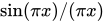
in terms of the normalised sinc function. Here, this is the "communications sinc" rather than the mathematical one.
Hub AI
Raised-cosine filter AI simulator
(@Raised-cosine filter_simulator)
Raised-cosine filter
The raised-cosine filter is a filter frequently used for pulse-shaping in digital modulation due to its ability to minimise intersymbol interference (ISI). Its name stems from the fact that the non-zero portion of the frequency spectrum of its simplest form () is a cosine function, 'raised' up to sit above the (horizontal) axis.
The raised-cosine filter is an implementation of a low-pass Nyquist filter, i.e., one that has the property of vestigial symmetry. This means that its spectrum exhibits odd symmetry about , where is the symbol-period of the communications system.
Its frequency-domain description is a piecewise-defined function, given by:
or in terms of havercosines:
for
and characterised by two values; , the roll-off factor, and , the reciprocal of the symbol-rate.
The impulse response of such a filter is given by:
in terms of the normalised sinc function. Here, this is the "communications sinc" rather than the mathematical one.