Hubbry Logo
Sinc functionSinc functionMain
Open search
Sinc function
Community hub
Sinc function
logo
8 pages, 0 posts
0 subscribers
Be the first to start a discussion here.
Contribute something
Sinc function
Sinc function
from Wikipedia

Sinc
Part of the normalized and unnormalized sinc function shown on the same scale
Part of the normalized sinc (blue) and unnormalized sinc function (red) shown on the same scale
General information
General definition
Fields of applicationSignal processing, spectroscopy
Domain, codomain and image
Domain
Image
Basic features
ParityEven
Specific values
At zero1
Value at +∞0
Value at −∞0
Maxima1 at
Minima at
Specific features
Root
Related functions
Reciprocal
Derivative
Antiderivative
Series definition
Taylor series

In mathematics, physics and engineering, the sinc function (/ˈsɪŋk/ SINK), denoted by sinc(x), is defined as either or
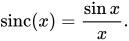
the latter of which is sometimes referred to as the normalized sinc function. The only difference between the two definitions is in the scaling of the independent variable (the x axis) by a factor of π. In both cases, the value of the function at the removable singularity at zero is understood to be the limit value 1. The sinc function is then analytic everywhere and hence an entire function.

The normalized sinc function is the Fourier transform of the rectangular function with no scaling. It is used in the concept of reconstructing a continuous bandlimited signal from uniformly spaced samples of that signal. The sinc filter is used in signal processing.

The function itself was first mathematically derived in this form by Lord Rayleigh in his expression (Rayleigh's formula) for the zeroth-order spherical Bessel function of the first kind.

The sinc function is also called the cardinal sine function.

Definitions

[edit]
The sinc function as audio, at 2000 Hz (±1.5 seconds around zero)

The sinc function has two forms, normalized and unnormalized.[1]

In mathematics, the historical unnormalized sinc function is defined for x ≠ 0 by

Alternatively, the unnormalized sinc function is often called the sampling function, indicated as Sa(x).[2]

In digital signal processing and information theory, the normalized sinc function is commonly defined for x ≠ 0 by

In either case, the value at x = 0 is defined to be the limiting value for all real a ≠ 0 (the limit can be proven using the squeeze theorem).

The normalization causes the definite integral of the function over the real numbers to equal 1 (whereas the same integral of the unnormalized sinc function has a value of π). As a further useful property, the zeros of the normalized sinc function are the nonzero integer values of x.

Etymology

[edit]

The function has also been called the cardinal sine or sine cardinal function.[3][4] The term "sinc" is a contraction of the function's full Latin name, the sinus cardinalis[5] and was introduced by Philip M. Woodward and I.L Davies in their 1952 article "Information theory and inverse probability in telecommunication", saying "This function occurs so often in Fourier analysis and its applications that it does seem to merit some notation of its own".[6] It is also used in Woodward's 1953 book Probability and Information Theory, with Applications to Radar.[5][7]

Properties

[edit]
The local maxima and minima (small white dots) of the unnormalized, red sinc function correspond to its intersections with the blue cosine function.

The zero crossings of the unnormalized sinc are at non-zero integer multiples of π, while zero crossings of the normalized sinc occur at non-zero integers.

The local maxima and minima of the unnormalized sinc correspond to its intersections with the cosine function. That is, sin(ξ)/ξ = cos(ξ) for all points ξ where the derivative of sin(x)/x is zero and thus a local extremum is reached. This follows from the derivative of the sinc function:

The first few terms of the infinite series for the x coordinate of the n-th extremum with positive x coordinate are [citation needed] where and where odd n lead to a local minimum, and even n to a local maximum. Because of symmetry around the y axis, there exist extrema with x coordinates xn. In addition, there is an absolute maximum at ξ0 = (0, 1).

The normalized sinc function has a simple representation as the infinite product:

The cardinal sine function sinc(z) plotted in the complex plane from -2-2i to 2+2i

and is related to the gamma function Γ(x) through Euler's reflection formula:

Euler discovered[8] that and because of the product-to-sum identity[9]

Domain coloring plot of sinc z = sin z/z

Euler's product can be recast as a sum

The continuous Fourier transform of the normalized sinc (to ordinary frequency) is rect(f): where the rectangular function is 1 for argument between −1/2 and 1/2, and zero otherwise. This corresponds to the fact that the sinc filter is the ideal (brick-wall, meaning rectangular frequency response) low-pass filter.

This Fourier integral, including the special case is an improper integral (see Dirichlet integral) and not a convergent Lebesgue integral, as

The normalized sinc function has properties that make it ideal in relationship to interpolation of sampled bandlimited functions:

  • It is an interpolating function, i.e., sinc(0) = 1, and sinc(k) = 0 for nonzero integer k.
  • The functions xk(t) = sinc(tk) (k integer) form an orthonormal basis for bandlimited functions in the function space L2(R), with highest angular frequency ωH = π (that is, highest cycle frequency fH = 1/2).

Other properties of the two sinc functions include:

  • The unnormalized sinc is the zeroth-order spherical Bessel function of the first kind, j0(x). The normalized sinc is j0x).
  • where Si(x) is the sine integral,
  • λ sinc(λx) (not normalized) is one of two linearly independent solutions to the linear ordinary differential equation The other is cos(λx)/x, which is not bounded at x = 0, unlike its sinc function counterpart.
  • Using normalized sinc,
  • The following improper integral involves the (not normalized) sinc function:

Relationship to the Dirac delta distribution

[edit]

The normalized sinc function can be used as a nascent delta function, meaning that the following weak limit holds:

This is not an ordinary limit, since the left side does not converge. Rather, it means that

for every Schwartz function, as can be seen from the Fourier inversion theorem. In the above expression, as a → 0, the number of oscillations per unit length of the sinc function approaches infinity. Nevertheless, the expression always oscillates inside an envelope of ±1/πx, regardless of the value of a.

This complicates the informal picture of δ(x) as being zero for all x except at the point x = 0, and illustrates the problem of thinking of the delta function as a function rather than as a distribution. A similar situation is found in the Gibbs phenomenon.

We can also make an immediate connection with the standard Dirac representation of by writing and

which makes clear the recovery of the delta as an infinite bandwidth limit of the integral.

Summation

[edit]

All sums in this section refer to the unnormalized sinc function.

The sum of sinc(n) over integer n from 1 to equals π − 1/2:

The sum of the squares also equals π − 1/2:[10][11]

When the signs of the addends alternate and begin with +, the sum equals 1/2:

The alternating sums of the squares and cubes also equal 1/2:[12]

Series expansion

[edit]

The Taylor series of the unnormalized sinc function can be obtained from that of the sine (which also yields its value of 1 at x = 0):

The series converges for all x. The normalized version follows easily:

Euler famously compared this series to the expansion of the infinite product form to solve the Basel problem.

Higher dimensions

[edit]

The product of 1-D sinc functions readily provides a multivariate sinc function for the square Cartesian grid (lattice): sincC(x, y) = sinc(x) sinc(y), whose Fourier transform is the indicator function of a square in the frequency space (i.e., the brick wall defined in 2-D space). The sinc function for a non-Cartesian lattice (e.g., hexagonal lattice) is a function whose Fourier transform is the indicator function of the Brillouin zone of that lattice. For example, the sinc function for the hexagonal lattice is a function whose Fourier transform is the indicator function of the unit hexagon in the frequency space. For a non-Cartesian lattice this function can not be obtained by a simple tensor product. However, the explicit formula for the sinc function for the hexagonal, body-centered cubic, face-centered cubic and other higher-dimensional lattices can be explicitly derived[13] using the geometric properties of Brillouin zones and their connection to zonotopes.

For example, a hexagonal lattice can be generated by the (integer) linear span of the vectors

Denoting one can derive[13] the sinc function for this hexagonal lattice as

This construction can be used to design Lanczos window for general multidimensional lattices.[13]

Sinhc

[edit]

Some authors, by analogy, define the hyperbolic sine cardinal function.[14][15][16]

See also

[edit]

References

[edit]

Further reading

[edit]
[edit]
Revisions and contributorsEdit on WikipediaRead on Wikipedia
from Grokipedia
The sinc function, also known as the cardinal sine function, is a fundamental mathematical function in analysis, signal processing, and , typically defined in its unnormalized form as sinc(x)=sinxx\operatorname{sinc}(x) = \frac{\sin x}{x} for x0x \neq 0 and sinc(0)=1\operatorname{sinc}(0) = 1, or in its normalized form as sinc(x)=sin(πx)πx\operatorname{sinc}(x) = \frac{\sin(\pi x)}{\pi x} for x0x \neq 0 with the same value at zero. This function is even, symmetric about the y-axis, exhibits decaying oscillations with lobes that decrease in as x|x| increases, and has zeros at all non-zero integer multiples of π\pi in the unnormalized case or integers in the normalized case. The sinc function plays a central role in as the of the , representing the ideal in the and the kernel for bandlimited signals in the Shannon sampling theorem. Its integral over the real line equals π\pi for the unnormalized form, highlighting its utility in normalization and approximation theory, while in numerical methods, it underpins sinc for efficient function reconstruction. In practical applications, such as and , the sinc function models patterns and effects, though its infinite extent often necessitates truncation or windowing in computations.

Fundamental Definitions

Unnormalized Form

The unnormalized sinc function is defined mathematically as sinc(x)={sinxxx0,1x=0.\operatorname{sinc}(x) = \begin{cases} \frac{\sin x}{x} & x \neq 0, \\ 1 & x = 0. \end{cases} This piecewise definition addresses the at x=0x = 0, where the expression sinxx\frac{\sin x}{x} encounters . The point x=0x = 0 represents a , resolved by assigning the value given by the limit limx0sinxx=1\lim_{x \to 0} \frac{\sin x}{x} = 1, which ensures the function is continuous everywhere, including at the origin. This limit follows from the standard expansion of the sine function around zero, sinx=xx36+O(x5)\sin x = x - \frac{x^3}{6} + O(x^5), yielding sinxx=1x26+O(x4)1\frac{\sin x}{x} = 1 - \frac{x^2}{6} + O(x^4) \to 1 as x0x \to 0. In certain contexts, particularly signal processing literature, the unnormalized sinc is denoted as Sa(x)\mathrm{Sa}(x) to distinguish it from scaled variants. The function features an oscillatory profile that decays as x1|x|^{-1} for large x|x|, with zeros at x=nπx = n\pi for every nonzero integer nn, corresponding to the roots of sinx=0\sin x = 0 away from the origin. Its graph displays a principal lobe centered at zero, symmetric about the y-axis, and enveloped by successively smaller sidelobes that diminish in amplitude. Unlike the normalized form, which scales the argument by π\pi for unit integral over the real line, the unnormalized version integrates to π\pi from -\infty to \infty.

Normalized Form

The normalized sinc function is defined as \sinc(x)={sin(πx)πxx0,1x=0,\sinc(x) = \begin{cases} \frac{\sin(\pi x)}{\pi x} & x \neq 0, \\ 1 & x = 0, \end{cases} where the value at x=0x = 0 is obtained by taking the limit as xx approaches 0, yielding 1 by the standard sin(u)/u1\sin(u)/u \to 1 as u0u \to 0 with u=πxu = \pi x. This form differs from the unnormalized sinc by incorporating a π\pi-scaling in the argument, which normalizes the function such that its integral over the entire real line equals 1: \sinc(x)dx=1\int_{-\infty}^{\infty} \sinc(x) \, dx = 1. The normalized sinc exhibits zeros at all nonzero integers, i.e., \sinc(n)=0\sinc(n) = 0 for any integer n0n \neq 0, due to sin(πn)=0\sin(\pi n) = 0 while the denominator πn0\pi n \neq 0. This orthogonality property at integer points, combined with \sinc(0)=1\sinc(0) = 1, implies that the sum over all integers is 1: n=\sinc(n)=1\sum_{n=-\infty}^{\infty} \sinc(n) = 1. Often denoted simply as the normalized sinc in digital signal processing literature, this variant is particularly valued for its role in sampling theory, where the summation of its integer translates equals 1, facilitating ideal bandlimited signal reconstruction.

Origins

Etymology

The term "sinc" was coined by Philip M. Woodward in a 1952 technical report co-authored with I. L. Davies on applications of to telecommunication and systems. In this work, Woodward introduced the abbreviation to denote the function sinxx\frac{\sin x}{x}, noting that it "occurs so often in and its applications that it does seem to merit a name of its own." The name is a shorthand derived directly from the mathematical expression "sin x / x" for the unnormalized form of the function. Woodward specified that "sinc" should be pronounced like "," emphasizing its phonetic simplicity in technical discourse. This introduction occurred amid post-World War II advancements in , where the function's role in waveform analysis necessitated efficient notation. The term's first formal publication appeared in Woodward's 1953 monograph Probability and Information Theory, with Applications to , where it was defined on page 29 as sincx=sinxx\operatorname{sinc} x = \frac{\sin x}{x}. Initially used informally within radar research circles, "sinc" gained standardization through its adoption in subsequent literature, becoming a staple in texts on Fourier transforms and communications engineering by the late .

Historical Development

The function sin(x)/x\sin(x)/x, now recognized as the unnormalized sinc function, first appeared in mathematical literature through Joseph Fourier's foundational 1822 treatise Théorie analytique de la chaleur, where it emerged in series expansions for solving the heat equation via Fourier series, foreshadowing the development of transform theory. In optics and wave theory, the sinc function gained significance as the envelope of diffraction patterns. Joseph von Fraunhofer described the single-slit diffraction pattern around 1821, which mathematically corresponds to the sinc function for a rectangular aperture. George Biddell Airy described the related Airy disk pattern for circular apertures in 1835, involving a form akin to J1(x)x\frac{J_1(x)}{x} that parallels the sinc profile for linear apertures. Gustav Kirchhoff provided a rigorous scalar diffraction theory in 1882, deriving the Fresnel-Kirchhoff integral that yields the sinc function as the intensity distribution for diffraction through a rectangular slit, formalizing its application in wave optics. The sinc function played an implicit yet pivotal role in sampling theory through the Nyquist-Shannon theorem. Harry Nyquist's 1928 analysis of telegraph transmission established the minimum bandwidth requirements for signal reconstruction without , implying the need for adequate sampling rates. explicitly formulated the theorem in 1949 at Bell Laboratories, demonstrating that ideal bandlimited signal reconstruction from samples uses sinc interpolation, a breakthrough tied to wartime communications research. Following , the sinc function saw increased adoption in and , particularly at Bell Laboratories during the , where it informed for and bandwidth optimization.

Mathematical Properties

Basic Analytic Properties

The sinc function, in both its unnormalized form sinc(x)=sinxx\operatorname{sinc}(x) = \frac{\sin x}{x} (with sinc(0)=1\operatorname{sinc}(0) = 1) and normalized form sinc(x)=sin(πx)πx\operatorname{sinc}(x) = \frac{\sin(\pi x)}{\pi x} (with sinc(0)=1\operatorname{sinc}(0) = 1), is an even function, satisfying sinc(x)=sinc(x)\operatorname{sinc}(-x) = \operatorname{sinc}(x) for all real xx. This follows directly from the even nature of the sine function when scaled appropriately in the denominator. Additionally, the function is bounded on the real line, with sinc(x)1|\operatorname{sinc}(x)| \leq 1 for all xx, achieving equality only at x=0x = 0. The sinc function is continuous everywhere on R\mathbb{R}, including at x=0x = 0, where the removable singularity is resolved by defining the value as the limit limx0sinc(x)=1\lim_{x \to 0} \operatorname{sinc}(x) = 1. Moreover, it is infinitely differentiable on R\mathbb{R}, as the function extends analytically to the entire , forming an . This smooth behavior ensures that all derivatives exist and are continuous at every point, including the origin. For large x|x|, the sinc function displays asymptotic decay characterized by sinc(x)1x|\operatorname{sinc}(x)| \sim \frac{1}{|x|}, modulated by the oscillatory nature of the numerator, leading to persistent ripples that diminish in amplitude. This slow decay, slower than exponential but faster than constant, contributes to the function's utility in applications requiring gradual roll-off. Beyond the central peak at x=0x = 0, the unnormalized sinc function features alternating local maxima and minima in its side lobes, with subsequent lobes showing progressively decreasing amplitudes. These extrema occur at points solving tanx=x\tan x = x (for x0x \neq 0), reflecting the interplay between the oscillatory sine and the decaying envelope. The normalized form exhibits analogous structure, scaled by π\pi, which is particularly relevant in discrete signal processing contexts.

Integral and Summation Formulas

The unnormalized sinc function, defined as \sinc(x)=sinxx\sinc(x) = \frac{\sin x}{x} (with \sinc(0)=1\sinc(0) = 1), satisfies the principal definite integral \sinc(x)dx=π\int_{-\infty}^{\infty} \sinc(x) \, dx = \pi. This result, known as the in its half-range form, implies 0\sinc(x)dx=π2\int_{0}^{\infty} \sinc(x) \, dx = \frac{\pi}{2}. These integrals arise naturally in , where the sinc function is the inverse transform of the . For the normalized sinc function, \sinc(x)=sin(πx)πx\sinc(x) = \frac{\sin(\pi x)}{\pi x} (again with \sinc(0)=1\sinc(0) = 1), the corresponding integral evaluates to \sinc(x)dx=1\int_{-\infty}^{\infty} \sinc(x) \, dx = 1. This normalization ensures the function integrates to unity over the real line, making it suitable as an interpolating kernel in signal processing. A key summation property holds for the normalized form: n=\sinc(x+n)=1\sum_{n=-\infty}^{\infty} \sinc(x + n) = 1 for all real xx. This identity, central to the Shannon-Nyquist sampling theorem, can be derived via the , which equates the discrete sum to a sum over the of sinc (the rect function) evaluated at frequencies, yielding a constant value of 1. Alternatively, a direct derivation uses the partial fraction expansion πcsc(πx)=n=(1)nx+n\pi \csc(\pi x) = \sum_{n=-\infty}^{\infty} \frac{(-1)^n}{x + n}; substituting into the expression for the sum gives n=sin(π(x+n))π(x+n)=sin(πx)πn=(1)nx+n=sin(πx)ππsin(πx)=1\sum_{n=-\infty}^{\infty} \frac{\sin(\pi (x + n))}{\pi (x + n)} = \frac{\sin(\pi x)}{\pi} \sum_{n=-\infty}^{\infty} \frac{(-1)^n}{x + n} = \frac{\sin(\pi x)}{\pi} \cdot \frac{\pi}{\sin(\pi x)} = 1.

Series Expansions

The unnormalized sinc function, defined as \sinc(x)=sinxx\sinc(x) = \frac{\sin x}{x} for x0x \neq 0 and \sinc(0)=1\sinc(0) = 1, possesses a Taylor series expansion around x=0x = 0 derived from the power series of the sine function divided by xx: \sinc(x)=n=0(1)nx2n(2n+1)!.\sinc(x) = \sum_{n=0}^{\infty} \frac{(-1)^n x^{2n}}{(2n+1)!}. This expansion arises because the sinc function is infinitely differentiable at x=0x = 0, with all odd-order derivatives vanishing there. The series converges for all complex xx, reflecting the fact that the unnormalized sinc function is an . For the normalized sinc function, defined as \sinc(x)=sin(πx)πx\sinc(x) = \frac{\sin(\pi x)}{\pi x} for x0x \neq 0 and \sinc(0)=1\sinc(0) = 1, the around x=0x = 0 adjusts for the π\pi scaling in the argument of the sine: \sinc(x)=n=0(1)nπ2nx2n(2n+1)!.\sinc(x) = \sum_{n=0}^{\infty} \frac{(-1)^n \pi^{2n} x^{2n}}{(2n+1)!}. Like its unnormalized counterpart, this series converges everywhere in the , as the normalized sinc is also an . These representations are especially valuable for approximating the sinc function when x|x| is small, where truncating after a few terms yields high accuracy with minimal computational effort, such as in initial-value problems or local evaluations in numerical algorithms.

Relations to Other Concepts

Connection to Dirac Delta Distribution

The Dirac delta distribution δ(x)\delta(x) admits an integral representation involving a limit of cosine functions, which directly connects to the sinc function through explicit evaluation of the integral. Specifically, δ(x)=limα1π0αcos(kx)dk.\delta(x) = \lim_{\alpha \to \infty} \frac{1}{\pi} \int_{0}^{\alpha} \cos(k x) \, dk. Evaluating the integral yields 0αcos(kx)dk=sin(αx)x\int_{0}^{\alpha} \cos(k x) \, dk = \frac{\sin(\alpha x)}{x}, so the expression simplifies to δ(x)=limαsin(αx)πx,\delta(x) = \lim_{\alpha \to \infty} \frac{\sin(\alpha x)}{\pi x}, where sin(αx)πx\frac{\sin(\alpha x)}{\pi x} is a scaled form of the unnormalized sinc function sinc(u)=sinuu\operatorname{sinc}(u) = \frac{\sin u}{u}. This limit holds in the distributional sense, meaning that for any smooth test function ϕ(x)\phi(x) with compact support, sin(αx)πxϕ(x)dxϕ(0)\int_{-\infty}^{\infty} \frac{\sin(\alpha x)}{\pi x} \phi(x) \, dx \to \phi(0) as α\alpha \to \infty. Equivalently, the sinc function provides a sequence of approximations to the delta distribution via scaling. For the unnormalized sinc, δ(x)=limϵ0+1πϵsinc(xϵ),\delta(x) = \lim_{\epsilon \to 0^+} \frac{1}{\pi \epsilon} \operatorname{sinc}\left( \frac{x}{\epsilon} \right), where the factor 1πϵ\frac{1}{\pi \epsilon} ensures the integral over the real line remains unity for each ϵ>0\epsilon > 0. In the theory of distributions, the sinc function itself serves as a test function in the Schwartz space due to its rapid decay and smoothness, but the key connection here is the limiting process that generates the delta from scaled sincs. This approximation is particularly useful in contexts requiring a smooth cutoff, as the sinc's oscillatory tails provide a natural bandwidth limitation. Historically, this sinc-based representation has been employed in physics to regularize the Dirac delta distribution, replacing singular impulses with finite-bandwidth approximations to facilitate computations in and field theory while preserving key distributional properties in the limit. For instance, early applications in wave mechanics used such limits to handle point sources without introducing divergences prematurely. Seminal treatments appear in texts, where the connection arises from the inverse transform of a rectangular approaching a constant, yielding the delta.

Hyperbolic Variant (Sinhc)

The hyperbolic variant of the sinc function, often denoted as \sinhc(x)\sinhc(x), is defined as \sinhc(x)=sinhxx\sinhc(x) = \frac{\sinh x}{x} for x0x \neq 0, with the value at x=0x = 0 taken as the limit \sinhc(0)=1\sinhc(0) = 1. This definition parallels the structure of the trigonometric sinc function but replaces the sine with its hyperbolic counterpart, yielding a function that grows exponentially for large x|x| rather than oscillating. The function \sinhc(x)\sinhc(x) is an entire function of the complex variable, analytic everywhere in the , as its expansion converges for all zCz \in \mathbb{C}: \sinhc(z)=n=0z2n(2n+1)!.\sinhc(z) = \sum_{n=0}^{\infty} \frac{z^{2n}}{(2n+1)!}. This series arises directly from the Taylor expansion of sinhz\sinh z. It has no real zeros, since sinhx=0\sinh x = 0 only at x=0x = 0 for real xx, and \sinhc(x)\sinhc(x) approaches 1 there; for x>0x > 0, \sinhc(x)\sinhc(x) is strictly monotonically increasing. Unlike the sinc function, whose integral over the real line equals π\pi, the improper integral \sinhc(x)dx\int_{-\infty}^{\infty} \sinhc(x) \, dx diverges. This follows from the asymptotic behavior \sinhc(x)12ex/x\sinhc(x) \sim \frac{1}{2} e^{|x|} / |x| as x|x| \to \infty, which grows too rapidly for convergence. The hyperbolic sinc appears in the analysis of modified Bessel functions, where it serves as a bounding or normalizing factor in inequalities and representations for generalized forms. It also arises in solutions to certain diffusion equations, particularly in contexts involving hyperbolic modifications that account for finite propagation speeds.

Multidimensional Extensions

The sinc function extends naturally to higher dimensions through separable Cartesian and isotropic radial forms, providing foundational tools for multidimensional signal representation and . In the Cartesian form, the n-dimensional unnormalized sinc function is defined as the product \sinc(x)=i=1nsinxixi,\sinc(\mathbf{x}) = \prod_{i=1}^n \frac{\sin x_i}{x_i}, where x=(x1,,xn)Rn\mathbf{x} = (x_1, \dots, x_n) \in \mathbb{R}^n. This separable structure allows independent computation along each coordinate axis, facilitating efficient numerical evaluation in applications requiring rectangular frequency-domain support. The radial form generalizes the function isotropically. In two dimensions, a common extension is the function, defined as somb(r)=J1(r)r,\operatorname{somb}(\mathbf{r}) = \frac{J_1(|\mathbf{r}|)}{|\mathbf{r}|}, where J1J_1 is the of the first kind of order one and r=r12+r22|\mathbf{r}| = \sqrt{r_1^2 + r_2^2}
Add your contribution
Related Hubs
Contribute something
User Avatar
No comments yet.