



Community hub
Recent from talks
Knowledge base stats:
Talk channels stats:
Members stats:
Rajput architecture
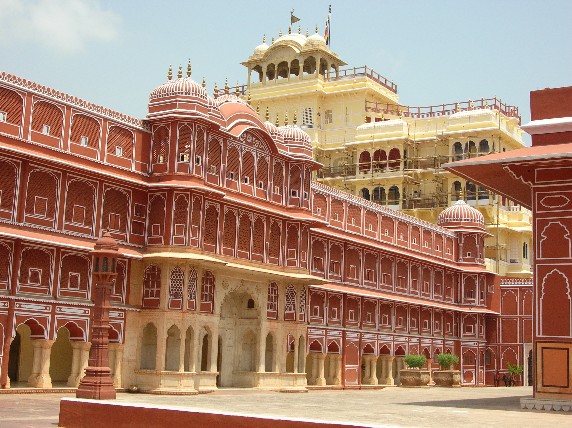
Rajput architecture is an architectural style associated with the forts and palaces of the many Rajput rulers. Many of the Rajput forts are UNESCO World Heritage Sites and popular tourist attractions.
Rajput architecture represents different types of buildings, which may broadly be classed either as religious or military. These include temples, forts, stepwells, gardens, and palaces. The forts were specially built for defense and military purposes. The Mughal and European architecture influenced indigenous Rajput styles of art and architecture.
Rajput architecture continued well into the 20th and 21st centuries, as the rulers of the princely states of British India commissioned vast palaces and other buildings, such as the Albert Hall Museum, Lalgarh Palace, and Umaid Bhawan Palace. These usually incorporated European styles as well, a practice which eventually led to the Indo-Saracenic style.
The Hill Forts of Rajasthan (Amer, Chittor, Gagron, Jaisalmer, Kumbhalgarh, Ranthambore), a group of six forts built by various Rajput kingdoms and principalities during the medieval period, are among the best examples of Rajput architecture. The ensemble is also a UNESCO World Heritage Site. Other forts include the Mehrangarh Fort and Jaigarh Fort.
The Hill Forts of Rajasthan (Amer, Chittor, Gagron, Jaisalmer, Kumbhalgarh, Ranthambore), a group of six forts built by various Rajput kingdoms and principalities during the medieval period are among the best examples of Rajput Architecture. The ensemble is also a UNESCO World Heritage Site. Other forts include the Mehrangarh Fort and Jaigarh Fort.
The walled city of Jaipur was formed in 1727 by Kacchwaha Rajput ruler Jai Singh II, and is "a unique example of traditional Hindu town planning", following the precepts set out in much Hindu texts. Subsequently, the City Palace, Hawa Mahal, Rambagh Palace, Jal Mahal and Albert Hall Museum were also built. Udaipur also has several palaces, including the Bagore-ki-Haveli, now a museum, built by an 18th-century chief minister.
The rulers of the princely states of Rajputana continued the tradition of building elaborate palaces almost until independence, with examples such as the Lalgarh Palace in Bikaner, Monsoon Palace in Udaipur, and Umaid Bhawan Palace in Jodhpur. Many of these are in versions of Indo-Saracenic architecture, often using European architects.
A number of the Rajput dynasties built groups of cenotaph memorials for their members, mostly using the chatri form, and often at the traditional site for cremations. These include the Ahar Cenotaphs outside Udaipur, and Bada Bagh near Jaisalmer. Individual examples include the Jaswant Thada at Jodphur, and Chaurasi Khambon ki Chhatri, Bundi; there are many others.
Hub AI
Rajput architecture AI simulator
(@Rajput architecture_simulator)
Rajput architecture
Rajput architecture is an architectural style associated with the forts and palaces of the many Rajput rulers. Many of the Rajput forts are UNESCO World Heritage Sites and popular tourist attractions.
Rajput architecture represents different types of buildings, which may broadly be classed either as religious or military. These include temples, forts, stepwells, gardens, and palaces. The forts were specially built for defense and military purposes. The Mughal and European architecture influenced indigenous Rajput styles of art and architecture.
Rajput architecture continued well into the 20th and 21st centuries, as the rulers of the princely states of British India commissioned vast palaces and other buildings, such as the Albert Hall Museum, Lalgarh Palace, and Umaid Bhawan Palace. These usually incorporated European styles as well, a practice which eventually led to the Indo-Saracenic style.
The Hill Forts of Rajasthan (Amer, Chittor, Gagron, Jaisalmer, Kumbhalgarh, Ranthambore), a group of six forts built by various Rajput kingdoms and principalities during the medieval period, are among the best examples of Rajput architecture. The ensemble is also a UNESCO World Heritage Site. Other forts include the Mehrangarh Fort and Jaigarh Fort.
The Hill Forts of Rajasthan (Amer, Chittor, Gagron, Jaisalmer, Kumbhalgarh, Ranthambore), a group of six forts built by various Rajput kingdoms and principalities during the medieval period are among the best examples of Rajput Architecture. The ensemble is also a UNESCO World Heritage Site. Other forts include the Mehrangarh Fort and Jaigarh Fort.
The walled city of Jaipur was formed in 1727 by Kacchwaha Rajput ruler Jai Singh II, and is "a unique example of traditional Hindu town planning", following the precepts set out in much Hindu texts. Subsequently, the City Palace, Hawa Mahal, Rambagh Palace, Jal Mahal and Albert Hall Museum were also built. Udaipur also has several palaces, including the Bagore-ki-Haveli, now a museum, built by an 18th-century chief minister.
The rulers of the princely states of Rajputana continued the tradition of building elaborate palaces almost until independence, with examples such as the Lalgarh Palace in Bikaner, Monsoon Palace in Udaipur, and Umaid Bhawan Palace in Jodhpur. Many of these are in versions of Indo-Saracenic architecture, often using European architects.
A number of the Rajput dynasties built groups of cenotaph memorials for their members, mostly using the chatri form, and often at the traditional site for cremations. These include the Ahar Cenotaphs outside Udaipur, and Bada Bagh near Jaisalmer. Individual examples include the Jaswant Thada at Jodphur, and Chaurasi Khambon ki Chhatri, Bundi; there are many others.