Hubbry Logo
Ralph LazoRalph LazoMain
Open search
Ralph Lazo
Community hub
Ralph Lazo
logo
8 pages, 0 posts
0 subscribers
Be the first to start a discussion here.
Ralph Lazo
Ralph Lazo
from Wikipedia

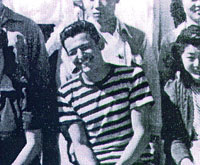
Ralph Lazo (November 3, 1924 – January 1, 1992) was the only known non-spouse, non-Japanese American who voluntarily relocated to a Japanese American internment camp during World War II. His experience was the subject of the 2004 narrative short film Stand Up for Justice: The Ralph Lazo Story.

Key Information

Biography

[edit]

Ralph Lazo, born in Los Angeles on November 3, 1924,[1] was of Mexican-American and Irish American descent. His mother died when he and his sister were young, leaving them in the care of their father, who found work painting houses and murals.[2]

As a Belmont High School student at age 17, Lazo learned that his Japanese American friends and neighbors were being forcibly removed as part of the Japanese American Internment and incarcerated at Manzanar.[3] Lazo was so outraged that he joined friends on a train that took hundreds to Manzanar in May 1942.[2][4][5] Manzanar officials never asked him about his ancestry.[6]

"Internment was immoral", Lazo told the Los Angeles Times. "It was wrong, and I couldn't accept it."[3] "These people hadn't done anything that I hadn't done except to go to Japanese language school."[7]

Lazo attended school at the camp, and also spent time entertaining orphaned children who had been forcibly relocated to Manzanar.[2] In 1944, Lazo was elected president of his class at Manzanar High School.[3] After his graduation, he remained at the camp until August 1944, when he was inducted into the US Army.[3] He served as a staff sergeant in the South Pacific until 1946, helping liberate the Philippines. Lazo was awarded the Bronze Star for heroism in combat.[3][4] The film Stand Up for Justice: The Ralph Lazo Story documents his life story, particularly his stand against the incarceration.[8]

After the war, Lazo returned to Los Angeles, where he graduated from UCLA with a degree in sociology and earned a master's degree in education from Cal State Northridge.[2] Lazo spent his career teaching, including at Los Angeles Valley College, mentoring disabled students and encouraging Latinos to attend college and vote.[9] Lazo also helped raise funds for a class-action lawsuit to win reparations for Japanese Americans interned during the war, which resulted in the Civil Liberties Act of 1988. This act offered an apology to interned Japanese Americans on behalf of the U.S. government and stated that the internment was based on "race prejudice, war hysteria, and a failure of political leadership."[1]

Lazo died in 1992 from liver cancer, at the age of 67.[10]

References

[edit]

Further reading

[edit]
Revisions and contributorsEdit on WikipediaRead on Wikipedia
from Grokipedia
Ralph Lazo (November 3, 1924 – January 1, 1992) was an American civil activist of and Irish descent, best known for voluntarily entering the War Relocation Center in 1942 as a high school student to accompany his Japanese American friends interned there following Executive Order 9066. Born and raised in , Lazo attended Belmont High School, where he formed close bonds with classmates targeted for forced relocation amid wartime hysteria after the attack. At age 17, he traveled to the facility without disclosing his non-Japanese ancestry, becoming the sole documented non-Japanese, non-familial individual to self-relocate to an internment camp in an act of personal solidarity against the policy's injustice. While at for approximately two years, Lazo organized recreational programs, including dances and talent shows, to boost internees' morale amid the camp's harsh conditions of barbed wire, guard towers, and communal living. His presence drew attention when camp administrators discovered his background in 1944, prompting internees to successfully for him to remain until his voluntary departure in 1945. Following the war, Lazo enlisted in the U.S. Army, serving in the South Pacific and earning the for combat heroism. He later pursued higher education, earning degrees in , and sustained lifelong engagement in civil rights efforts, including opposition to discrimination in .

Early Life

Family Background and Childhood

Ralph Lazo was born on November 3, 1924, in , , to parents of Mexican and Irish descent. His mother, Rose Padilla, originally from Chihuahua, , died when Lazo was five years old, leaving him and his sister to be raised primarily by their father, John Houston Lazo, a house painter and muralist whose work often required him to be absent from home. The family resided in the diverse Temple Street neighborhood of , an area populated by residents of various ethnic backgrounds, including , , , and others, fostering early interracial interactions for Lazo. Due to his father's employment, Lazo received some of his early schooling on a Native American reservation in , reflecting the instability of his childhood circumstances. This period shaped his exposure to multicultural environments from a young age, though specific details on his pre-teen years remain limited in historical records.

Education and Pre-War Social Connections

Lazo, of Mexican and Irish descent, was born on November 4, 1924, in Los Angeles and spent part of his early childhood in Arizona, where his father worked as a movie projectionist on a Native American reservation; there, he received his initial schooling. By his teenage years, the family had returned to Los Angeles, and Lazo enrolled at Belmont High in the city's downtown area, attending as a student in 1942. At Belmont, Lazo developed strong social ties with numerous —second-generation —who comprised a significant portion of the student body, reflecting the diverse demographics of the surrounding Bunker Hill neighborhood where many resided. These friendships, forged through shared school experiences, motivated his later decision to accompany classmates to following , as he sought to remain with friends facing forced relocation. Lazo's connections extended beyond the classroom, embedding him in a multicultural community that contrasted with the racial animosities escalating after the attack on December 7, 1941.

Japanese American Internment Context

Historical Rationale for Internment

The Japanese on December 7, 1941, prompted immediate fears among U.S. military officials of and by the approximately 127,000 persons of Japanese ancestry residing on the West Coast, including about 112,000 in alone. Lieutenant General , commanding the Western Defense Command, contended in his memoranda that this population's concentration near vital ports, airfields, and industrial facilities created a security vulnerability, as distinguishing loyal from potentially disloyal individuals—many of whom retained cultural ties to —was deemed impractical without mass exclusion. DeWitt's assessments drew parallels to Axis fifth-column activities in Europe, warning of risks from Issei (first-generation immigrants ineligible for citizenship) who owed allegiance to Emperor Hirohito and Nisei (U.S.-born citizens) potentially influenced by Japanese-language schools and community organizations. His February 14, 1942, proclamation established military exclusion zones, recommending evacuation to avert sabotage of defense infrastructure, such as aircraft factories and shipyards, amid reports of suspicious activities like Japanese fishing boats allegedly signaling submarines—though these claims lacked corroboration from naval intelligence. On February 19, 1942, President signed , empowering the Secretary of War and military commanders to exclude "any or all persons" from designated areas for reasons of military necessity, without specifying ethnicity but applied almost exclusively to . DeWitt's subsequent Final Report (1943) formalized the rationale, asserting that voluntary measures like FBI registrations had failed to mitigate threats and that relocation prevented "imminent invasion or predatory incursion," justifying the policy as a precautionary measure against unprovable but catastrophic risks. Empirical records, including declassified intelligence and post-war reviews, revealed no instances of or by interned on the West Coast; the FBI had already arrested suspected alien spies prior to the order, and naval assessments dismissed widespread signaling threats. DeWitt's report omitted this absence of evidence, with portions later suppressed by the War Department for admitting racial generalizations over facts, underscoring that the rationale rested on probabilistic fears rather than documented threats.

Debates on Necessity and Injustices

The internment of Japanese Americans was justified by the Roosevelt administration and military authorities primarily on grounds of military necessity, citing fears of espionage and sabotage following the December 7, 1941, attack on Pearl Harbor and reports of Japanese submarine activity off the U.S. West Coast. General John L. DeWitt, head of the Western Defense Command, argued in his February 1942 final recommendation that the ethnic Japanese population posed an inherent security risk due to potential infiltration by Imperial Japanese agents and cultural ties to Japan, asserting that "the Japanese race is an enemy race" and that distinguishing loyal from disloyal individuals was impracticable in wartime. Proponents, including some West Coast politicians and naval intelligence reports of unexplained signals, contended that preventive detention averted potential fifth-column activities similar to those in other occupied territories, though no specific empirical evidence of planned sabotage by Japanese Americans was publicly presented at the time. Counterarguments against necessity, bolstered by postwar declassified intelligence, emphasized the absence of documented threats from the Japanese American community. The Office of Naval Intelligence (ONI) and (FBI) assessments prior to concluded that posed minimal risk, with the FBI having already arrested approximately 2,000 suspected leaders on charges based on individualized evidence, leaving the broader population unindicted. During the war, no instances of or by were recorded, despite extensive , undermining claims of urgent collective threat. The 1980 Commission on Wartime Relocation and Internment of Civilians (CWRIC), after reviewing military records and testimony, determined that the mass exclusion of over 120,000 individuals—two-thirds U.S. citizens—was not driven by military imperatives but by racial prejudice, wartime hysteria, and failures in political leadership, with DeWitt's reports later found to include fabricated data admitted by the Department of Justice in 1983. Debates on injustices highlight the policy's disproportionate impact and violations of constitutional protections. Approximately 110,000 mainland were forcibly removed from their homes without hearings or evidence of wrongdoing, resulting in economic losses estimated at $ million in and businesses abandoned or sold at fire-sale prices, alongside from family separations and in remote camps under armed guard. The Supreme Court's 1944 decision upheld the exclusions as permissible amid exigency, but this was effectively overturned in 1983 when the ruling was vacated amid revelations of suppressed contrary evidence, marking a rare judicial repudiation. Critics, including contemporary dissenters like Justice , argued the policy eroded by endorsing over targeted investigations, a stance echoed in CWRIC findings that individualized loyalty screenings—later implemented via questionnaires—could have sufficed without mass uprooting. polls from 1942-1944 reflected division, with initial support around 60% waning as the lack of threats became evident, though West Coast residents exhibited higher approval amid local pressures.

Voluntary Internment at Manzanar

Decision and Entry in 1942

In early 1942, Ralph Lazo, a 17-year-old high school student of Mexican and Irish descent in , grew increasingly outraged by the U.S. government's forced relocation of his Japanese American classmates and friends under , viewing it as an unjust separation from peers he had known since childhood. Rather than accept the internment as inevitable, Lazo resolved to accompany his friends to demonstrate solidarity, becoming the only documented non-Japanese American (excluding spouses) to voluntarily enter a War Relocation Authority camp. To execute his plan without interference, Lazo deceived his family by claiming he was attending , then boarded a train in May 1942 with a group of Japanese American evacuees departing , concealing his non-Japanese heritage to pass initial checks by authorities. The train carried hundreds to , a remote facility in California's established earlier that year to house over 10,000 amid wartime security measures. Upon arrival, Lazo registered under his own name and was admitted as an internee, leveraging the camp's initial screening processes that did not rigorously verify ethnic backgrounds for those claiming Japanese ties. Lazo's entry highlighted the voluntary nature of his commitment, as non-Japanese civilians faced no legal compulsion to intern themselves, yet he persisted in the harsh desert conditions of —marked by barracks, dust storms, and limited resources—to maintain friendships and protest the policy's racial basis. This act of self-imposed confinement underscored his personal conviction that the internment's blanket application ignored individual loyalties, a stance he later articulated in interviews without seeking special treatment or publicity within the camp.

Activities and Role Within the Camp

Upon arriving at in July 1942, Lazo secured employment delivering mail within the camp for a of $12 per month. He later transitioned to a role as recreation director, earning $16 per month, where he organized social events to boost morale among internees, including Friday night dances and caroling parties featuring live bands. Lazo enrolled in the camp's high school program, where he was elected and actively encouraged Japanese American students to engage in extracurricular activities. Athletically, he joined the camp's , helping to energize participation and foster community spirit through sports. These efforts reflected his commitment to solidarity, as he integrated into daily camp life despite his non-Japanese ancestry, initially living with bachelors before relocating to a friend's family barrack with administrative approval. Lazo departed on two occasions during his tenure. In one instance, he represented the camp at a conference, advocating for internees' perspectives. On the other, he traveled to a meeting to testify publicly against the policy, highlighting its injustices based on his firsthand experiences. These actions underscored his role not only in internal camp functions but also in external advocacy, though he otherwise remained within the facility until his draft induction in August 1944.

Military Service and Release

Draft and Heritage Revelation

In August 1944, while still interned at , Lazo was drafted into the as part of the wartime selective service. The drafting process involved official verification of his personal records, which revealed his non-Japanese ancestry—specifically and Irish descent—contradicting assumptions among camp inmates and administrators that he was of Japanese American heritage. This disclosure was formalized in a U.S. government news release at the time, marking the first official acknowledgment of his Latino background beyond his immediate family. The heritage revelation prompted Lazo's release from , as his status as a non-Japanese American volunteer no longer aligned with policies, though it did not alter his eligibility for . Upon induction, he attained the rank of and was deployed to the South Pacific theater, where he participated in combat operations until the war's end in 1945. For his actions, Lazo received the for heroism, though specific details of the commendation remain tied to classified military records from the period. This transition from internee to soldier underscored the selective application of wartime restrictions, as faced ongoing scrutiny under policies like despite similar draft obligations.

Departure from Manzanar

In August 1944, after approximately two years at , Ralph Lazo was drafted into the , which necessitated his release from the camp. This marked only the second time Lazo had left since his voluntary entry in 1942; his first brief absence had been to represent the camp at a conference in . The draft process revealed Lazo's true Mexican-Irish American heritage, as camp records had listed him as Japanese American, allowing officials to confirm he was not subject to internment restrictions. Upon induction, Lazo departed for military training before deployment to the South Pacific, where he served as a in campaigns contributing to the liberation of the . His exit contrasted with the experiences of most Japanese American incarcerees, many of whom faced loyalty questionnaires and segregation policies that delayed or complicated their own or release. Lazo's voluntary status and subsequent honorable discharge underscored his unique position among the camp's population, though he maintained lifelong ties to former incarcerees.

Post-War Life and Career

Higher Education and Professional Path

Following his discharge from the U.S. Army after , Lazo enrolled at the (UCLA), where he earned a in . He later obtained a master's degree in education from (then known as San Fernando Valley State College). Lazo began his professional career as a high in the Los Angeles area, focusing on education and youth development. From 1970 to 1987, he served as an academic counselor at , where he specialized in mentoring students with disabilities and advocating for greater access to higher education among Latino communities. Throughout his tenure, he emphasized practical support for underrepresented students, drawing on his own experiences of and to guide counseling efforts.

Mentoring and Community Involvement

After , Lazo pursued higher education, earning a in from the , before embarking on a career in as a high school teacher and later as an academic counselor at . In these roles, he focused on mentoring students with disabilities, providing guidance to help them navigate academic and personal challenges. Lazo also actively encouraged Latino students to pursue higher education and participate in civic processes, such as voting, drawing from his own Mexican-American heritage to promote opportunities within underserved communities. His efforts extended to fostering broader community engagement, including maintaining lifelong connections with affected by internment. Throughout his professional life, Lazo supported redress efforts for Japanese American internees by helping to raise funds for class-action lawsuits seeking reparations and governmental acknowledgment of injustices, while attending reunions and advocating for on their behalf. These activities underscored his commitment to across ethnic lines, reflecting a consistent pattern of community-oriented rooted in his wartime experiences.

Later Activism and Reparations Efforts

In the 1980s, amid the broader Japanese American redress movement, Ralph Lazo contributed to initiatives supporting class-action lawsuits seeking reparations for individuals interned during . These efforts targeted compensation for the estimated 120,000 affected by , emphasizing legal challenges to government actions deemed unconstitutional. Lazo's involvement included aiding in the collection of funds for litigation such as Hohri v. , a 1980 class-action suit filed on behalf of internees demanding $6,000 per person in damages plus punitive awards. Although the suit was ultimately dismissed by the U.S. in 1987, it amplified public and congressional awareness, influencing the legislative path to redress. His fundraising work aligned with organizations like for Civil Rights and Redress (NCRR), where he was posthumously honored for advocacy that helped secure the Civil Liberties Act of 1988. This legislation authorized $20,000 payments to surviving internees and a formal apology, marking a partial vindication of claims pursued through such legal funds. Lazo's participation underscored his lifelong commitment to rectifying violations, drawing from his personal experiences at .

Views on Civil Liberties

Lazo regarded the internment of Japanese Americans as a profound injustice and violation of constitutional protections, stating that it was "wrong" because the internees "hadn’t done anything that [he] hadn’t done except go to Japanese language school." This perspective stemmed from his firsthand observation of the forced removal and incarceration, which he protested by voluntarily entering in 1942, viewing it as an affront to the meaningful guarantees of the . He maintained that such measures, enacted under on February 19, 1942, unjustly targeted over 120,000 individuals of Japanese ancestry—two-thirds of whom were U.S. citizens—without or evidence of disloyalty, prioritizing ethnic solidarity over legal rights. In his later years, Lazo actively championed reparations as essential redress for these abuses, becoming one of the earliest supporters of the movement seeking compensation and an official apology for surviving internees. He contributed to fundraising efforts for a class-action lawsuit that pressured Congress, ultimately influencing the , signed into law on August 10, 1988, which provided $20,000 payments to each eligible survivor and acknowledged the as a "grave injustice" driven by "racial prejudice, war hysteria, and a failure of political leadership." Despite facing personal threats for his stance as a perceived sympathizer, Lazo persisted in advocating for , emphasizing that restoring rights required governmental admission of error rather than evasion. Lazo's broader commitment to extended to promoting civic participation among marginalized groups, including voter registration drives in during his time at UCLA in the late and encouraging voting among Latinos and former internees as a counselor at starting in the . He linked these efforts to defending democratic freedoms against , drawing parallels between the internment's erosion of liberties and ongoing barriers faced by ethnic minorities, though he focused primarily on historical rectification over expansive policy reforms.

Death and Legacy

Final Years and Passing

In the later stages of his career, Lazo served as an academic counselor at from 1970 to 1987, where he advocated for expanded educational access for students and other underrepresented minorities. Following his , he continued mentoring disabled students and encouraging youth to pursue higher education, maintaining a low-profile commitment to reflective of his lifelong humility. Lazo died on , 1992, at the age of 67, from . His passing received limited contemporary attention, with his story gaining wider posthumous recognition years later through documentaries and historical retrospectives.

Posthumous Recognition and Cultural Impact

In 1992, shortly after Lazo's death on , the Nikkei for Civil Rights and Redress (NCRR) posthumously honored him at their annual Day of Remembrance event in , recognizing his voluntary internment at as an act of solidarity with . This tribute underscored his lifelong commitment to , which NCRR had sought to document through film production. Lazo's story gained wider visibility through cultural and educational works in the following decades. In 2004, NCRR co-produced the 30-minute educational docudrama Stand Up for Justice: The Ralph Lazo Story with Visual Communications, dramatizing his decision to join friends at and his subsequent activism; family members attended its premiere screening. The film, distributed for classroom use, highlights themes of interracial friendship and resistance to 9066. A children's , A Stowaway at Manzanar: Inspired by the True Story of Ralph Lazo, further popularized his experiences for younger audiences, focusing on his teenage defiance of internment policies. His legacy has influenced initiatives, including a booklet detailing his residency and a New York Times "Overlooked No More" that reframed his life amid broader discussions of wartime injustices. Educational projects, such as the Lowell Milken Center's "Ralph Lazo: The Voluntary Prisoner" exhibit developed by students in 2018, have integrated his narrative into curricula on civil rights and heroism, emphasizing personal agency against discriminatory policies. These efforts portray Lazo as a model of cross-ethnic alliance, though his recognition remains niche compared to Japanese American internees, reflecting selective historical emphasis on victimhood over individual protest.

References

Add your contribution
Related Hubs
User Avatar
No comments yet.