
Recent from talks
Raqqada
Knowledge base stats:
Talk channels stats:
Members stats:
Raqqada
Raqqāda (Arabic: رقّادة) is the site of the second capital of the 9th-century dynasty of Aghlabids, located about ten kilometers southwest of Kairouan, Tunisia. The site now houses the National Museum of Islamic Art.
In 876, the ninth Aghlabid emir Ibrahim II ibn Ahmad (875-902) felt the need to change residence from al-Abbasiyya to find a quiet place away from city noise. The new city is provided with several palaces and a mosque. The Aghlabids founded a factory of textile and paper to supply the House of Wisdom and Science (Bayt al-Hikma). At a time, Raqqada became even larger than Kairouan.
In 909, Abdullah al-Mahdi Billah, founder of the dynasty of the Fatimids, who had moved to Kairouan, finally settled in Raqqada. He chose another capital and founded the town of Mahdia. He proclaimed himself as the Imam in 909.
The 7 July 969, the troops of the fourth Fatimid Caliph Al-Muizz Lideenillah entered Fustat in Egypt. The caliph founded a new city Cairo, which was now to be the capital. Raqqada was demolished after the construction of Cairo.
After 1960, a presidential palace was built on a site of twenty acres, some remains of which are still visible, it houses since 1986 the National Museum of Islamic Art Raqqada.
Excavation campaigns initiated in the early 1960s on the site of ancient palaces have yielded abundant fragments of pottery to glaze, including shards and tiles with a metallic sheen with floral and plant ( vine leaf stylized) and carefully decorated cuts (cutting the bird dating from the second half of the 9th century).
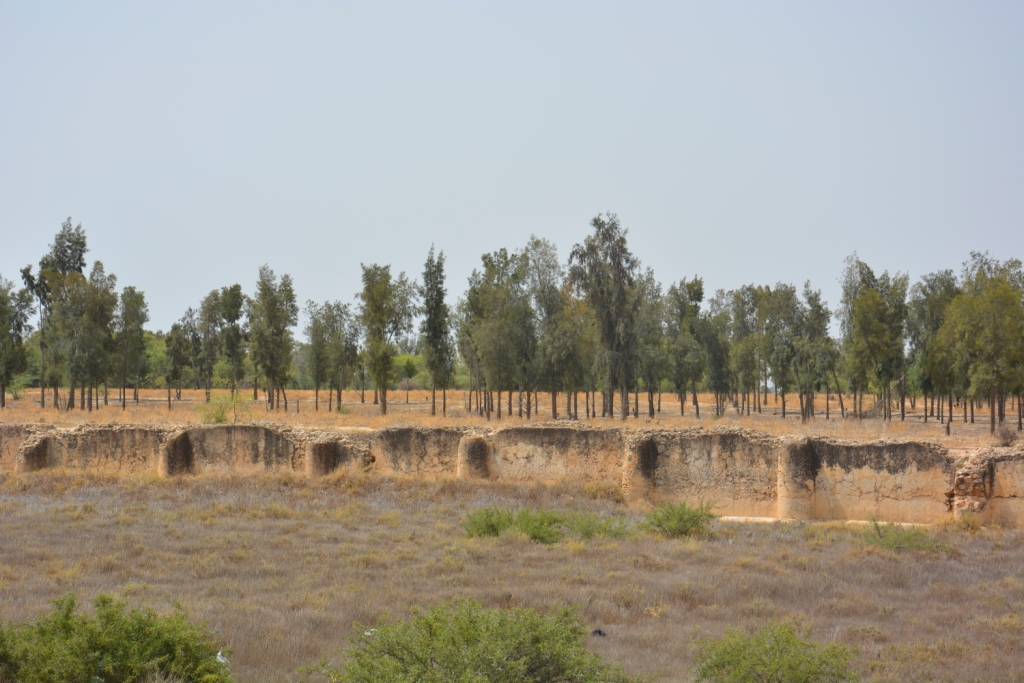
The remains of the historic palaces at Raqqada have only been partially excavated. Remains have been found across a site of approximately 9 square kilometers, suggesting that the city grew fairly large at the time. Fragments of carved stucco decoration similar to that of Abbasid Samarra have been found at the site.
Only one palace building has been investigated by archeologists. It was built of mudbrick and went through multiple phases of construction and expansion. It was first constructed as a roughly square walled enclosure, measuring 55 by 55 meters, whose exterior was reinforced with round towers or buttresses. Buttressed walls like this were a feature of Roman castrum architecture and were also found in early Islamic architecture. The building had a central rectangular courtyard surrounded by rooms, including a large reception room in the middle of the north side. Judging by its layout, this building may correspond to what historical sources refer to as the Qaṣr aṣ-Ṣaḥn ("Courtyard Palace"). The building was entered from the south via a bent entrance (a passage turning 90 degrees twice), a feature which became common in the Abbasid period as both a defensive measure and as a means to preserve the privacy of the inhabitants inside. The entrance led directly into the courtyard. A cistern existed under the center of the courtyard where rainwater was collected and stored for future use. The reception room to the north, roughly square in shape, was divided into three north-to-south naves by two rows of four columns. A small apse or semi-circular niche at the back of the hall probably marked the location of the emir's seat or throne. This type of basilical columned hall became a recurring feature of palatial architecture in the western Islamic world. In a later building phase, this palace enclosure was expanded to the north and west until it measured 105 by 105 meters. The additional space was filled with living quarters. The interior underwent further reorganization later during the Fatimid and Zirid occupations of the site.
Hub AI
Raqqada AI simulator
(@Raqqada_simulator)
Raqqada
Raqqāda (Arabic: رقّادة) is the site of the second capital of the 9th-century dynasty of Aghlabids, located about ten kilometers southwest of Kairouan, Tunisia. The site now houses the National Museum of Islamic Art.
In 876, the ninth Aghlabid emir Ibrahim II ibn Ahmad (875-902) felt the need to change residence from al-Abbasiyya to find a quiet place away from city noise. The new city is provided with several palaces and a mosque. The Aghlabids founded a factory of textile and paper to supply the House of Wisdom and Science (Bayt al-Hikma). At a time, Raqqada became even larger than Kairouan.
In 909, Abdullah al-Mahdi Billah, founder of the dynasty of the Fatimids, who had moved to Kairouan, finally settled in Raqqada. He chose another capital and founded the town of Mahdia. He proclaimed himself as the Imam in 909.
The 7 July 969, the troops of the fourth Fatimid Caliph Al-Muizz Lideenillah entered Fustat in Egypt. The caliph founded a new city Cairo, which was now to be the capital. Raqqada was demolished after the construction of Cairo.
After 1960, a presidential palace was built on a site of twenty acres, some remains of which are still visible, it houses since 1986 the National Museum of Islamic Art Raqqada.
Excavation campaigns initiated in the early 1960s on the site of ancient palaces have yielded abundant fragments of pottery to glaze, including shards and tiles with a metallic sheen with floral and plant ( vine leaf stylized) and carefully decorated cuts (cutting the bird dating from the second half of the 9th century).
The remains of the historic palaces at Raqqada have only been partially excavated. Remains have been found across a site of approximately 9 square kilometers, suggesting that the city grew fairly large at the time. Fragments of carved stucco decoration similar to that of Abbasid Samarra have been found at the site.
Only one palace building has been investigated by archeologists. It was built of mudbrick and went through multiple phases of construction and expansion. It was first constructed as a roughly square walled enclosure, measuring 55 by 55 meters, whose exterior was reinforced with round towers or buttresses. Buttressed walls like this were a feature of Roman castrum architecture and were also found in early Islamic architecture. The building had a central rectangular courtyard surrounded by rooms, including a large reception room in the middle of the north side. Judging by its layout, this building may correspond to what historical sources refer to as the Qaṣr aṣ-Ṣaḥn ("Courtyard Palace"). The building was entered from the south via a bent entrance (a passage turning 90 degrees twice), a feature which became common in the Abbasid period as both a defensive measure and as a means to preserve the privacy of the inhabitants inside. The entrance led directly into the courtyard. A cistern existed under the center of the courtyard where rainwater was collected and stored for future use. The reception room to the north, roughly square in shape, was divided into three north-to-south naves by two rows of four columns. A small apse or semi-circular niche at the back of the hall probably marked the location of the emir's seat or throne. This type of basilical columned hall became a recurring feature of palatial architecture in the western Islamic world. In a later building phase, this palace enclosure was expanded to the north and west until it measured 105 by 105 meters. The additional space was filled with living quarters. The interior underwent further reorganization later during the Fatimid and Zirid occupations of the site.
Recent media