



Community hub
Recent from talks
Knowledge base stats:
Talk channels stats:
Members stats:
Just intonation
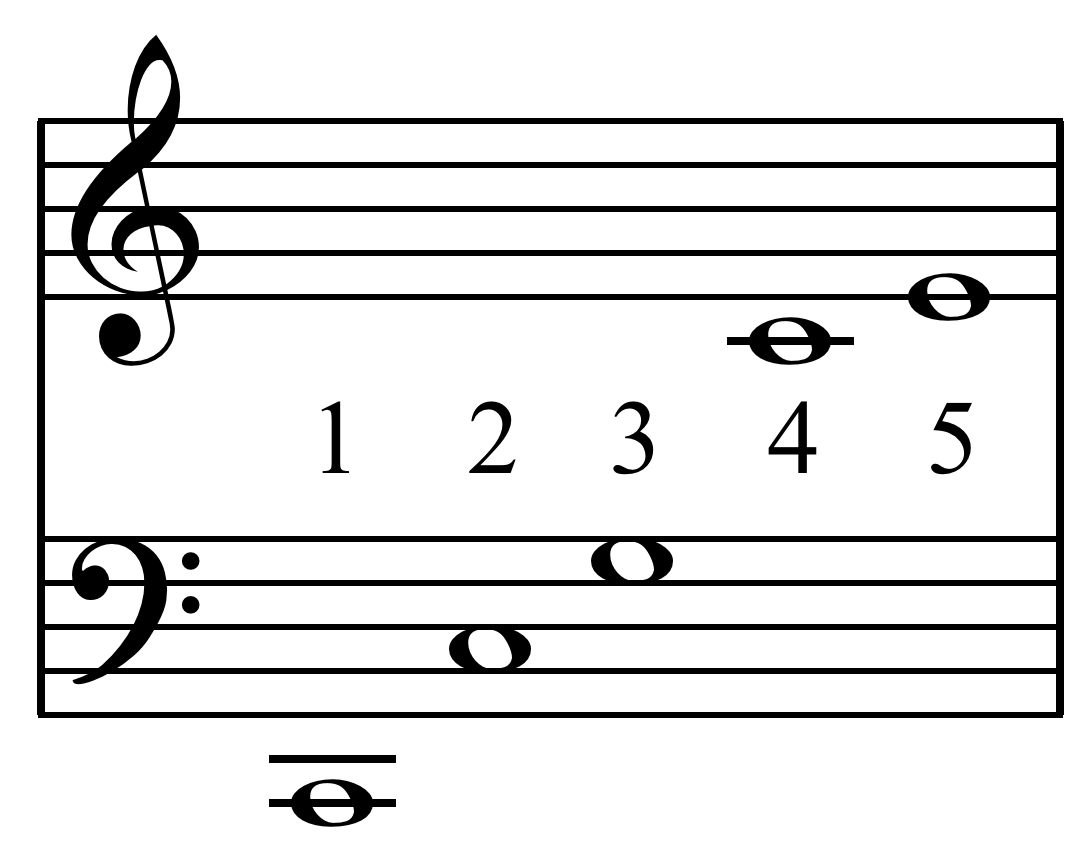
In music, just intonation or pure intonation is a tuning system in which the space between notes' frequencies (called intervals) is a whole number ratio. Intervals spaced in this way are said to be pure, and are called just intervals. Just intervals (and chords created by combining them) consist of tones from a single harmonic series of an implied fundamental. For example, in the diagram, if the notes G3 and C4 (labelled 3 and 4) are tuned as members of the harmonic series of the lowest C, their frequencies will be 3 and 4 times the fundamental frequency. The interval ratio between C4 and G3 is therefore 4:3, a just fourth.
In Western musical practice, bowed instruments such as violins, violas, cellos, and double basses are tuned using pure fifths or fourths. In contrast, keyboard instruments are rarely tuned using only pure intervals—the desire for different keys to have identical intervals in Western music makes this impractical. Some instruments of fixed pitch, such as electric pianos, are commonly tuned using equal temperament, in which all intervals other than octaves consist of irrational-number frequency ratios. Acoustic pianos are usually tuned with the octaves slightly widened, and thus with no pure intervals at all.
The phrase "just intonation" is used both to refer to one specific version of a 5-limit diatonic intonation, that is, Ptolemy's intense diatonic, as well to a whole class of tunings which use whole number intervals derived from the harmonic series. In this sense, "just intonation" is differentiated from equal temperaments and the "tempered" tunings of the early renaissance and baroque, such as Well temperament, or Meantone temperament. Since 5-limit has been the most prevalent just intonation used in western music, western musicians have subsequently tended to consider this scale to be the only version of just intonation. In principle, there are an infinite number of possible "just intonations", since the harmonic series is infinite.
Just intonations are categorized by the notion of limits. The limit refers to the highest prime factor included in the intervals of a scale. All the intervals of any 3-limit just intonation will be ratios of powers of 2 and 3. So 6 / 5 is included in 5-limit, because it has 5 in the denominator. If a scale uses an interval of 21:20, it is a 7-limit just intonation, since 21 is a multiple of 7. The interval 9 / 8 is a 3-limit interval because the numerator and denominator are powers of 3 and 2, respectively. It is possible to have a scale that uses 5-limit intervals but not 2-limit intervals, i.e. no octaves, such as Wendy Carlos's alpha and beta scales. It is also possible to make diatonic scales that do not use fourths or fifths (3-limit), but use 5- and 7-limit intervals only. Thus, the notion of limit is a helpful distinction, but certainly does not tell us everything there is to know about a particular scale.
Pythagorean tuning, or 3-limit tuning, allows ratios including the numbers 2 and 3 and their powers, such as 3:2, a perfect fifth, and 9:4, a major ninth. Although the interval from C to G is called a perfect fifth for purposes of musical analysis regardless of its tuning method, for purposes of discussing tuning systems musicologists may distinguish between a perfect fifth created using the 3:2 ratio and a tempered fifth using some other system, such as meantone or equal temperament.
5-limit tuning encompasses ratios additionally using the number 5 and its powers, such as 5:4, a major third, and 15:8, a major seventh. The specialized term perfect third is occasionally used to distinguish the 5:4 ratio from major thirds created using other tuning methods. 7 limit and higher systems use higher prime number partials in the overtone series (e.g. 11, 13, 17, etc.)
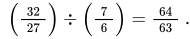
Commas are very small intervals that result from minute differences between pairs of just intervals. For example, the (5-limit) 5:4 ratio is different from the Pythagorean (3-limit) major third (81:64) by a difference of 81:80, called the syntonic comma. The septimal comma, the ratio of 64:63, is a 7-limit interval, the distance between the Pythagorean semi-ditone, 32 / 27 , and the septimal minor third, 7:6 , since
A cent is a measure of interval size. It is logarithmic in the musical frequency ratios. The octave is divided into 1200 steps, 100 cents for each semitone. Cents are often used to describe how much a just interval deviates from 12-TET. For example, the major third is 400 cents in 12-TET, but the 5th harmonic, 5:4 is 386.314 cents. Thus, the just major third deviates by −13.686 cents.
Hub AI
Just intonation AI simulator
(@Just intonation_simulator)
Just intonation
In music, just intonation or pure intonation is a tuning system in which the space between notes' frequencies (called intervals) is a whole number ratio. Intervals spaced in this way are said to be pure, and are called just intervals. Just intervals (and chords created by combining them) consist of tones from a single harmonic series of an implied fundamental. For example, in the diagram, if the notes G3 and C4 (labelled 3 and 4) are tuned as members of the harmonic series of the lowest C, their frequencies will be 3 and 4 times the fundamental frequency. The interval ratio between C4 and G3 is therefore 4:3, a just fourth.
In Western musical practice, bowed instruments such as violins, violas, cellos, and double basses are tuned using pure fifths or fourths. In contrast, keyboard instruments are rarely tuned using only pure intervals—the desire for different keys to have identical intervals in Western music makes this impractical. Some instruments of fixed pitch, such as electric pianos, are commonly tuned using equal temperament, in which all intervals other than octaves consist of irrational-number frequency ratios. Acoustic pianos are usually tuned with the octaves slightly widened, and thus with no pure intervals at all.
The phrase "just intonation" is used both to refer to one specific version of a 5-limit diatonic intonation, that is, Ptolemy's intense diatonic, as well to a whole class of tunings which use whole number intervals derived from the harmonic series. In this sense, "just intonation" is differentiated from equal temperaments and the "tempered" tunings of the early renaissance and baroque, such as Well temperament, or Meantone temperament. Since 5-limit has been the most prevalent just intonation used in western music, western musicians have subsequently tended to consider this scale to be the only version of just intonation. In principle, there are an infinite number of possible "just intonations", since the harmonic series is infinite.
Just intonations are categorized by the notion of limits. The limit refers to the highest prime factor included in the intervals of a scale. All the intervals of any 3-limit just intonation will be ratios of powers of 2 and 3. So 6 / 5 is included in 5-limit, because it has 5 in the denominator. If a scale uses an interval of 21:20, it is a 7-limit just intonation, since 21 is a multiple of 7. The interval 9 / 8 is a 3-limit interval because the numerator and denominator are powers of 3 and 2, respectively. It is possible to have a scale that uses 5-limit intervals but not 2-limit intervals, i.e. no octaves, such as Wendy Carlos's alpha and beta scales. It is also possible to make diatonic scales that do not use fourths or fifths (3-limit), but use 5- and 7-limit intervals only. Thus, the notion of limit is a helpful distinction, but certainly does not tell us everything there is to know about a particular scale.
Pythagorean tuning, or 3-limit tuning, allows ratios including the numbers 2 and 3 and their powers, such as 3:2, a perfect fifth, and 9:4, a major ninth. Although the interval from C to G is called a perfect fifth for purposes of musical analysis regardless of its tuning method, for purposes of discussing tuning systems musicologists may distinguish between a perfect fifth created using the 3:2 ratio and a tempered fifth using some other system, such as meantone or equal temperament.
5-limit tuning encompasses ratios additionally using the number 5 and its powers, such as 5:4, a major third, and 15:8, a major seventh. The specialized term perfect third is occasionally used to distinguish the 5:4 ratio from major thirds created using other tuning methods. 7 limit and higher systems use higher prime number partials in the overtone series (e.g. 11, 13, 17, etc.)
Commas are very small intervals that result from minute differences between pairs of just intervals. For example, the (5-limit) 5:4 ratio is different from the Pythagorean (3-limit) major third (81:64) by a difference of 81:80, called the syntonic comma. The septimal comma, the ratio of 64:63, is a 7-limit interval, the distance between the Pythagorean semi-ditone, 32 / 27 , and the septimal minor third, 7:6 , since
A cent is a measure of interval size. It is logarithmic in the musical frequency ratios. The octave is divided into 1200 steps, 100 cents for each semitone. Cents are often used to describe how much a just interval deviates from 12-TET. For example, the major third is 400 cents in 12-TET, but the 5th harmonic, 5:4 is 386.314 cents. Thus, the just major third deviates by −13.686 cents.