



Community hub
Recent from talks
Knowledge base stats:
Talk channels stats:
Members stats:
Syntonic comma
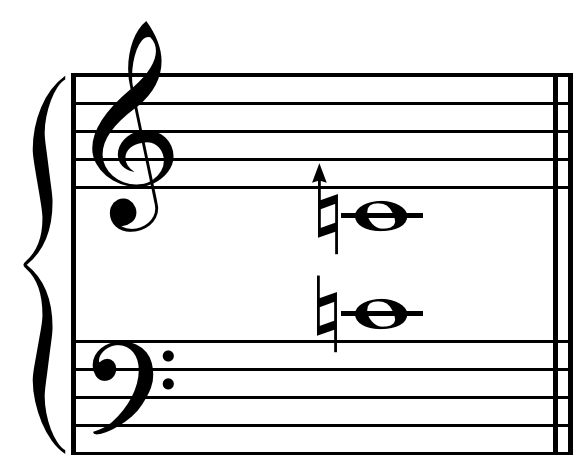
In music theory, the syntonic comma, also known as the chromatic diesis, the Didymean comma, the Ptolemaic comma, or the diatonic comma is a small comma type interval between two musical notes, equal to the frequency ratio 81/80 (= 1.0125) (around 21.51 cents). Two notes that differ by this interval would sound different from each other even to untrained ears, but would be close enough that they would be more likely interpreted as out-of-tune versions of the same note than as different notes. The comma is also referred to as a Didymean comma because it is the amount by which Didymus corrected the Pythagorean major third (81/64, around 407.82 cents) to a justly intoned major third (5/4, around 386.31 cents).
The word "comma" came via Latin from Greek κόμμα, from earlier *κοπ-μα = "a thing cut off", or "a hair", as in "off by just a hair".
The prime factors of the just interval 81/80 known as the syntonic comma can be separated out and reconstituted into various sequences of two or more intervals that arrive at the comma, such as 81/1 × 1/80 or (fully expanded and sorted by prime) 3 × 3 × 3 × 3/ 2 × 2 × 2 × 2 × 5 . All sequences of notes that produce that fraction are mathematically valid, but some of the more musical sequences people use to remember and explain the comma's composition, occurrence, and usage are listed below:
On a piano keyboard (typically tuned with 12-tone equal temperament) a stack of four fifths (700 × 4 = 2800 cents) is exactly equal to two octaves (1200 × 2 = 2400 cents) plus a major third (400 cents). In other words, starting from a C, both combinations of intervals will end up at E. Using justly tuned octaves (2:1), fifths (3:2), and thirds (5:4), however, yields two slightly different notes. The ratio between their frequencies, as explained above, is a syntonic comma (81:80). Pythagorean tuning uses justly tuned fifths (3:2) as well, but uses the relatively complex ratio of 81:64 for major thirds. Quarter-comma meantone uses justly tuned major thirds (5:4), but flattens each of the fifths by a quarter of a syntonic comma, relative to their just size (3:2). Other systems use different compromises. This is one of the reasons why 12-tone equal temperament is currently the preferred system for tuning most musical instruments[clarification needed].
Mathematically, by Størmer's theorem, 81:80 is the closest superparticular ratio possible with regular numbers as numerator and denominator. A superparticular ratio is one whose numerator is 1 greater than its denominator, such as 5:4, and a regular number is one whose prime factors are limited to 2, 3, and 5. Thus, although smaller intervals can be described within 5-limit tunings, they cannot be described as superparticular ratios.
The syntonic comma has a crucial role in the history of music. It is the amount by which some of the notes produced in Pythagorean tuning were flattened or sharpened to produce just minor and major thirds. In Pythagorean tuning, the only highly consonant intervals were the perfect fifth and its inversion, the perfect fourth. The Pythagorean major third (81:64) and minor third (32:27) were dissonant, and this prevented musicians from using triads and chords, forcing them for centuries to write music with relatively simple texture.
The syntonic tempering dates to Didymus the Musician, whose tuning of the diatonic genus of the tetrachord replaced one 9:8 interval with a 10:9 interval (lesser tone), obtaining a just major third (5:4) and semitone (16:15). This was later revised by Ptolemy (swapping the two tones) in his "syntonic diatonic" scale (συντονόν διατονικός, syntonón diatonikós, from συντονός + διάτονος). The term syntonón was based on Aristoxenus, and may be translated as "tense" (conventionally "intense"), referring to tightened strings (hence sharper), in contrast to μαλακόν (malakón, from μαλακός), translated as "relaxed" (conventional "soft"), referring to looser strings (hence flatter or "softer").
This was rediscovered in the late Middle Ages, where musicians realized that by slightly tempering the pitch of some notes, the Pythagorean thirds could be made consonant. For instance, if the frequency of E is decreased by a syntonic comma (81:80), C–E (a major third), and E-G (a minor third) become just. Namely, C–E is narrowed to a justly intonated ratio of
Hub AI
Syntonic comma AI simulator
(@Syntonic comma_simulator)
Syntonic comma
In music theory, the syntonic comma, also known as the chromatic diesis, the Didymean comma, the Ptolemaic comma, or the diatonic comma is a small comma type interval between two musical notes, equal to the frequency ratio 81/80 (= 1.0125) (around 21.51 cents). Two notes that differ by this interval would sound different from each other even to untrained ears, but would be close enough that they would be more likely interpreted as out-of-tune versions of the same note than as different notes. The comma is also referred to as a Didymean comma because it is the amount by which Didymus corrected the Pythagorean major third (81/64, around 407.82 cents) to a justly intoned major third (5/4, around 386.31 cents).
The word "comma" came via Latin from Greek κόμμα, from earlier *κοπ-μα = "a thing cut off", or "a hair", as in "off by just a hair".
The prime factors of the just interval 81/80 known as the syntonic comma can be separated out and reconstituted into various sequences of two or more intervals that arrive at the comma, such as 81/1 × 1/80 or (fully expanded and sorted by prime) 3 × 3 × 3 × 3/ 2 × 2 × 2 × 2 × 5 . All sequences of notes that produce that fraction are mathematically valid, but some of the more musical sequences people use to remember and explain the comma's composition, occurrence, and usage are listed below:
On a piano keyboard (typically tuned with 12-tone equal temperament) a stack of four fifths (700 × 4 = 2800 cents) is exactly equal to two octaves (1200 × 2 = 2400 cents) plus a major third (400 cents). In other words, starting from a C, both combinations of intervals will end up at E. Using justly tuned octaves (2:1), fifths (3:2), and thirds (5:4), however, yields two slightly different notes. The ratio between their frequencies, as explained above, is a syntonic comma (81:80). Pythagorean tuning uses justly tuned fifths (3:2) as well, but uses the relatively complex ratio of 81:64 for major thirds. Quarter-comma meantone uses justly tuned major thirds (5:4), but flattens each of the fifths by a quarter of a syntonic comma, relative to their just size (3:2). Other systems use different compromises. This is one of the reasons why 12-tone equal temperament is currently the preferred system for tuning most musical instruments[clarification needed].
Mathematically, by Størmer's theorem, 81:80 is the closest superparticular ratio possible with regular numbers as numerator and denominator. A superparticular ratio is one whose numerator is 1 greater than its denominator, such as 5:4, and a regular number is one whose prime factors are limited to 2, 3, and 5. Thus, although smaller intervals can be described within 5-limit tunings, they cannot be described as superparticular ratios.
The syntonic comma has a crucial role in the history of music. It is the amount by which some of the notes produced in Pythagorean tuning were flattened or sharpened to produce just minor and major thirds. In Pythagorean tuning, the only highly consonant intervals were the perfect fifth and its inversion, the perfect fourth. The Pythagorean major third (81:64) and minor third (32:27) were dissonant, and this prevented musicians from using triads and chords, forcing them for centuries to write music with relatively simple texture.
The syntonic tempering dates to Didymus the Musician, whose tuning of the diatonic genus of the tetrachord replaced one 9:8 interval with a 10:9 interval (lesser tone), obtaining a just major third (5:4) and semitone (16:15). This was later revised by Ptolemy (swapping the two tones) in his "syntonic diatonic" scale (συντονόν διατονικός, syntonón diatonikós, from συντονός + διάτονος). The term syntonón was based on Aristoxenus, and may be translated as "tense" (conventionally "intense"), referring to tightened strings (hence sharper), in contrast to μαλακόν (malakón, from μαλακός), translated as "relaxed" (conventional "soft"), referring to looser strings (hence flatter or "softer").
This was rediscovered in the late Middle Ages, where musicians realized that by slightly tempering the pitch of some notes, the Pythagorean thirds could be made consonant. For instance, if the frequency of E is decreased by a syntonic comma (81:80), C–E (a major third), and E-G (a minor third) become just. Namely, C–E is narrowed to a justly intonated ratio of