



Community hub
Recent from talks
Knowledge base stats:
Talk channels stats:
Members stats:
Ray casting
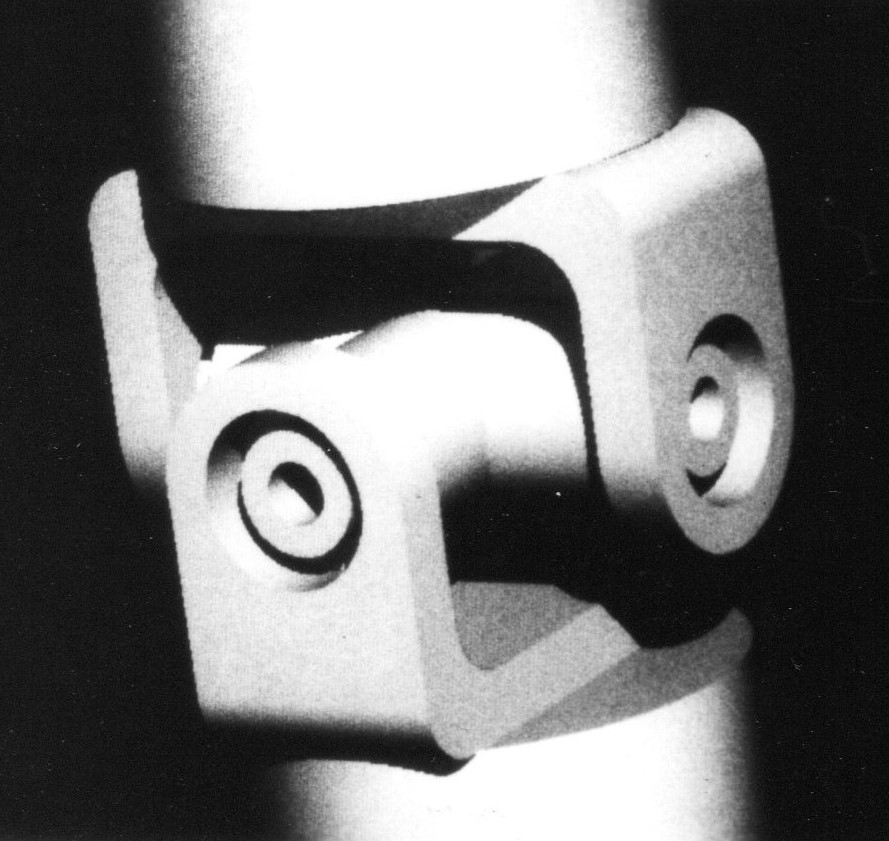
Ray casting is the methodological basis for 3D CAD/CAM solid modeling and image rendering. It is essentially the same as ray tracing for computer graphics where virtual light rays are "cast" or "traced" on their path from the focal point of a camera through each pixel in the camera sensor to determine what is visible along the ray in the 3D scene.
The term "Ray Casting" was introduced by Scott Roth while at the General Motors Research Labs from 1978–1980. His paper, "Ray Casting for Modeling Solids", describes modeled solid objects by combining primitive solids, such as blocks and cylinders, using the set operators union (+), intersection (&), and difference (−). The general idea of using these binary operators for solid modeling is largely due to Voelcker and Requicha's geometric modelling group at the University of Rochester. See solid modeling for a broad overview of solid modeling methods.
Before ray casting (and ray tracing), computer graphics algorithms projected surfaces or edges (e.g., lines) from the 3D world to the image plane where visibility logic had to be applied. The world-to-image plane projection is a 3D homogeneous coordinate system transformation, also known as 3D projection, affine transformation, or projective transform (homography). Rendering an image this way is difficult to achieve with hidden surface/edge removal. Plus, silhouettes of curved surfaces have to be explicitly solved for whereas it is an implicit by-product of ray casting, so there is no need to explicitly solve for it whenever the view changes.
Ray casting greatly simplified image rendering of 3D objects and scenes because a line transforms to a line. So, instead of projecting curved edges and surfaces in the 3D scene to the 2D image plane, transformed lines (rays) are intersected with the objects in the scene. A homogeneous coordinate transformation is represented by a 4×4 matrix. The mathematical technique is common to computer graphics and geometric modeling. A transform includes rotations around the three axes, independent scaling along the axes, translations in 3D, and even skewing. Transforms are easily concatenated via matrix arithmetic. For use with a 4×4 matrix, a point is represented by [X, Y, Z, 1], and a direction vector is represented by [Dx, Dy, Dz, 0]. (The fourth term is for translation, which does not apply to direction vectors.)
Ray casting is the most basic of many computer graphics rendering algorithms that use the geometric algorithm of ray tracing. Ray tracing-based rendering algorithms operate in image order to render three-dimensional scenes to two-dimensional images. Geometric rays are traced from the eye of the observer to sample the light (radiance) travelling toward the observer from the ray direction. The speed and simplicity of ray casting comes from computing the color of the light without recursively tracing additional rays that sample the radiance incident on the point that the ray hit. This eliminates the possibility of accurately rendering reflections, refractions, or the natural falloff of shadows; however all of these elements can be faked to a degree, by creative use of texture maps or other methods. The high speed of calculation made ray casting a handy rendering method in early real-time 3D video games.
The idea behind ray casting is to trace rays from the eye, one per pixel, and find the closest object blocking the path of that ray—think of an image as a screen-door, with each square in the screen being a pixel. This is then the object the eye sees through that pixel. Using the material properties and the effect of the lights in the scene, this algorithm can determine the shading of this object. The simplifying assumption is made that if a surface faces a light, the light will reach that surface and not be blocked or in shadow. The shading of the surface is computed using traditional 3D computer graphics shading models. One important advantage ray casting offered over older scanline algorithms was its ability to easily deal with non-planar surfaces and solids, such as cones and spheres. If a mathematical surface can be intersected by a ray, it can be rendered using ray casting. Elaborate objects can be created by using solid modelling techniques and easily rendered.
From the abstract for the paper "Ray Casting for Modeling Solids":
To visualize and analyze the composite solids modeled, virtual light rays are cast as probes. By virtue of its simplicity, ray casting is reliable and extensible. The most difficult mathematical problem is finding line-surface intersection points. So, surfaces as planes, quadrics, tori, and probably even parametric surface patches may bound the primitive solids. The adequacy and efficiency of ray casting are issues addressed here. A fast picture generation capability for interactive modeling is the biggest challenge.
Hub AI
Ray casting AI simulator
(@Ray casting_simulator)
Ray casting
Ray casting is the methodological basis for 3D CAD/CAM solid modeling and image rendering. It is essentially the same as ray tracing for computer graphics where virtual light rays are "cast" or "traced" on their path from the focal point of a camera through each pixel in the camera sensor to determine what is visible along the ray in the 3D scene.
The term "Ray Casting" was introduced by Scott Roth while at the General Motors Research Labs from 1978–1980. His paper, "Ray Casting for Modeling Solids", describes modeled solid objects by combining primitive solids, such as blocks and cylinders, using the set operators union (+), intersection (&), and difference (−). The general idea of using these binary operators for solid modeling is largely due to Voelcker and Requicha's geometric modelling group at the University of Rochester. See solid modeling for a broad overview of solid modeling methods.
Before ray casting (and ray tracing), computer graphics algorithms projected surfaces or edges (e.g., lines) from the 3D world to the image plane where visibility logic had to be applied. The world-to-image plane projection is a 3D homogeneous coordinate system transformation, also known as 3D projection, affine transformation, or projective transform (homography). Rendering an image this way is difficult to achieve with hidden surface/edge removal. Plus, silhouettes of curved surfaces have to be explicitly solved for whereas it is an implicit by-product of ray casting, so there is no need to explicitly solve for it whenever the view changes.
Ray casting greatly simplified image rendering of 3D objects and scenes because a line transforms to a line. So, instead of projecting curved edges and surfaces in the 3D scene to the 2D image plane, transformed lines (rays) are intersected with the objects in the scene. A homogeneous coordinate transformation is represented by a 4×4 matrix. The mathematical technique is common to computer graphics and geometric modeling. A transform includes rotations around the three axes, independent scaling along the axes, translations in 3D, and even skewing. Transforms are easily concatenated via matrix arithmetic. For use with a 4×4 matrix, a point is represented by [X, Y, Z, 1], and a direction vector is represented by [Dx, Dy, Dz, 0]. (The fourth term is for translation, which does not apply to direction vectors.)
Ray casting is the most basic of many computer graphics rendering algorithms that use the geometric algorithm of ray tracing. Ray tracing-based rendering algorithms operate in image order to render three-dimensional scenes to two-dimensional images. Geometric rays are traced from the eye of the observer to sample the light (radiance) travelling toward the observer from the ray direction. The speed and simplicity of ray casting comes from computing the color of the light without recursively tracing additional rays that sample the radiance incident on the point that the ray hit. This eliminates the possibility of accurately rendering reflections, refractions, or the natural falloff of shadows; however all of these elements can be faked to a degree, by creative use of texture maps or other methods. The high speed of calculation made ray casting a handy rendering method in early real-time 3D video games.
The idea behind ray casting is to trace rays from the eye, one per pixel, and find the closest object blocking the path of that ray—think of an image as a screen-door, with each square in the screen being a pixel. This is then the object the eye sees through that pixel. Using the material properties and the effect of the lights in the scene, this algorithm can determine the shading of this object. The simplifying assumption is made that if a surface faces a light, the light will reach that surface and not be blocked or in shadow. The shading of the surface is computed using traditional 3D computer graphics shading models. One important advantage ray casting offered over older scanline algorithms was its ability to easily deal with non-planar surfaces and solids, such as cones and spheres. If a mathematical surface can be intersected by a ray, it can be rendered using ray casting. Elaborate objects can be created by using solid modelling techniques and easily rendered.
From the abstract for the paper "Ray Casting for Modeling Solids":
To visualize and analyze the composite solids modeled, virtual light rays are cast as probes. By virtue of its simplicity, ray casting is reliable and extensible. The most difficult mathematical problem is finding line-surface intersection points. So, surfaces as planes, quadrics, tori, and probably even parametric surface patches may bound the primitive solids. The adequacy and efficiency of ray casting are issues addressed here. A fast picture generation capability for interactive modeling is the biggest challenge.